
Confidentiality best practices in Christian conflict resolution are not a procedural detail; they are a moral obligation shaped by Scripture and a practical discipline that protects people, ministries, and donors. When confidentiality is handled carelessly, conflict resolution can become another venue for harm: reputations damaged, victims silenced, facts distorted, and trust eroded across a congregation or ministry community.
Donors have a particular stake in this question. Confidentiality failures often signal deeper weaknesses in governance, leadership judgment, and accountability. Conversely, ministries that handle sensitive matters with restraint, documentation, and clear boundaries tend to be the same ministries that can be trusted with money, authority, and vulnerable people.
Confidentiality is a theological duty before it is a policy
Christian conflict resolution operates under the authority of Christ, not the instincts of institutional self-protection. Scripture does not use modern compliance language, but it consistently commends restraint in speech, careful handling of another person’s dignity, and truthful process. “A gossip betrays a confidence, but a trustworthy person keeps a secret” (Proverbs 11:13). The point is not secrecy for its own sake; it is a moral posture that refuses to use another person’s pain as currency.
The same Scripture that warns against gossip also commands the church to pursue truth and justice. That creates a tension donors should not ignore: confidentiality cannot become a spiritualized way to avoid accountability, evade mandatory reporting, or conceal disqualifying misconduct. Mature ministries treat confidentiality as a means of neighbor-love, not as a shield against light.
Confidentiality is not the same as secrecy
Secrecy protects institutions; confidentiality protects people and process. In practice, confidentiality means limiting information to those who must know it to perform their responsibilities, and communicating with precision rather than insinuation. Secrecy often means suppressing disclosure even when disclosure is needed for safety, lawful reporting, or appropriate governance.
Christian reconciliation has boundaries
Matthew 18’s call to pursue a brother’s restoration does not erase other biblical obligations. Restitution, protection of the vulnerable, and the proper exercise of authority are also biblical themes. The church’s history has shown that pressuring victims to remain silent “for unity” can become complicity. Donors should regard a ministry’s confidentiality practices as part of its theology applied to real life.

Donors should expect clear confidentiality boundaries and written consent
In conflict resolution settings, people often assume confidentiality is absolute because the environment feels pastoral, compassionate, and prayerful. But many Christian conflict resolution ministries are not covered by the legal rules that apply to licensed mental health counseling, and “pastoral confidentiality” varies significantly by state and circumstance. That does not make the work less valuable; it means donors should expect unusually clear communication about what confidentiality does and does not mean.
Across our verification work at Most Trusted, we observe that the healthiest ministries state confidentiality terms early, in writing, and in plain language. They treat informed consent as a form of respect, not a waiver to protect the organization.
Define the scope of confidentiality before stories are shared
Ministries should explain, in advance, who will have access to information (mediators, supervisors, case review committees, board designees), how information will be stored, and when information may be shared. “We keep this private” is not a policy; it is a sentiment that will collapse under pressure.
Use written consent that covers real scenarios
Effective consent documents address the situations that actually arise: allegations involving minors, threats of self-harm or harm to others, potential criminal conduct, and the ministry’s obligations to cooperate with a church’s elders or a nonprofit’s board. They also address whether the ministry can share a summary of outcomes with leadership, and whether parties may record sessions. The goal is not to anticipate every edge case; it is to eliminate surprises when stakes rise.
Confidentiality must serve truth, safety, and lawful reporting
The hardest confidentiality questions are not about private marital disputes or misunderstandings between coworkers. They arise when conflict includes abuse, coercion, fraud, or patterns of spiritual intimidation. In those cases, the ministry’s confidentiality posture becomes a test of whether it understands its duty to the vulnerable.
Mandatory reporting laws vary by jurisdiction and by role. Churches and ministries should not treat that complexity as an excuse for vagueness. For donors evaluating ministries in Christian Conflict Resolution Ministries, a credible approach includes competent legal counsel, training, and written procedures that remove discretion in critical moments.
When abuse is alleged, confidentiality cannot be used to isolate victims
Victims and whistleblowers are often pressured through informal channels: “Don’t ruin his ministry,” “Think about the church’s witness,” “This must stay between us.” That is not confidentiality; it is leverage. The ministry’s responsibility is to create a pathway where allegations are taken seriously, documented, and routed to the appropriate authorities.
Research underscores why caution is warranted. In a national study, the vast majority of child sexual abuse is perpetrated by someone the child knows and trusts, not a stranger, which makes institutional reluctance to disclose especially dangerous (U.S. Department of Justice, Bureau of Justice Statistics).
Reporting and due process are part of ethical confidentiality
Christian donors sometimes assume that “keeping matters within the church” is the biblically faithful course. Christians genuinely disagree about how Matthew 18 applies when crimes are alleged, but the state does not delegate its responsibilities to ecclesial processes. When a ministry treats law enforcement or child protective services as inherently hostile, donors should ask whether that posture is protecting children or protecting the institution.
Data handling and communications discipline are where good intentions fail
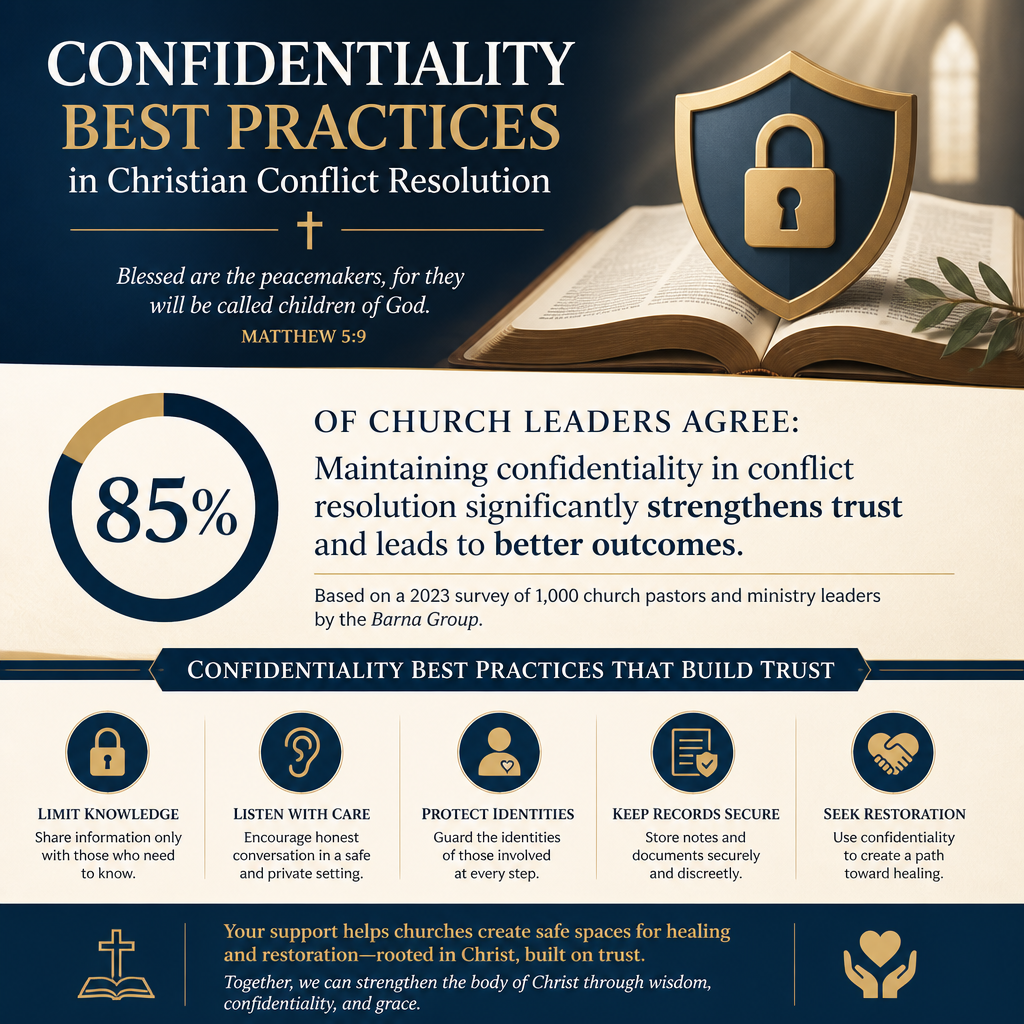
Most confidentiality breaches are not dramatic betrayals. They are everyday lapses: notes left unsecured, email threads forwarded, prayer chains used as information channels, or casual debriefs that name names. Conflict resolution ministries handle stories that can destroy livelihoods and families; they should behave like organizations entrusted with sensitive data.
The ministries that meet The Most Trusted Standard tend to treat confidentiality as an operational system: access control, documentation norms, retention schedules, and communication protocols that are actually followed under stress.
Build a minimal-necessary information culture
A simple discipline is often the most effective: share only what is necessary for the next responsible action. If an elder board needs to know that an allegation has been made and that a reporting process is underway, it may not need the full narrative. If a donor asks for details, the ministry should be able to explain why it cannot provide them.
Adopt concrete practices that can be audited
- Written case file standards, including what is recorded and what is intentionally not recorded
- Secure storage for notes and recordings, with limited access and strong authentication
- A documented retention and deletion schedule tied to legal counsel’s guidance
- Clear rules about texting, personal email, and unofficial messaging apps for case communication
- Training that addresses prayer requests, informal conversations, and social media ambiguity
For donors, these are not merely administrative concerns. The same habits that prevent confidentiality breaches also reduce the likelihood of conflicts of interest, retaliatory leadership behavior, and “version control” battles where the loudest storyteller becomes the perceived truth.
What donors should look for when evaluating a conflict resolution ministry
Donors cannot and should not demand access to confidential case details. But donors can reasonably expect verifiable signals of ethical seriousness: governance that asks hard questions, leadership that welcomes scrutiny, and transparency about process even when outcomes must remain private.
This is where independent verification can serve the church. Most Trusted evaluates Christian nonprofits against The Most Trusted Standard, examining whether a ministry’s faith commitments, financial integrity, governance, and transparency are aligned with its public claims. Confidentiality practices are part of that alignment, because mishandled confidentiality is often the first visible crack in a deeper structure.
Ask for policies and oversight, not stories
A mature ministry can provide:
Legal and Ethical Standards in Christian Conflict Resolution matters here because confidentiality intersects with legal counsel, mandatory reporting, board authority, and documented procedures. Donors should ask whether confidentiality policies are board-approved, periodically reviewed, and paired with training.
Watch for predictable warning signs
Several patterns should prompt caution: an insistence on absolute confidentiality without exceptions; a reflex to bypass civil authorities; leadership that controls information through informal channels; and a culture where “unity” consistently means silence. None of these proves wrongdoing, but together they often indicate a ministry that has not faced the moral weight of its own work.
Conversely, the most credible ministries can explain their confidentiality commitments with clarity, can name the limits of those commitments, and can describe accountability mechanisms without disclosing private information. That posture does not satisfy curiosity; it earns trust.
FAQs for Confidentiality best practices in Christian conflict resolution
Should Christian mediators promise absolute confidentiality?
Absolute confidentiality is rarely wise and is often misleading. Ethical practice requires clear exceptions for safety, mandatory reporting, credible threats, and circumstances where governance authorities must act. The better standard is defined confidentiality: information is restricted to those who must know, disclosed only for responsible action, and handled with documented care.
How can donors evaluate confidentiality if cases are private?
Donors should evaluate process rather than content. That includes written confidentiality and reporting policies, evidence of training, secure data practices, board oversight, and a willingness to explain boundaries without defensiveness. Independent verification can also help donors assess whether a ministry’s internal controls and leadership accountability are consistent with the public trust it seeks.
A confidentiality practice worthy of the church’s witness
Christian conflict resolution is meant to serve reconciliation, not spectacle; truth, not rumor; protection of the vulnerable, not preservation of reputations. Confidentiality best practices in Christian conflict resolution are one of the clearest indicators that a ministry understands the weight of what it holds. Donors can give with greater confidence when a ministry’s privacy commitments are defined, accountable, and disciplined enough to endure the moment when confidentiality becomes costly.



