
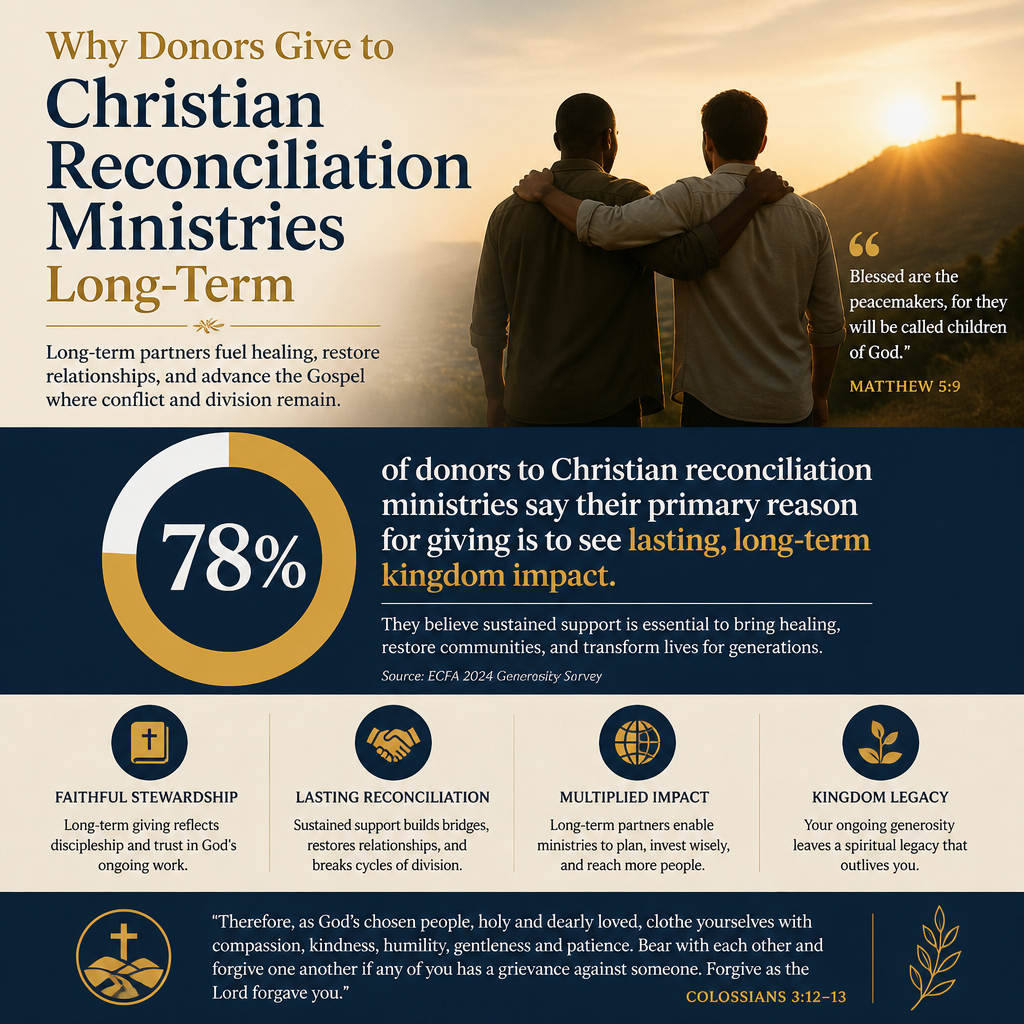
Why donors give to Christian reconciliation ministries long-term has less to do with sentiment and more to do with formation. These ministries place donors at the intersection of costly discipleship, church integrity, and public witness—areas where quick wins are rare and perseverance matters.
Christian reconciliation work also exposes a tension sophisticated givers recognize: conflict is unavoidable in a fallen world, yet the church is commanded to embody a different way of being human. Donors who stay often do so because they come to see reconciliation not as a specialty program, but as a sustained commitment to the ethics of the Kingdom of God.
Long term giving follows a theological vision of peace that requires time
Reconciliation is not an accessory to the gospel
Scripture does not treat reconciliation as peripheral. Paul writes that in Christ, God reconciled us to himself and “gave us the ministry of reconciliation” (2 Corinthians 5). Jesus blesses peacemakers as “sons of God” (Matthew 5). The logic is comprehensive: peace with God reshapes peace with others, and the community formed by that peace becomes a sign of the coming Kingdom.
Donors give long-term when a ministry’s work is anchored in that theological center rather than in generic conflict-management technique. The goal is not merely to reduce tension, but to pursue truth-telling, repentance, forgiveness, restitution, and restored fellowship where possible. That moral arc cannot be compressed into a quarterly deliverable without distorting what Christian reconciliation actually claims to be.
The work is slow because it deals with real moral injury
Reconciliation ministries are often asked to enter situations marked by betrayal, spiritual abuse, racialized distrust, litigation threats, fractured leadership, or multi-generational church splits. Even when parties want peace, memory and fear do not yield on demand. Donors who remain committed tend to accept that the New Testament’s commands—bear with one another, speak truth in love, pursue unity—describe a practiced life, not an event.
What this means in practice is that the fruit donors are looking for is frequently durable rather than dramatic: a church that learns to confront sin without scapegoating; elders who adopt clear discipline processes; victims who receive dignified care; leaders who submit to accountability; a community that can endure disagreement without fragmentation.

Donors stay when outcomes are measured faithfully, not superficially
Reconciliation is measurable, but not in the way donors are sometimes sold
Christians genuinely disagree about what “success” should mean in reconciliation. Some define it as restored relationship. Others, rightly, insist that in cases involving abuse or entrenched deception, safety and truth may require separation, formal discipline, or legal reporting. Mature donors tend to support ministries that acknowledge these realities rather than promising reconciliation on a timeline.
Credible reporting in this field often looks like process integrity: clear intake protocols, documented safeguarding practices, articulated biblical principles, trained mediators or facilitators, and follow-up that tests whether a fragile peace is becoming a stable pattern. A ministry can tell the truth about hard cases—where restoration did not happen—while still demonstrating faithfulness and competence.
Evidence matters because the field is vulnerable to spiritualized opacity
Some ministries in the broader “peace and unity” space have used spiritual language to avoid accountability, especially when leaders are implicated. Donors who give long-term frequently do so because they find a ministry that refuses that pattern. They see sober disclosure about governance, financial controls, and safeguarding as a form of discipleship, not a concession to secular expectations.
Across our verification work at Most Trusted, we observe that reconciliation ministries that consistently meet The Most Trusted Standard tend to treat transparency as part of their pastoral posture. They explain what they do, what they do not do, who oversees the work, and how conflicts of interest are handled. Donors rarely remain for years where “trust us” replaces verifiable practices.
Longevity grows when donors see the ministry strengthen churches, not replace them
Healthy reconciliation work builds local capacity
Christian donors are often wary of ministries that create dependency: an outside expert perpetually mediating disputes without changing the underlying culture. Long-term giving is more common when a ministry equips churches to develop their own practices: Matthew 18 processes, wise counseling pathways, elder accountability, trauma-informed care, and clear communication norms rooted in truth and charity.
Capacity-building also respects ecclesiology. Reconciliation belongs to the church’s life under Scripture, not to a branded personality. Donors who care about long-term renewal often prefer ministries that strengthen pastors and elders rather than subtly undermining them.
Partnership is sustained when boundaries are explicit
The harder question is what reconciliation ministries should do when church leadership refuses accountability. Donors who have seen institutions protect themselves at the expense of the vulnerable understand that ambiguity here is dangerous. A mature ministry clarifies when it will step back, when it will insist on outside review, and when it will report to civil authorities in situations involving criminal conduct.
For donors discerning the broader landscape of Christian Conflict Resolution Ministries, this boundary clarity is a meaningful indicator of seriousness. It signals a commitment to justice and protection alongside mercy and restoration, echoing the biblical insistence that God’s peace is never purchased by denying truth.
Long term donors often fund reconciliation because they know the cost of division
Church conflict has measurable downstream effects
When churches fracture, the costs are not only emotional. Financial strain, diminished mission focus, staff turnover, and community cynicism follow. Research on congregational conflict consistently notes how quickly dispute can erode participation and morale. For example, the Hartford Institute for Religion Research has documented how conflict contributes to congregational stress and decline in many settings, especially when leadership is contested or trust collapses Hartford Institute for Religion Research.
Donors who have lived through these dynamics often give long-term because they see reconciliation as preventative ministry. The gift is not simply to solve one dispute; it is to reduce the likelihood of repeating the same cycle of avoidance, escalation, and schism over decades.
Public witness is now part of many donors’ urgency
American trust in institutions has weakened across sectors, and churches have not been immune. When conflict is handled with denial, coercion, or secrecy, communities notice. When churches address sin and harm with integrity, communities notice that as well. Donors supporting reconciliation ministries for the long term often do so because they believe Christian witness is moral before it is rhetorical.
This is one reason many donors appreciate verification disciplines that do not flatter ministries. The “Overhead Myth” statement—signed by major evaluators and philanthropic leaders—helped clarify that simplistic spending ratios are poor proxies for performance and can even pressure nonprofits into underinvesting in accountability and effectiveness BBB Wise Giving Alliance. Reconciliation work, which depends on training, supervision, and careful process, is especially susceptible to donor pressure if donors demand artificially low administrative costs rather than faithful practice.
Trust and longevity require verification disciplines donors can understand
Long term givers usually have a defined due diligence posture
Donors who remain for years tend to develop a stable set of questions. They are less impressed by charisma and more interested in whether a ministry can be trusted with power, money, and vulnerable people. Those questions become sharper in reconciliation work because the ministry is often invited into situations where reputations, legal risk, and pastoral authority are at stake.
A practical way to evaluate long-term reliability is to ask whether the ministry demonstrates maturity across theology, financial integrity, governance, and public transparency. At Most Trusted, we evaluate ministries against The Most Trusted Standard, a 15-criteria framework designed to help donors give with confidence to Christian organizations that can substantiate their claims.
What donors should expect from a reconciliation ministry worth sustaining
- Clear statement of faith and explicit biblical commitments that guide practice in contested cases
- Governance that can hold leaders accountable, including conflicts-of-interest protections
- Documented safeguarding practices for victims and whistleblowers, not merely verbal assurances
- Transparent financial reporting that allows donors to see how funds support actual work
- Outcome reporting that distinguishes between restored relationship, restored safety, and necessary separation
Donors also benefit from recognizing the limits of any ministry. A reconciliation organization cannot manufacture repentance, force confession, or guarantee unity. What it can do is create conditions where truth is sought, harm is named, vulnerable people are protected, and biblical processes are applied with competence and courage.
For donors thinking through sustained support in Donor Partnership and Legacy Giving in Christian Conflict Resolution, the central discernment is whether the ministry has built structures that can bear the weight of long-term trust. The most persuasive “case for support” is not urgency; it is proven faithfulness under pressure.
FAQs for Why donors give to Christian reconciliation ministries long-term
Should donors prioritize reconciliation even when a situation involves abuse or criminal behavior?
Christian reconciliation never requires concealing crime or pressuring victims into unsafe proximity. In cases involving abuse, a faithful posture typically begins with protection, truth-telling, and lawful reporting where required, alongside pastoral care and appropriate discipline. Donors should look for ministries that state these commitments plainly, document their safeguarding procedures, and refuse spiritual language that functions as silence.
What should long-term donors do if a ministry reports few reconciled relationships?
Few restored relationships may signal failure, or it may reflect honest work in severe cases where repentance and restitution are absent. Donors should ask what the ministry means by “reconciliation,” how it reports process integrity, and whether it can demonstrate responsible practice: trained staff, clear protocols, credible governance, and follow-up that tests durability. A ministry that tells the truth about hard outcomes can be more trustworthy than one that promises frequent restoration without explaining the moral and practical costs.
Why long term giving endures in reconciliation work
Donors give to Christian reconciliation ministries long-term when they recognize that the work is not primarily technical and not reliably quick. It is an expression of the church’s calling to embody God’s peace in a world shaped by sin, fear, and power. Sustained giving follows sustained trust—earned through theological clarity, governance that can withstand pressure, and transparent practices that protect the vulnerable while pursuing truth and restoration.



