

What Christian peacemaking ministries need from major donors is rarely complicated in theory, but it is demanding in practice: patient capital, disciplined expectations, and governance strong enough to protect the ministry’s spiritual integrity when conflict becomes expensive. Christian conflict resolution is not a public-relations service for churches and leaders. It is a form of discipleship under pressure, a work of reconciliation that touches money, power, trauma, and truth.
Scripture names reconciliation as central to the gospel, not adjacent to it. “All this is from God, who through Christ reconciled us to himself and gave us the ministry of reconciliation” (2 Corinthians 5:18). The ministries that pursue this calling often do so in conditions where measurable outcomes are slow, confidentiality is essential, and the incentives of modern philanthropy can unintentionally reward what is visible rather than what is faithful.
Major donors are not funding a program but a long obedience
Peacemaking is rarely linear. A mediation process may expose deeper sin patterns, leadership failures, or long-standing injustice that cannot be resolved by a single facilitated meeting. A donor who expects quick closure can unintentionally pressure a ministry toward shallow agreement rather than durable reconciliation.
What this means in practice is that major donors should expect the ministry to invest in process, not just events: training, case assessment, follow-up care, and accountability structures that keep fragile agreements from collapsing six months later.
Patience is a theological commitment, not a personality trait
Christian donors often understand patience in personal sanctification but underestimate its relevance to institutional conflict. James frames perseverance as a work God uses to mature his people (James 1:2–4). In peacemaking work, perseverance may mean funding multi-year capacity rather than one-time interventions that produce a short-lived sense of relief.
Confidentiality limits what a ministry can report
Some donors interpret limited storytelling as a transparency problem. In conflict resolution, discretion can be an ethical requirement. Ministries must balance confidentiality with accountability by reporting what they can: aggregate case volumes, training hours delivered, adherence to written policies, and independent oversight—without exposing vulnerable parties to further harm.

Healthy peacemaking requires governance that can withstand pressure
Conflict draws strong personalities, reputational risk, and occasionally litigation. A peacemaking ministry can be tempted to protect its brand, its revenue, or its alliances. The donor’s role is not to become an informal board member, but to insist—before funding—that governance is capable of resisting those temptations.
Across our verification work at Most Trusted, we observe that ministries doing high-stakes reconciliation work tend to thrive when their boards are both spiritually serious and administratively competent. It is difficult to pursue truth and mercy simultaneously without a governing body that can ask hard questions, document decisions, and protect against conflicts of interest.
Independent oversight is not optional in high-trust ministry
Christians genuinely disagree about how to handle certain disputes: when to go public, when to pursue formal church discipline, when restorative processes are appropriate, and when a case requires legal reporting or external investigation. Donors should not fund a peacemaking brand; they should fund a ministry with clear policies and accountable decision-making.
For donors assessing ministries in this field, it is also worth remembering that the sector has matured in how it thinks about overhead. The “Overhead Myth” letter—signed by GuideStar, Charity Navigator, and BBB Wise Giving Alliance—argued that judging nonprofits primarily by overhead ratios is misleading and can create perverse incentives against necessary infrastructure such as compliance, supervision, and evaluation GuideStar.
Leadership formation matters as much as technical skill
Many peacemaking ministries can teach negotiation skills. Fewer can form leaders who tell the truth, withstand criticism, and refuse to weaponize spiritual language. Donors should ask how staff and volunteer conciliators are trained in theological anthropology, abuse dynamics, trauma awareness, and ecclesiology—not merely mediation technique.
Donors should fund the costly middle of the work
The most visible parts of peacemaking are conferences, public events, and published resources. Those can be valuable, but they are not the costly middle where reconciliation is tested: intake, triage, case management, supervised practice, and long-term follow-up.
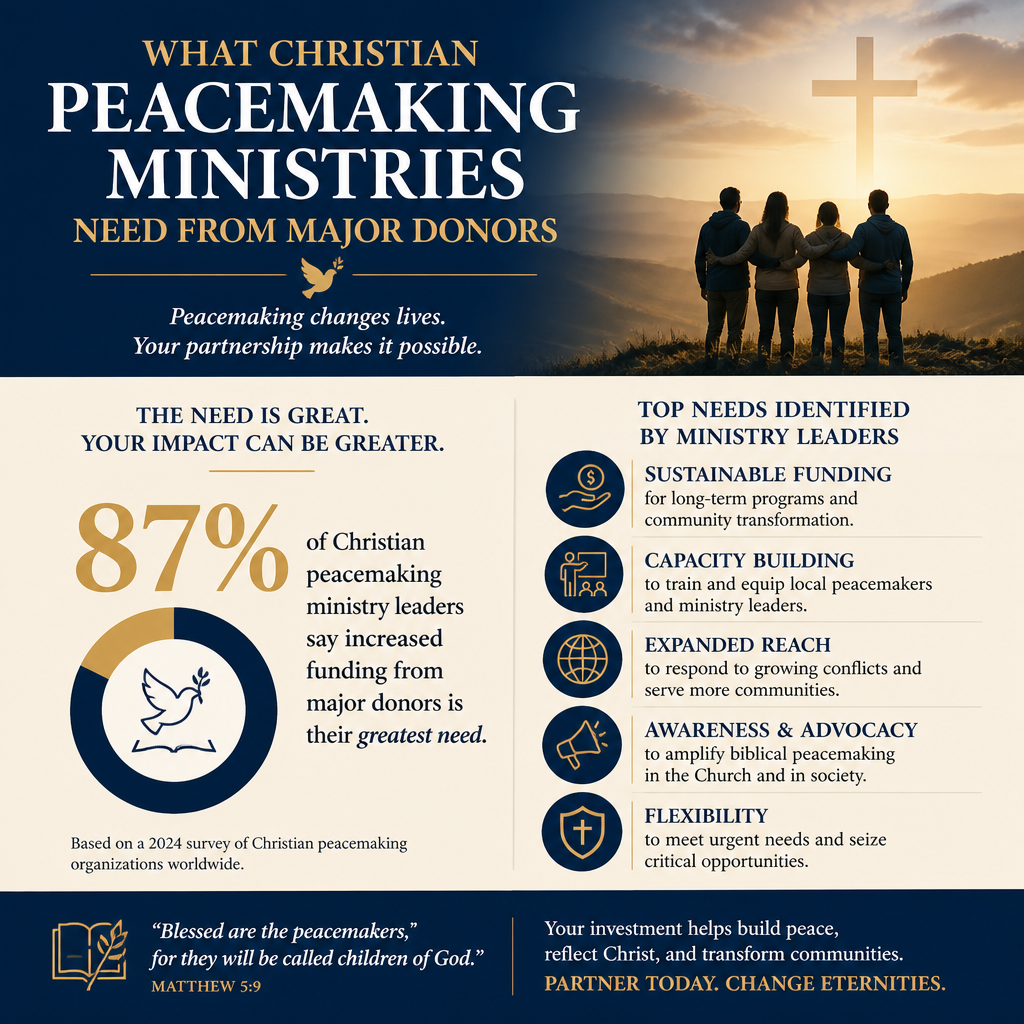
The harder question is whether a ministry has the internal capacity to do the work with integrity when the cases are messy, polarized, or politically sensitive. This is where major donors can make the difference between a ministry that scales influence and a ministry that sustains faithfulness.
Capacity that donors often underfund
Major gifts are particularly suited to funding the unglamorous systems that protect people and preserve integrity. A short list of capacity areas that deserve serious donor attention includes:
- Case intake protocols, recordkeeping, and secure data practices
- Supervision for conciliators, including regular case review and continuing education
- Trauma-informed safeguards and referral pathways for counseling and legal support
- Written policies for conflicts of interest, confidentiality, and mandatory reporting
- Evaluation that measures what can be measured without distorting the mission
Training ministries is not the same as funding casework
Some peacemaking ministries focus on equipping pastors and elders; others do direct intervention. Both approaches can be legitimate, and donors should not assume that “more cases resolved” is always the right benchmark. A training-centered model may produce fewer reportable stories but can strengthen dozens of congregations over time. A casework model may require greater legal prudence and deeper aftercare costs.
Measuring reconciliation requires maturity about evidence
Donors rightly want evidence. But in conflict work, simplistic metrics can incentivize superficial peace. Counting “agreements signed” may reward quick compromises that ignore underlying sin, injustice, or safety concerns. Counting “relationships restored” can pressure victims to reconcile prematurely or publicly.
Evidence should be framed in a way that honors both truth and mercy. That often means a combination of quantitative indicators and qualitative accountability, tied to a coherent theology of reconciliation and a sober view of human sin.
What evidence can look like without compromising integrity
Appropriate indicators may include numbers of leaders trained, retention of trained conciliators over time, documented adherence to policies, third-party reviews of training curricula, and post-process surveys where appropriate and safe. Some ministries can also report how often they refer cases out because reconciliation would be unsafe or unjust in the moment—a sign of ethical clarity rather than failure.
Expect mixed outcomes and tell the truth about them
Peacemaking work includes failures: parties who refuse accountability, leaders who double down, congregations that split, and situations where the ministry learns that earlier steps were insufficient. Mature donors should treat honest reporting of mixed outcomes as a credibility marker, not as a reason to withdraw support. The alternative is a storytelling culture that rewards selective disclosure.
For donors seeking a broader frame for the field, our editorial coverage of Christian Conflict Resolution Ministries addresses how different models define success, accountability, and faithfulness in complex disputes.
What major donors can reasonably require before making a significant gift
Christian donors are not called to cynicism, but neither are we called to naiveté. Scripture’s warnings about partiality, dishonest scales, and wolves in sheep’s clothing are not merely about individual ethics; they also shape how the church should exercise stewardship and discernment.
At Most Trusted, we evaluate ministries against The Most Trusted Standard, a 15-criteria framework across Faith Foundation, Financial Integrity, Governance and Leadership, and Transparency and Effectiveness. For peacemaking ministries, this framework helps donors distinguish between sincere intention and durable trustworthiness.
Reasonable requirements that strengthen, not control
Major donors can require clarity without drifting into operational control. A donor’s questions should strengthen governance and protect the vulnerable rather than steering outcomes in individual cases. Appropriate expectations often include:
Doctrinal clarity and pastoral theology: a written statement of faith and a theological account of reconciliation that does not minimize justice, safety, or truth-telling.
Governance safeguards: an accountable board, conflict-of-interest policies, and documented decision-making for sensitive matters.
Financial integrity: reviewed or audited financials appropriate to size, clear restrictions management, and avoidance of manipulative fundraising.
Transparency with appropriate limits: public reporting of leadership, finances, and policies, while maintaining necessary confidentiality in casework.
Ethical boundaries: clear protocols on abuse, mandatory reporting, and when a case is unsuitable for reconciliation processes.
Legacy giving and the ministry’s time horizon
Some of the most strategic funding for peacemaking ministries is long-horizon: endowments for training, scholarships for under-resourced pastors, and multi-year commitments that protect independence when particular cases trigger backlash. Donors who think in decades are often the ones who allow a ministry to refuse compromised funding and to remain faithful when public opinion shifts.
For donors considering long-term commitments, our work on Donor Partnership and Legacy Giving in Christian Conflict Resolution examines the distinctive challenges of resourcing reconciliation work without distorting it.
FAQs for What Christian peacemaking ministries need from major donors
Should donors prioritize peacemaking ministries that report high success rates?
Not automatically. High reported success can reflect careful screening, wise boundaries, and skilled facilitation, but it can also reflect narrow definitions of success or selective reporting. Donors should ask how a ministry defines “resolution,” what safeguards protect vulnerable parties, and how the ministry reports mixed outcomes without violating confidentiality.
How can a donor evaluate a peacemaking ministry without access to private case details?
Focus on what can be verified: governance quality, written policies, training standards, financial reporting, independent oversight, and evidence of ethical boundaries. A ministry that is serious about reconciliation will be able to articulate its theology, describe its process, document its safeguards, and submit to accountability without turning private pain into fundraising content.
A major gift should purchase faithfulness, not visibility
What Christian peacemaking ministries need from major donors is a form of partnership that honors the moral weight of reconciliation. The donor’s task is to fund the systems, formation, and oversight that keep peacemaking truthful, safe, and spiritually serious. When major giving rewards integrity rather than spectacle, ministries are freed to pursue the slow work that Scripture calls reconciliation—patiently, accountably, and without fear.



