
Why Christian reconciliation ministries teach Matthew 18 is not a matter of preference or conflict-management fashion. It is a question of ecclesial obedience: Jesus gave his people a disciplined process for pursuing truth, repentance, forgiveness, and, when possible, restored fellowship. When donors underwrite reconciliation work, they are not simply funding “peacemaking.” They are helping ministries practice a form of pastoral care that assumes sin is real, words have moral weight, and the church must be capable of both mercy and judgment.
Matthew 18:15–20 sits inside Jesus’ larger teaching on life together among his disciples: humility, care for the vulnerable, the seriousness of causing others to stumble, and the pursuit of the straying brother or sister. Reconciliation ministries return to this passage because it names both the goal and the guardrails. It dignifies the injured party, protects the accused from rumor, and insists that hidden conflict is not a stable foundation for Christian unity.
Matthew 18 is a discipleship framework, not a crisis script
Jesus assumes conflict will occur among disciples
Matthew 18 does not begin with an idealized community. It assumes a church where real offenses happen and where “brother against brother” can become the norm unless addressed. That assumption is not cynical; it is biblical realism about remaining sin. Christian reconciliation ministries teach Matthew 18 because it tells the truth about the church’s condition between the resurrection and the final restoration.
The process begins privately: “If your brother sins against you, go and tell him his fault, between you and him alone” (Matthew 18:15). This is spiritually formative. It trains believers to refuse both silent resentment and public accusation. It also trains leaders to resist the institutional reflex to treat every conflict primarily as a reputational risk.
The steps protect both parties from common abuses
Done rightly, Matthew 18 is simultaneously firm and humane. It creates a pathway for the injured to be heard and for the accused to be addressed with fairness. The movement from one-to-one conversation, to two or three witnesses, to the gathered church is a measured escalation. It is not a shortcut to exclusion; it is a refusal to leave serious sin unaddressed.
Many ministries teach this passage because donors, board members, and even pastors can unintentionally reward either avoidance or aggression. Avoidance says, “Peace is the absence of tension.” Aggression says, “Justice is immediate exposure.” Matthew 18 rejects both. It aims for repentance and restoration, while acknowledging that persistent refusal to repent has consequences for fellowship.

Witnesses, authority, and due process are moral goods
Two or three witnesses is not bureaucracy
In the second step, Jesus calls for “one or two others” so “every charge may be established by the evidence of two or three witnesses” (Matthew 18:16). This is not an innovation; it echoes the Old Testament concern for truthful testimony and protection against false accusation (Deuteronomy 19:15). Reconciliation ministries emphasize this because churches are not immune to the dynamics that distort conflict everywhere else: selective memory, social pressure, and the human tendency to make ourselves the hero of our own stories.
Witnesses in Matthew 18 are not merely observers. In mature practice they function as wise, truth-seeking counselors who help clarify what actually happened, what repentance would require, and what restitution or repair is appropriate. This is where trained mediators can serve the church well, especially when power dynamics or complex relationships make a direct conversation unsafe or ineffective.
Tell it to the church is an accountability boundary
The third step—“tell it to the church” (Matthew 18:17)—is often misunderstood. It is not a license for spectacle. It is a recognition that the church is a moral community with real authority, not merely a voluntary association. Reconciliation ministries teach this because Christians genuinely disagree about how public discipline should be, how to handle confidentiality, and how to account for trauma. These are not trivial questions. But Matthew 18 still requires the church to be capable of naming persistent, unrepentant sin as sin.
For donors, this has practical implications. Ministries that teach Matthew 18 responsibly will typically have policies that distinguish between interpersonal offense, criminal conduct, and situations involving coercion or ongoing danger. A ministry’s faithfulness is not measured by whether it “handles everything internally,” but by whether it honors both Scripture and lawful reporting obligations, especially where abuse is alleged.
Matthew 18 shapes the ministry’s moral imagination
Reconciliation is not conflict avoidance
Scripture’s vision for peace is thicker than getting back to polite conversation. Biblical reconciliation is inseparable from truth. Jesus does not say, “Let it go.” He says, “Go.” That command reorders the moral imagination of a church that would rather preserve appearances than do the slow work of repentance and repair.
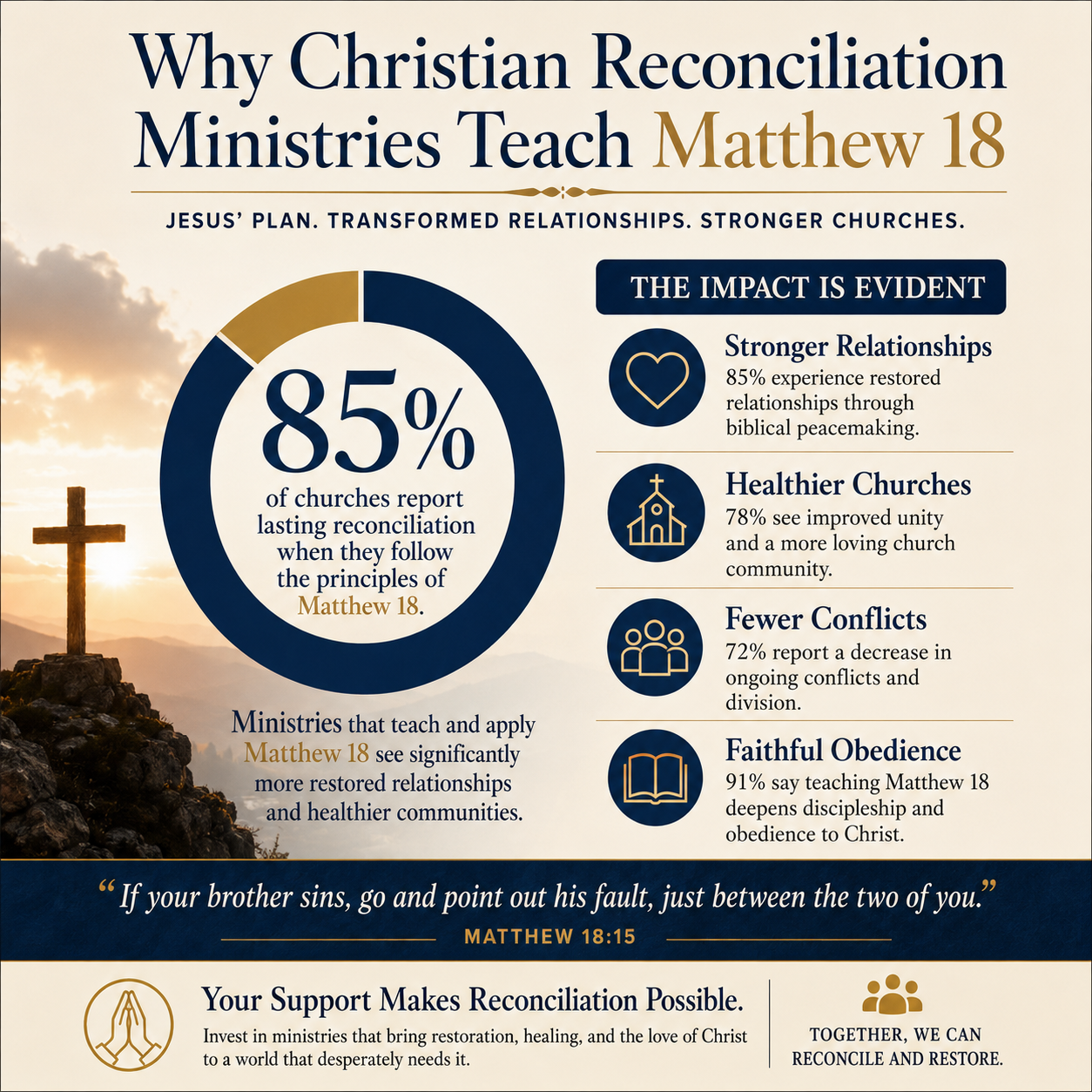
This is one reason reconciliation ministries teach Matthew 18 as a core text rather than a specialized tool. When a congregation learns to address offense directly and charitably, it becomes harder for grievance to calcify into factions. It becomes harder for leaders to manage dissent by marginalizing the dissenters. And it becomes easier for ordinary believers to practice the daily disciplines of confession and forgiveness without denying the reality of harm.
Forgiveness and accountability belong together
Matthew 18 is followed by Peter’s question about forgiveness and Jesus’ parable of the unforgiving servant (Matthew 18:21–35). Reconciliation ministries often teach these texts together because churches regularly separate what Jesus joined: mercy and moral seriousness. Some communities stress forgiveness in ways that can minimize harm or pressure victims to reconcile without repentance. Other communities stress accountability in ways that foreclose mercy and treat people as disposable once they fail.
The biblical pattern is more exacting. Forgiveness is commanded. Repentance is required for restored fellowship where trust has been broken. And consequences are not the enemy of grace; they can be one of the ways grace trains us to fear God and love neighbor.
Donors should understand what faithful practice requires
The work is labor-intensive and easily distorted
Teaching Matthew 18 in the abstract is simple. Practicing it in real cases is demanding. It requires time, spiritual maturity, competent leadership, and often outside expertise. It also requires a ministry culture that values truth over speed. Donors sometimes want “resolution” on a quarterly timetable; reconciliation is often slower because it is dealing with conscience, not merely compliance.
In many churches, conflict is one of the leading reasons pastors consider leaving. A 2022 Barna report found that a significant share of pastors had “seriously considered quitting full-time ministry” at least once, with stress and relational strain among the contributing factors (Barna). Reconciliation ministries teach Matthew 18 because they are trying to strengthen the relational and moral infrastructure that keeps leaders and congregations from being driven by unmanaged, recurring conflict.
What this means in practice for giving decisions
Across our verification work at Most Trusted, we observe that ministries doing reconciliation well tend to pair biblical conviction with operational clarity. They can explain their process, their boundaries, and the limits of mediation. They also tend to train leaders to recognize when Matthew 18 has been misapplied to silence the vulnerable or to bypass lawful investigations.
For donors evaluating a reconciliation ministry, the following indicators are worth asking about:
- Clear policies on mandatory reporting and cooperation with civil authorities when criminal conduct is alleged
- Training that distinguishes interpersonal conflict from abuse, coercive control, and harassment
- A documented process for witnesses, documentation, and escalation that prioritizes truth and fairness
- Defined oversight, including board accountability for leadership misconduct allegations
- A theology of forgiveness that does not require immediate reconciliation or the removal of appropriate consequences
Many donors also want comparability across ministries. That is one reason Most Trusted evaluates organizations against The Most Trusted Standard, a 15-criteria framework spanning Faith Foundation, Financial Integrity, Governance and Leadership, and Transparency and Effectiveness. In reconciliation work, governance and transparency are not administrative details. They are the structures that keep spiritual language from becoming a cover for dysfunction.
Those exploring the broader field can begin with Christian Conflict Resolution Ministries, where the spectrum of approaches—from pastoral counseling to formal mediation to church discipline training—becomes clearer in its practical trade-offs.
Matthew 18 is often contested because it can be misused
Misapplication is a real danger, especially where power is unequal
Christians genuinely disagree about how Matthew 18 should be applied in cases involving leaders, institutions, or allegations of abuse. Those disagreements are not merely theoretical. In some settings, Matthew 18 has been invoked to pressure victims to meet privately with an alleged abuser, to treat public disclosure as “gossip,” or to delay reporting until “the process” is exhausted. Those moves contradict the moral intent of the passage, which aims at truth and protection, not concealment.
Reconciliation ministries that teach Matthew 18 responsibly address these distortions explicitly. They teach that private confrontation is not required when it would be unsafe. They clarify that witness involvement is not optional in serious matters. And they insist that the church’s pursuit of holiness does not negate the state’s God-given role to restrain evil (Romans 13:1–4).
Public credibility depends on integrity, not public relations
The harder question for donors is how to distinguish ministries using Matthew 18 as a pathway to repentance from ministries using it as a shield against accountability. This is where verifiable practices matter: independent oversight, clear financial reporting, and transparent outcomes that do not confuse “case closed” with genuine reconciliation.
For donors comparing ministries within a funding portfolio, Christian Conflict Resolution Programs Donors Can Support can help frame the categories of work and the kinds of evidence that warrant confidence. A ministry does not need to be perfect to be faithful. It does need to be honest, governed, and willing to submit itself to scrutiny.
FAQs for Why Christian reconciliation ministries teach Matthew 18
Does Matthew 18 mean Christians should never involve civil authorities?
No. Matthew 18 addresses sin and discipline within the church; it does not override the duty to report crimes or cooperate with lawful investigations. Responsible reconciliation ministries teach explicit boundaries: abuse, credible threats, and criminal conduct require immediate safeguarding measures and often mandatory reporting, alongside any pastoral care the church provides.
Is Matthew 18 only about church discipline, or also about everyday conflict?
It is both. The passage culminates in church discipline for persistent, unrepentant sin, but it begins with a private conversation for ordinary offenses. Many reconciliation ministries teach Matthew 18 as a normal discipleship practice precisely because everyday resentments, if left unaddressed, often become the seeds of larger ruptures.
Why this passage remains central
Christian reconciliation ministries teach Matthew 18 because Jesus entrusted his church with a way of pursuing peace that is not sentimental and not cynical. It assumes sin must be named, testimony matters, repentance is possible, and forgiveness is commanded. Donors who fund this work are investing in a church that can tell the truth about itself, protect the vulnerable, and practice a form of unity strong enough to endure disagreement without fracture.



