

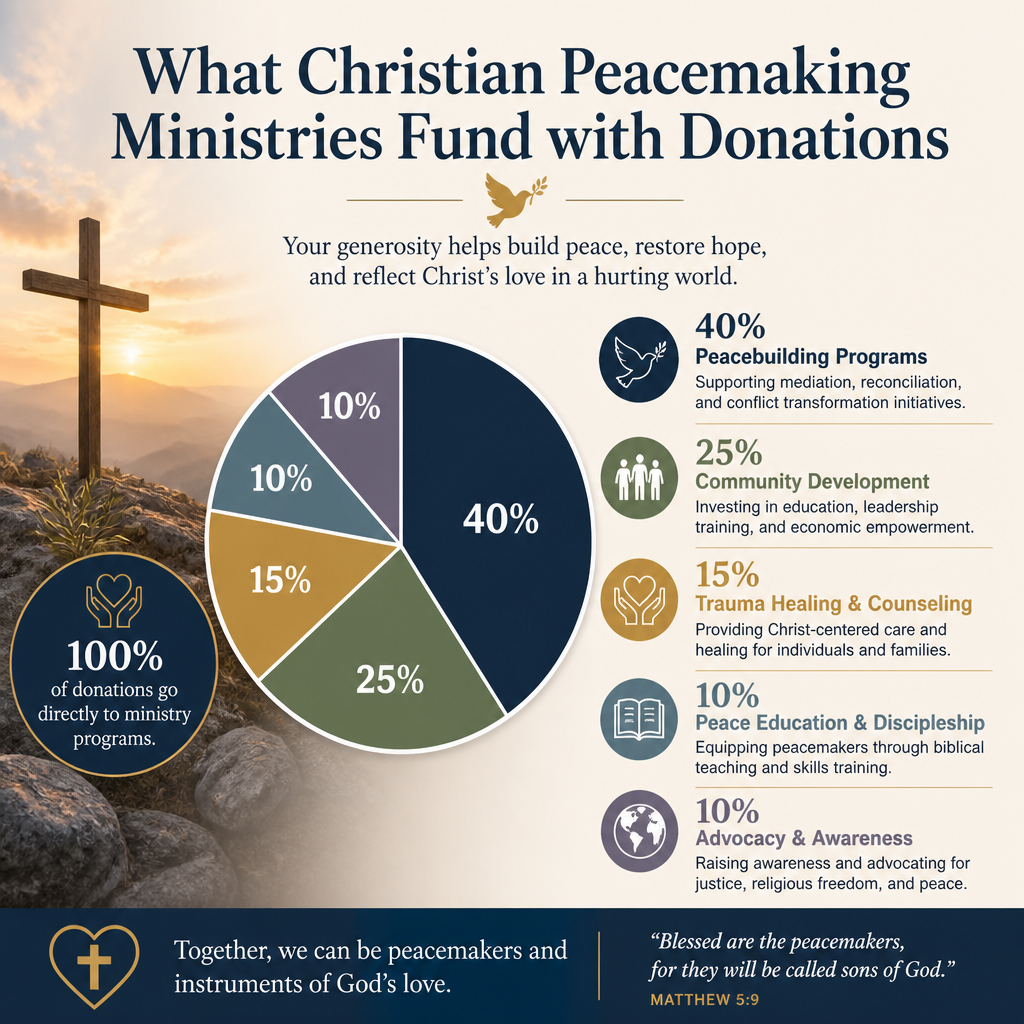
When donors ask what Christian peacemaking ministries fund with donations, they are rarely asking for a generic budget breakdown. They are asking whether their giving will strengthen the church’s witness, protect the vulnerable, and pursue reconciliation without sacrificing truth. That is a morally serious question, because Scripture treats reconciliation as a gospel-shaped obligation, not an optional program (2 Corinthians 5:18–20 Bible Gateway).
At their best, Christian conflict resolution ministries finance work that most congregations cannot sustain alone: careful training, durable processes, trauma-aware care, and accountable case handling. At their worst, they can become unaccountable counseling brands, grievance pipelines, or “peace” projects that reward the powerful and silence the wounded. Donors have reason to press for clarity, because peacemaking can be named in the abstract while the money quietly funds something else.
What donations make possible in frontline peacemaking work
Christian peacemaking is not primarily an event; it is a discipline. Donations often fund the slow, labor-intensive work of helping people tell the truth, assume responsibility, and pursue repair where repair is possible. In ministry settings, the unit of work is frequently a relationship, a congregation, or a leadership team—complex, emotionally charged, and rarely solved by one meeting.
Across our verification work at Most Trusted, the ministries that meet The Most Trusted Standard tend to treat casework as pastoral and ethical practice, not mere service delivery. That posture changes how funds are spent: less on constant promotion, more on qualified practitioners, clear safeguards, and follow-through.
Case intake, triage, and referral pathways
Many ministries use donations to build disciplined intake systems: initial listening, risk screening, conflict mapping, and decisions about whether a case is appropriate for mediation, coaching, restorative processes, or referral. This is where ministries either demonstrate sobriety about harm—or they do not. The best programs acknowledge that not every “conflict” is symmetrical, and not every dispute should be mediated.
Facilitated processes that take time
Donations often underwrite the hours that rarely appear on a brochure: preparation calls, documentation, shuttle diplomacy, carefully structured sessions, and post-process check-ins. When the conflict involves staff power, governance issues, or allegations of misconduct, faithful peacemaking requires documentation and boundaries, not sentimental appeals to unity. The biblical call to be “peacemakers” (Matthew 5:9 Bible Gateway) is not permission to rush reconciliation or to confuse quiet with peace.

Training and formation that outlast a single dispute
Many donors instinctively prefer “direct work” over training. Yet in conflict resolution, training is often the most defensible long-term investment: it reduces future harm, improves leadership judgment, and equips local churches to carry their own responsibilities. The question is not whether a ministry trains, but what it trains, how it trains, and whether it measures whether training changes behavior.
Equipping pastors, elders, and lay reconcilers
Donations commonly fund curricula, workshops, and cohort-based formation for leaders who must handle disputes about money, authority, doctrine, staffing, and discipline. Mature programs train leaders to distinguish among interpersonal conflict, organizational dysfunction, and abuse dynamics. They also teach appropriate use of Matthew 18, which is frequently misapplied as a universal template rather than a pastoral instruction requiring wisdom about context and danger.
Field-tested frameworks and continuing education
Some ministries invest in structured training based on established frameworks rather than personality-driven methods. The When Helping Hurts framework articulated by Steve Corbett and Brian Fikkert has shaped many Christian approaches to power, dignity, and unintended harm, including how outsiders enter difficult situations without displacing local responsibility (When Helping Hurts). While not a conflict-resolution manual, its emphasis on wise help is directly relevant to mediation and reconciliation work, where helpers can easily take control in ways that weaken communities.
Because disputes increasingly intersect with trauma, mental health, and legal constraints, responsible ministries also budget for continuing education and supervision. Donors should see this not as “overhead,” but as competence and duty of care.
Safeguards, ethics, and accountability in sensitive cases
Christian peacemaking ministries often meet people at their most vulnerable: betrayed spouses, whistleblowers, fired staff, wounded congregants, and leaders under pressure. Donations therefore fund the moral infrastructure of the work—policies, boundaries, and governance practices that reduce predictable failure modes.
Christians genuinely disagree about how to balance confidentiality, transparency, repentance, and institutional risk. The more consequential the allegations, the more a ministry must show that its instincts are governed by Scripture’s concern for justice and impartiality, not by reputation management (Proverbs 18:17 Bible Gateway).
Clear standards for neutrality and power imbalances
In classic mediation, neutrality is often treated as a professional ideal. In church contexts, “neutrality” can become a cover for moral evasion. Responsible ministries fund protocols that name power differences and protect participants who may be economically, spiritually, or socially dependent on the other party. They also set criteria for when mediation is inappropriate—particularly where credible allegations of abuse, coercion, or criminal conduct are present.
Mandatory reporting, recordkeeping, and boundaries
Donations may support legal consultation, secure documentation systems, and staff training related to mandatory reporting obligations and confidentiality limits. Donors should expect a ministry to state plainly how it handles threats of self-harm, child endangerment, or credible allegations of criminal behavior. These are not bureaucratic details; they are part of loving one’s neighbor in truth.
Measuring effectiveness without reducing peace to metrics
Peacemaking is notoriously difficult to quantify. A restored relationship may be real but private; a necessary separation may be righteous but painful. Still, donors are right to ask for evidence that a ministry’s work is more than stories and sentiment. Responsible ministries invest in appropriate measurement, and they communicate both outcomes and limitations.
What responsible outcomes can look like
The most credible ministries report outcomes in categories that reflect the nature of their work: completion rates for facilitated processes, participant feedback on fairness and safety, adherence to protocols, referrals made when mediation was inappropriate, and follow-up indicators of stability. When ministries claim high success rates, donors should ask what “success” means: agreement reached, relationship restored, litigation avoided, or public scandal contained.
Transparency that resists the overhead trap
Donors sometimes pressure ministries to minimize administrative spending, yet the field has long warned that overhead ratios are a blunt instrument. The “Overhead Myth” letter—signed by GuideStar (now Candid), BBB Wise Giving Alliance, and Charity Navigator—argued that overhead measures can distort incentives and distract from mission and results (Candid). Peacemaking ministries need competent administration: secure systems, careful scheduling, conflict-of-interest checks, and documentation. The ethical question is whether these costs serve accountable ministry, not whether they can be made to look small.
For donors evaluating the space broadly, our coverage of Accountability and Transparency in Christian Conflict Resolution Ministries addresses what meaningful disclosure tends to include and what omissions should prompt follow-up.
What wise donors should look for in a peacemaking budget
Donations fund real people and real decisions. A donor’s task is not to micromanage, but to insist on coherence: the money should match the stated theology, the ethical commitments, and the practical realities of conflict work. Ministries that speak eloquently about reconciliation yet cannot explain how they protect the vulnerable are asking donors to underwrite risk.
Signals of maturity and credibility
Across our team’s work, several budget-linked signals tend to correlate with healthier practice. None is infallible; together, they form a pattern a prudent donor can test.
- Competence is funded. Staff and contractors have relevant training, supervision, and clear scopes of practice.
- Safeguards are resourced. Written policies exist for conflicts of interest, power imbalances, and when to refer out.
- Governance is active. A functioning board provides oversight rather than lending a name.
- Transparency is specific. Financial statements and program descriptions allow donors to understand what the ministry actually does.
- Learning is ongoing. The ministry can describe what it has changed after failures, complaints, or hard cases.
How Most Trusted evaluates these questions
Most Trusted exists because donors should not have to choose between cynicism and naïveté. We verify ministries against The Most Trusted Standard, a 15-criteria framework across Faith Foundation, Financial Integrity, Governance and Leadership, and Transparency and Effectiveness. In peacemaking work, this framework helps donors assess whether a ministry’s theology of reconciliation is matched by credible oversight, financial discipline, and truthful reporting.
Donors who want a wider view of the field can also consult our work on Christian Conflict Resolution Ministries, where we address common models, risks, and questions that recur across organizations.
FAQs for What Christian peacemaking ministries fund with donations
Do donations mostly pay for mediation sessions, or for administration?
Both, and the proportion is not a moral verdict by itself. Effective peacemaking requires trained practitioners and significant unseen work: intake, preparation, documentation, scheduling, supervision, and follow-up. The more helpful question is whether administrative spending is clearly tied to ethical safeguards and demonstrable service, and whether the ministry can explain its costs in plain terms.
Should donors avoid ministries with higher overhead percentages?
Not automatically. Sector leaders have warned that overhead ratios can mislead donors and pressure nonprofits to underinvest in the very systems that prevent harm and fraud (Candid). Donors should instead ask whether the ministry’s financial reporting is transparent, whether governance is credible, and whether the ministry can show evidence of effectiveness appropriate to conflict resolution work.
Funding peace that is truthful, accountable, and durable
Christian donors do not give to purchase a superficial calm. We give because Christ reconciled us to God, and he calls his people to practice that reconciliation with truth, repentance, justice, and mercy. Donations to Christian peacemaking ministries are best spent where that calling is pursued with competence and safeguards, where leaders are accountable, and where ministries tell the truth about what their work can and cannot accomplish.



