
Donor partnership and legacy giving in Christian conflict resolution is ultimately a question of whether a ministry’s peacemaking work will endure beyond the urgency of the present case. Christian donors do not only fund interventions; we underwrite a moral witness that insists reconciliation is possible because Christ has reconciled us to God and therefore commands us to pursue peace with one another.
That aspiration is costly. Christian conflict resolution ministries operate in contested spaces where outcomes can be hard to measure, confidentiality limits public storytelling, and the long arc of trust-building resists quarterly metrics. Mature giving in this field recognizes those constraints without excusing weak governance or thin transparency. It asks for evidence appropriate to the work and for structures that keep a ministry faithful when founders change, crises hit, or donor priorities shift.
Why peacemaking ministries need partners rather than transactions
Most donors have felt the tension: reconciliation is central to discipleship, yet conflict work can feel intangible compared with feeding programs or disaster relief. Scripture does not treat peace as optional. Jesus blesses peacemakers as “sons of God” (Matthew 5:9), and Paul teaches that God “gave us the ministry of reconciliation” (2 Corinthians 5:18). The donor question is not whether peacemaking matters, but what faithful funding looks like when progress is uneven and public validation is limited.
Transactional giving tends to demand clean outputs: a certain number of mediations completed, a certain number of leaders trained, a certain number of sessions delivered. Those are not irrelevant, but they are incomplete. A mediation can “succeed” on paper and still leave a congregation spiritually fragmented. A training can be well attended and still fail to change how leaders address sin, power, or repentance. Partnership funding makes room for the slow work: case screening, follow-up care, prevention training, and the unglamorous internal policies that keep vulnerable people safe.
Confidentiality is ethical, but it complicates donor confidence
In many conflict situations—especially those involving pastoral misconduct, marital breakdown, or abuse allegations—ministry staff must protect privacy. That is not a marketing inconvenience; it is a moral obligation. It also means donors cannot rely on testimonials or detailed case studies to assess effectiveness. The more sensitive the work, the greater the need for a ministry to demonstrate competence through governance, clear protocols, and credible oversight rather than persuasive stories.
Reconciliation is not the same as reunification
Christians genuinely disagree about how to speak of reconciliation when there has been severe harm. Some ministries have learned, sometimes through painful failure, that premature calls for “unity” can pressure victims to return to unsafe situations. Donors should expect ministries to distinguish forgiveness from trust, and restoration from accountability. Where there are allegations of abuse, the ministry’s posture toward law enforcement cooperation, mandatory reporting, and survivor care is not a secondary detail; it is part of its theological fidelity.
Prevention work is often the highest-return investment
Many donors are drawn to acute crisis response, but prevention often yields the most durable fruit: training elders in Matthew 18 processes, teaching congregations to handle disagreement without factionalism, and strengthening policies that reduce the likelihood of future harm. This is where recurring support matters. Prevention work is difficult to fund with one-time gifts because its benefits are distributed over years and across many people who will never know which donor made it possible.

What major donors should look for before committing long-term
Conflict ministries can attract charismatic leadership, urgent demand, and strong theological language. That combination can also mask weak internal controls. Across our verification work at Most Trusted, we observe that ministries doing the most sensitive reconciliation work tend to become either unusually transparent in their governance and safeguards, or unusually defensive. The donor’s responsibility is to discern which posture is present.
We recommend evaluating a prospective partner with the same seriousness used for other high-trust ministries, while adjusting expectations for what can be publicly disclosed. A donor does not need private case files. A donor does need verifiable structures that demonstrate maturity.
Faithful theology expressed in policies, not only statements
A ministry’s faith foundation is not proven by a doctrinal page alone. It is proven by how leaders handle confession, correction, and power. Does the organization have a clear theology of justice and mercy that informs its practice? Does it articulate the difference between peacemaking and conflict avoidance? In Scripture, peace is never a euphemism for silence in the face of sin. “Let justice roll down like waters” (Amos 5:24) is not in tension with the call to unity; it is part of the path toward it.
Donors should ask how the ministry trains staff and volunteers to recognize coercive control, spiritual abuse, and manipulative repentance. Even in church-based settings, these dynamics are not rare. The most trustworthy ministries are able to speak plainly about them without adopting a secular posture that treats the church as merely another institution.
Financial integrity that fits the risk profile of the work
Conflict resolution ministries often rely on a mix of donations, training fees, and sometimes retained consultants. That can be legitimate, but it introduces complexity. Donors should expect clear financial statements, reasonable compensation practices, and an audit or independent financial review where appropriate. Donors should also be cautious about “black box” discretionary spending justified by confidentiality. Confidentiality should apply to counselees, not to board-level oversight of finances.
For perspective on how Americans generally approach charitable giving, the Giving USA annual report remains a standard reference point for trends in philanthropy and donor behavior. Category-level trends do not validate a particular ministry, but they can help donors see whether a ministry’s funding model is plausible and resilient.
Governance and leadership that can withstand conflict inside the ministry
A ministry that specializes in resolving conflict should be able to withstand conflict internally. That requires more than a gifted founder. Donors should look for an active, independent board; clear lines of authority; and documented processes for handling grievances, whistleblowing, and staff discipline. Where the ministry works with churches, donors should also ask how it manages conflicts of interest when a powerful pastor or donor is involved in a case.
One indicator of maturity is whether the organization has faced hard moments publicly and responded with candor: leadership transitions, third-party investigations, policy updates, or board reforms. Not every crisis is a sign of failure. A refusal to learn from crises often is.
Legacy giving as a theological act of continuity
Planned giving is frequently treated as a fundraising technique. For Christian donors, it is better understood as a theological act: the purposeful ordering of one’s estate as part of stewardship before God. Scripture consistently frames wealth as entrusted, temporary, and accountable. “As for the rich in this present age… they are to do good, to be rich in good works, to be generous and ready to share” (1 Timothy 6:17–18). Legacy giving extends that readiness beyond the donor’s lifetime.
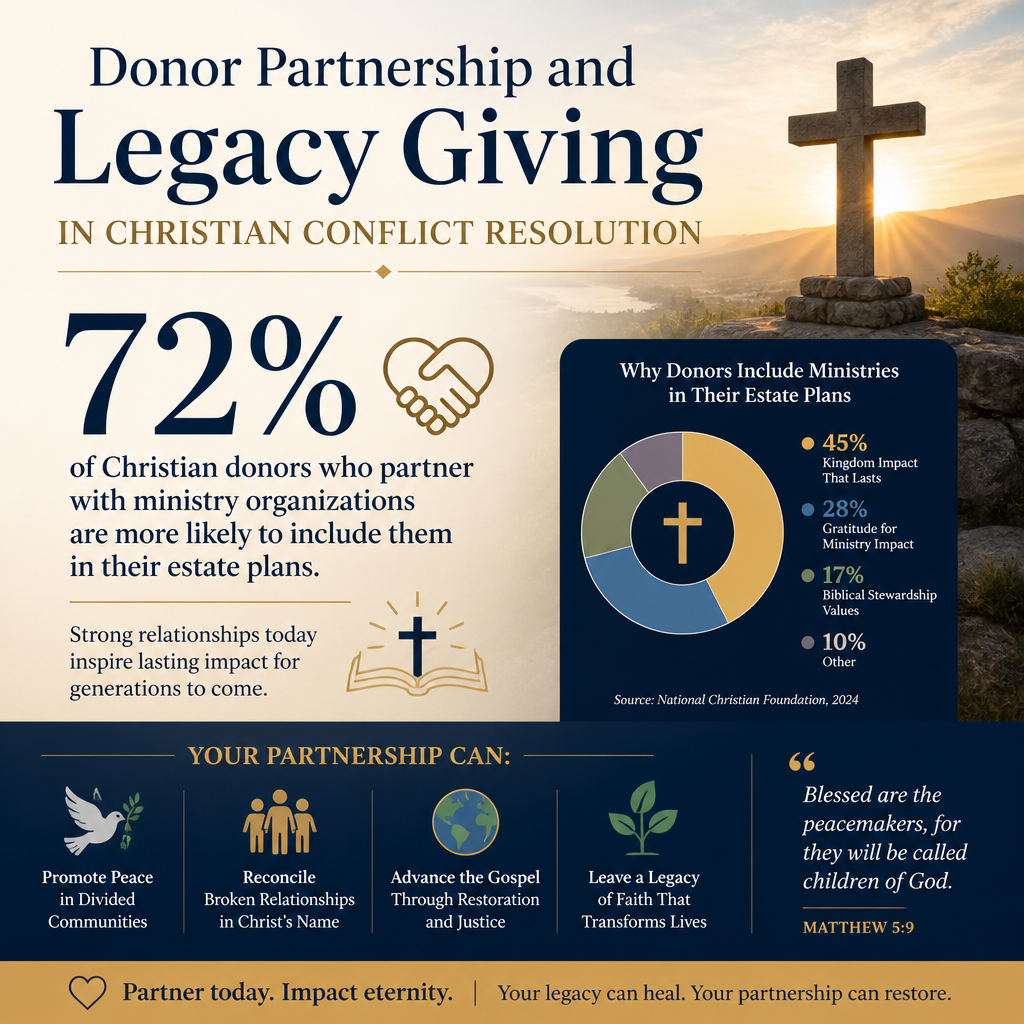
In the conflict resolution field, legacy gifts are particularly strategic because they can stabilize work that is otherwise vulnerable to episodic funding. A bequest can establish a reserve, underwrite staff development, or support the slow work of equipping churches before crisis strikes. It can also protect a ministry from the pressure to chase visibility at the expense of integrity.
Bequests and beneficiary designations are often the cleanest starting point
For many donors, the simplest planned gift is a bequest in a will or trust, or a beneficiary designation on a retirement account. These gifts can be significant without affecting current cash flow. Donors should ensure that the ministry’s legal name is correct and that the organization is positioned to receive and steward such gifts responsibly.
Because conflict ministries often work across denominational lines, donors should also consider whether their intent is best served by supporting a particular ministry’s operations or by restricting the gift to a defined purpose such as training, survivor support, or mediation subsidies. Restrictions can preserve donor intent, but they can also create long-term burdens if they are too narrow. Wise legacy gifts align with a ministry’s demonstrated capacity and strategic direction.
Endowment and reserve questions deserve clarity, not suspicion
Some Christian donors are wary of endowments, fearing institutional complacency. Others see reserves as prudent for continuity. Both instincts can be faithful. The question is whether reserves serve mission or replace it. A ministry addressing conflict should not be forced into financial fragility that tempts it to accept inappropriate cases, dilute standards, or retain staff who should be disciplined. At the same time, an organization should be able to explain why it holds funds, how they are governed, and how spending decisions are made.
For donors thinking about donor-advised funds, the National Philanthropic Trust’s annual reporting provides a credible snapshot of DAF activity and grantmaking patterns (National Philanthropic Trust). Again, field-level data is not ministry-level evidence, but it helps donors calibrate how planned and structured giving fits into broader patterns of generosity.
Legacy gifts should reinforce accountability and transparency
Planned giving can inadvertently reduce a donor’s feedback loop; the donor is no longer present to ask questions. That makes governance safeguards even more important. Donors should prefer ministries that publish clear annual reporting, maintain updated board information, and demonstrate measurable commitments to ethical practice. In conflict work, “effectiveness” may mean fewer public stories but stronger systems: training completion with demonstrated competency, follow-up protocols, third-party evaluation of curricula, or documented outcomes over time.
Building a partnership plan that honors both prudence and faith
Most long-term donors eventually face a practical challenge: how to support peacemaking without becoming entangled in the conflicts themselves. A ministry may be called into disputes where donors have relationships, opinions, or history. Partnership requires careful boundaries. Donors can support the work without attempting to direct case decisions, choose mediators, or pressure timelines.
Recurring giving supports readiness, not only response
Monthly support is often the most mission-aligned form of ordinary giving in this field. It allows ministries to retain skilled staff, respond quickly when churches call, and invest in prevention. Donors sometimes treat recurring giving as “maintenance,” but readiness is part of faithfulness. In Scripture, wise stewardship includes preparedness (Proverbs 21:5) without confusing preparedness with control.
Major gifts can fund capacity, but capacity must be verifiable
Donors often want to fund growth: more mediators, more trainings, broader geographic reach. Growth can be faithful, but it is not automatically virtuous. We recommend that major donors ask for evidence that a ministry can scale without lowering standards: documented training pathways, supervision ratios, case intake criteria, and clear policies for high-risk situations. When a ministry cannot articulate these elements, the safer interpretation is not humility; it is underdevelopment.
Verification helps donors give with confidence in a high-trust field
The more relational and confidential a ministry’s work is, the more donors need a structured way to assess trustworthiness. Most Trusted exists to serve that need by evaluating ministries against The Most Trusted Standard, a 15-criteria framework spanning faith foundation, financial integrity, governance and leadership, and transparency and effectiveness. The goal is not to replace prayerful discernment. It is to complement it with verifiable evidence—so that generosity is not asked to function as naïveté.
Donors seeking to situate legacy decisions within the broader landscape of reconciliation work may also want to understand the range of ministry models—church-based conciliation, professional mediation, restorative justice, and community peacemaking—within Christian Conflict Resolution Ministries.
A durable witness requires durable funding
Donor partnership and legacy giving in Christian conflict resolution is not primarily about securing a ministry’s future; it is about preserving a credible Christian witness in a fracturing age. The church’s conflicts are never merely interpersonal. They touch doctrine, power, money, harm, and credibility before a watching world. Funding this work well requires more than enthusiasm. It requires clear-eyed prudence, theological seriousness, and a commitment to institutions that can demonstrate trustworthiness over time.



