
What it costs to fund Christian camp staff is rarely a single number, because staffing is not a line item so much as the human infrastructure of ministry. Donors who want to fund Christian camp staff faithfully are usually asking a deeper question: what does it take for a camp to recruit, form, supervise, and retain people who can safely shepherd children and teenagers toward Christ for a summer and beyond?
The answer matters because camp work sits at the intersection of discipleship and duty of care. Camps ask staff to proclaim the gospel, model Christian community, and carry real responsibility for minors. When staffing is underfunded, the consequences are not merely operational; they can become spiritual and moral failures—burnout, shortcuts in screening, weak supervision, and a culture that confuses sacrifice with neglect. Christian donors should not romanticize under-resourcing as virtue.
Cost begins with vocation and a real labor market
Camp staffing is ministry, but it is also employment
Christian camps often recruit from churches and Christian colleges, and many staff accept lower pay because they see the work as a calling. That calling is genuine. Yet Scripture’s theology of work does not treat laborers as interchangeable inputs. “The worker deserves his wages” is not merely a practical saying; Jesus uses it to ground ethical provision for those sent into ministry (Luke 10:7).
In practice, camps compete in a labor market shaped by regional wages, housing costs, and alternative summer jobs. When camps set compensation far below comparable youth-facing roles, they shift costs onto young adults and their families. That shift can narrow the staff pipeline to those with financial support, undermining diversity of background and the church’s broader witness.
Why donors should not anchor on a single hourly rate
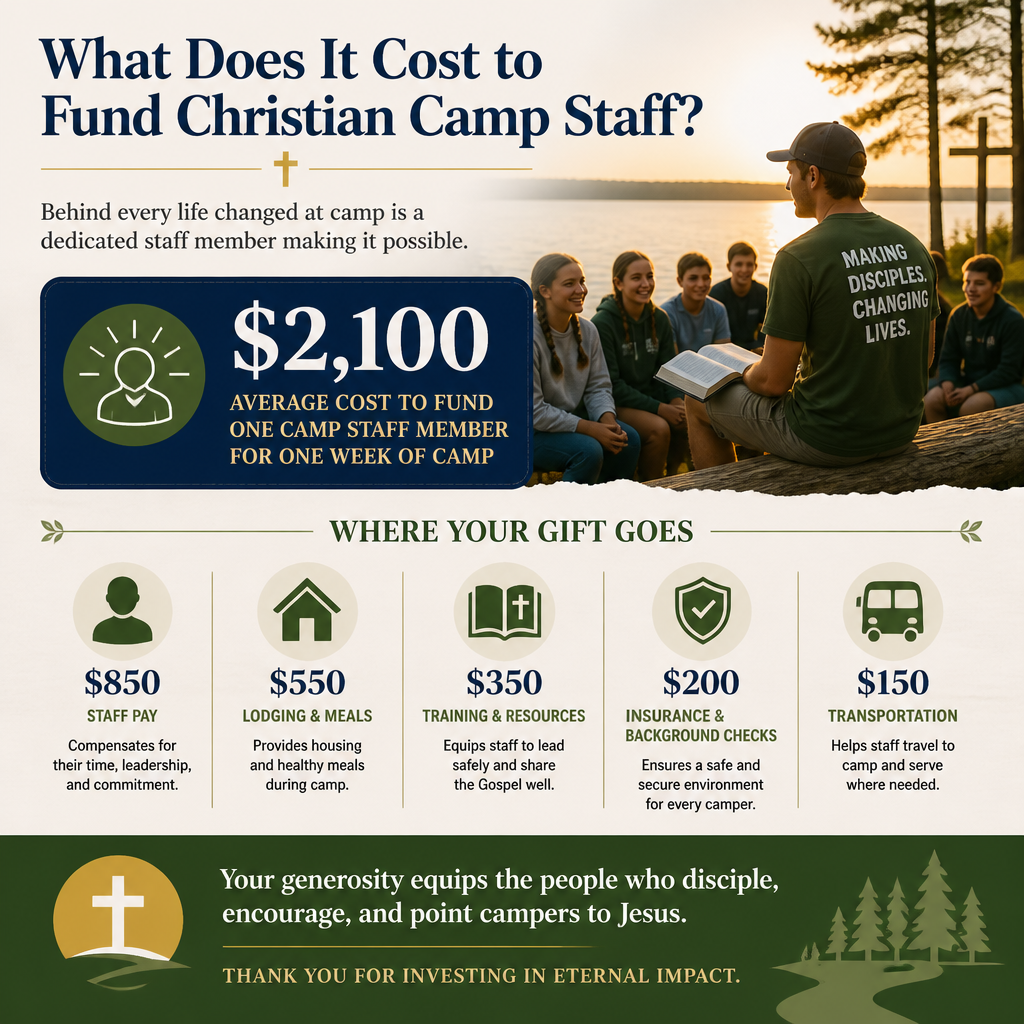
Many donors try to evaluate “cost to fund staff” by asking what counselors earn per week. That number matters, but it is incomplete. A camp’s staffing cost is a bundle: wages or stipends, payroll taxes, workers’ compensation, background checks, training time, supervision ratios, and often room and board. Even when room and board are provided, they are not free. They are real costs carried by the camp’s operating budget.
Across our verification work at Most Trusted, we observe that high-trust camps and conference ministries tend to describe staffing costs in a way that ties dollars to outcomes and safeguards. They do not treat staff as a variable expense to be minimized; they treat staffing as a primary means of discipleship and protection.

The core cost categories donors should understand
Direct compensation and statutory costs
Direct pay is usually the largest visible component. Depending on role, camps may use seasonal salaries, weekly stipends, or hourly wages. Beyond that, employers typically carry payroll taxes and may carry state-required workers’ compensation coverage. Those statutory costs vary by state and classification, but they are not optional.
Donors sometimes press ministries to keep “overhead” low by minimizing these costs. That instinct can be well-intentioned, but it can also be poorly informed. The nonprofit sector has repeatedly warned that fixating on overhead can distort incentives and reduce effectiveness; Charity Navigator, Candid, and BBB Wise Giving Alliance jointly argued that overhead ratios are a poor measure of nonprofit performance in their “Overhead Myth” letter (Charity Navigator).
Training, supervision, and ministry formation
If a camp is serious about spiritual formation and child safety, it will spend real time and money before the first camper arrives. Training includes theological and program orientation, emergency procedures, behavior management, mandatory reporting expectations, and clear boundaries for staff-camper interactions. The cost is both in materials and in paid time for staff who arrive early.
Supervision also costs money because it requires higher ratios of experienced leaders to first-time counselors. Underfunded supervision produces a predictable pattern: young counselors carry responsibilities beyond their formation, leadership stretches thin, and preventable incidents increase. A camp’s staffing budget should reflect a theology of shepherding that includes oversight, not just enthusiasm.
Screening, background checks, and safeguarding infrastructure
Responsible camps screen staff carefully, including background checks and reference processes, and they maintain policies that can withstand scrutiny. The urgency is not theoretical. Child sexual abuse is tragically prevalent; a widely cited meta-analysis by David Finkelhor and colleagues estimated that 1 in 4 girls and 1 in 13 boys experience child sexual abuse in the United States (Centers for Disease Control and Prevention).
Not every camp incident is criminal, and not every safeguard prevents every harm. Christians genuinely disagree about the best safeguards in every context. Yet donors should insist that camps treat safeguarding as a core ministry responsibility, not as a compliance burden. Funding that supports screening systems, reporting protocols, and staff training is often among the most consequential giving a donor can do.
What a reasonable staffing budget often includes
Thinking in per-staff and per-camper terms
Because camps vary widely—day camps, overnight camps, specialty camps, retreat centers—a “typical” number can mislead. A more reliable approach is to ask what it costs to place one well-supported staff member on the field for the season, and what the staff-to-camper ratios are in different program areas. High-adventure programming, waterfront activities, and special-needs camps require higher training burdens and supervision ratios. Those realities should change what donors consider reasonable.
Donors can also ask how many weeks the camp operates at full capacity, and how staff are used in shoulder seasons. Some camps subsidize summer with retreats and rentals. That is not inherently problematic; it can be wise stewardship. But it complicates staff allocation. Transparent ministries explain how staff costs are distributed across programs and seasons.
A short checklist donors can use when funding staff
When a camp invites donors to underwrite staff, we recommend asking for a clear budget narrative that includes at least the following:
- Compensation structure for each role and what is included beyond pay
- Training schedule, required hours, and who leads it
- Safeguarding policies, background check process, and reporting pathway
- Supervision ratios and escalation protocols for behavioral or safety concerns
- Retention strategy for high-performing staff and leadership development
These questions are not adversarial. They are the ordinary due diligence of Christian stewardship. A camp that answers them clearly is usually signaling maturity rather than defensiveness.
The harder question is sustainability and the cost of doing it well
Underfunded staffing creates predictable spiritual and operational risks
Many camps operate with narrow margins and rising costs. Food, insurance, transportation, and facility maintenance all compete for limited dollars. Staff costs are sometimes treated as the most flexible lever, especially when donors prefer to pay for “camperships” rather than staff support. Yet when staffing is squeezed, camps often compensate by stretching young leaders, shortening training, or tolerating weaker performance. Over time, that can erode the very spiritual environment donors intend to support.
Burnout is also a real pastoral concern. When ministries normalize chronic exhaustion and low pay as proof of devotion, they can slip into a theology of scarcity rather than a theology of faithful provision. Christian donors are not responsible to make ministry work comfortable. We are responsible to avoid underwriting systems that depend on preventable harm.
Housing, meals, and the hidden costs donors overlook
Many camps provide room and board. Donors sometimes treat that as a substitute for compensation, but it is better understood as an additional cost carried by the camp on behalf of staff. Housing requires maintenance, utilities, and staffing for supervision. Meals require kitchen staff, food purchasing, and compliance with health regulations. When donors fund staff, they are often funding this ecosystem of support that makes sustained ministry possible.
For donors seeking broader context on how camps and retreat ministries operate, we maintain coverage within Christian Camps and Conferences. Staffing costs are inseparable from the camp’s overall model of discipleship, safety, and financial stewardship.
How Most Trusted evaluates staffing funding through The Most Trusted Standard
What verification asks beyond a budget spreadsheet
Most Trusted exists to help donors give with confidence by evaluating Christian nonprofits against The Most Trusted Standard, a 15-criteria framework across Faith Foundation, Financial Integrity, Governance and Leadership, and Transparency and Effectiveness. Staffing funding touches all of these areas. A camp can pay counselors more and still fail if it lacks governance, ignores safeguarding, or cannot demonstrate program integrity. Conversely, a camp can be well-governed and still harm staff and campers if it underfunds training and supervision.
Across our review work, the clearest indicator of reliability is not a single metric, but a pattern of verifiable practices: documented policies, meaningful board oversight, consistent financial reporting, and a culture that welcomes scrutiny where children are involved. Donors should expect camps to articulate how staffing investments serve spiritual formation and measurable safety outcomes.
Signals of a high-trust request to fund staff
A credible staff-funding appeal usually includes clarity on what the dollars buy, how staff are recruited and trained, and how leadership monitors performance. It also acknowledges trade-offs. For example: increasing pay may require higher tuition or more fundraising; expanding training may require longer staff commitments; raising supervision ratios may reduce enrollment capacity. Mature ministries do not conceal these tensions.
Donors interested specifically in the staffing and counselor dimension can find related analysis in Supporting Christian Camp Staff and Counselors. Funding people well is often the most direct way to strengthen a camp’s long-term fruitfulness.
FAQs for What does it cost to fund Christian camp staff
Is it better to fund camp scholarships or camp staff?
Both can be faithful giving, and the best choice depends on what the camp’s constraints actually are. If the camp has empty beds because families cannot pay, scholarships may unlock ministry reach. If the camp is constrained by staff capacity, training, or supervision ratios, funding staff can be the higher-impact gift because it strengthens the camp’s ability to disciple and protect every camper who attends.
What should donors ask for before underwriting a staff member?
Donors should ask for a clear description of the role, the compensation package, training requirements, and safeguarding expectations, along with how the camp evaluates staff performance and addresses incidents. It is also reasonable to ask how the camp’s board oversees child safety and how the camp communicates financial transparency. A camp that treats these questions as normal stewardship is generally signaling organizational health.
Funding camp staff is funding the integrity of the ministry
The cost to fund Christian camp staff is not merely the amount required to put a counselor in a cabin for a week. It is the cost of forming trustworthy leaders, sustaining a safe environment for children, and honoring the labor of those who serve. Donors who fund staff are not paying for “overhead.” They are underwriting the human care through which the gospel is taught, modeled, and protected in a setting where the stakes are high.



