
How to sponsor a Christian camp staff member is, at its best, a practical form of discipleship. Camps remain one of the few places where a teenager will sit under daily biblical teaching, submit to Christian authority, and practice Christian community with fewer distractions than the ordinary year allows. Sponsoring staff is not primarily underwriting an event; it is helping sustain the men and women who carry spiritual responsibility for children and families.
The harder question is how to sponsor a staff member in a way that is spiritually faithful and institutionally sound. Summer ministry can drift into sentimental storytelling, thin accountability, or informal money-handling that would never pass scrutiny in other ministry settings. Mature donors can honor the calling of camp staff while still insisting on the ordinary disciplines of governance, financial integrity, and transparent reporting.
Begin with a clear theology of staff support
Sponsorship is participation in ministry, not a private arrangement
The New Testament assumes that those who labor in gospel ministry should be supported by the people of God. Paul argues this at length and grounds it not only in pragmatic need but in moral order: “the Lord commanded that those who proclaim the gospel should get their living by the gospel” (1 Corinthians 9:14). When donors sponsor a staff member, we are not purchasing outcomes; we are sharing in the work by bearing part of the material cost.
This is why “sponsor” language can mislead if it suggests a transactional relationship: funds in exchange for spiritual results. Christian formation is not a vendor relationship. A faithful sponsorship frames the gift as support for faithful labor, offered with open hands and accountable expectations.
Name the pastoral realities of camp staffing
Camp staff often shoulder a concentrated form of ministry pressure: long hours, emotional intensity, conflict mediation, and spiritually weighty conversations with young people. In many settings, staff are young adults navigating support-raising for the first time. Some are paid seasonal wages; others serve as missionaries raising their own support. Donors should understand the difference, because it determines what “sponsorship” actually funds and what reporting is reasonable.
We also recommend recognizing a structural vulnerability: informal fundraising can create blurred boundaries, especially when staff feel compelled to meet budgets quickly. That does not mean distrust. It means building sponsorship practices that protect the staff member, the camp, and the donor.

Choose the right vehicle for your giving
Direct-to-staff gifts can create avoidable risk
Many donors begin with the most personal approach: writing a check to the staff member. That can be lawful in some cases, but it often creates problems. If the gift is intended to be tax-deductible, it generally must be made to a qualified nonprofit, not to an individual. The IRS is clear that charitable contributions must be made to qualified organizations to be deductible, not to specific individuals, even if the donor’s intent is charitable (IRS Charities and Nonprofits).
Even when tax deductibility is not the donor’s concern, giving to individuals can weaken oversight. It can also place staff in a difficult position regarding reporting, stewardship, and perceived favoritism. A mature practice is to give through the camp or its designated ministry entity whenever possible.
Give through the camp or a designated ministry account
Many camps maintain restricted funds or designated accounts for seasonal staff support. A donor can often give to “staff support” generally, or to a particular staff member’s support account, with the understanding that the organization retains legal discretion and oversight. That last point matters. If the camp is truly accountable, it will not promise donors absolute control; it will promise faithful stewardship and clear documentation.
Where camps run scholarships for camper tuition, donors sometimes ask whether sponsoring staff is less effective than subsidizing campers. Both can be faithful. Staff support addresses the ministry’s capacity and stability; camper scholarships address access. A camp that sustains healthy staff formation and retention often protects campers spiritually and emotionally.
Do due diligence that fits the size and risk of the gift
Ask questions that reveal governance and financial integrity
Christian donors routinely feel a tension here: we want to trust ministry leaders, but we also know that goodwill is not a control environment. Scripture’s warning about the love of money (1 Timothy 6:10) is not cynical; it is realistic. Strong stewardship is one way ministries love their neighbors and protect their witness.
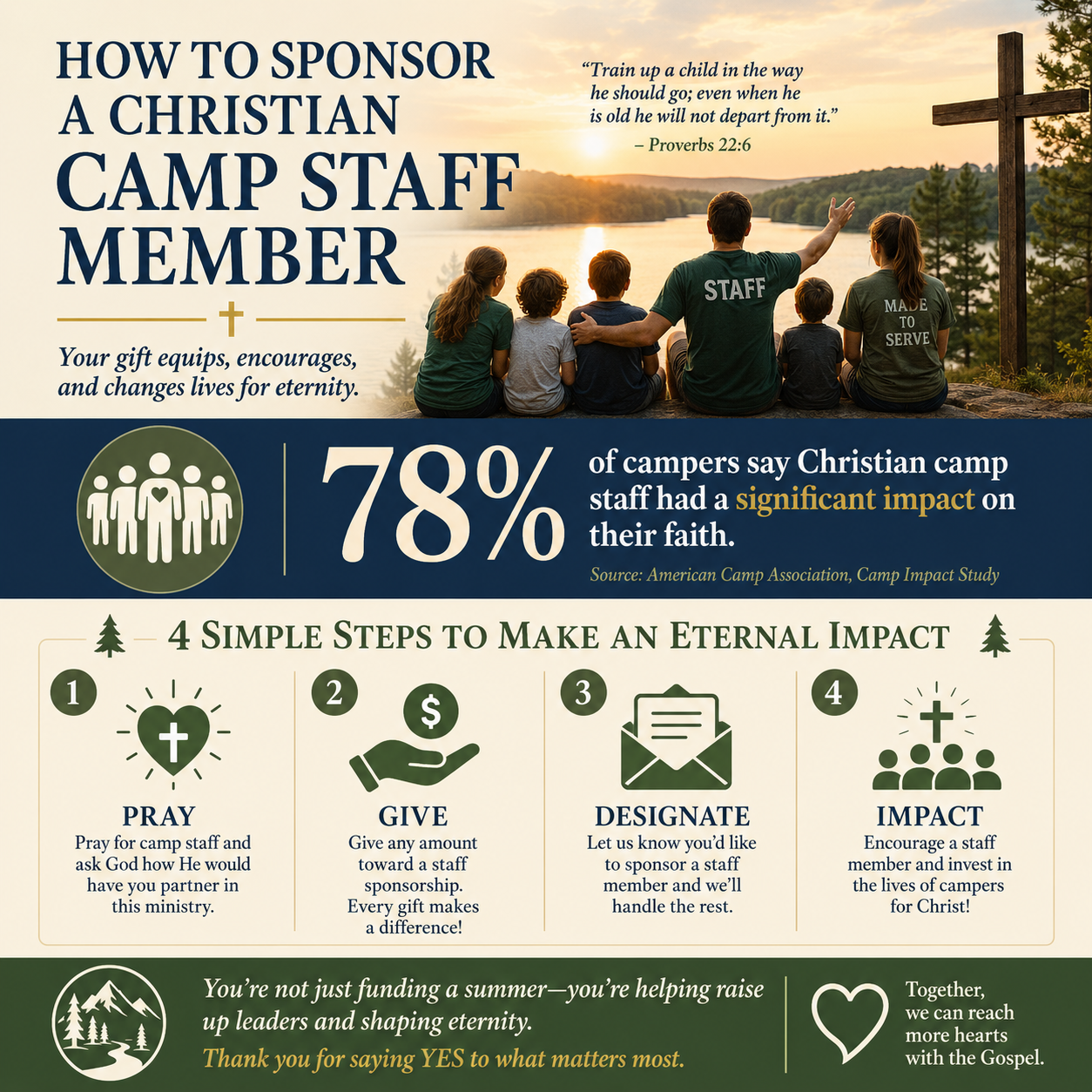
What this means in practice is asking a few direct questions before sponsoring a staff member at a significant level. The questions do not need to be accusatory; they should be ordinary:
- Is the camp a registered 501(c)(3) nonprofit, and can it provide an EIN and giving receipt?
- Does the camp have an independent board with real oversight, not merely advisory titles?
- Are financial statements reviewed internally and, when appropriate, externally?
- How are restricted or designated gifts tracked and reported?
- What is the camp’s child protection policy and staff screening process?
Child safety is not a secondary issue for camps; it is a core fiduciary obligation. The public record is sobering: the U.S. Department of Justice has reported that many sexual assaults against children are committed by someone the child knows (Office of Justice Programs, U.S. Department of Justice). A donor is reasonable to ask how a camp screens staff, trains counselors, and responds to allegations.
Use third-party verification when you cannot personally investigate
Some donors have the time and proximity to evaluate a camp carefully. Many do not. When the relationship is distant, donors typically default to trust signals: stories, photos, endorsements, or a charismatic director. Those are not worthless, but they are not a substitute for verifiable evidence.
Most Trusted exists precisely for this problem. We evaluate Christian nonprofits against The Most Trusted Standard, a 15-criteria framework across Faith Foundation, Financial Integrity, Governance and Leadership, and Transparency and Effectiveness. The point is not to burden ministries with bureaucracy; it is to give donors a way to give with confidence when personal familiarity is limited. For donors supporting seasonal staff, a verified organization can carry much of the accountability load that would otherwise fall on an individual staff member.
Structure sponsorship for spiritual health and organizational clarity
Distinguish between salary support, project costs, and personal needs
We recommend clarifying in writing what the gift is intended to do and what it is not intended to do. Not because donors should micromanage, but because clarity prevents embarrassment and temptation. A staff member who knows precisely what support covers is less likely to rely on informal assumptions.
Set a reporting cadence that is humane and meaningful
Camps can overburden staff with constant donor updates. Donors can also unintentionally train staff to produce “spiritual wins” as content. Neither posture is healthy. A better approach is to request a modest cadence: perhaps one mid-summer update and one end-of-season summary, ideally sent by the camp rather than the individual counselor.
When reporting is done well, it includes concrete measures without turning ministry into a spreadsheet. Examples include the number of campers served, staff-to-camper ratios, the camp’s biblical curriculum themes for the season, staff training hours completed, and any improvements to safety protocols. If a camp only reports in emotional narratives and never offers operational clarity, donors should take note.
Give in ways that strengthen the wider camp ecosystem
Sponsorship should not bypass accountability structures
Donors sometimes form deep affection for one counselor and begin supporting them in a way that functionally detaches them from the camp’s supervision. That can create divided loyalties. It can also expose the staff member to pressure to maintain a donor relationship even if they should take correction, rest, or a different ministry assignment.
Healthy camps have clear lines of authority, written policies, and pastoral care for staff. Sponsorship should reinforce those lines, not undermine them. For donors who want to understand the broader context of camp ministry, we encourage engagement with Christian Camps and Conferences as a field of Christian formation, risk management, and gospel proclamation.
Consider supporting staff development, not only staffing slots
Some of the most strategic giving in the camp world is not tied to a single counselor’s summer placement. It supports leadership development: training in trauma-informed care, counseling skills, theological formation, and child protection practices. It funds the infrastructure that reduces burnout and improves consistency year to year. This is less emotionally immediate than “sponsoring a counselor,” but it often stabilizes the ministry’s long-term fruit.
Christians genuinely disagree about the best balance between “frontline” and “capacity” giving. The field has also had to reckon with the “overhead” fixation that can inadvertently reward underinvestment in systems and people. The sector’s corrective is well stated in the Overhead Myth letter, signed by Charity Navigator, Candid, and the BBB Wise Giving Alliance, which argues that donors should focus on results and transparency rather than simplistic overhead ratios (Charity Navigator).
If your goal is to sustain those who serve campers week after week, we recommend learning the typical support models, accountability expectations, and risk points in Supporting Christian Camp Staff and Counselors. Mature sponsorship is less about a single gift and more about strengthening the conditions under which faithful staff can thrive.
FAQs for How to sponsor a Christian camp staff member
Should we sponsor a staff member directly or give through the camp?
We recommend giving through the camp or its designated ministry entity whenever possible. It protects the staff member from informal money-handling, provides appropriate receipts and documentation, and keeps accountability with the organization that bears responsibility for safety and supervision. Direct gifts to individuals can also create tax and reporting complications, especially if the donor assumes deductibility.
What should we ask a camp before sponsoring staff?
At minimum, ask how staff are screened and trained, how designated gifts are tracked, what governance oversight exists, and what reporting a donor can reasonably expect. A camp that welcomes these questions and answers them plainly is typically signaling institutional maturity. If answers are evasive, or if all accountability rests on a single charismatic leader, donors should slow down and seek verifiable information.
A faithful sponsorship is both generous and accountable
Sponsoring Christian camp staff is a serious act of stewardship because it funds spiritual authority exercised over children and young people. The goal is not suspicion; it is integrity. When giving is routed through accountable structures, paired with modest reporting expectations, and grounded in a theology of shared gospel labor, donors can strengthen staff without distorting the ministry. This is the kind of generosity that honors Christ, protects the vulnerable, and sustains long-term fruit.



