
How Christian camps hire seasonal staff is not a peripheral operational question. It is one of the clearest windows into a camp’s spiritual seriousness, its care for young leaders, and its willingness to submit ministry ambition to accountable practice. For donors, staffing is also where many preventable failures begin: rushed hiring, informal supervision, weak child-safety controls, and a theology of calling that unintentionally excuses poor management.
Summer camp ministry can be a profound good. It can also be unusually vulnerable to burnout, moral injury, and leadership shortcuts, because the calendar is immovable and the labor market is tight. A mature donor posture does not treat these as “back office” details; it asks whether the camp’s staffing model reflects the character of Christ and the obligations Scripture places on those who shepherd the young.
Seasonal hiring is a discipleship decision before it is a staffing decision
The camp is forming counselors even as counselors are forming campers
Christian camps commonly recruit seasonal staff with a dual purpose: to serve children and to develop young adults in leadership, faith, and maturity. That ambition is commendable, but it creates a moral responsibility. If a camp publicly frames seasonal work as discipleship, it must be willing to bear the costs of discipleship: careful selection, honest expectations, competent training, and meaningful supervision.
Scripture’s warnings about leadership are not abstract. James cautions that “not many of you should become teachers” because teachers will be judged with greater strictness (James 3:1). A camp counselor is not a pastor, but a counselor exercises real spiritual and relational authority over minors. Theologically, that authority requires more than charisma and a “good testimony.” It requires prudent governance.
Why donors should resist the romance of calling without controls
Many camps rightly speak of calling and service. The harder question is whether “calling” is used to justify avoidable instability: low pay without clarity, long hours without rest, and thin oversight because “we are family.” Christians genuinely disagree about the best staffing models for seasonal ministry, but there is broad agreement that the fruit of the Spirit should not be purchased through exhaustion or ambiguity.
Across our verification work at Most Trusted, we observe that ministries that meet The Most Trusted Standard tend to treat staffing as part of their ministry integrity, not merely a seasonal scramble. Their hiring practices are documented, repeatable, and transparent enough that a board can evaluate them, not just applaud the outcomes.

Where camps find seasonal staff and what each channel signals
Traditional pipelines and their strengths and risks
Christian camps typically recruit from a set of recurring pipelines: alumni, partner churches, Christian colleges, regional networks, and returning seasonal staff. Each channel has strengths. Alumni already understand camp culture. Churches can vouch for character and provide pastoral cover. Christian colleges often have students seeking ministry experience and willing to live communally for a summer.
Each channel also carries predictable blind spots. Alumni networks can become insular. Church referrals can confuse spiritual familiarity with professional suitability. Campus recruiting can create an overreliance on young staff without enough experienced supervisors to stabilize the team. A careful camp acknowledges these trade-offs rather than assuming that “Christian” pipelines guarantee maturity.
The modern pressure points of the seasonal labor market
Many camps report difficulty filling roles, particularly for waterfront, ropes, maintenance, kitchen, and health staff. The broader reality is that nonprofits compete in the same labor market as every other employer, with wage pressures and housing constraints. The U.S. Bureau of Labor Statistics continues to show high levels of job openings and churn in leisure and hospitality compared to many other sectors, which affects camps directly.U.S. Bureau of Labor Statistics
When labor is scarce, camps face a temptation to lower standards quietly or to compress screening to meet the calendar. Donors should not assume a camp is careless simply because it struggles to hire; the market is real. But scarcity does test whether a camp has built a resilient staffing model or one that depends on last-minute heroics.
What responsible seasonal hiring should include
Screening that is spiritual and professional
A camp can and should ask about faith, doctrine, and church involvement. It should also ask professional questions with equal seriousness: reliability, boundaries with minors, conflict response, and the ability to submit to authority. The camps that serve children well do not pit “heart” against “competence.” They recognize that competence is one expression of love of neighbor when one’s neighbor is a child entrusted to the camp.
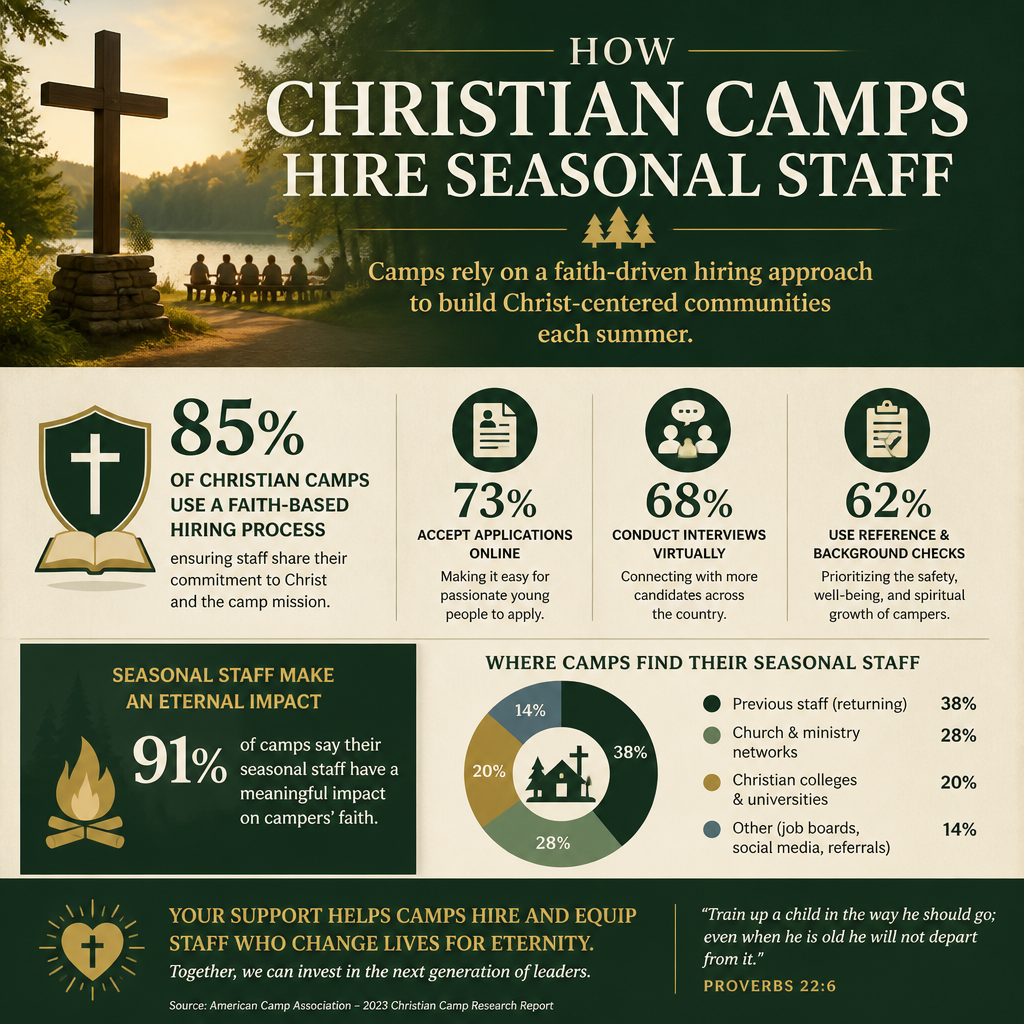
At a minimum, donors should expect a camp to have a documented hiring process that is consistent across applicants, including structured interviews and reference checks. Informal processes tend to privilege the well-connected and can unintentionally hide patterns of misconduct or instability.
Child safety requirements are not optional
Child safety is one area where donors can ask direct questions without apology. Camps should conduct background checks appropriate to their jurisdiction and roles, maintain clear boundaries policies, and train staff on reporting obligations. In the United States, mandated reporter laws and definitions differ by state, but the underlying principle is consistent: children must be protected, and allegations must be handled lawfully and promptly. Donors can begin with a camp’s stated policy and then ask whether staff are trained to follow it in real scenarios.
For donors wanting a high-level frame for what “appropriate” often includes, this short list is a useful starting point:
- Written child protection policy with clear conduct standards and reporting steps
- Role-appropriate background checks and identity verification
- Reference checks that include prior work with minors when applicable
- Training on boundaries, supervision ratios, and incident reporting
- Documented supervision structure with escalation pathways
These measures do not eliminate risk. They do demonstrate whether leadership is willing to be judged by something more than intentions. For donors exploring the broader ecosystem of camp ministry, our coverage of Christian Camps and Conferences situates staffing within governance, program design, and integrity practices that can be evaluated over time.
Training, supervision, and spiritual care determine whether hiring “worked”
Orientation is necessary but not sufficient
Most camps provide pre-summer orientation, often intensive and sincere. The question is whether training is treated as an event or as a system. Seasonal staff need ongoing coaching, not simply a binder and a pep talk. They also need clear role definitions: what authority they have, what they must never do, and what to do when they are overwhelmed or unsure.
The field has had to reckon with the fact that charismatic ministry environments can unintentionally reward performative spirituality. A wise camp trains staff to distinguish emotional intensity from pastoral wisdom, and it equips leaders to respond to mental health concerns, self-harm disclosures, and abuse allegations with seriousness and humility. Not every counselor can be a clinician; every counselor can be trained to escalate appropriately.
Supervision ratios and mid-summer accountability
Seasonal ministry often strains supervision. Leaders are young, hours are long, and the pace is relentless. What this means in practice is that the camp’s supervisory structure matters at least as much as its recruiting. Camps that rely on a few overextended directors to monitor dozens of staff are vulnerable, even if the directors are spiritually mature.
Donors can ask whether the camp has routine check-ins, documented incident reporting, and real consequences for boundary violations. A healthy camp will also have a defined plan for staff discipline and dismissal that is both compassionate and firm. The goal is neither punitive culture nor naïve permissiveness, but a community where sin is named, harm is prevented, and repentance is not used to avoid accountability.
What donors can verify before funding staffing-heavy camp models
Questions that reveal whether the camp is governed or merely driven
Some donors hesitate to ask operational questions because they fear sounding distrustful. Yet Scripture commends discernment. “Let the wise hear and increase in learning” (Proverbs 1:5). When a ministry asks the church to fund it, the church has the right to understand how that ministry safeguards the vulnerable and stewards resources.
Concrete, respectful questions often clarify more than general assurances:
- Who approves hiring policies and who reviews exceptions when the camp is short-staffed?
- What child protection training is required before staff are ever alone with campers?
- How does the camp supervise first-year counselors, and how are concerns documented?
- What is the process for reporting suspected abuse, and who is trained to handle it?
- How does the camp measure staff retention and reasons for mid-summer departures?
These are governance questions, not mere preferences. They also connect directly to donor risk: camps with weak controls can face preventable harm, reputational crisis, and legal costs that damage both families and long-term ministry.
How Most Trusted approaches verification in staffing-adjacent areas
Most Trusted exists because donors deserve more than narrative confidence. We evaluate ministries against The Most Trusted Standard, a 15-criteria framework spanning faith foundation, financial integrity, governance and leadership, and transparency and effectiveness. Seasonal hiring touches all of these. Hiring policies reflect leadership competence. Training and supervision reflect program integrity. Disclosure practices reflect transparency. Budgeting for staff care reflects financial stewardship.
When donors want to support the people who carry camp ministry on their backs, our work on Supporting Christian Camp Staff and Counselors addresses the practical realities that either sustain faithful workers or grind them down in the name of results.
FAQs for How Christian camps hire seasonal staff
Do Christian camps usually prioritize spiritual maturity over experience when hiring counselors?
Many camps emphasize spiritual maturity because counseling is relational and spiritually influential work. Responsible camps, however, refuse the false choice between maturity and competence. They screen for character and doctrinal alignment while also assessing reliability, boundaries with minors, and the ability to learn and submit to supervision. Donors should be cautious when “calling” is used to excuse a lack of training or controls.
What should donors ask about background checks and child safety training?
Donors can ask whether background checks are conducted for every staff member with access to minors, whether reference checks are required, and whether staff receive training on boundaries and reporting before campers arrive. It is also reasonable to ask who receives reports, how incidents are documented, and whether the camp has an established relationship with local authorities for mandated reporting when required by law.
A staffing model can be a witness or a liability
Christian camps can be places of genuine gospel fruit, and seasonal staff are often the human instruments through which that fruit appears. Yet a camp’s hiring and supervision practices also reveal whether it treats the vulnerable with the seriousness Scripture demands. Donors serve camps well when they fund not only programs, but also the less visible structures that protect children, form young leaders, and honor Christ through accountable, transparent stewardship.



