

How Christian camp counselors are trained and screened is not a procedural footnote; it is a moral question about who is entrusted with children bearing God’s image. Donors understand that camps can become places of lasting spiritual fruit, but they also know the modern child-safety landscape: one weak process, one unreported incident, one leader who confuses charisma with maturity, and the ministry’s witness is damaged along with a child’s wellbeing.
Scripture never treats authority over the vulnerable as casual. Jesus’ warning about causing “one of these little ones” to stumble (Matthew 18:6) is not merely about doctrine; it names the gravity of influence and harm. For donors, the question is not whether a camp claims Christian identity. The question is whether its selection, training, and oversight of counselors is disciplined enough to deserve trust.
Screening begins with theology and governance, not a background check
Strong counselor screening is an expression of Christian discipleship under accountable leadership. Camps that are serious about holiness and safety tend to place child protection inside governance rather than delegating it to a summer operations checklist. That governance posture matters because it determines whether standards are enforced when doing so is costly: turning away an energetic applicant, removing a popular counselor, or delaying program expansion until supervisory capacity exists.
Across our verification work at Most Trusted, ministries that meet The Most Trusted Standard consistently treat safeguarding as a core leadership responsibility, not a “risk team” function. This includes documented policies, board-level visibility, and evidence that leadership follows its own processes when pressure mounts.
What donors should expect a camp to require before arrival
At minimum, Christian camps should be able to show a coherent pre-season screening process that includes identity, history, and references. A criminal background check is necessary, but it is not sufficient; it is a lagging indicator that only captures reported and recorded offenses.
- Multiple references, including at least one supervisory reference, with documented follow-up
- Clear eligibility criteria that disqualify applicants for boundary violations, not only for convictions
- Written affirmation of faith and conduct expectations, including sexual conduct and substance use
- Structured interview questions that probe judgment, boundaries, and response to authority
- Signed policies on child protection, reporting duties, technology use, and overnight supervision
Background checks are valuable and limited
Many donors assume background checks function like a comprehensive clearance system. They do not. Even in the best circumstances, they can miss offenses committed in other jurisdictions, offenses not prosecuted, and harmful behaviors that never reached the justice system. The U.S. Department of Justice’s National Sex Offender Public Website is one useful tool, but it is only as complete as the data provided by jurisdictions and only reflects convicted registrants U.S. Department of Justice NSOPW.
What this means in practice is that donors should ask camps how background checks fit within a wider “defense in depth” approach: references, supervision ratios, restricted one-on-one settings, training, and mandatory reporting protocols that assume risk is real rather than theoretical.

Training must form judgment, not only transmit rules
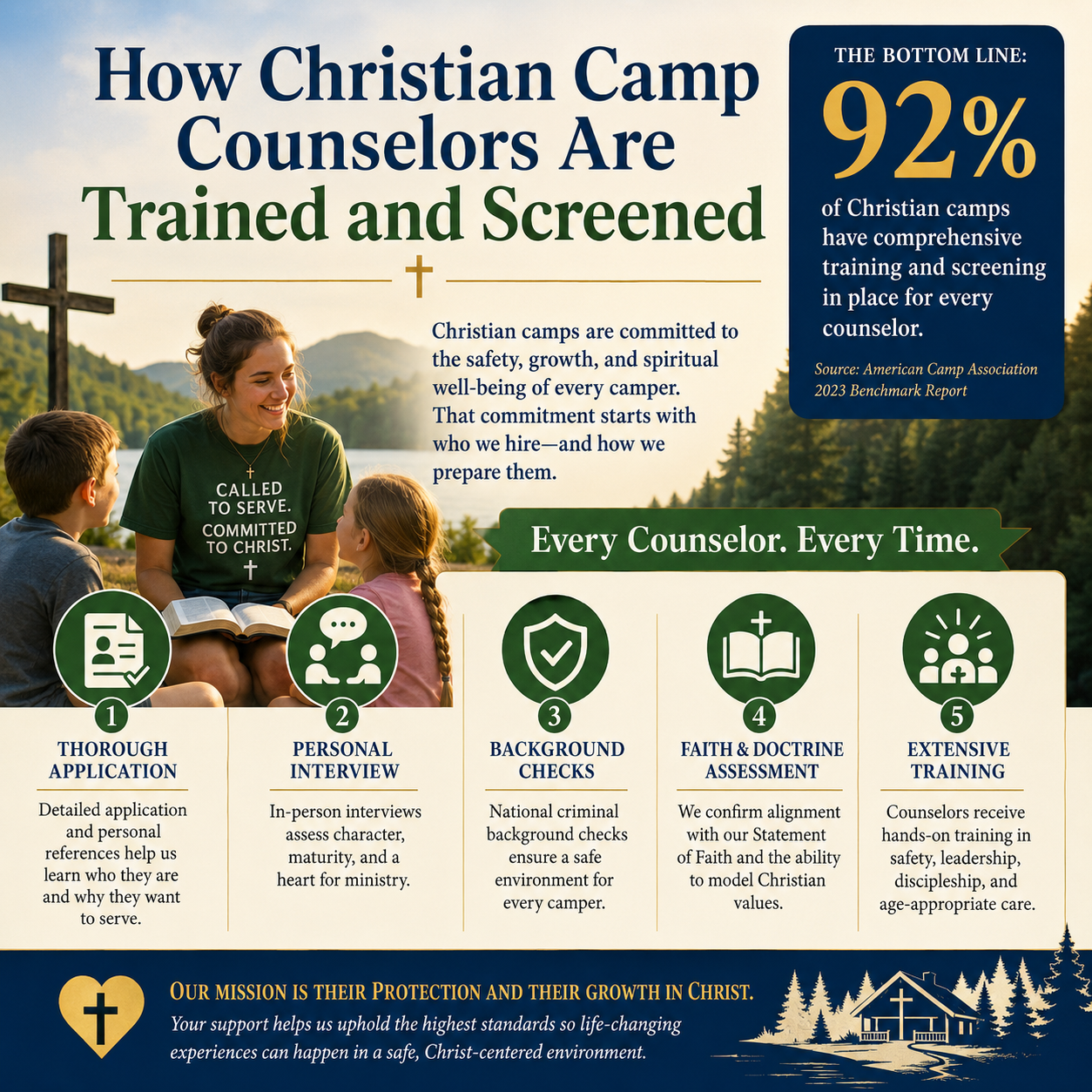
Christian camp counselor training succeeds when it aims at more than compliance. Camps often rely on young adults, some with limited ministry experience and limited exposure to trauma, mental health crises, or predatory behavior patterns. The training question is whether a camp equips counselors to exercise wise, restrained authority under pressure, including pressure created by campers’ emotional needs and families’ expectations.
The ministries that sustain trust over time treat training as formation: counselors learn to recognize the difference between spiritual influence and emotional dependency, between warmth and familiarity, between a private “pastoral moment” and a situation that requires supervision and documentation.
Core content strong camps cover before campers arrive
Pre-season orientation should include doctrine and culture, but donors should also expect training that reflects the realities of child safety and adolescent development. Many camps now incorporate scenario-based practice because policies understood in the abstract are often forgotten in the decisive moment.
Training topics that typically indicate seriousness include:
- Appropriate physical contact guidelines, with examples and prohibited behaviors
- Boundary training for digital communication and social media
- Recognizing grooming behaviors and responding without confrontation-driven escalation
- Managing disclosures of abuse, self-harm ideation, or suicidal statements
- Documentation practices and when to elevate concerns to supervisors
Mandatory reporting is not optional for Christian ethics
Every state has its own statutory framework, but the moral principle is clear: when a child may be harmed, adult leaders must act with urgency and clarity. Donors should ask whether a camp trains counselors to report immediately to designated leadership and, when required, to civil authorities. The Child Welfare Information Gateway provides a widely used summary of state mandatory reporting laws and definitions Child Welfare Information Gateway.
The tension is that camps often want to “handle things pastorally.” Pastoral care is not a substitute for reporting. It is what Christians provide in addition to reporting, and never in competition with it.
Supervision and program design are where screening proves itself
Counselor screening and training can be sincere and still fail if the camp’s daily rhythms create predictable isolation and unchecked authority. Safeguarding is operational. A camp can affirm every right policy and still place a nineteen-year-old counselor alone with a distressed camper in a cabin, late at night, without a second adult nearby, without a clear escalation path, and without oversight that is visible and consistent.
Donors should view a camp’s supervision design as a tangible measure of whether leadership understands human weakness. Scripture is realistic about sin and temptation; wise ministry structures reflect that realism.
What better-designed programs tend to institutionalize
Well-run camps commonly build guardrails into schedules, staffing patterns, and spaces. The details vary by program model, but certain practices recur across organizations that have had to reckon honestly with risk.
- Two-adult visibility expectations, especially in cabins and during counseling conversations
- Restricted counselor access to private camper contact information
- Clear rules for overnight supervision, bathroom and shower protocols, and changing areas
- Formal incident reporting channels that do not depend on a single leader’s discretion
- Regular, documented check-ins between unit leaders and counselors during the week
Why “culture” is not enough
Many Christian camps emphasize family culture, which is often a genuine strength. The limitation is that culture is difficult to audit and easy to romanticize. Donors should look for evidence that a camp’s culture is backed by enforceable policies, measured supervision, and a reporting environment where young staff can surface concerns without fear of retaliation or spiritual shaming.
For donors who want to understand the broader ecosystem of risk and responsibility in this space, our coverage of Christian Camps and Conferences examines the patterns that tend to distinguish durable ministries from those that rely on goodwill alone.
Vetting spiritual maturity without confusing it with charisma
Christian camps often recruit counselors from churches, Bible colleges, and campus ministries. This can be a strength, but it introduces a temptation donors recognize: assuming that Christian vocabulary signals maturity. It does not. A counselor’s theological alignment matters, yet maturity is better assessed through patterns of humility, teachability, and consistency under authority.
The most careful camps separate three questions that are often blended together: Is this applicant orthodox in confession? Is this applicant safe in conduct? Is this applicant competent for the role assigned? Each requires distinct evidence.
References that test character, not only enthusiasm
Donors should ask how references are used. The weakest approach collects names and checks the box. The stronger approach asks references to speak to boundary history, emotional stability, response to correction, and patterns in relationships with minors or younger peers. It also asks whether the applicant has ever been removed from a role, counseled for misconduct, or instructed to avoid certain responsibilities.
Christians genuinely disagree about how much weight to place on formal credentials versus local church affirmation. What is difficult to dispute is the value of documented, probing references and the willingness to delay hiring when references are incomplete or vague.
Discipleship and discipline must be real categories
A mature camp does not assume counselors will be finished products. It builds in spiritual care and accountability: clear expectations, avenues for confession and help, and real discipline when conduct breaches occur. Donors should listen for whether leadership can describe not only how it trains counselors, but also how it corrects them.
For donors focused specifically on staff systems and accountability, Supporting Christian Camp Staff and Counselors addresses how camps structure recruitment, supervision, and retention in ways that honor both ministry effectiveness and child protection.
What donors can ask and what verified evidence should exist
Donors are often offered stories: conversions at the campfire, reconciled families, long-term calling into ministry. Those stories can be true, and donors should rightly rejoice. But giving with confidence requires asking for verifiable evidence that a camp’s training and screening are consistent, documented, and overseen by accountable leadership.
At Most Trusted, we encourage donors to ask camps to show the artifacts of their claims. Ministries do not need to disclose sensitive personnel details, but they should be able to show policies, training outlines, reporting procedures, and governance oversight without defensiveness.
Practical donor questions that test readiness
The following questions tend to produce clarity quickly:
- Who owns child protection policies, and how often are they reviewed by leadership and the board?
- What training is required before counselors begin, and how is comprehension verified?
- How does the camp prevent isolated one-on-one settings between counselors and campers?
- What is the process when a camper discloses abuse or self-harm risk?
- How are concerns documented, and what is the escalation path when a leader is involved?
Evidence that tends to correlate with sustained trust
Donors should not expect perfection; they should expect accountability. The camps most likely to earn long-term confidence typically show consistency across documents, training, supervision, and incident response. They can name external standards they use, professional counsel they consult when needed, and how they learned from past near-misses without hiding them behind vague language.
This is where an independent verification lens can be helpful. The Most Trusted Standard evaluates ministries across faith commitments, financial integrity, leadership and oversight, and transparency and effectiveness. For camps, that framework often surfaces whether safeguarding is integrated into the ministry’s operating reality or kept at the edges.
FAQs for How Christian camp counselors are trained and screened
Should donors require a camp to run background checks on every counselor?
We should expect background checks for counselors and any staff with camper access, but we should also recognize their limits. A check can confirm whether certain offenses appear in accessible records; it cannot guarantee safety. The more decisive question is whether the camp pairs checks with disciplined references, boundary training, supervision design, and clear reporting procedures.
What is a reasonable sign that training is more than a one-time orientation?
Training that is taken seriously is repeated, tested, and reinforced during the season. Camps often do this through scenario drills, mid-summer refreshers, documented supervisor check-ins, and clear incident reporting expectations. Donors can ask to see training outlines and the camp’s process for verifying completion and comprehension.
Trust is built where formation and safeguards meet
Christian camps are positioned to shape young hearts and callings, and donors have good reason to value that work. The question is whether the ministry’s counselor training and screening honor the weight of the trust parents extend and the seriousness Scripture attaches to the care of children. When camps unite spiritual formation with disciplined safeguards, donors are not merely funding programming; they are supporting a ministry that treats stewardship, authority, and child protection as inseparable.



