
When Christian camps need scholarship funding most is not primarily a question of seasonal cash flow. It is a question of whether the church will open the life of discipleship to families who cannot pay, at the very moments when camp ministry is most spiritually and financially exposed. Scholarship funding at the wrong time can become a ceremonial gesture; at the right time, it becomes a credible act of Christian mercy and a disciplined form of stewardship.
Camp is often where a teenager hears the gospel with clarity, encounters Christian community without cynicism, or discovers a calling to serve. Yet the camp business model is fragile: it depends on enrollment, staff availability, and donor confidence, all under a calendar that cannot simply be extended by another month. Donors who want their giving to carry weight will ask not only, “How many scholarships were granted?” but also, “When did scholarship dollars prevent a family from being turned away?”
Scholarship demand spikes when families face predictable financial pressure
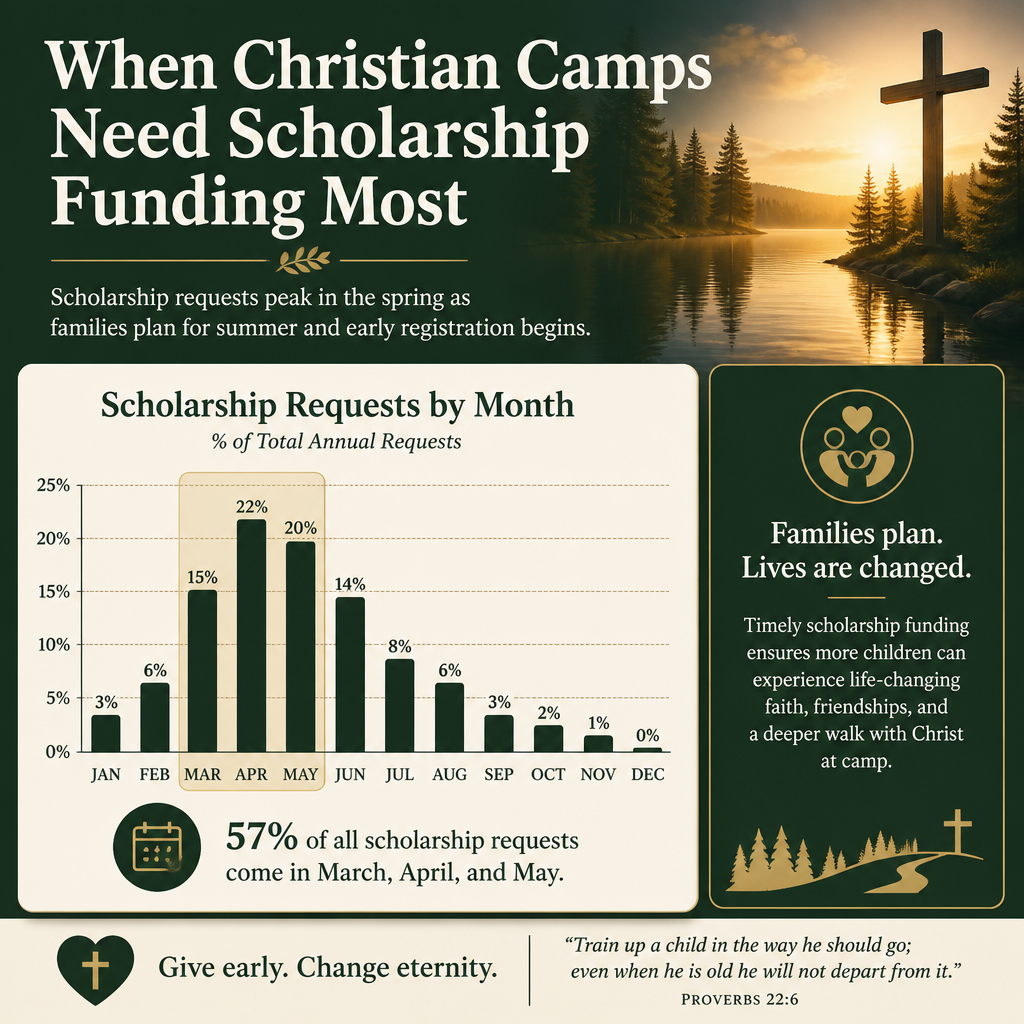
Late winter and early spring are the decision window
For many camps, scholarship need becomes visible well before summer. Families decide whether to register while they are still carrying post-holiday expenses, winter utility bills, and early-year insurance deductibles. Camps often set early registration deadlines to stabilize planning, which means scholarship requests concentrate when household budgets are tight and uncertainty is high.
Some Christian households have stable income but low liquidity; others face chronic instability. The difference matters for scholarship design. A donor-funded “last-minute rescue” fund may miss families who quietly opt out in February because they assume camp is not for them. A scholarship strategy that is present early communicates welcome and lowers the psychological cost of asking for help.
Inflation makes sticker shock more common
Price sensitivity is not a moral failure; it is a feature of life for many faithful families. When food and essentials rise, discretionary spending collapses first, and camp is often categorized as discretionary even when it functions as spiritual formation. The U.S. Bureau of Labor Statistics reports that food prices rose meaningfully in recent years, shaping the margin where camp fees are decided.U.S. Bureau of Labor Statistics
What this means in practice is that scholarship funding is needed most when families are making yes-or-no choices, not only when they have already decided and simply lack the final payment.

Scholarships become urgent when camp revenue risk concentrates
The months just before the first session carry outsized financial weight
Camps carry fixed costs that do not scale down easily: property maintenance, insurance, food service commitments, program materials, and staff recruiting. Scholarship dollars are needed most when the camp is close enough to summer that expenses are already committed, yet early enough that enrollment can still be shaped. A camper who cannot attend in May is often a bed left empty in July.
Donors sometimes assume that scholarship gifts are interchangeable with general operating support. In well-governed organizations, scholarship accounts are managed with real restrictions and real reporting. But the underlying economic reality is still present: camps cannot make disciples if they cannot open the gate, and they cannot open the gate if they cannot meet payroll and feed campers.
Weather, travel, and public confidence create short-notice gaps
There are years when enrollment is disrupted by factors no camp controls: severe weather, wildfires, regional travel disruption, or sudden reputational crises in the broader camp sector. In those moments, scholarship funding can serve as a stabilizing tool if it is paired with transparent communication and sound governance. It can also be misused as a marketing patch if leaders are tempted to mask deeper problems.
Christians genuinely disagree about how much donor money should be used to hold prices down versus funding pastoral staff, facility renewal, or counselor training. The harder question is not whether scholarships matter, but how scholarship strategy is integrated with the camp’s full discipleship model and risk management.
Scholarships matter most when they remove barriers to Christian formation
Camp is not entertainment when it is ordered toward discipleship
The church has long recognized that spiritual formation is not only cognitive; it is communal and embodied. Camps can provide a concentrated environment of worship, Scripture, friendships, and service where a young person practices faith rather than merely hearing about it. When scholarship funding is scarce, camp becomes accessible mainly to families already resourced with Christian community-building experiences.
Scripture does not treat access to the life of God as a luxury good. The pattern of God’s kingdom is welcome to the poor and the outsider, and a warning to any community that implicitly tells the needy they do not belong. James condemns favoritism as a contradiction of faith in Christ.BibleGateway, James 2
Scholarship timing should prioritize first-time campers and critical transitions
Across our verification work at Most Trusted, we observe that camps with the clearest discipleship outcomes often focus scholarships on moments of high formative leverage: first-time attendance, middle-school transitions, and high-school leadership programs. These are stages where belonging and identity are being negotiated, and where a church family can either extend a hand or unintentionally close a door.
That does not mean returning campers should be deprioritized. It means donors should ask whether a scholarship program is strategically ordered toward spiritual formation rather than simply distributed on a first-come basis.
Scholarship funding is most needed when staff capacity is strong enough to steward it
A scholarship is only as effective as the experience it funds
Donors often focus on the number of scholarships. Mature stewardship asks a second question: whether the camp can deliver a safe, pastorally serious program at the scale scholarship funding makes possible. If a camp cannot recruit qualified counselors, cannot supervise appropriately, or cannot maintain basic child protection standards, then expanding access may increase harm.
This is one reason verification matters. Most Trusted evaluates ministries against The Most Trusted Standard, a 15-criteria framework that examines faith commitments, financial integrity, governance and leadership, and transparency and effectiveness. The point is not bureaucracy. The point is that donors should not have to choose between compassion and prudence.
What donors should ask before funding scholarships at scale
Well-run camps can answer practical questions without defensiveness. Scholarship funding is needed most when leaders are ready to steward it and can demonstrate that readiness. Before major scholarship gifts, we recommend asking for clarity in areas such as:
- Written scholarship criteria and whether awards are needs-based, discipleship-prioritized, or both
- Child safety policies, background checks, and incident response protocols
- How scholarship recipients are integrated without stigma in cabin life and activities
- Whether scholarships are paired with pastoral follow-up through local churches
- Financial reporting that distinguishes restricted scholarship funds from general operations
These questions are not a lack of trust; they are stewardship. They also protect camps from donor expectations that quietly distort ministry priorities.
Scholarships are most faithful when they avoid dependency and preserve dignity
Scholarships should strengthen families and churches, not replace them
The When Helping Hurts framework, articulated by Steve Corbett and Brian Fikkert, has helped many Christian ministries examine how assistance can unintentionally erode agency and dignity when it is not paired with wise relational context.When Helping Hurts Scholarship programs can fall into similar patterns if they are designed as one-way charity rather than as an invitation into community.
The strongest scholarship models often include sliding scales, shared responsibility where feasible, and partnership with churches that can vouch for need and provide follow-up. In these models, the scholarship does not merely reduce a price; it signals that the body of Christ is making room at the table.
Transparency protects both campers and donors
Christian donors have become rightly alert to the ways restricted funds can be misrepresented. A scholarship appeal that functions as general fundraising without clarity is not only a governance problem; it is a spiritual integrity problem. Camps that honor donors will state what scholarship dollars cover, what they do not cover, and how outcomes are measured beyond attendance.
Those who want a broader view of how camp ministry functions across regions and models can explore Christian Camps and Conferences, where the landscape is treated with the seriousness it deserves. Donors who want to understand mechanics and safeguards in scholarship programs can also review How Christian Camp Scholarships Work as a reference point for sound practice.
FAQs for When Christian camps need scholarship funding most
Is it better to fund scholarships early in the year or right before camp starts?
Early funding is usually more decisive because it influences whether families register at all, and it helps camps plan staffing and programming with fewer last-minute shocks. Late funding can still matter when a family encounters an emergency or when a payment deadline is imminent, but donors should recognize that many families quietly self-exclude months earlier if they assume help will not be available.
Should donors restrict gifts to scholarships or give unrestricted support instead?
Both can be faithful, depending on the camp’s governance and financial clarity. Restricted scholarship funding can protect access for low-income families, but it requires strong accounting and reporting. Unrestricted support can strengthen staffing, safety, and program quality, which also serves scholarship recipients. The key is to give in a way that matches the camp’s demonstrated capacity and transparency, and to ask for reporting that shows how the gift advanced discipleship rather than merely reducing a price.
Scholarship funding that arrives at the decisive moment
When Christian camps need scholarship funding most is when the decision to attend is still open, when camp finances are already committed, and when the ministry can honestly steward both the funds and the children entrusted to its care. Donors serve the church best when scholarship giving is timely, governed, and ordered toward the spiritual good of campers rather than the maintenance of a budget line.
Generosity is not only a transfer of money; it is a moral act that reveals what we believe about belonging in the household of God. Scholarship funding, given wisely, becomes a concrete form of that belief.



