

What does a Christian camp scholarship usually cover? In most programs, a scholarship reduces the direct cost of camp so a child or teenager can participate without the family bearing the full burden of tuition and related fees.
For Christian donors, the question is not merely logistical. It is a stewardship question. A camp scholarship sits at the intersection of formation, family economics, and a ministry’s integrity. The same gift can be an instrument of discipleship or a source of avoidable confusion if the scholarship is poorly designed, poorly communicated, or treated as a marketing device rather than an act of mercy shaped by truth.
What a camp scholarship typically pays for
Base tuition and program costs
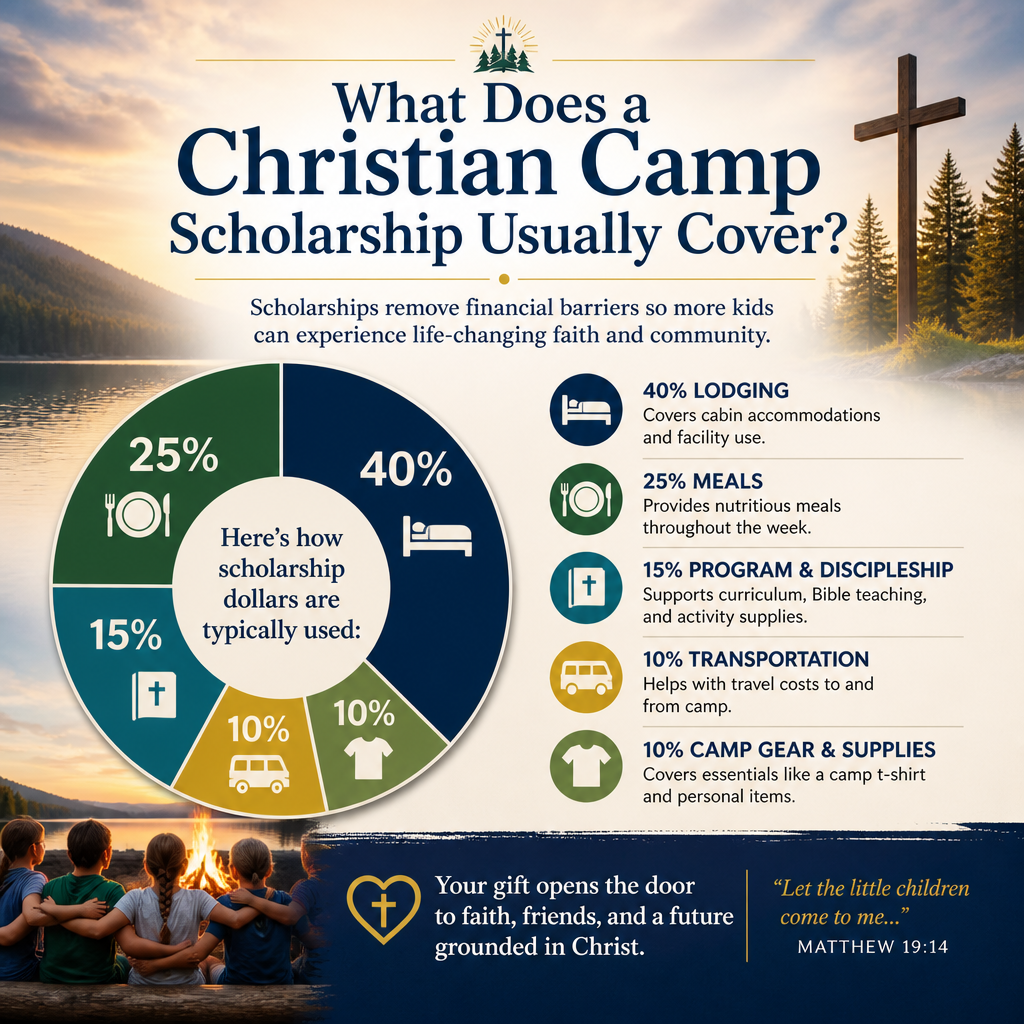
Most Christian camp scholarships primarily offset camp tuition. Tuition generally includes lodging, meals, curriculum, worship gatherings, counseling staff, and core activities. In practice, this is the central obstacle for many families: one invoice that arrives all at once and exceeds what a household can absorb without sacrificing necessities.
Across our verification work at Most Trusted, the healthier programs define “tuition” precisely and publish what is included and what is not. Clarity is not cosmetic; it is part of truthful dealing. When donors cannot tell what their gift actually purchases, trust erodes and families feel exposed to surprise charges.
Program fees that are functionally required
Many camps add required fees on top of tuition: a program fee for certain age groups, a high-adventure fee, or a transportation surcharge for a mandatory shuttle. Scholarships often cover these when they are effectively non-optional. The principle is straightforward: if the camp treats an item as necessary for participation, a scholarship that ignores it can functionally exclude the very families it claims to serve.
Some camps also cover registration deposits as part of scholarship funding. This matters because deposits are frequently the first barrier. A family may intend to pay the remainder over time, but they cannot secure a spot without an upfront payment.

What may be included but varies widely by camp
Transportation and travel assistance
Transportation is one of the most uneven elements. Some scholarship funds pay for bus routes, airport pickups, or gas cards. Others exclude travel entirely, arguing that scholarship dollars should prioritize the core camp experience. Both approaches can be defensible, but each reflects a theology of access. A camp that serves rural communities may need to treat transportation as a justice issue, not a convenience.
When travel is included, careful controls matter. The goal is not bureaucracy for its own sake. The goal is to prevent misuse while treating families with dignity. Programs that meet The Most Trusted Standard tend to document how travel assistance is calculated and approved, then report totals in aggregate so donors understand the scope without exposing recipients.
Gear, uniforms, and required equipment
Some camps require specific gear: closed-toe shoes for safety, a sleeping bag, a swimsuit, a Bible, or a camp t-shirt used for group identification. Scholarships sometimes include a small allowance for these items, or camps maintain a gear closet with donated supplies.
Here the tension is real. Donors rightly resist funding “extras,” yet a family without basic equipment can experience shame and exclusion, and safety requirements are not negotiable. A well-run program distinguishes between necessary gear (safety, participation) and optional upgrades (brand-name items, premium add-ons) and structures assistance accordingly.
What scholarships often do not cover and why
Spending money, optional activities, and add-ons
Many scholarships exclude discretionary spending: snack shack money, souvenirs, photos, or optional excursions. Camps often avoid subsidizing these to keep scholarship funds focused on access rather than comfort. This can be wise stewardship, but it should be communicated plainly to families so they can prepare their child without embarrassment.
When optional activities carry social weight—where “optional” becomes “expected”—a camp’s leadership has a pastoral responsibility to notice. A scholarship program can be technically generous and still fail children socially if it creates two tiers of experience. Christian ministry should not ignore that dynamic simply because it is difficult to quantify.
Medical costs and special services
Scholarships typically do not cover medical bills or specialized support services unless the camp explicitly includes them. Camps may require families to carry insurance, and most will clarify that the family remains responsible for medical expenses arising during camp.
Special needs supports are also inconsistent. Some camps have the staffing and training to serve children with disabilities well; others do not. When camps claim to offer inclusive programming, donors should expect proof: staff ratios, training standards, and clear accommodation policies. Good intentions are not a substitute for competence, particularly where a child’s safety is involved.
How scholarships are funded and why that matters to donors
The three common funding models
Christian camps generally fund scholarships in one of three ways: designated donor gifts, general operating revenue set aside for scholarships, or a hybrid model. Each carries different implications for transparency and sustainability.
- Designated scholarship funds can build donor confidence, but they require disciplined accounting and clear definitions of eligible expenses.
- Operating-funded scholarships can reduce restricted-fund complexity, but donors may struggle to see the direct line between gift and student impact.
- Hybrid models can be the most stable, but only if leadership is candid about what portion is donor-subsidized versus cross-subsidized from tuition.
This is where donor discernment becomes more than an instinct. A camp can genuinely want to help families and still run its scholarship program in ways that conceal true costs or create unaccountable discretion. The Christian tradition has long treated financial honesty as a moral obligation, not a mere administrative preference (cf. 2 Corinthians 8:21).
Assessing integrity without punishing necessary overhead
Scholarship programs require administration: application review, income verification or pastoral references, follow-up with families, and data tracking. Some donors equate administration with waste. The field has learned to correct that reflex. Charity Navigator, Candid, and the BBB Wise Giving Alliance jointly warned donors against using overhead ratios as a proxy for effectiveness, emphasizing that overhead can be necessary for results and accountability Charity Navigator.
What this means in practice is that donors should ask better questions than “How low is your overhead?” A more faithful line of inquiry is: “Do you have adequate controls so scholarship dollars reach the intended purpose, and do you measure outcomes that matter for discipleship and family support?” These questions align with seriousness about stewardship without collapsing into simplistic metrics.
What donors should look for in a trustworthy scholarship program
Transparent policies that protect dignity
A Christian camp scholarship application often requires families to disclose sensitive information. That reality demands restraint. The best programs collect only what is necessary to make a fair decision, store it securely, and communicate decisions without shaming recipients. Donors can ask whether the camp has written privacy practices and whether staff are trained to handle hardship disclosures with pastoral care.
Some camps rely on pastoral or school references rather than strict income thresholds. Christians genuinely disagree about which method is more just. Income verification can feel dehumanizing, while reference-based models can unintentionally privilege families with stronger church access. A mature program names its approach and its trade-offs, then works to mitigate predictable weaknesses.
Evidence of formation, not just attendance
Scholarships are typically justified by access, but the Christian rationale is deeper: the hope that a young person encounters Christ, grows in faith, and is strengthened for life in the church. Donors should expect camps to describe how they pursue spiritual formation with integrity: counselor training, doctrinal clarity, safeguarding standards, and post-camp follow-up with families and churches.
Many Christian camps talk about “life change” but track little beyond participation counts. Counting campers is not wrong, but it is incomplete. Where camps do measure outcomes, they should do so carefully, without manufacturing conversions or pressuring children into performative spirituality. For donors who want to engage the broader ecosystem of summer ministry, we maintain ongoing editorial coverage of Christian Camps and Conferences as part of our commitment to verifiable clarity.
Verification and accountability beyond self-report
Camps are often close-knit communities, and that closeness can blur accountability. Donors should welcome ministries that invite outside review—financial statements, governance practices, child safety policies, and truthful reporting about results. At Most Trusted, our evaluations against The Most Trusted Standard attend to the kinds of controls that protect both donors and recipients: financial integrity, governance competence, theological clarity, and transparent communication.
For donors focusing specifically on scholarship mechanisms—restricted funds, application processes, and reporting—our analysis of How Christian Camp Scholarships Work addresses the most common points where good intentions either mature into faithful practice or drift into avoidable harm.
FAQs for What does a Christian camp scholarship usually cover
Do Christian camp scholarships usually cover the full cost of camp?
Some do, but many are partial scholarships that reduce tuition rather than eliminate it. Partial awards can allow a limited scholarship fund to serve more campers, but they can also leave the lowest-income families unable to bridge the remaining balance. A trustworthy camp will explain whether awards are need-based, first-come-first-served, or constrained by available funding, and it will be candid about what families are still expected to pay.
Can donors restrict a gift to scholarships and expect it to be used only for that purpose?
Often yes, but the details matter. A camp should define “scholarship” expenses in writing, maintain accounting practices that track restricted gifts appropriately, and report scholarship revenue and expenditures in a way donors can verify. Donors should also recognize that restriction is a moral request, not a magic wand; it depends on the ministry’s internal controls and governance. That is why independent verification is valuable when donors need confidence beyond a ministry’s own assurances.
Scholarships as a form of serious stewardship
Christian camp scholarships usually cover tuition and required participation costs, sometimes extending to travel and essential gear, and often excluding discretionary add-ons. The deeper question for donors is whether the scholarship is administered with truthfulness, dignity, and accountable care—so that access to formation is expanded without creating new forms of confusion or harm. When scholarship programs are clear in what they cover, disciplined in how they decide, and honest in how they report, they reflect the kind of stewardship Scripture commends and donors are right to demand.



