
What capital projects Christian camps need to fund is not primarily a question of amenities. It is a question of stewardship: how a ministry cares for people made in God’s image, protects the integrity of its witness, and sustains a setting where the Word can be heard without preventable distraction or harm.
Capital campaigns can also expose fault lines. Donors often carry understandable caution after seeing projects that grew beyond scope, blurred into vanity construction, or left a camp with debt service that quietly reshaped its programming. The Christian camp movement has also changed materially: expectations around child protection, accessibility, and year-round retreat use have risen, while labor constraints and construction costs have tightened. The wise donor approach is neither reflexive enthusiasm nor reflexive skepticism, but discernment grounded in verifiable plans.
1. Safety and duty of care come before expansion
Child protection standards require physical investments
Camps often disciple children and teenagers in concentrated settings with high relational access. That is a gift, and it carries a duty of care. Donors do not need to be reminded that abuse scandals have damaged trust across American institutions; what is frequently missed is how often prevention and response depend on the built environment. A ministry can have sound policies and still be undermined by facilities that create unobservable spaces, unclear traffic patterns, or inadequate supervision sightlines.
Practical capital priorities here are not glamorous: improving lighting and exterior visibility; redesigning check-in and drop-off to reduce confusion; installing access control for staff-only zones; replacing interior doors that compromise supervision; creating appropriate counseling rooms with windows and clear protocols; and upgrading technology systems that support incident reporting and visitor management. These are tangible expressions of Jesus’ insistence that causing “little ones” to stumble is a grave matter (Matthew 18).
Risk management is a ministry issue, not a legal one
Insurance, liability, and regulatory compliance are frequently treated as back-office concerns. In practice, they shape whether a camp can continue serving families at all. Many camps must also modernize fire safety systems, upgrade commercial kitchens to code, replace aging electrical infrastructure, and mitigate known environmental hazards. When donors ask whether a project is “mission-related,” we recommend including the question of preventable catastrophe. A preventable injury does not only create legal exposure; it harms a neighbor and weakens a camp’s moral credibility.
2. Core infrastructure is where stewardship becomes visible
Deferred maintenance is rarely neutral
The camps that endure tend to treat roofs, water, and power as spiritual stewardship issues. Deferred maintenance is not simply postponing a bill; it often shifts risk onto guests and staff, narrows program capacity, and eventually raises the total cost. For donors, the challenge is that infrastructure needs are hard to see. A new waterfront draws attention; a sewer main replacement does not. Yet a failed wastewater system can shut down an entire summer.
Across our verification work at Most Trusted, we see that ministries with disciplined financial integrity usually maintain a clear capital replacement schedule and reserve strategy. This is consistent with basic nonprofit finance: well-governed organizations avoid surprise capital crises by planning for predictable asset lifecycles, even when donors prefer “new” to “necessary.”
Utilities determine year-round ministry viability
Many camps have shifted toward multi-season use: retreats, men’s and women’s events, church weekends, pastor care, and school partnerships. That ministry pattern depends on insulation, HVAC, water systems, and reliable power. Capital projects that reduce utility volatility—such as modern boilers, heat pumps where appropriate, building envelope improvements, and backup power for critical functions—can be among the most strategic gifts a donor makes. These projects often pay back over time and stabilize pricing for churches that rent space.
When donors evaluate these proposals, the best questions are operational: What will this reduce in annual risk and expense? What programming becomes possible that is currently constrained? How will the ministry measure the improvement in reliability?
3. Program spaces should serve formation, not spectacle
Cabins, lodges, and meeting rooms shape discipleship
Christian camps are not formed by buildings, but they are shaped by them. Cabin layout affects supervision and community; meeting rooms affect whether teaching can be heard and whether worship is hospitable to the full body. The theological issue is not whether a camp should build; it is whether the built environment serves the camp’s stated formation goals.
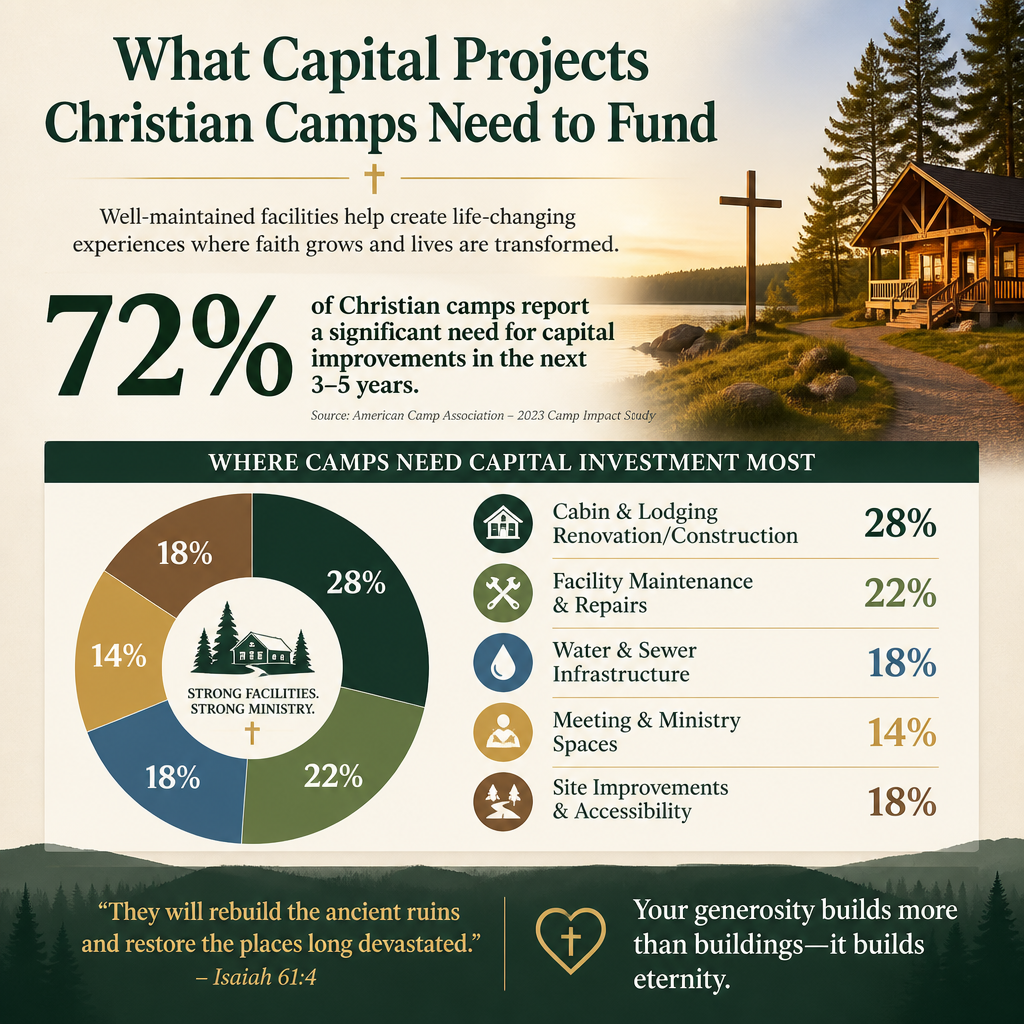
Common high-impact capital projects include: replacing unsafe or deteriorated cabins; building flexible retreat lodging that serves churches and families; renovating chapels for acoustics and accessibility; and creating multi-purpose teaching spaces that can support both large gatherings and small-group discipleship. A camp that claims to form Christian leaders should be able to articulate how each space supports Scripture-saturated teaching, prayer, and wise mentoring rather than vague appeals to “growth.”
Food service and hospitality are spiritual disciplines in practice
Meals are not incidental to Christian community. Scripture repeatedly treats table fellowship as meaningful: hospitality is commanded, and shared meals become sites of instruction, reconciliation, and joy. A kitchen that cannot safely serve guests, or a dining hall that forces unnecessary chaos, undermines that witness.
Capital needs here often include commercial kitchen modernization, dishwashing and sanitation upgrades, allergen-aware prep zones, and dining hall renovations that improve flow and reduce bottlenecks. Donors should expect camps to connect these projects to both health standards and ministry outcomes, especially for families with medical needs who are often quietly excluded by outdated facilities.
4. Accessibility and inclusivity are tests of neighbor-love
ADA compliance is a floor, not the whole ethical question
Many camps operate older facilities on beautiful terrain that was never designed for mobility access. The law establishes minimum requirements, but Christian ethics asks more than legal compliance. A camp that proclaims the welcome of the gospel should be able to welcome bodies that move differently, hear differently, or process sensory input differently.
Capital projects can include accessible cabins and bathrooms, ramps and pathways, hearing assistance systems in chapels, improved signage, and sensory-considerate spaces. Donors do not need to treat this as a niche concern. The church’s witness is diminished when families affected by disability consistently experience Christian spaces as impractical or humiliating.
For donors who want to understand the broader ministry context for camps and retreat centers, we track common patterns and concerns across Christian Camps and Conferences.
Protecting vulnerable guests also includes environmental stewardship
Outdoor ministry is embodied ministry. When a camp’s water quality, shoreline integrity, or wildfire preparedness is neglected, the risk is not merely operational; it is borne by campers and staff. Some projects—stormwater management, erosion control, septic upgrades, and safer waterfront infrastructure—are simultaneously creation care and neighbor-love. Donors should ask whether a camp has engaged qualified engineers and whether long-term maintenance is funded, not merely built.
5. Donors should fund plans, not pressure
The strongest campaigns begin with governance clarity
Capital campaigns can subtly distort decision-making. A major gift offered with restrictive preferences can force a camp to build what it cannot sustain. The healthiest ministries resist this dynamic by grounding projects in board-approved master planning, realistic total-cost estimates, and a clear operating model after construction. Mature boards are willing to say no to projects that would increase risk, even when a donor is enthusiastic.
What this means in practice is that donors should expect to see, at minimum, a feasibility study or comparable demand assessment, independent cost estimates, and an operating pro forma that includes staffing, maintenance, utilities, and reserves. The question is not “Can we raise the money to build?” but “Can we operate this faithfully for the next twenty years?”
A practical donor checklist for evaluating camp capital requests
The following questions tend to separate well-formed capital projects from aspirational ones:
- Scope discipline: Is there a defined project scope with contingencies and a change-order process?
- Total cost of ownership: Has the camp budgeted for maintenance, staffing, and replacement reserves after completion?
- Safety integration: Does the design reduce known supervision and safety risks rather than creating new ones?
- Mission fit: Can leadership describe how the project strengthens discipleship outcomes and guest care?
- Financial integrity: Will the project avoid unsustainable debt or fragile revenue assumptions?
This is also where independent verification matters. Most Trusted exists to help donors give with confidence by evaluating ministries against The Most Trusted Standard, a 15-criteria framework that tests faith foundation, financial integrity, governance and leadership, and transparency and effectiveness. Capital projects touch every one of those areas, which is why they deserve more than architectural renderings and visionary language.
For donors focusing specifically on how ministries present facility needs, capital readiness, and financial realism, we maintain analysis related to Funding Christian Camp Facilities and Capital Needs.
FAQs for What capital projects Christian camps need to fund
Should donors prefer capital projects over scholarships and program funding?
Not as a rule. Camps require both: scholarships protect access for families of limited means, and capital projects protect safety and long-term viability. The faithful question is whether a camp’s operating model is sustainable and whether facilities investments are targeted to remove genuine constraints. When a camp consistently solicits scholarships while ignoring deteriorating life-safety systems, donors should press for a more truthful plan.
Is taking on debt for a camp capital project ever appropriate?
Sometimes, but it is rarely morally neutral. Debt can be a prudent bridge when there is reliable, diversified revenue and strong governance oversight; it can also become a form of presumption when repayment depends on optimistic enrollment growth or continued emergency fundraising. Donors should ask to see board deliberation, stress-tested projections, and a repayment plan that does not crowd out core ministry or staff care.
Funding the built environment as an act of stewardship
Christian camps exist to create space for Scripture, worship, repentance, and belonging—often at pivotal moments in a young person’s life. The capital projects Christian camps need to fund should therefore be judged by more than excitement. They should be judged by whether they protect the vulnerable, strengthen formation, and sustain a credible witness over time. Donors best serve camps when they fund disciplined plans that tell the truth about costs, risks, and long obedience in the same direction.



