

How donors can fund Christian camp renovations without drifting into mere property management is a stewardship question, not a construction question. Camps form young disciples in concentrated time, and built environments can either support that work or quietly undermine it through safety failures, accessibility barriers, and deferred maintenance that drains staff attention.
Most Christian donors also recognize a second reality: capital projects can be spiritually clarifying or spiritually distorting. A new dining hall may be the difference between a camp that can host churches for another generation and a ministry that slowly closes; it can also become a monument to ambition if it is not governed with sobriety, transparency, and a clear ministry case.
Renovations are ministry infrastructure not prestige projects
Start with a theology of place and formation
Christian camps trade in a rare ministry currency: unhurried attention. The space itself becomes part of the formation—cabins that foster community, chapels that invite reverence, trails that make room for honest conversation. That is not sentimentalism; it is an acknowledgment that discipleship happens in embodied settings. When a facility is unsafe, inaccessible, or chronically failing, the ministry’s attention shifts from shepherding souls to managing emergencies.
In practice, donors serve camps best when they ask first-order questions: What does this renovation protect or make possible in the camp’s discipleship model? How does the project reduce risk to children and volunteers? What ministry outcomes are constrained today by the current facilities? A renovation that solves those problems is not “overhead.” It is a direct investment in the ministry’s ability to keep its promises.
Recognize the complexity of the capital moment
Capital campaigns can tempt ministries toward overpromising, especially when peer organizations announce major builds or when boards assume that “bigger” automatically means “more effective.” Christians genuinely disagree about how much a camp should spend on comfort and aesthetics, and those disagreements are not always unspiritual. Yet Scripture’s warning against pride and self-deception is perennial. Donors should expect sober planning, not inflated renderings.
Fund renovations the way wise stewards fund risk
Prioritize safety, compliance, and mission continuity
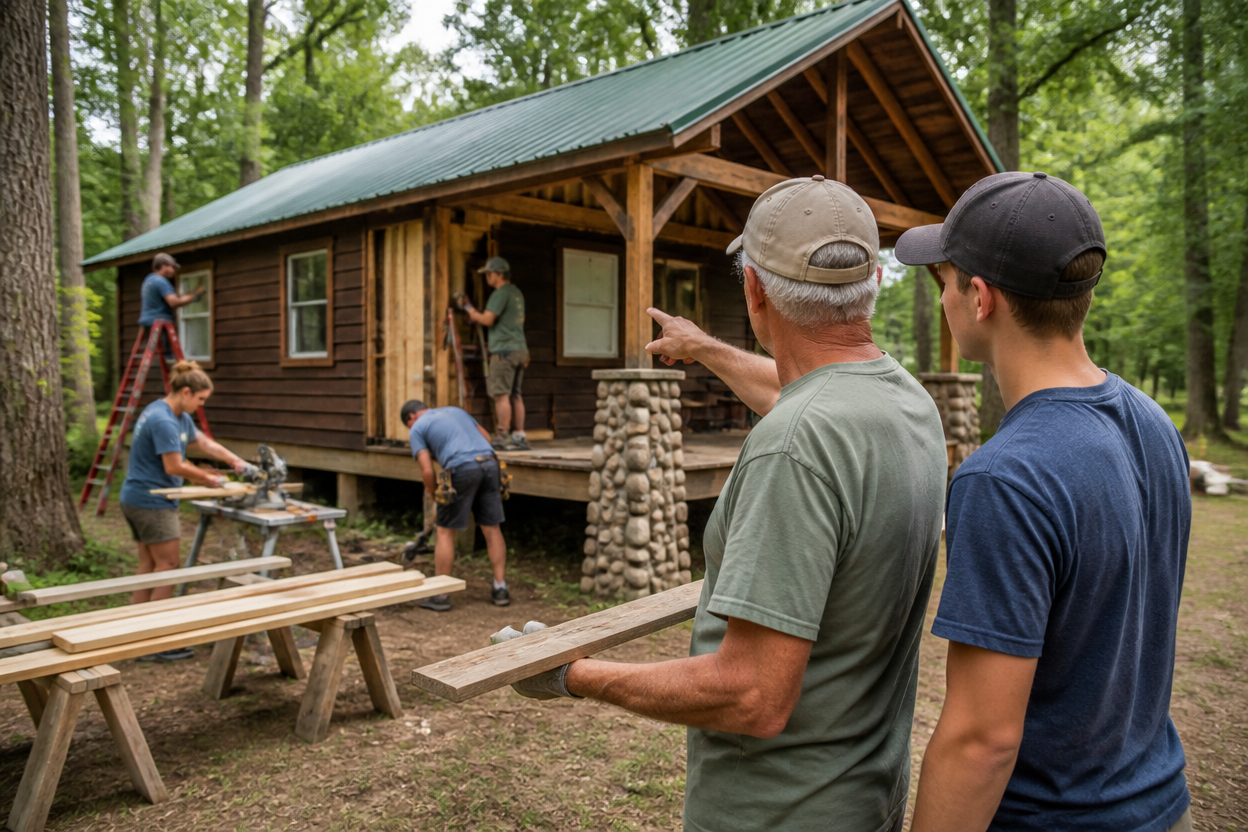
Some renovation needs are not optional. Aging electrical systems, fire egress, potable water, and structural integrity are moral concerns when minors are in care. Donors should also consider Americans with Disabilities Act access for U.S.-based camps, even when exemptions are claimed in narrow cases; hospitality is a Christian instinct, and accessibility is often the practical expression of that instinct.
One useful donor discipline is to view a camp campus as a portfolio of risk: life safety risk, legal risk, reputational risk, and mission continuity risk. Renovations that reduce those risks typically deserve priority over projects that mainly improve brand impression.
Ask for a credible facility condition baseline
A serious renovation plan usually begins with an external facility condition assessment or a comparable professional evaluation that identifies deferred maintenance, lifecycle replacement schedules, and code issues. Donors need not become engineers, but donors should insist on evidence that the ministry knows what it owns, what it costs to maintain, and what failure looks like if projects are postponed.
Deferred maintenance is not a theoretical concern. The U.S. National Park Service describes a nationwide deferred maintenance and repairs backlog of $22.3 billion for FY 2023, illustrating how quickly underfunded assets accumulate liabilities when upkeep is delayed National Park Service. Camps are not federal parks, but the principle holds: postponement compounds cost and narrows choices.
Choose the right funding instruments for the right renovation needs
Match the gift to the cash flow reality
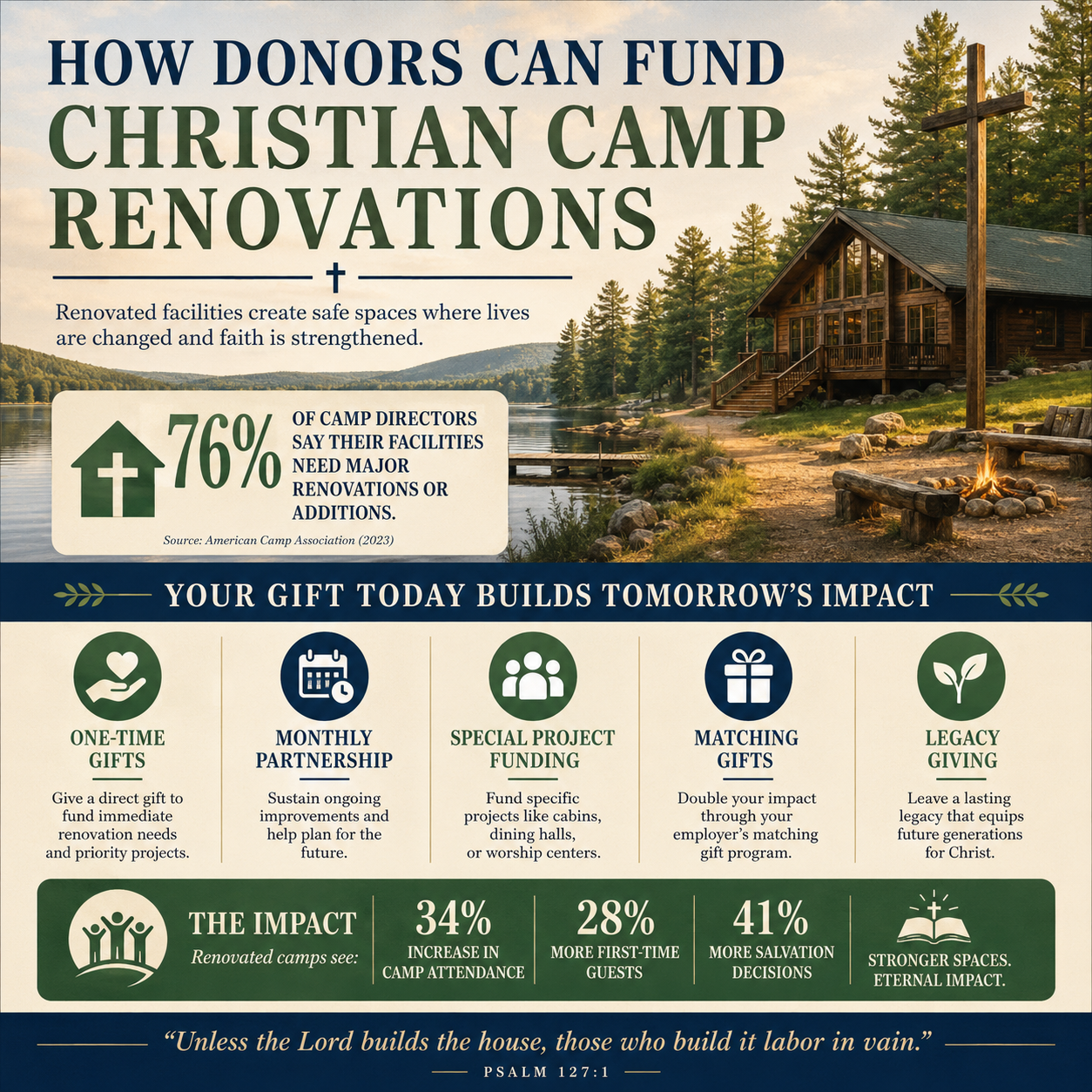
Renovations are rarely funded well by a single instrument. Wise donors and wise ministries match funding forms to the project’s timeline and the camp’s operating volatility, which is often seasonal and weather-dependent. Some projects are best funded by straightforward restricted gifts; others by multi-year pledges; others by challenge grants that unlock broader participation. In some cases, planned gifts align well with long-horizon replacements, especially when donors care about endowing the camp’s future rather than simply completing the current phase.
Debt deserves special attention. Borrowing can be responsible when a ministry has stable demand, conservative projections, and clear repayment capacity. It can also become a spiritual and operational snare if the camp has to raise program fees beyond what churches can bear or if staff are pressured to book groups primarily to service loans rather than to serve the mission. Donors should not treat “no debt” as a universal rule, but should expect a board to articulate why any debt is warranted and how it will be managed.
A practical menu of donor options
For many donors, the decision is not whether to give, but how to give in a way that strengthens the ministry’s long-term integrity. Options that commonly fit camp renovations include:
- Restricted project gifts with clear scope, budget, and reporting expectations.
- Multi-year pledges aligned to construction draw schedules and permitting timelines.
- Matching or challenge grants that widen the donor base and reduce overreliance on one benefactor.
- Equipment and furnishing gifts for defined needs that follow core construction.
- Reserve or maintenance funding that prevents the next cycle of deferred maintenance.
Donors who want to think beyond a single project should spend time with the broader landscape of Christian Camps and Conferences, since renovations intersect with program strategy, staffing, child protection policies, and governance practices.
What trustworthy renovation leadership looks like under The Most Trusted Standard
Governance and transparency are not decorative
Across our verification work at Most Trusted, we observe that capital projects expose a ministry’s real operating maturity. Healthy organizations document decisions, preserve board independence, manage conflicts of interest in vendor selection, and communicate with donors in measured language. Unhealthy organizations often rely on personality, urgency, and vague spiritualized claims that discourage legitimate questions.
The Most Trusted Standard evaluates ministries across 15 criteria spanning Faith Foundation, Financial Integrity, Governance and Leadership, and Transparency and Effectiveness. Donors funding renovations should care especially about whether a camp can demonstrate: board oversight of major contracts, documented policies that prevent self-dealing, audited financials or equivalent independent review when appropriate to scale, and clear reporting on restricted fund use.
Expect candor about overhead and true costs
Donors sometimes pressure camps to report the lowest possible “overhead,” inadvertently rewarding underinvestment in maintenance systems, financial controls, and competent project management. The nonprofit sector has explicitly warned against this distortion. The joint “Overhead Myth” letter from GuideStar, Charity Navigator, and the BBB Wise Giving Alliance argues that overhead ratios are a poor proxy for effectiveness and can drive harmful behavior Candid Guidestar.
For renovations, the implication is straightforward: a camp that budgets for professional oversight, proper insurance, and realistic contingencies is often more trustworthy than a camp that promises a low-cost build without explaining how it will manage risk. Donors should reward honesty, not just frugality.
Do the diligence that protects both children and donor intent
Questions that clarify whether a renovation is warranted
Renovation giving is one of the places where donor intent and child safety intersect. A donor who funds a project that later fails inspection, runs far over budget, or exposes campers to hazards has not merely lost money; that donor has participated in a breakdown of stewardship. Diligence is a Christian duty when minors and volunteers are being entrusted to an organization’s care.
Before making a significant renovation gift, donors should ask for documentation and direct answers on matters such as scope, safety, and governance. The goal is not suspicion; it is clarity.
A diligence checklist that respects the camp and protects the mission
Many camps welcome disciplined questions because they know that clear answers build durable trust. For significant gifts, we recommend asking for:
- A written project scope with what is included and explicitly excluded.
- A budget with contingencies and an explanation of assumptions (labor, materials, timeline).
- Competitive bids or justified sole-source selection, plus conflict-of-interest disclosures.
- A construction timeline that accounts for permitting, inspections, and seasonal constraints.
- A post-project maintenance plan so today’s renovation does not become tomorrow’s backlog.
Donors who want a deeper view of how facility giving relates to governance and financial integrity should also review the broader practices described under Funding Christian Camp Facilities and Capital Needs, because the healthiest capital work is inseparable from the ministry’s operating discipline.
When a camp serves children, donors should also pay attention to safeguarding policies and training, even if those policies are not part of the construction budget. Child protection has become a central accountability concern across the American church, and donors should not treat it as secondary to building plans. The U.S. Department of Justice has documented the prevalence and underreporting of child sexual abuse, underscoring why prevention systems matter wherever minors are gathered U.S. Department of Justice Office on Violence Against Women.
FAQs for How donors can fund Christian camp renovations
Should donors restrict gifts for a specific building or give unrestricted support?
Both can be faithful, but they serve different needs. Restricted renovation gifts protect donor intent when a project is defined and time-bound, and they can reduce the temptation to divert funds under pressure. Unrestricted support strengthens the camp’s capacity to maintain facilities, manage surprises, and fund the less visible work that keeps a campus safe. For larger commitments, many donors blend the two: a restricted component for the project and an unrestricted or reserve component that supports long-term maintenance and oversight.
Is it wise to fund new construction when a camp has deferred maintenance?
Not always. New construction can be warranted if it replaces failing capacity, resolves code issues, or enables a program model the camp can sustain. Yet a camp with significant deferred maintenance should be able to explain why it is adding assets before it has stabilized existing ones. Donors should ask for a facility condition assessment, a maintenance plan, and a realistic operating budget that includes lifecycle replacement. Without those, new construction may enlarge the problem rather than solve it.
Funding renovations as a form of faithful stewardship
Christian camp renovations are often less about bricks and more about keeping a ministry’s promises: safety for children, hospitality for churches, and spaces that support repentance, worship, and vocation. Donors serve camps best when they fund the work with clear intent, appropriate instruments, and measured diligence—rewarding truthfulness, governance, and long-term sustainability. That is the kind of giving that strengthens the Church rather than merely improving a campus.



