
When donors ask what share of donations funds Christian camp programs, they are usually asking a larger stewardship question: whether a ministry’s spending patterns reflect its stated mission and produce credible spiritual and developmental outcomes. Camps are labor-intensive by design. They require staff, safe facilities, food service, transportation, insurance, and year-round planning to deliver a short season of concentrated ministry. A faithful answer therefore cannot be reduced to a single “good” percentage.
The harder question is whether the camp’s reported “program” spending is honest, consistently defined, and meaningfully connected to what happens with campers. Some organizations can report a high program ratio while drifting from mission or hiding weak governance. Others carry necessary infrastructure costs that keep children safe and leaders accountable, yet appear “less efficient” on paper. What donors need is a way to read the financial story without being misled by simplistic benchmarks.
Program spending in a camp setting is not a single line item
Why camps blur the usual nonprofit categories
In most nonprofit financial statements, expenses are allocated across program services, management and general, and fundraising. Camps complicate these categories because the same assets and staff often serve multiple functions at once. A retreat center kitchen serves “program” when feeding campers, but the facility may also host donor events, church retreats, or off-season rentals. Year-round staff may both disciple counselors and manage compliance. Reasonable accounting relies on allocation methods that should be documented and consistently applied.
For donors, this means the “program” share is only as trustworthy as the definitions behind it. A camp can classify large portions of occupancy, maintenance, and salaries as program services, and in many cases that is appropriate. The question is whether the organization’s allocation method is conservative, explained, and stable across years. Sudden shifts—without a clear change in operations—deserve scrutiny.
What donors should expect in plain disclosure
At minimum, donors should be able to trace how the ministry defines “camp programs” and what costs are included. We recommend looking for clear language in audited financial statements or annual reports: whether counselor training, child protection compliance, and on-site medical staffing are counted as program; whether capital repairs are treated as program support; and how multi-use facilities are allocated. Clarity here is a form of honesty.

A percentage can mislead without context and that is widely recognized
The sector has rejected the simplistic overhead test
Christians have long cared about integrity in administration, and Scripture commends it. Paul took pains to handle financial gifts “honorably not only in the Lord’s sight but also in the sight of man” (2 Corinthians 8:21). Yet modern nonprofit analysis has also learned that reducing faithfulness to a single ratio creates perverse incentives. The joint statement known as the “Overhead Myth” letter—signed by leading evaluators—warned donors that focusing on overhead alone can starve organizations of the infrastructure needed for effectiveness and accountability. See the letter hosted by BBB Wise Giving Alliance: BBB Wise Giving Alliance.
For camps, “infrastructure” is not cosmetic. Child safety protocols, background checks, training, incident response procedures, and properly maintained facilities are part of responsible ministry. Donors should resist the temptation to reward only the thinnest administrative spend, especially when the beneficiary population includes minors.
What this means for Christian camp donors
Rather than asking for a single ideal percentage, donors can ask whether the camp’s expense structure matches its theology of ministry and its duty of care. A camp that disciples teenagers through immersive community will carry higher staffing and housing costs than a ministry that distributes curriculum. A camp that provides scholarships to under-resourced families may have higher fundraising expense because it must raise restricted funds. Stewardship evaluates faithfulness to purpose, not merely low overhead.
Reasonable benchmarks exist but should be treated as guardrails
Use program ratios as one indicator among several
Some donors still want a working frame of reference. For many charities, independent evaluators often look for a strong share of spending directed toward program activities. Charity Navigator, for example, has historically emphasized program expense and provides general expectations for efficient use of funds, while also cautioning against ratio-only judgments. Their methodology materials are available here: Charity Navigator. That can be a useful guardrail, but it is not a theology of stewardship and it is not tailored to the unique cost structure of camps.
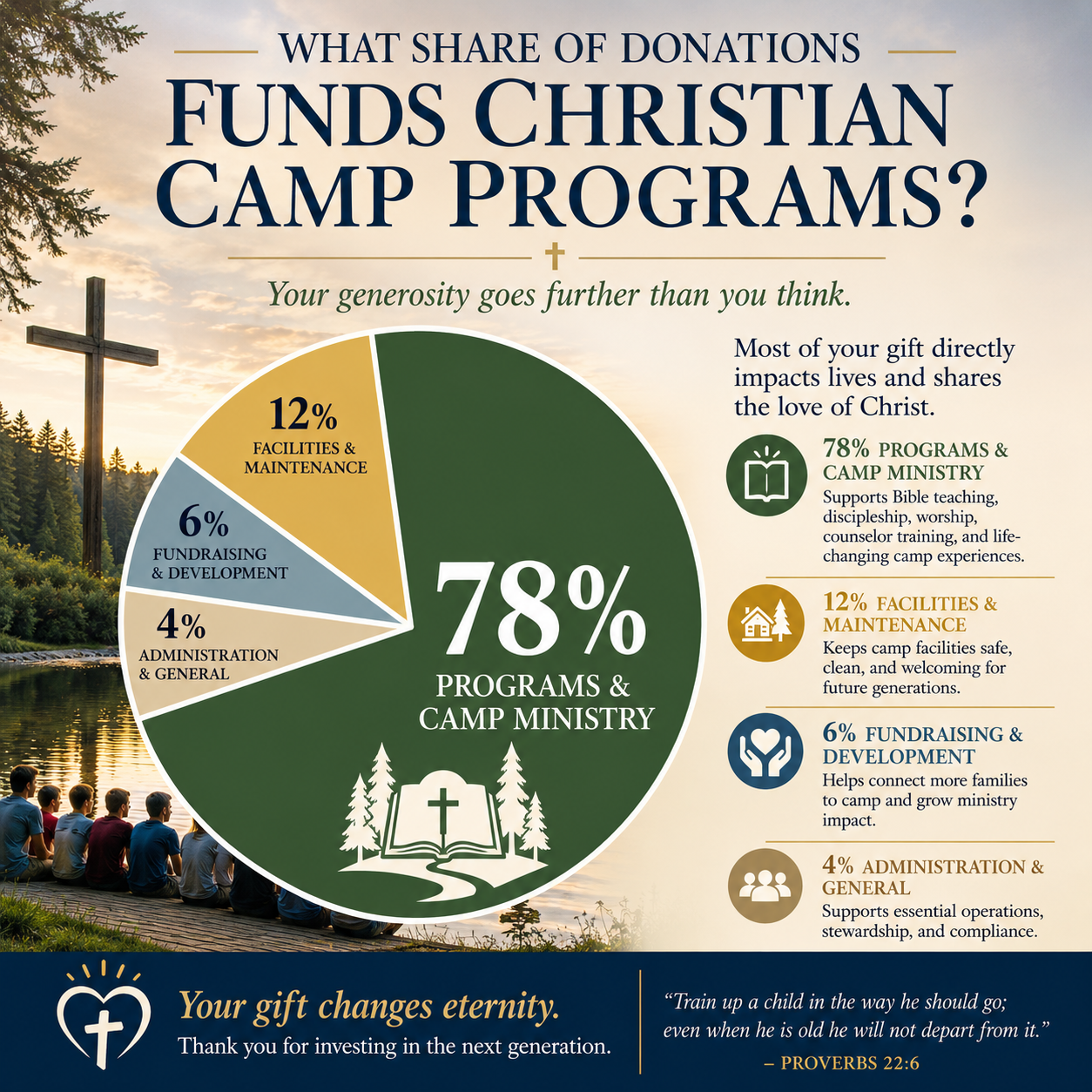
Across our verification work at Most Trusted, the ministries that meet The Most Trusted Standard tend to show consistency: program definitions do not change opportunistically, administrative spending is explained rather than hidden, and fundraising practices align with donor intent. Donors are best served by patterns over time, not isolated snapshots.
Ask for the story behind the numbers
When a camp says, “X percent of donations funds Christian camp programs,” donors can ask three follow-up questions: Which expenses are included in “program”? How does the camp allocate shared costs such as facilities and leadership salaries? And what outcomes or outputs correspond to those expenses—camp weeks delivered, campers served, scholarship recipients, counselor training completed, or follow-up discipleship pathways in local churches?
Reading the camp’s IRS Form 990 can help, especially Schedule O where organizations sometimes explain allocations, though not all camps file a 990 (some are churches or integrated auxiliaries). Where a camp is large enough to obtain an audit, audited statements and footnotes often provide the clearest view of classification and consistency.
What donors should verify beyond the percentage
Governance, safety, and financial integrity are part of program faithfulness
A camp can spend heavily on “program” and still fail children through weak governance or unsafe practices. Because camps are entrusted with minors, donors should treat safeguarding and accountability as central, not peripheral. Evidence of mature governance includes an independent board, clear conflict-of-interest practices, documented child protection policies, and credible incident reporting procedures. These realities are not easily summarized in a pie chart, but they represent the moral substance of stewardship.
For donors who want to evaluate camps with rigor, the Accountability and Transparency in Christian Camps and Conferences category is a useful place to compare what ministries disclose and what they do not. Transparency is not virtue-signaling; it is a way of honoring donors, parents, and the young people being served.
A practical checklist for donor conversations
- Ask for a clear definition of “camp programs” and which costs are included.
- Look for consistency in expense allocation across multiple years.
- Confirm whether financial statements are reviewed or audited, and whether the auditor is independent.
- Examine how scholarships are funded and whether restricted gifts are handled according to donor intent.
- Assess safeguarding: training, background checks, supervision ratios, and incident response practices.
These questions are not adversarial. They are the ordinary due diligence of Christians who take seriously both generosity and prudence. Proverbs commends honest weights and measures; donors should not feel ashamed to ask for honest categories and clear reporting.
How Most Trusted evaluates camp spending under The Most Trusted Standard
We look for coherence between faith, financials, and outcomes
Most Trusted exists because donors need more than a fundraising narrative. Under The Most Trusted Standard, we assess ministries across faith foundation, financial integrity, governance and leadership, and transparency and effectiveness. For camps, that means we do not treat the program-spend percentage as the final word. We examine whether the ministry’s stated purpose is recognizably Christian, whether leadership and governance structures reduce the risk of misuse, whether financial reporting is credible, and whether the ministry communicates outcomes with appropriate humility and specificity.
What this means in practice is that a camp with a lower reported program ratio may still be a more trustworthy steward than a camp with a higher ratio, if the former is audited, governed independently, candid about challenges, and attentive to safeguarding. The Christian doctrine of stewardship includes truthfulness, justice, and care for the vulnerable, not only cost-minimization.
Where donors can compare camps more responsibly
Donors who want to go deeper than a single percentage can explore the broader landscape of Christian Camps and Conferences. The goal is not suspicion; it is confidence grounded in verifiable evidence. Responsible giving is neither cynical nor naive. It is the mature posture of Christians who believe resources are entrusted by God for his purposes and for the good of those served.
FAQs for What share of donations funds Christian camp programs
Is there a healthy percentage of donations that should go to camp programs?
A healthy percentage depends on how the camp defines “program,” how it allocates shared costs, and what it must spend to operate safely and responsibly. Donors can use program ratios as a guardrail, but should place equal weight on consistent reporting, independent oversight, safeguarding practices, and credible evidence that spending connects to actual ministry outcomes.
How can we tell whether a camp is counting overhead as program spending?
Ask the camp to explain, in writing, how it allocates facilities, leadership salaries, and year-round support costs between program and administration, and whether that approach has changed year to year. Where available, audited financial statement footnotes and the IRS Form 990 can provide the most concrete explanations. Sudden reclassifications without operational changes are a common warning sign.
Stewardship requires more than a ratio
Donors rightly want to know what share of donations funds Christian camp programs, but mature stewardship asks for more: truthful definitions, consistent accounting, safe operations, and outcomes that correspond to the camp’s stated mission. A camp’s expense ratio can be a helpful starting point. It should never be the only measure of trustworthiness, especially when the ministry’s work depends on doing the costly, careful work of discipleship and child protection well.



