
Why Christian camp audits matter for donor trust is ultimately a question about stewardship under God. When donors fund a camp’s ministry, they are not merely purchasing a week of programming; they are entrusting resources for spiritual formation, child safety, and gospel witness. Trust grows where stewardship can be tested, verified, and explained without defensiveness.
Christian donors also understand that camps operate with real constraints: seasonal revenue, aging facilities, volunteer labor, and the complexity of working with minors. Audits do not eliminate those pressures. They do, however, establish whether leaders are facing those pressures with competence, honesty, and accountability—or whether financial and operational risk is being managed in ways that could eventually harm campers and compromise Christian witness.
Audits are a stewardship practice before they are a compliance task
Scripture treats money as a discipleship matter
In the New Testament, the collection for the saints was handled with deliberate transparency. Paul insisted on safeguards so that no one could discredit the ministry’s administration of funds, seeking “what is honorable not only in the Lord’s sight but also in the sight of man” (2 Corinthians 8:21). A credible audit is one modern way ministries can operationalize that same principle: not suspicion, but integrity made visible.
Donors are often asked to give sacrificially to send children to camp, renovate cabins, or expand outreach. That sacrificial giving is not an abstract virtue. It represents foregone family vacations, delayed home repairs, or reduced discretionary spending. When a camp treats external financial review as optional, it can unintentionally communicate that donor sacrifice is assumed rather than honored.
Donor trust is not sentimental confidence
Christian camps rightly emphasize spiritual outcomes: conversions, renewed faith, reconciled relationships, and callings clarified. Donors rejoice in those stories, and they should. But donor trust is not primarily emotional reassurance; it is a settled confidence that leadership is competent and accountable with resources that belong to God. An audit helps a board demonstrate that confidence with evidence, not marketing.

Christian camps face distinctive financial risks that donors rarely see
Seasonality can hide weakness until it becomes urgent
Camps frequently carry costs year-round while revenue arrives in concentrated windows. That model can mask cash-flow fragility, deferred maintenance, and reliance on restricted gifts to cover unrestricted needs. An audit does not solve a structural problem, but it clarifies whether leadership understands it and governs accordingly.
Across our verification work at Most Trusted, we observe that many donor concerns are not about fraud. They are about avoidable breakdowns: weak internal controls, unclear restriction handling, and budgets that function more as hopes than disciplined plans. Those are the kinds of issues a serious audit engagement can surface early, when correction is still possible.
Restricted gifts require disciplined accounting
Donors often give to camps with explicit intentions: a scholarship fund, a building project, or a program for underserved communities. Restricted giving is a moral commitment as well as an accounting category. When restrictions are commingled or reallocated without formal permission, it can become a breach of trust even if every dollar remained “within the ministry.”
Many donors have heard the “overhead” debate and know that administrative spending is not inherently wasteful. Charity Navigator, Candid, and the BBB Wise Giving Alliance have publicly argued against simplistic overhead ratios because they can mislead donors and pressure nonprofits into underinvesting in capacity and controls.Charity Navigator A credible audit supports that more mature donor posture: it evaluates how money is handled, not merely how it is categorized.
An audit is one signal within a larger accountability ecosystem
Audits test the books, not the culture
It is possible to have clean audited statements and still have a leadership culture that is defensive, opaque, or resistant to board oversight. It is also possible for a camp to be spiritually faithful and missionally fruitful while still lacking financial discipline. Christian donors should not confuse an audit with holiness, nor assume that relational warmth guarantees operational integrity.
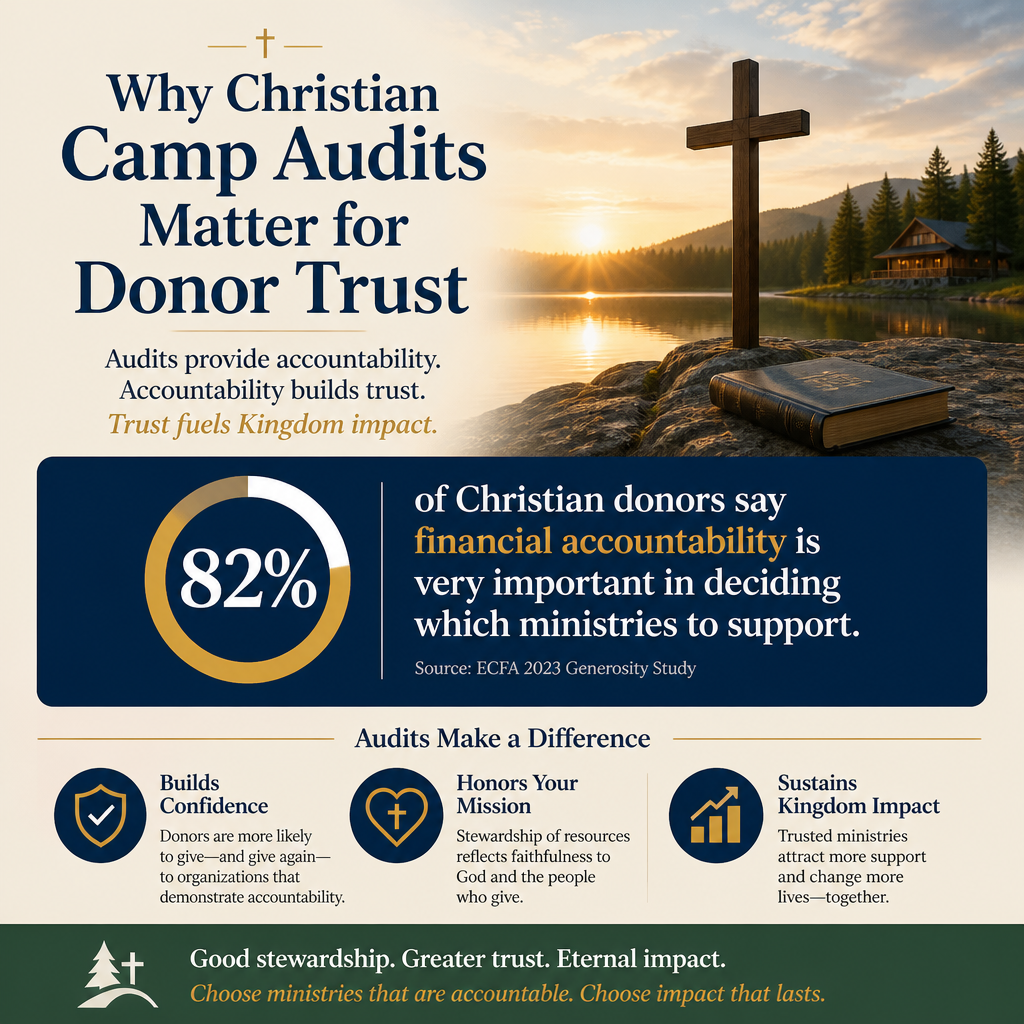
What this means in practice is that audits should be understood as one component of a broader accountability system: independent governance, clear conflict-of-interest policies, documented internal controls, and transparent communication to stakeholders. Within Christian Camps and Conferences, the most stable ministries tend to treat these practices as ordinary stewardship rather than exceptional measures reserved for crises.
Why donors should care even when trust feels warranted
Many camps have long histories, beloved staff, and multi-generational loyalty. Those are genuine assets. Yet familiarity can also reduce questions that should be asked, especially when leadership transitions occur or when a ministry expands beyond its previous operational maturity. Audits help a camp remain trustworthy through seasons of change, not merely in seasons of strength.
Christians genuinely disagree about how formal financial oversight must be for smaller ministries. Some donors are comfortable with reviewed statements or compilation reports when the scale is modest. Others expect a full audit as soon as public fundraising begins. The point is not to impose a one-size-fits-all demand, but to recognize that the need for verification increases with complexity, public exposure, and the vulnerability of those served.
What donors should look for in a camp audit and related disclosures
The right questions are specific
Donors can honor camp leaders and still ask precise questions. Serious ministries usually welcome these questions because they signal engaged partnership rather than suspicion. The most useful inquiries focus on clarity and governance, not rumor or insinuation.
- Whether audited financial statements are available upon request, and for what fiscal year
- Which independent CPA firm performed the audit and whether the opinion was unmodified
- Whether the board reviews management letters and tracks remediation of findings
- How the camp accounts for restricted gifts and donor-designated funds
- Whether key internal controls exist for cash handling, scholarships, and vendor payments
Transparency is not the same as public exposure
Some ministries fear that sharing audited statements will invite misunderstanding from donors who are unfamiliar with nonprofit accounting. That concern is not frivolous. Yet the answer is not concealment; it is interpretation. A camp can provide audited statements alongside a brief explanation of major line items, seasonal dynamics, and capital needs. Donors who are treated as mature stewards usually respond with patience and confidence.
In Accountability and Transparency in Christian Camps and Conferences, the most credible posture we see is neither secrecy nor performative disclosure, but straightforward openness: leaders share what is true, explain what is complex, and correct what needs correction.
How Most Trusted evaluates audits within The Most Trusted Standard
Verification examines patterns, not isolated documents
Most Trusted exists to help Christian donors give with confidence by evaluating ministries against The Most Trusted Standard, a 15-criteria framework spanning Faith Foundation, Financial Integrity, Governance and Leadership, and Transparency and Effectiveness. Within that framework, an audit is meaningful because it can corroborate how a ministry presents itself and how it actually operates.
A single document cannot carry the full weight of trust. Our evaluation looks for alignment: whether governance structures support oversight, whether financial reporting is consistent with public claims, and whether transparency is practiced as a matter of discipleship rather than public relations.
Audits protect more than donors
Audits also protect campers, staff, and the long-term health of the ministry. Weak internal controls can lead to payroll disruption, vendor disputes, improperly handled scholarships, or deferred safety investments that eventually become emergencies. When a camp’s finances become unstable, the downstream effects often land on families and frontline staff first.
When donors prioritize verified accountability, they help create incentives for camps to strengthen systems before crises occur. That is not cynicism; it is prudence. Scripture commends prudence not as fear, but as wise stewardship in a world where good intentions do not remove operational risk.
FAQs for Why Christian camp audits matter for donor trust
Is an audit required for every Christian camp?
Not every camp is legally required to obtain an audit, and requirements vary by state, revenue size, and funding sources. The more practical question for donors is whether the camp’s level of financial complexity and public fundraising warrants independent assurance. As a camp grows, handles significant restricted gifts, or manages multiple revenue streams, an audit becomes a more proportionate expectation.
What if a camp says an audit is too expensive?
Audit costs are real, especially for smaller ministries. Donors can reasonably ask what alternative safeguards are in place: strong board oversight, periodic external reviews, clear internal controls, and timely financial reporting. A camp that cannot yet fund an audit should still be able to explain a credible path toward stronger assurance as capacity grows, rather than treating transparency as optional.
A credible audit strengthens gospel credibility in public life
Christian camps proclaim a message of truth, repentance, and new life. That proclamation is strengthened when financial practices are consistent with the same moral seriousness. Audits matter for donor trust because they make stewardship verifiable, help boards govern with clarity, and reduce the likelihood that preventable financial failures will harm campers and discredit ministry. Donors who give as stewards before God are right to seek that kind of evidence-based confidence.



