

What to ask Christian aviation ministries before giving is not a matter of suspicion; it is a matter of stewardship. Aviation is expensive, risk-heavy, and often carried out far from a donor’s line of sight. Those realities can either magnify faithful service or conceal weak practices, depending on the ministry’s spiritual seriousness and operational discipline.
Christian aviation can be one of the church’s most strategic instruments for mercy and mission: transporting medical teams, evacuating the vulnerable, supplying remote clinics, and supporting local pastors and Bible translators where roads do not exist or security is fragile. Yet donors also know how quickly a compelling story can outrun verifiable evidence. Scripture commends generosity, but it never blesses naiveté. “It is required of stewards that they be found faithful” (1 Corinthians 4:2). Faithfulness can be examined.
1. How does the ministry understand mission, and who defines the outcomes
Ask for a theological account of aviation as service
Aviation ministries often describe themselves as “a platform for the gospel.” That can be true, but donors should press for a more careful account: how does the organization connect flying to disciple-making, local church strengthening, and works of mercy without turning the aircraft into the mission itself? Mature ministries can articulate their calling without romanticizing risk or confusing activity with fruit.
We recommend asking what Scripture and ecclesiology shape their strategy. Do they primarily serve local churches and indigenous Christian leaders, or do they unintentionally centralize foreign initiative? A ministry that treats local pastors as partners—rather than as beneficiaries—will usually show it in decision rights, not only in language.
Ask who sets priorities and how trade-offs are made
Flight hours are finite. Maintenance cycles force hard scheduling decisions. Weather and security constraints can reroute the best intentions. Ask who decides which flights happen and why. Is there a transparent prioritization system that balances evangelism support, medical access, disaster response, and routine logistics? If everything is urgent, nothing is accountable.
It is also fair to ask how the ministry thinks about dignity and dependency. The When Helping Hurts framework, articulated by Steve Corbett and Brian Fikkert, has helped many Christian ministries face how well-meant aid can undermine local capacity when outsiders remain the default solution. See the authors’ overview at whenhelpinghurts.org.

2. What evidence demonstrates real impact beyond flight stories
Ask for outcomes that are specific, modest, and verifiable
Aviation produces naturally compelling narratives: a life-saving medevac, a storm delivery, an airstrip carved into jungle. Stories are not wrong; they are simply incomplete as evidence. Ask what the ministry measures that would still matter if no one wrote a newsletter about it. Examples might include on-time delivery rates for medical supply routes, clinic stockout reductions tied to improved logistics, or documented increases in access to pastoral training made possible by transport.
Where ministries work alongside health systems, it is legitimate to ask whether their efforts align with recognized public-health priorities rather than duplicating them. The World Health Organization has long emphasized that access barriers include geography and transportation; donors can use that as a conceptual anchor when evaluating claims about “reaching the unreached.” See the WHO homepage for primary materials: who.int.
Ask how the ministry avoids impact inflation
Some ministries report “people reached” by multiplying seats on flights by estimated exposure to services. That can be directionally helpful, but it can also be a proxy that disguises uncertainty. Ask which numbers are audited, which are estimates, and what assumptions drive the estimates. Mature organizations label estimates as estimates and can explain why they use them.
Donors should also ask about negative indicators. What does the ministry track that could reveal harm—safety incidents, local partner dissatisfaction, regulatory violations, or patterns of dependency? Trust grows when an organization is willing to speak about limits, failure modes, and corrective action.
3. How safety, compliance, and maintenance are governed in high-risk settings
Ask who owns safety and what authority they have
In aviation, “culture” is not a soft topic. It is a life-and-death system. Ask whether the ministry has a formal Safety Management System, who leads it, and whether that leader has the authority to ground aircraft without fundraising consequences. A ministry that cannot say “no” to a risky flight because a donor is watching is already in moral danger.
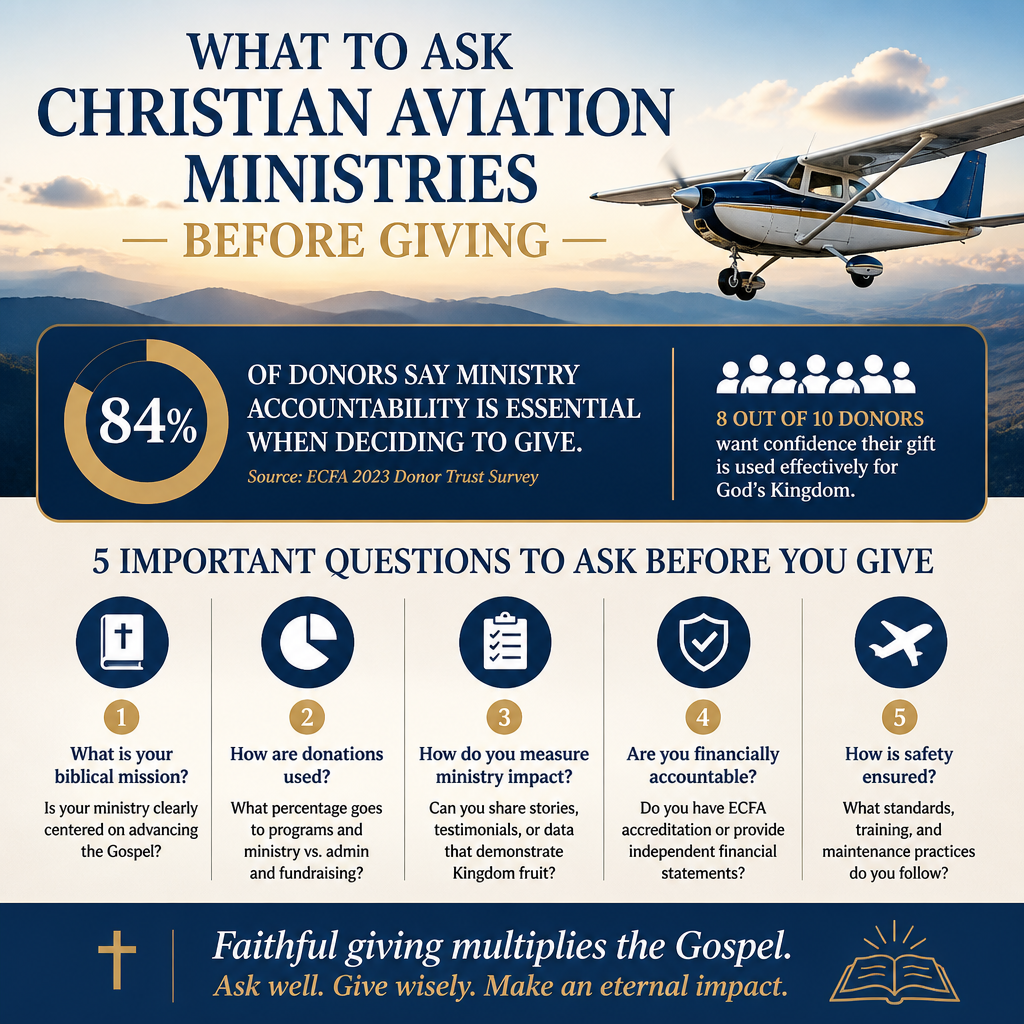
Ask how incident reporting works. Is there a non-punitive pathway for pilots and mechanics to report near-misses? Does the board see safety metrics, or only the executive team? These questions are not intrusive; they are proportionate to the risk and to the sacredness of human life.
Ask about maintenance discipline and regulatory reality
Maintenance in remote contexts is especially complex: parts scarcity, mechanic availability, weather exposure, and the temptation to defer non-urgent issues. Ask what standards govern their maintenance program, who signs off on airworthiness, and what external oversight exists. If the ministry operates across multiple countries, ask how it handles differing civil aviation authorities and whether it has a strong compliance function rather than a patchwork of informal relationships.
Donors can also ask whether the ministry aligns with sector norms that emphasize learning and standardization. While not every Christian aviation organization will hold the same accreditations, credible ministries usually participate in recognized peer networks that sharpen safety practice. If the ministry is isolated, donors should ask why.
4. Whether financial integrity matches the real costs of aviation
Ask for clarity on cost drivers and funding resilience
Aviation has predictable financial pressures: fuel, hangar and insurance costs, training, avionics, and the inevitable capital needs of aircraft replacement. Ask for a plain explanation of what drives their budget and what could destabilize it. Donors should not be satisfied with “we fly by faith” if it means operating without reserves, without replacement planning, or with chronic deferral of maintenance-related expenses.
It is appropriate to ask about revenue concentration. If a small number of donors fund a large share of flight operations, the ministry may be vulnerable to sudden contraction. The nonprofit sector broadly has faced rising financial volatility in recent years; the National Council of Nonprofits has documented ongoing structural pressures and the importance of reserves and sustainable funding models. See councilofnonprofits.org.
Ask questions that go beyond simplistic overhead debates
Some donors still treat overhead as a proxy for virtue. That instinct is understandable but often misdirected. The better question is whether administrative spending is fit for purpose—adequate for compliance, safety, financial controls, and partner accountability. Charity Navigator, Candid (GuideStar), and the BBB Wise Giving Alliance have cautioned donors against over-relying on overhead ratios as a measure of effectiveness; see the letter and context at Charity Navigator’s site: charitynavigator.org.
We recommend asking for the audited financial statements, the current-year budget, and a clear explanation of how restricted gifts are tracked and honored. In aviation ministries, designated gifts for aircraft purchases, avionics upgrades, and pilot support can create real accounting complexity. Competent systems matter.
- Do you provide audited financials, and are they current?
- How do you track and report restricted gifts for aircraft, fuel, and capital projects?
- What percentage of revenue is concentrated among top donors, and what is the contingency plan?
- What reserves policy guides operations and aircraft replacement planning?
- How do you prevent donor restrictions from distorting operational priorities?
5. Whether governance and transparency are strong enough for distance and complexity
Ask what the board governs, not merely what it endorses
Because aviation ministries often operate far from their donor base, governance is not a formality. Ask who sits on the board, what relevant competencies are present (aviation safety, finance, law, cross-cultural ministry), and how conflicts of interest are handled. Ask whether the board reviews executive compensation, safety reports, audit findings, and strategic risk—not only program updates.
Strong governance also includes spiritual accountability. Donors can ask how the ministry guards against celebrity dynamics, mission drift, or pressure to exaggerate results for fundraising. Scripture warns that teachers and leaders will be judged with greater strictness (James 3:1). A serious ministry will treat that warning as a gift, not a threat.
Ask for transparency that respects security without hiding basics
Some contexts are sensitive. Names, locations, and flight routes can create security risks for local believers. Donors should respect that. But security is not a blank check for opacity. Ask what information can be shared: governance documents, financials, safety policies, partner references, and clear program reporting with redactions when necessary.
Across our verification work at Most Trusted, we observe that ministries meeting The Most Trusted Standard tend to make it easy for serious donors to understand how decisions are made and how money is stewarded, even when certain details must remain confidential for safety. Transparency is not the publication of everything; it is the disclosure of what a steward can rightly disclose.
For donors evaluating the broader landscape, it is often helpful to begin with the larger ecosystem of Christian Aviation Ministries, then narrow to the questions that fit your intended role—supporting logistics, sponsoring pilots, underwriting safety systems, or funding local church partnerships. The questions shift slightly depending on what the gift is meant to accomplish.
Donors who want a wider frame for relational partnership—not only transactional giving—will also find value in the practices gathered under Praying for and Partnering with Christian Aviation Ministries, where spiritual support, mutual accountability, and long-term trust are treated as part of faithful stewardship.
FAQs for What to ask Christian aviation ministries before giving
Should donors prioritize evangelism flights over humanitarian flights
Christians genuinely disagree about how to weight explicit proclamation and works of mercy, but Scripture refuses to separate them as competing goods. A better donor question is whether the ministry’s flight priorities are governed by a coherent theology and accountable decision-making, and whether local church partners affirm the balance. Ministries that treat mercy as mere preamble to “real ministry,” or treat proclamation as dispensable, usually reveal a truncated gospel.
Is it reasonable to ask an aviation ministry for safety and incident information
Yes. Because aviation involves elevated risk, donors have a moral obligation to ask whether the ministry has a functioning safety system and whether leaders can ground operations when necessary. Donors should not demand sensitive details that compromise security or privacy, but it is appropriate to ask for safety governance, maintenance standards, training requirements, and evidence of learning from incidents and near-misses.
Giving with confidence in a ministry that flies beyond your sightline
Christian aviation ministries can represent some of the most costly and consequential stewardship opportunities available to donors. The very features that make them strategic—distance, complexity, urgency—also increase the need for disciplined governance, clear theology, and transparent evidence. Asking careful questions is not cynicism. It is a way of honoring the people on the ground, the crew in the air, and the Lord to whom every steward will give an account.



