
Knowing how to visit a Christian aviation ministry base is less about arranging travel and more about practicing donor stewardship in person. A base visit can clarify whether an aviation ministry’s culture, safety posture, and theological commitments align with the kind of partnership donors intend when they give for the sake of the gospel.
Christian aviation sits at an intersection of proclamation, mercy, risk management, and logistics. Mature donors rightly want more than moving stories about remote airstrips; they want verifiable signals of integrity, leadership, and effectiveness. A thoughtful visit can supply those signals, but only if it is planned with humility and rigor.
Start with the purpose of the visit
Clarify what a base visit can and cannot prove
Aviation environments are compelling. A hangar tour, a flight dispatch board, and a briefings room full of maps can communicate seriousness quickly. The temptation is to treat that seriousness as proof of spiritual health or organizational trustworthiness. A base visit can reveal patterns—how leaders handle risk, how staff speak about local partners, how transparent the ministry is when questions become specific—but it cannot replace sustained evidence.
Across our verification work at Most Trusted, the ministries that meet The Most Trusted Standard tend to welcome scrutiny without defensiveness. They do not treat questions about governance, finances, safeguarding, or outcomes as distractions from mission. They treat them as part of mission, because Scripture does. Paul expected believers to “take pains to do what is right, not only in the eyes of the Lord but also in the eyes of man” (2 Corinthians 8:21).
Set a donor posture that honors the people you are visiting
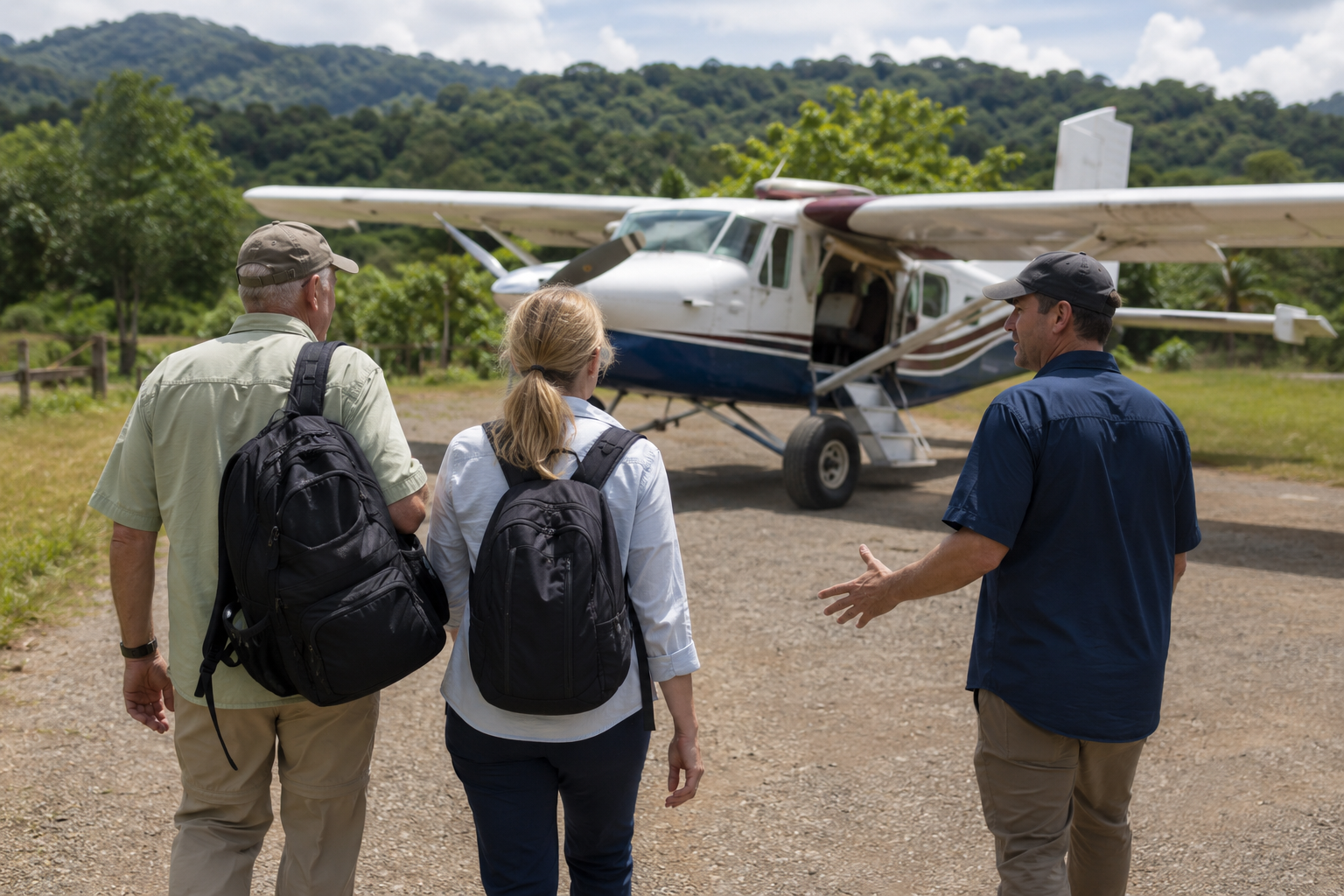
Base staff are not curators of donor experiences; they carry responsibilities that can include flight safety, medical logistics, security constraints, and care for families living cross-culturally. A visit should strengthen their work rather than consume it. The strongest posture is curious, brief, and prepared: prepared with relevant questions, brief in requests for access, and curious about what is hard as well as what is inspiring.
Choose the right kind of visit and timing
Understand operational constraints and safety realities
Christian aviation bases are regulated environments. In the United States, flight operations sit under Federal Aviation Administration oversight, and requirements for safety management, aircraft maintenance, and pilot currency are not optional. The FAA’s focus on aviation safety is public and extensive, and donors can familiarize themselves with basic safety categories and terminology through the agency’s resources at faa.gov.
Internationally, standards and enforcement vary by country, and ministries often operate under multiple aviation authorities and internal policies. That complexity means a base visit should be scheduled when leaders have time to explain the safety and compliance framework—not merely show aircraft.
Avoid visits that unintentionally disrupt the mission
Some seasons are predictably intense: major medical outreach weeks, disaster response surges, end-of-year reporting cycles, and peak training windows for pilots and mechanics. Donors sometimes assume that being present during a high-activity week offers a more “authentic” picture. It may, but it also raises the cost to staff time and attention. A mature visit seeks clarity without becoming an operational burden.
For those evaluating partnership across the wider field, it is often helpful to orient first to the broader landscape of Christian Aviation Ministries, then schedule a base visit as a confirming step rather than a first impression.
Prepare questions that test trustworthiness, not merely activity
Governance, finances, and transparency questions that matter on a base tour
Aviation ministries can be visually impressive while still being fragile organizations. Aircraft are expensive assets; maintenance is non-negotiable; and the donor-facing narrative can drift toward “we need another plane” as a default. A wise visit presses beneath assets to accountability.
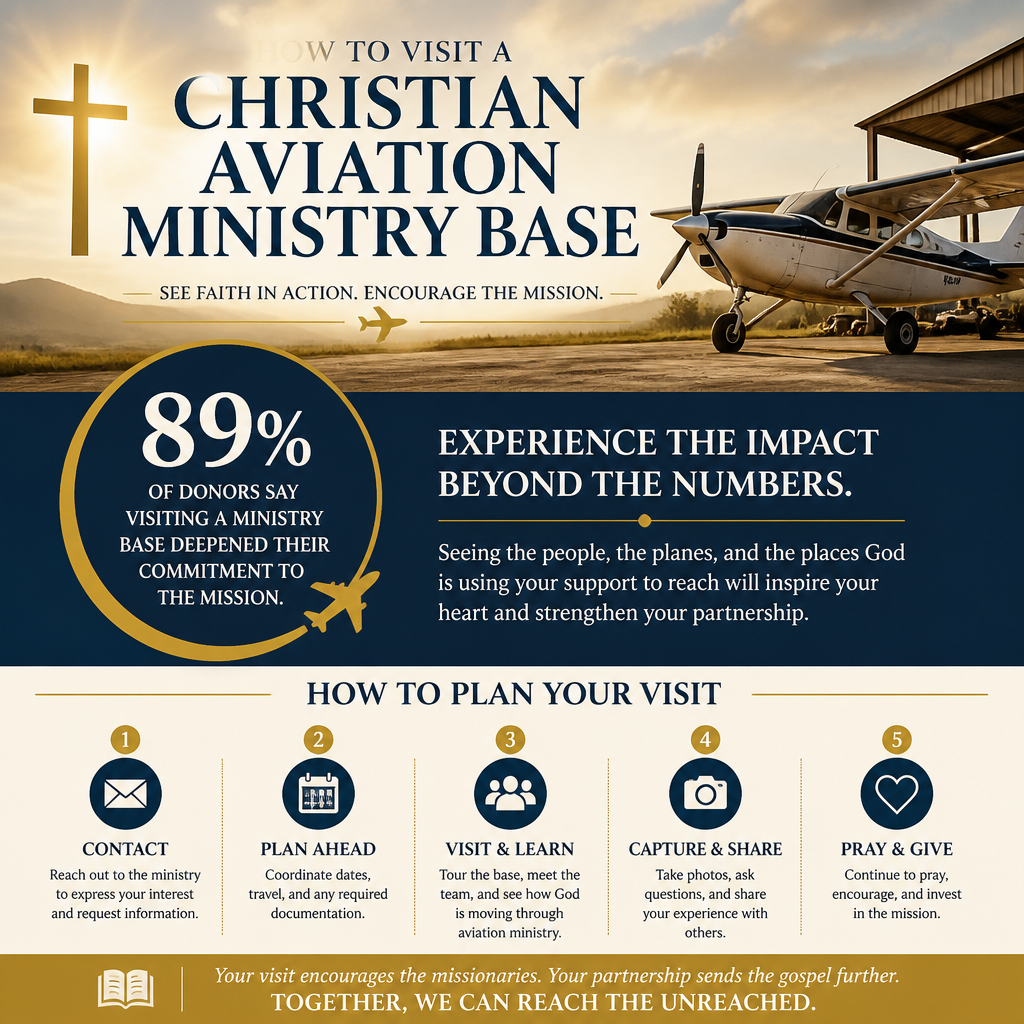
These questions tend to surface meaningful distinctions without turning a visit into an interrogation:
- How does the board oversee risk, especially aviation safety, child safeguarding, and cross-cultural conduct?
- What internal controls exist for fuel, parts, procurement, and designated gifts?
- How are incidents documented, reviewed, and communicated to stakeholders?
- What financial statements are available, and how quickly are they provided upon request?
- How does leadership evaluate program effectiveness beyond stories and flight hours?
For U.S.-based ministries, donors can independently confirm basic nonprofit status and filings. The Internal Revenue Service maintains the Tax Exempt Organization Search, which can help verify an organization’s standing and public information at irs.gov.
Effectiveness questions that respect the local church and local leadership
Christian aviation can easily be framed as the hero of the story: the plane arrives; help arrives. Yet most faithful aviation ministries describe themselves as enablers of local ministry, not replacements for it. The better questions ask about the strength of local partnerships, not the scale of foreign initiative.
Donors should listen for whether staff can name local churches, indigenous leaders, and in-country institutions as primary actors. Where the ministry speaks as though the gospel advances chiefly through imported capacity, wisdom calls for caution. The Great Commission is not fulfilled by logistics alone, but neither does logistics sit outside obedience. The question is whether logistics serves disciple-making in a way that dignifies the church on the ground.
What to observe on site beyond the tour
Culture shows up in small, repeatable behaviors
A base visit reveals how people speak when no one is performing. Donors should watch for patterns: do leaders credit teams or center themselves; do staff speak about local communities with respect or condescension; do safety practices appear consistent or selective. Consistency matters because it signals whether values are operationalized or merely articulated.
Pay attention to whether staff can explain how decisions are made. In healthy organizations, responsibility is clear: who can approve a flight, who can ground an aircraft, who manages safeguarding concerns, and who has authority over financial commitments. Blurred lines often indicate governance weakness or overdependence on a founder figure.
Safeguarding and dignity are part of aviation ministry, not add-ons
Aviation ministries regularly transport vulnerable people: patients, children, displaced families, survivors of violence, and those with limited power to advocate for themselves. Donors should ask how the ministry handles consent, privacy, and documentation. If photography is common on the base, what protects individuals from becoming marketing content?
Christians genuinely disagree about how much donor communication should rely on images and personal stories, but there is broad agreement that vulnerable people must not be used. A serious base visit asks for the policy, the training process, and the accountability mechanism—not simply assurances of good intentions.
Those who want a wider framework for donor partnership—prayer, expectations, accountability, and long-term relationship—will often benefit from engaging Praying for and Partnering with Christian Aviation Ministries before and after a site visit.
Follow up with disciplined due diligence
Request documents and verify what can be verified
A base visit should generate a concrete list of follow-up items. Mature ministries will not treat these requests as distrust; they will treat them as stewardship. In many cases, donors can reasonably ask for recent audited financial statements if available, the most recent annual report, board roster, conflict-of-interest policy, and a high-level summary of safeguarding standards.
Where audits are not available—common for smaller ministries—donors should not automatically assume wrongdoing. The harder question is whether the organization has alternative controls, such as independent financial review, clear segregation of duties, and consistent reporting. The Most Trusted Standard evaluates ministries across faith foundation, financial integrity, governance and leadership, and transparency and effectiveness, precisely because no single artifact proves trustworthiness.
Guard against the halo effect and donor capture
There is a specific temptation in Christian aviation: donors can be won by courage, sacrifice, and a palpable sense of calling. Those are real goods, and the church should honor them. Yet the halo of sacrifice can make donors reluctant to ask ordinary questions about budgets, oversight, executive accountability, or measurable outcomes.
Scripture commends generosity, but it also commends wisdom. “The simple believes everything, but the prudent gives thought to his steps” (Proverbs 14:15). A faithful donor posture honors the missionary and the mechanic by refusing to confuse admiration with verification.
FAQs for How to visit a Christian aviation ministry base
Should donors ask to fly during a base visit?
It is appropriate to ask what observer opportunities exist, but donors should not presume access to flight operations. Many ministries will limit nonessential flights for safety, insurance, regulatory, or operational reasons. A stronger request is to observe a safety briefing, meet with maintenance leadership, or review how dispatch decisions are made; those settings often reveal more about seriousness than a donor flight would.
What if the ministry is warm and inspiring but reluctant to share documents?
Reluctance is not proof of misconduct, but it is a meaningful data point. Donors can ask what the ministry is willing to share and why certain items are restricted. If an organization consistently resists basic transparency—financial statements, governance information, or safeguarding standards—donors should consider whether partnership is wise. Most Trusted exists because trust should be grounded in verifiable evidence, not only relational warmth.
A base visit is stewardship when it is disciplined and reverent
Christian aviation ministry is often costly, frequently dangerous, and sometimes unseen by the churches and donors who make it possible. Visiting a base can deepen gratitude and sharpen confidence, but only when the visit is framed as stewardship: honoring the people served, respecting operational realities, and seeking evidence where evidence can be found. Done well, it strengthens partnership for the long obedience of gospel work rather than for the emotions of a single day.



