
What training Christian aviation ministry pilots need is not a narrow technical question; it is a stewardship question. Donors are not merely funding aircraft and fuel. They are funding a ministry’s ability to move people and cargo safely through environments where margin for error is thin and where the moral weight of risk is borne by real families and real communities.
Aviation is unforgiving of improvisation. The same gospel that sends the church outward also calls leaders to sober judgment: “Suppose one of you wants to build a tower. Won’t you first sit down and estimate the cost…?” (Luke 14:28). In Christian aviation, the “cost” includes competence, recurrent training, maintenance discipline, and organizational courage to stop flying when conditions are not safe.
1. The baseline is professional competency, not missionary sincerity
Licenses and ratings are a starting point, not a credential for mission complexity
Most aviation ministries operate under civil aviation rules, and the pilot’s required certificates and ratings depend on the aircraft, weather, and the kind of operation. In the United States, this typically begins with a Private Pilot certificate and progresses toward an Instrument Rating and Commercial certificate for pilots who will be flying regularly, carrying passengers, or operating in more demanding conditions.
For donors, the key is not the presence of a certificate in a file, but whether the ministry treats “meeting the minimum” as merely the first layer of safety. In many mission contexts, pilots face short and unimproved strips, limited weather reporting, mountainous terrain, language barriers, and the pressure of urgent medical or pastoral needs. Those pressures do not negate prudence; they intensify the requirement for it.
Instrument proficiency is often the dividing line between prudence and wishful thinking
Weather remains a leading factor in many general aviation accidents, and the risk is compounded when a pilot is not equipped to interpret and respond to changing conditions. In the United States, the FAA’s safety analysis has repeatedly identified loss of control and continued VFR flight into instrument meteorological conditions as persistent accident categories in general aviation, a signal that judgment and proficiency are as central as mechanical skill. Federal Aviation Administration
Christian donors should be cautious about romantic narratives that treat weather as a mere obstacle to be overcome by faith. Scripture commends courage, but it does not sanctify presumption. Ministries that train well tend to normalize conservative decisions: delaying, diverting, or cancelling without shame, and communicating those decisions as part of faithful stewardship rather than lack of spiritual resolve.

2. Mission aviation demands a distinct set of operational skills
Short-field, soft-field, and unimproved runway training is not optional in many regions
Operating from short, sloped, wet, or otherwise unimproved runways requires more than a single lesson in a training syllabus. It requires deep familiarity with performance planning, stabilized approach discipline, go-around decision-making, and aircraft-specific limitations. In many mission settings, the runway is not merely “short.” It is surrounded by terrain, subject to sudden wind shifts, and maintained with varying consistency.
Effective training emphasizes structured performance calculations and conservative safety margins, not bravado. A donor’s most practical question is whether the ministry requires standardized checkout procedures for each aircraft type and each class of runway environment, and whether it audits compliance.
Mountain flying and remote-area decision-making require mature judgment
Mountain flying is a specialized discipline: density altitude, downdrafts, ridge crossings, and valley traps punish pilots who rely on general experience rather than targeted training. Remote flying adds further complexity: limited alternate airports, scarce fuel availability, and delayed emergency response.
These realities reward ministries that build a culture of preflight rigor. They also reward ministries that resist the “hero pilot” model. A mature organization prefers systems over exceptionalism: clear go/no-go standards, documented risk assessments, and leadership that will back a pilot who says no.
3. Safety is formed through recurrent training and standardization
Recurrent training should be scheduled, documented, and evaluated
Aviation skill decays without practice, particularly in instrument procedures and emergency response. Strong ministries typically schedule recurrent training cycles that include flight reviews, instrument proficiency work where applicable, scenario-based emergency training, and periodic evaluation flights with an instructor or check pilot.
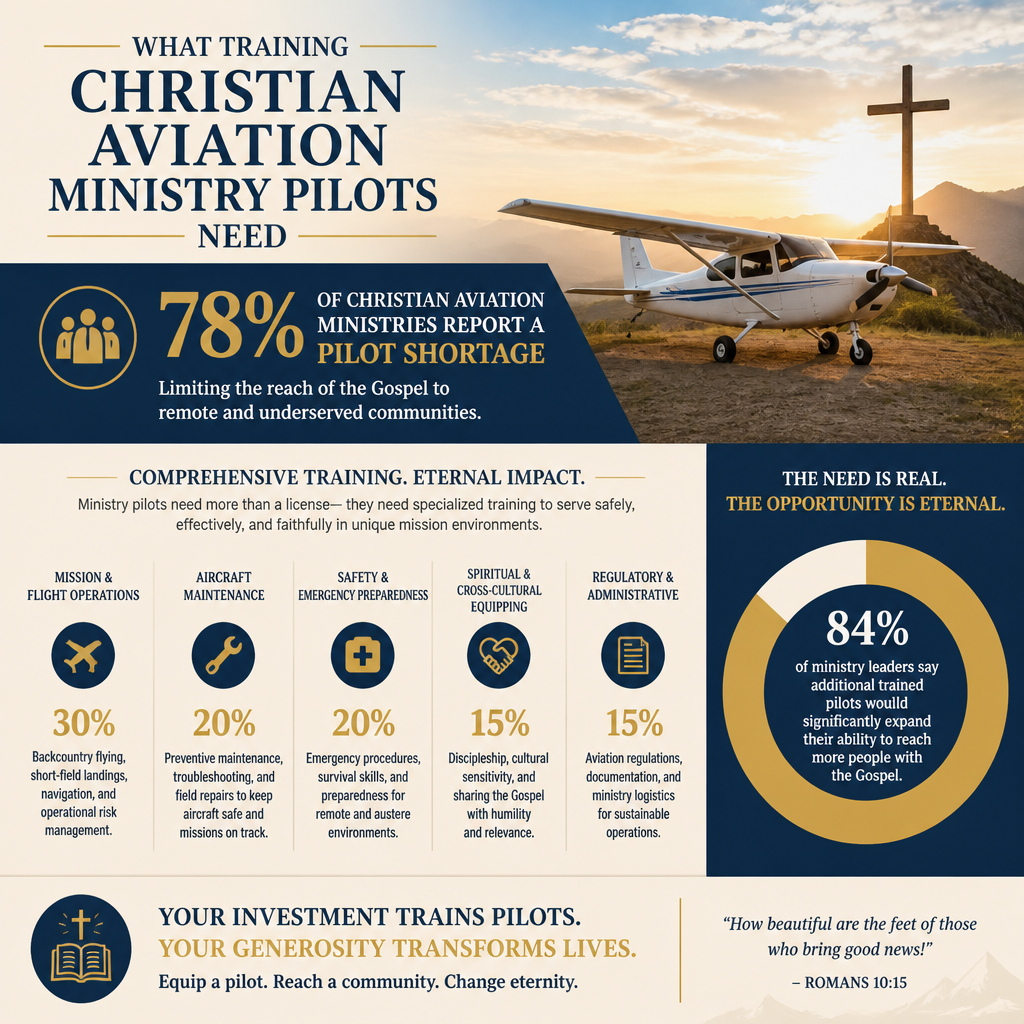
Donors should not be satisfied with “our pilots stay current.” They should look for evidence of a program: training frequency, defined objectives, recordkeeping, and clear remediation pathways when a pilot’s performance shows concerning trends.
Standard operating procedures protect both pilots and passengers
Many mission aviation operations are essentially small airlines in complexity, even if they fly small aircraft. Standard operating procedures, checklists, weight and balance discipline, sterile cockpit expectations, and standardized communications reduce reliance on memory and reduce the odds that stress will produce an error.
Where donors can often see the difference is in consistency. Ministries that treat SOPs as optional tend to have uneven performance across pilots and locations. Ministries that treat SOPs as a form of love for neighbor tend to be boring in the best way: repeatable, explainable, and accountable. For readers who want a broader picture of how ministries handle these operational questions, we address related patterns across Aircraft Safety and Pilot Training in Christian Aviation.
4. The harder question is organizational governance around risk
Training programs reflect leadership courage, not only pilot competence
Training is expensive in money and in mission tempo. In remote contexts, sending a pilot for recurrent training or bringing an instructor to the field can delay flights that donors and beneficiaries want completed. That is precisely why governance matters. If leadership cannot absorb short-term disruption in order to protect long-term integrity, the organization is not truly prepared to carry people by air.
Christians genuinely disagree about how much risk is appropriate in frontier missions. Some emphasize urgency; others emphasize caution. Wisdom requires more than slogans. It requires documented risk tolerance, clear authority for flight release decisions, and a transparent process for reviewing incidents without scapegoating pilots or hiding problems.
Incident reporting and learning cultures distinguish mature ministries
A strong safety culture is not one where nothing goes wrong; it is one where small problems are surfaced before they become tragedies. The aviation industry’s emphasis on confidential reporting and systematic learning exists because human factors are real: fatigue, time pressure, “mission-first” bias, and normalization of deviance.
Donors should ask whether the ministry tracks and reviews safety events, how it investigates them, and whether it makes changes that can be verified. The goal is not public embarrassment or internal blame. The goal is repentance in the practical sense: turning from patterns that endanger people.
5. Donor confidence should rest on verifiable standards, not stories
What donors can reasonably ask for
Christian aviation ministries often communicate compelling stories: a medical evacuation completed in time, a pastor delivered to an isolated village, a Bible translation team supported for months. Those stories matter. But donors are also stewards, and stewardship requires due diligence proportionate to the risk involved.
Across our verification work at Most Trusted, the ministries that meet The Most Trusted Standard tend to treat safety and training as an extension of discipleship and governance. They can demonstrate that their systems are not dependent on a single exceptional leader, and they can explain how decisions are made when conditions deteriorate.
- Training requirements: minimum certificates and ratings for each role, plus mission-specific competencies
- Recurrent training cadence: documented cycles, check rides, and emergency procedure practice
- Standardization: written SOPs, checklists, aircraft checkout processes, and enforcement mechanisms
- Risk governance: clear flight release authority, defined no-go criteria, and leadership backing for conservative decisions
- Safety accountability: incident reporting, review processes, and corrective actions that can be shown
How verification intersects with aviation claims
It is tempting to treat aviation safety as a purely technical domain beyond donor evaluation. Yet donors evaluate other high-risk domains—child protection, medical work, disaster response—by looking for governance and transparency. Aviation should be no different.
Verification is not a substitute for regulators or for professional instruction. It is a way to assess whether a ministry’s public claims align with internal disciplines: whether training is funded, scheduled, measured, and reviewed; whether leadership can articulate safety decisions; and whether the organization communicates honestly about limitations. For a wider view of how these aviation ministries fit within their broader calling and operations, see Christian Aviation Ministries.
FAQs for What training Christian aviation ministry pilots need
Should donors prioritize ministries that require instrument-rated pilots?
Instrument capability is often a meaningful indicator of seriousness, but it is not an absolute test. Some mission contexts legitimately operate in consistently clear conditions where an instrument rating may not be operationally necessary. The donor’s better question is whether the ministry has matched pilot qualifications to the actual environment, and whether it can show conservative weather minimums, recurrent proficiency training, and leadership support for cancellations.
What is a reasonable way for donors to ask about aviation safety without second-guessing professionals?
Donors can ask for systems rather than personal assurances: documented training requirements, recurrent training schedules, SOPs, incident reporting practices, and governance around flight release decisions. These are questions about stewardship and accountability, not about flying technique. Mature ministries generally welcome such questions because they have learned that trust grows where evidence and transparency are normal.
Stewardship in the air is stewardship on the ground
Christian aviation makes visible what is true of all ministry: love of neighbor must be expressed through competent practice. Pilots need licenses, ratings, and mission-specific skills, but they also need an organization willing to fund recurrent training, enforce standards, and tell the truth about risk. Donors who ask for verifiable evidence are not impeding mission. They are honoring the image of God in every passenger, every community served, and every pilot entrusted with their care.



