
How Christian aviation ministries manage operational risk is not a technical question reserved for pilots and mechanics. It is a stewardship question that sits directly in a donor’s line of sight: these ministries routinely operate complex aircraft in austere settings, and the margin for error is often thin.
Christian donors rarely need to be convinced that aviation can extend the Church’s reach. The harder question is whether a ministry’s operational discipline is strong enough to protect people, preserve witness, and sustain long-term service. In our work at Most Trusted, we find that risk is rarely reduced by a single policy or a charismatic leader. It is reduced by a system that holds together spiritual maturity, technical competence, governance accountability, and transparency that does not wait for crisis.
Operational risk begins as a discipleship question, not only a safety question
Stewardship in the air is stewardship on the ground
Scripture treats human life as sacred and stewardship as morally weighty. Christian aviation is not exempt because its mission is urgent. If anything, urgency increases temptation: to fly when fatigue is high, to accept marginal weather, to defer maintenance, to treat documented procedures as optional for “experienced” pilots. Mature ministries resist these pressures by shaping a culture where prudence is a form of love.
That culture is not vague. It shows up in how leaders speak about “get-there-itis,” how crews are trained to call a stop without fear, and how the organization handles disappointment when a flight is canceled. The visible decision is a canceled flight; the invisible decision is whether the ministry will reward faithful restraint or quietly punish it through reputation, internal politics, or fundraising expectations.
Risk is also reputational and spiritual
Operational failures carry more than financial consequences. They can create moral injury for staff, undermine trust with national church partners, and harm the credibility of Christian witness in communities already wary of foreign organizations. Many aviation accidents in the broader sector are not caused by a single catastrophic choice, but by accumulated normalization of deviance—small departures from standard practice that gradually become “how we do things.” Ministries that manage operational risk well treat that drift as a spiritual and organizational threat, not merely a compliance issue.

The strongest safety cultures insist on standards, training, and stop authority
Standards that are written, taught, and enforced
In aviation, standards are not bureaucratic decoration; they are shared expectations that make decision-making predictable under stress. Donors can reasonably expect ministries to maintain written operations manuals, standard operating procedures, and clearly defined minimums for weather, runway conditions, aircraft loading, and fuel reserves. Many ministries align their internal expectations with widely accepted industry guidance, including the International Civil Aviation Organization’s approach to Safety Management Systems, which emphasizes proactive hazard identification and continuous improvement rather than reactive blame after incidents International Civil Aviation Organization.
It is not enough for these standards to exist. They must be enforceable even when the CEO’s preferred outcome is a launch. Donors should pay attention to whether “stop authority” is real for pilots, mechanics, and operations staff. A ministry that cannot tolerate a canceled flight cannot sustain safe service for long.
Training that is recurrent and scenario-based
High reliability organizations train for routine competence and for rare, high-consequence scenarios. In aviation ministry contexts, that can include short-field operations, mountain weather, controlled flight into terrain risk, single-pilot workload management, and decision-making under pressure from partner expectations. Recurrent training is an investment, and it competes with mission expansion. The ministries most prepared for long-term service treat training as mission capacity, not overhead.
Donors can ask whether training is documented, whether check rides are conducted by qualified evaluators, and whether training results are used to improve operations rather than to shame people. For donors who want a wider view of the field’s safety and training distinctives, we maintain continuing analysis across Aircraft Safety and Pilot Training in Christian Aviation as part of our verification research.
Governance, maintenance discipline, and documentation reduce hidden failure modes
Maintenance is where theology meets math
Aircraft do not care about good intentions. They respond to physics, preventive maintenance, and disciplined inspections. A ministry’s maintenance program is one of the most revealing windows into its operational risk posture because maintenance failures often incubate quietly. Strong programs include scheduled inspections aligned to manufacturer guidance, credible parts sourcing, rigorous logbooks, and independent oversight when feasible.
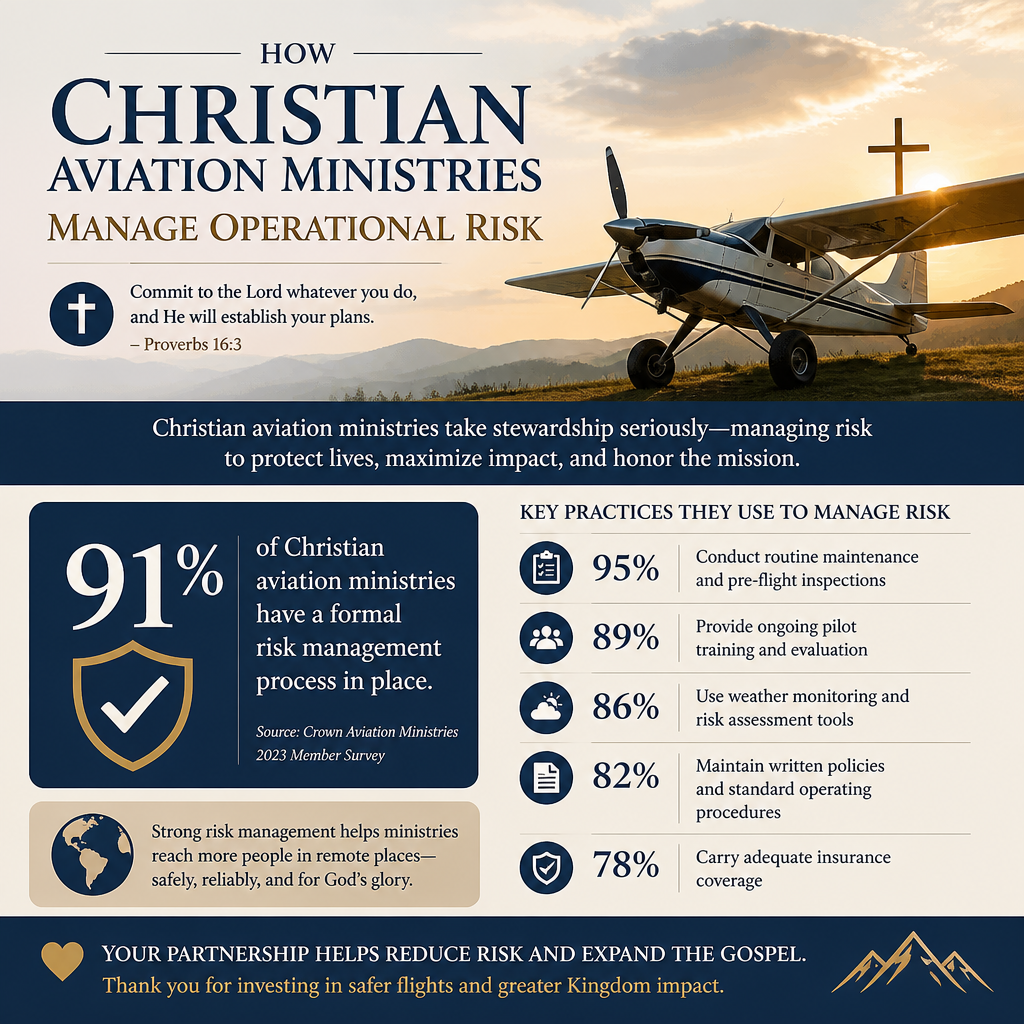
Donors should be cautious about simplistic indicators such as “our mechanic is a genius” or “we have always done it this way.” The question is whether the ministry can demonstrate a systematic approach: documented inspection intervals, calibration of tools, adherence to airworthiness directives, and a process for grounding an aircraft without fear of reprisal when a concern arises.
Board oversight must include safety competency
Operational risk is ultimately a governance matter because it involves trade-offs: growth versus training time, cost control versus redundancy, and aggressive schedules versus conservative margins. A board does not need to micromanage flight decisions, but it should ask for regular safety reporting, trend analysis, and evidence that leadership acts on findings.
Across our verification work, the ministries that meet The Most Trusted Standard tend to treat safety as part of fiduciary responsibility. Their boards can articulate what they monitor, how often they review incident and near-miss reports, and how they ensure adequate resources for maintenance and training. Where boards are passive or uninformed, risk typically migrates from “managed” to “latent.”
Incident reporting and learning systems separate mature ministries from lucky ones
Near-miss reporting is a gift to the organization
Many donors assume the absence of an accident is proof of safety. Aviation history suggests otherwise. Mature operators are often distinguished less by a spotless record and more by how they learn from minor events, hazards, and near misses.
A credible incident reporting culture has three marks: reports are encouraged, the response is non-punitive for honest mistakes, and leadership converts lessons into changes in training, procedures, or resourcing. If people are afraid to report a fuel miscalculation, a runway excursion, or a maintenance discrepancy, the organization will not learn until the stakes are far higher.
Data, trend review, and humility about human limits
Operational risk management requires humility about fatigue, distraction, and the subtle ways stress narrows judgment. The broader safety literature has long documented the role of human factors in aviation incidents, and the Federal Aviation Administration continues to emphasize human factors and risk management in pilot training and safety education Federal Aviation Administration. Ministries that take this seriously treat duty-time policies, rest, and workload management as forms of moral responsibility rather than personal toughness.
When donors evaluate a ministry, it is reasonable to ask for evidence of trend review: Are incidents categorized? Are recurring issues identified? Are corrective actions assigned and tracked? Without that loop, a ministry is often depending on goodwill and experience rather than a learning system.
What donors should ask and what credible transparency looks like
Questions that reveal substance rather than marketing
Donors do not need to become aviation experts to ask questions that separate mature risk management from reassuring language. The goal is not suspicion; it is stewardship. A ministry worthy of trust will not be offended by careful questions, because careful questions protect people and mission.
- Who has authority to cancel a flight, and how is that authority protected from internal pressure?
- What recurrent training is required for pilots and mechanics, and how is completion documented?
- How does the ministry handle incident and near-miss reporting, and what changes have been made as a result?
- What maintenance standards govern inspections, parts sourcing, and aircraft logbooks?
- How does the board receive and review safety information, and how often?
Transparency that respects privacy without hiding risk
Some safety information is appropriately limited for privacy, security, and legal reasons. But secrecy is not the same as discretion. Credible transparency shows up in aggregated reporting, clear explanations of safety systems, and willingness to describe improvements made after incidents without spin.
This is one reason verification can serve donors well. Most Trusted evaluates ministries against The Most Trusted Standard, a 15-criteria framework that attends to faith foundation, financial integrity, governance and leadership, and transparency and effectiveness. In aviation ministries, those categories converge: strong governance supports safety discipline; honest transparency supports learning; financial integrity supports maintenance and training; and a coherent faith foundation shapes whether leaders treat human limits with humility rather than bravado.
For donors seeking broader context on how aviation ministries relate to mission outcomes, accountability, and stewardship expectations, our ongoing coverage of Christian Aviation Ministries tracks patterns we can verify across organizations rather than relying on slogans.
FAQs for How Christian aviation ministries manage operational risk
Should donors prioritize ministries with newer aircraft as a sign of lower risk?
Newer aircraft can reduce certain maintenance burdens, but aircraft age alone is a weak proxy for operational risk. A well-maintained older airframe with disciplined inspections, good parts sourcing, and conservative operating practices may be safer than a newer aircraft flown under schedule pressure with weak training and inconsistent documentation. Donors are better served by asking about maintenance programs, recurrent training, and reporting culture than by assuming “new” means “safe.”
Is a ministry’s accident-free history enough to establish trust?
An accident-free history is encouraging, but it is not a complete risk assessment. Many hazards present as near misses, maintenance discrepancies, or judgment calls that never become public. Mature ministries build systems that surface those signals early and respond with humility and measurable corrective action. Donors should look for evidence of learning systems, board oversight, and transparency practices that do not depend on luck.
Risk management is mission fidelity over time
Christian aviation exists to serve the Church’s work in hard places, often under demanding constraints. Managing operational risk is therefore a question of moral seriousness: whether a ministry will protect life, honor partners, and sustain service for decades rather than seasons. Donors who ask for verifiable evidence of standards, training, governance oversight, and transparent learning are not slowing mission; they are strengthening it.



