

Accountability and transparency in Christian aviation ministries are not administrative preferences; they are spiritual and fiduciary obligations that sit close to the biblical doctrine of stewardship. Aviation work is operationally complex, capital-intensive, and often conducted across borders where regulation and banking norms vary. Donors are right to ask not only whether the gospel is being proclaimed, but whether financial practices, governance, and reporting are strong enough to protect both people and witness.
Most aviation ministries also operate in a tension donors can feel: the most compelling stories are frequently the hardest to verify, because they occur in remote places with limited infrastructure and heightened security risk. Yet Scripture does not relax the demand for integrity when circumstances are difficult. Paul’s ministry took extraordinary precautions with collected funds, insisting on visible accountability “so that no one should blame us” in the matter of administration (2 Corinthians 8:20–21). That standard has direct relevance for flight operations, restricted-access fields, and emergency medical transport where a single decision can have significant financial and safety consequences.
Why aviation ministries require a higher bar than ordinary financial hygiene
Christian aviation is not simply “missions with airplanes.” It is an ecosystem of regulated safety, specialized staffing, high-value assets, and unpredictable operating environments. That combination creates integrity risks that conventional nonprofit oversight can miss. When donors sense opacity here, it is often because the ministry’s systems have not matured to the weight its operations carry.
High-cost assets raise the stakes for governance and reporting
An aircraft is a ministry tool, but it is also a major financial instrument. Acquisition, depreciation, maintenance reserves, engine overhauls, avionics upgrades, hangar costs, and insurance are not incidental details. Transparent ministries explain how they budget for lifecycle costs and how capital decisions are approved, documented, and reviewed. When a ministry reports a surplus while deferring maintenance or relying on a small circle of internal approvals, donors should recognize that the apparent financial health may be brittle.
Evidence from the U.S. Government Accountability Office illustrates the broader risk environment around aviation maintenance. The GAO has documented challenges in ensuring consistent oversight and compliance in aviation maintenance contexts, underscoring why internal controls and documentation matter even when external regulation exists (U.S. Government Accountability Office).
Geography, security, and currency do not excuse weak controls
Costs vary by region for legitimate reasons: fuel supply chains, parts availability, mechanic certification, landing fees, and the administrative burden of cross-border compliance. Some ministries also limit public detail to protect staff and partners. Mature transparency names these constraints openly while still providing verifiable substance: audited financial statements, clear accounting policies, segmented reporting by program, and specific governance disclosures. Donors can respect security constraints while still requiring credible oversight.
The overhead debate is particularly misleading for aviation work
Donors are often trained to fixate on “administrative costs,” but aviation ministries expose the poverty of that metric. Safety management, mechanic supervision, quality assurance, pilot training, incident reporting systems, and compliance documentation may be categorized as overhead, yet they are essential to mission delivery and to protecting life. The widely endorsed “Overhead Myth” statement from sector leaders remains relevant here: minimizing overhead can be counterproductive when it reduces the capacity needed for results and accountability (Candid GuideStar).

What credible financial transparency looks like in aviation ministries
Transparency is not a public-relations posture. It is a disciplined practice of making key financial information accessible, intelligible, and comparable over time, without shifting definitions to flatter results. The ministries that donors trust most tend to treat financial statements as ministry documents, not internal artifacts.
Audited statements that donors can actually use
For ministries of meaningful scale, an independent audit is not a luxury; it is an external check that donors should expect. Audited financial statements should be available upon request, and in many cases posted publicly. A credible ministry will also explain what the audit does and does not do: an audit provides reasonable assurance that statements are free from material misstatement; it is not a guarantee against fraud. Donors should look for management letters, disclosure of related-party transactions where applicable, and consistent presentation year over year.
Program reporting that matches the operational reality
In aviation ministries, the most honest program reporting often distinguishes between flight operations, maintenance, training, and field support, rather than collapsing everything into a single “missions” category. Donors should expect clarity on how costs are allocated, particularly when aircraft serve multiple purposes: medical evacuation, pastor transport, disaster response, and cargo. Allocation can be legitimate, but it should be governed by a documented policy reviewed by leadership and, ideally, by an audit committee.
Reserves, restricted gifts, and the true cost of readiness
Aircraft and pilots must be ready when the need arises, which means readiness costs exist even when planes are grounded by weather, geopolitics, or maintenance cycles. Ministries should clearly report operating reserves and the handling of restricted gifts, especially if donors fund aircraft purchases, hangars, or major repairs. A donor’s confidence increases when a ministry can explain how designated funds are tracked, when they can be repurposed, and how donors are notified if circumstances change.
Donors should also be wary of ministries that repeatedly seek emergency gifts for predictable expenses such as engine overhauls, insurance, or compliance training. Chronic crisis fundraising can be a symptom of weak budgeting, unrealistic growth assumptions, or an unhealthy donor communications culture.
Governance and anti-fraud controls that protect donor intent and ministry witness
Financial integrity is not sustained by good intentions. It is sustained by governance that is willing to ask hard questions, and by internal controls designed for real-world temptation and real-world pressure. Aviation work adds distinctive fraud and misuse risks: fuel purchases in cash economies, procurement across borders, contractor relationships, and the complexity of tracking parts and maintenance labor.
Independent oversight that is more than a name on a letterhead
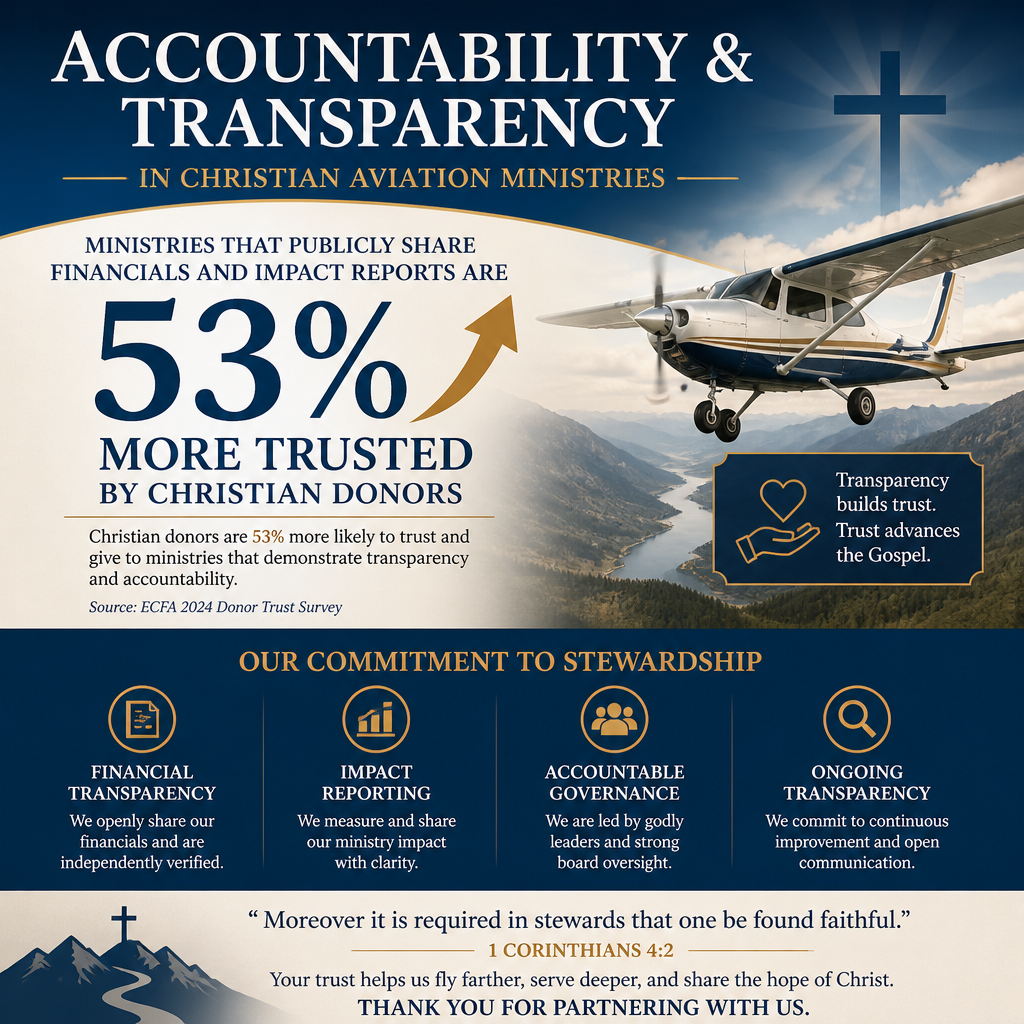
Effective boards do not simply bless leadership decisions; they test them. Donors should look for governance practices that indicate independence: documented conflict-of-interest policies, regular disclosure statements, and board minutes that reflect substantive review of finances, risk, and strategy. In aviation contexts, boards should also understand safety governance at a high level, even if they are not aviation specialists, because safety failures rapidly become financial and reputational failures.
Segregation of duties and purchasing controls in the real world
Small ministries often struggle with segregation of duties because staffing is lean. Donors should not demand an unrealistic corporate structure, but they should expect compensating controls. Examples include dual approvals for purchases above a threshold, a clear expense reimbursement policy, periodic review of credit card and fuel card transactions, and independent bank reconciliations. Ministries should be able to describe these controls without defensiveness.
Fraud prevention is not hypothetical. The Association of Certified Fraud Examiners has repeatedly found that occupational fraud is commonly detected through tips, a reminder that whistleblower channels and a culture that protects those who raise concerns are practical necessities (Association of Certified Fraud Examiners).
Partner accountability and the risk of delegated opacity
Aviation ministries often collaborate with churches, mission agencies, and local partners. Donors should look for clarity on how partner funds are controlled and verified. Delegating program delivery does not delegate responsibility. A ministry that routes funds to partners should have written agreements, documented deliverables, and a process for verifying outcomes and expenditures appropriate to the risk level. Where verification could endanger local believers, ministries should describe alternative safeguards rather than simply going silent.
This is also where Christians genuinely disagree about “how much transparency is enough.” Some donors prioritize maximum disclosure. Others prioritize security and discretion. The better ministries refuse the false choice; they provide meaningful transparency to donors while protecting vulnerable people, and they invite questions when donors need more assurance.
How donors can evaluate accountability without becoming cynical
Mature Christian donors often carry two burdens at once: the desire to be generous and the responsibility to be discerning. Cynicism is not discernment, but neither is naïveté. The goal is not to find a ministry with no risk; it is to find one that names risks truthfully and has governance capable of bearing them.
Questions that surface substance rather than rhetoric
Donors can ask a small set of questions that reveal whether accountability is operational or merely aspirational:
- Financial reporting: Are audited financial statements available? Are they recent, and are accounting policies consistent year to year?
- Cost clarity: How does the ministry explain administrative and safety-related costs, and do those explanations align with the operational realities of aviation?
- Controls: Who approves spending, who reconciles accounts, and what happens when controls cannot be fully separated due to small staff size?
- Governance: How does the board handle conflicts of interest, related-party transactions, and executive compensation decisions?
- Impact and ethics: How does the ministry report outcomes without inflating numbers or using stories that cannot be responsibly verified?
What donor stewardship looks like when costs vary by region
Regional cost differences can be legitimate, and donors should avoid simplistic comparisons. The harder question is whether the ministry can explain those differences in ways that are consistent with transparent bookkeeping. Fuel costs, customs delays, and the availability of certified maintenance all affect budgets. A credible ministry can show donors how these realities are incorporated into forecasts, how surprises are handled, and how leaders avoid shifting costs into restricted categories to make unrestricted finances appear healthier.
Where Most Trusted fits in donor due diligence
Most Trusted exists because donors should not have to choose between generosity and responsible verification. Across our evaluation work, we find that the ministries that meet The Most Trusted Standard tend to do three things well: they ground their mission clearly in historic Christian faith; they treat financial integrity as a form of discipleship; and they communicate with a level of transparency that invites scrutiny rather than resenting it. Where donors want to compare aviation ministries against consistent criteria, we provide independent verification across faith commitments, financial integrity, governance, and transparency and effectiveness.
For donors who are also assessing mission fit, theology, and the distinct challenges of flight-based ministry, see our coverage of Christian Aviation Ministries.
A Christian account of trust that still requires proof
Christian giving is an act of trust, but Scripture does not treat trust as permission to abandon prudence. The church is called to generosity, and also to conduct itself “honorably” in ways that withstand examination (2 Corinthians 8:21). Aviation ministries that embrace accountability and transparency do more than satisfy donor questions; they protect the vulnerable, strengthen their witness, and honor the Lord who sees what is done in secret.
Donors can ask for audited statements, clear governance practices, and credible reporting without treating ministries as adversaries. The goal is a form of partnership where generosity is guided by truth, and where stewardship is measured not only by outcomes but by the integrity with which the work is carried out.



