

When Christian donors ask what share of donations funds apologetics outreach, they are rarely asking for a single percentage. They are asking whether their giving actually advances the work of gospel witness—publicly commending Christ as true—rather than quietly subsidizing institutional maintenance.
The harder reality is that apologetics ministries account for outreach in different ways. Some treat content creation as outreach. Others reserve the term for direct evangelistic engagement on campuses, in media, or in live events. Still others embed apologetics inside discipleship, pastoral resourcing, or evangelism training. A donor can still make a wise decision, but only by reading the ministry’s definitions and financial signals with care.
Why a single percentage rarely tells the truth
Apologetics outreach has more than one legitimate form
Apologetics is part of the church’s witness: “always being prepared to make a defense to anyone who asks you for a reason for the hope that is in you” (1 Peter 3:15). That defense can be offered in a lecture hall, a podcast feed, a book, a YouTube channel, a small group curriculum, a radio call-in show, a campus dialogue, or a private conversation after an event. Each channel carries real costs, and not all costs map cleanly onto a line item called “outreach.”
For example, a ministry may spend heavily on research, writing, editing, and production. That may look like “program” expense, but it is also the outreach engine if the ministry’s primary touchpoint with seekers is content. Another ministry may spend heavily on travel, event staffing, and local partnerships. That is clearly outreach, but it may deliver fewer “impressions” than a single widely distributed video. Both models can be faithful; both can be mismanaged.
Accounting categories blur the boundary between outreach and support
Nonprofit financial statements typically divide expenses into program services, management and general, and fundraising. This framework is useful, but it does not answer a donor’s theological question: whether resources are being stewarded toward tangible ministry fruit. Sector-wide, donors have been taught to treat “overhead” as suspect, but the nonprofit field has challenged that reflex for years. The “Overhead Myth” joint letter—signed by Charity Navigator, GuideStar (now Candid), and the BBB Wise Giving Alliance—argues that overhead ratios can mislead donors and incentivize underinvestment in the very capacities that make programs effective.
That warning matters in apologetics. High-quality theological research, editorial rigor, safeguarding practices for student engagement, and serious measurement are not optional add-ons. Underfunding them can produce weak content, avoidable errors, and preventable harm.

What apologetics ministries usually mean by outreach spending
Common outreach cost centers donors can recognize
Across our verification work at Most Trusted, we see apologetics outreach expenses typically cluster around a few recognizable categories. The names vary, but the substance is often similar:
- Public content delivery such as broadcast, podcasting, video distribution, publishing, and platform operations
- Live engagement such as campus events, church events, debates, Q&A nights, and conference appearances
- Direct seeker engagement such as follow-up conversations, online response teams, and referrals to local churches
- Training evangelists and leaders through curricula, cohorts, or workshops designed to equip Christians to answer objections
- Translation and contextualization when the ministry adapts materials for other languages or cultural contexts
Each of these can qualify as “outreach” in a ministry’s internal language, but the donor’s task is to determine what is actually happening. A content-heavy ministry may be effective if it can demonstrate reach, engagement, and credible stories of impact. An event-heavy ministry may be effective if it can demonstrate real attendance, substantive interaction, and follow-through that connects people to the life of the church.
What gets mis-labeled as outreach
The risk is not only that ministries undercount outreach; it is that they overcount it. Branding campaigns framed as “evangelism,” internal staff retreats framed as “training,” or vague “awareness” initiatives framed as “impact” can inflate outreach language without advancing mission outcomes.
We also encourage donors to watch for ministries that treat “content output” as the primary outcome without addressing whether content is accurate, pastorally wise, and accountable to a clear doctrinal standard. Apologetics that wins arguments but erodes gentleness, humility, or fidelity to Scripture is not the apologetics the New Testament commends.

How to evaluate the share of donations going to outreach without falling for the overhead trap
Start with the audited financial signals, then move to program clarity
When a ministry is large enough to have an annual audit, an audited financial statement is one of the clearest discipline-producing tools available. Form 990s can also be useful for U.S. nonprofits. But donors should treat these documents as a starting point, not the final word, because they do not define “apologetics outreach” the way donors do.
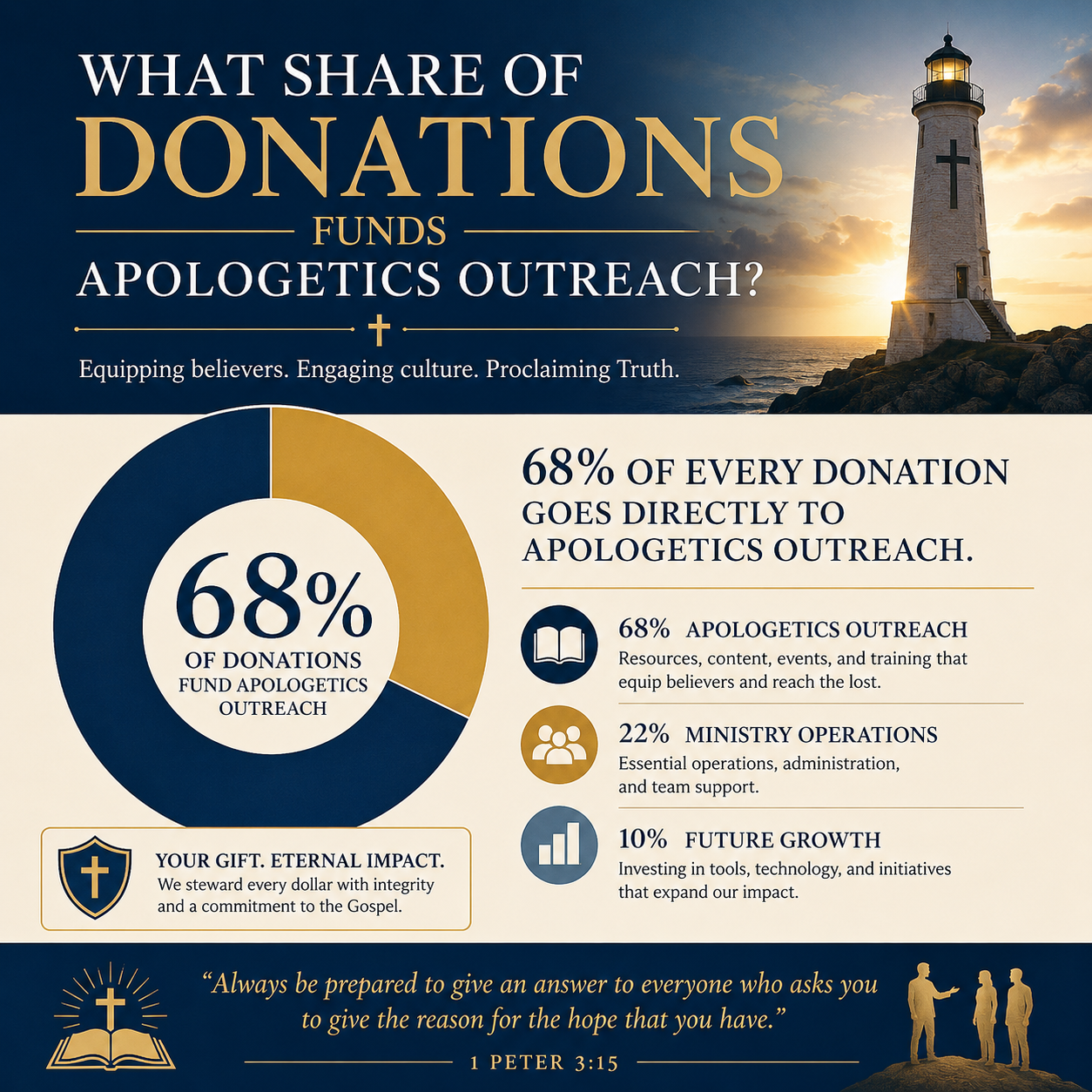
What this means in practice is that donors should ask two questions in sequence. First: what share of total expense is categorized as program service? Second: within program service, what share is plausibly and consistently tied to outreach activities rather than internal servicing? A ministry with a strong program ratio but unclear program descriptions can still be difficult to trust. A ministry with a slightly lower program ratio but high transparency and clear outcomes may be the better steward.
Use the Overhead Myth insight correctly
The Overhead Myth letter does not say overhead is irrelevant. It says overhead is not a proxy for effectiveness, and that fixation on overhead can distort stewardship. Donors still have a right—and a responsibility—to examine whether a ministry’s administrative and fundraising costs are reasonable for its size, complexity, and model. The question is whether those costs are warranted by real governance, financial controls, theological quality, and measurable mission advance.
High fundraising expense, for example, may be a necessary phase for a growing ministry, or it may be a symptom of an undisciplined acquisition model. Donors should seek a ministry’s explanation in plain language and verify whether the explanation is consistent over time.
Source: Charity Navigator homepage (for the Overhead Myth signatory organization)
Source: Candid homepage (GuideStar’s successor organization and Overhead Myth signatory)
Source: BBB Wise Giving Alliance homepage (Overhead Myth signatory organization)
Practical donor questions that reveal real outreach allocation
Questions that force definitions and evidence
Apologetics ministries that steward donations well tend to welcome precise questions. Vague answers often signal vague internal measurement. We recommend asking for definitions, timeframes, and examples that can be checked.
Here are questions that commonly clarify the share of donations funding outreach:
- How do you define apologetics outreach in your internal reporting, and what activities are excluded?
- What are your major outreach channels and what percentage of program expense is allocated to each?
- What portion of staff time is devoted to direct outreach versus internal operations and donor communications?
- What outcomes do you track besides content volume, such as live engagement, follow-up conversations, or church connection?
- How do you ensure theological accountability for what you publish and teach?
Questions that test whether outreach is spiritually responsible
Christian donors are not merely funding communications. They are funding witness. That brings spiritual responsibilities that a typical media organization does not carry. A ministry can spend a high share on “outreach” and still do harm if it cultivates performative outrage, rewards rhetorical domination, or treats the local church as a competitor rather than the ordained center of discipleship.
We encourage donors to ask how a ministry relates to local churches, whether it refers seekers into embodied community, and how it handles pastoral care when public apologetics surfaces trauma, doubt, or crisis. The more public the platform, the more serious the ministry’s duty of care.
How Most Trusted assesses apologetics outreach within The Most Trusted Standard
Allocation is a stewardship question, but it is not the only one
At Most Trusted, we evaluate Christian nonprofits against The Most Trusted Standard, a 15-criteria framework spanning faith commitments, financial integrity, governance and leadership, and transparency and effectiveness. Outreach allocation is part of what donors should examine, but it is not sufficient by itself. A ministry can spend heavily on outreach and still fail to demonstrate financial controls, board oversight, or truthful impact reporting.
Across our verification work, the ministries that meet The Most Trusted Standard tend to do three things consistently: they define their programs in plain language; they publish enough financial and operational detail to be checked; and they show that leadership treats donors as partners in stewardship rather than as targets in a marketing funnel.
Where to continue due diligence in context
Donors who want to compare apologetics organizations within a broader landscape of models and theological emphases can begin with Christian Apologetics Ministries. Donors who want a more specific lens on financial use and accountability patterns can consult How Christian Apologetics Ministries Use Donations as a way to frame questions consistently across ministries.
FAQs for What share of donations funds apologetics outreach
Is there a healthy percentage apologetics ministries should spend on outreach?
There is no universal biblical or financial percentage that fits every apologetics ministry. The right share depends on the ministry’s model, scale, and channels—content production, live events, training, or direct engagement each carry different cost structures. A more reliable approach is to verify that (1) program spending is clearly described, (2) leadership can explain how dollars connect to outreach activities, and (3) the ministry reports outcomes honestly without inflating numbers.
Should we avoid ministries with higher administrative or fundraising costs?
Not automatically. Sector guidance has warned donors against treating overhead ratios as a proxy for effectiveness, because that can punish ministries for investing in governance, systems, safeguarding, and evaluation. The better question is whether administrative and fundraising expenses are reasonable for the organization’s complexity and whether those functions strengthen stewardship and integrity. When costs rise, donors should expect clear explanations, consistent reporting over time, and evidence that leadership is not using “outreach” language to disguise operational drift.
Stewardship requires more than a ratio
Christian donors are right to ask what share of donations funds apologetics outreach, because giving is an act of stewardship before God, not a mere transaction. But the answer worth trusting is rarely a single number. The ministries most worthy of confidence define outreach carefully, report finances transparently, and demonstrate that their public defense of the faith is joined to humility, truthfulness, and accountable leadership.



