
What financial transparency looks like in apologetics ministries is not a secondary concern for Christian donors; it is part of the moral texture of stewardship. Scripture refuses to separate money from discipleship. “It is required of stewards that they be found faithful” (1 Corinthians 4:2), and faithfulness can be examined.
Apologetics adds a particular set of pressures. Much of the work is intellectual and communicative: research, publishing, media production, training events, digital outreach. Donors cannot “see the wells” or “count the meals” in the same way they might with mercy ministry. That difference makes clarity about budgets, controls, and results more—not less—important.
Transparency begins with a biblical doctrine of stewardship
Apologetics is ministry, not a private platform
Christian apologetics exists to commend the truth of the gospel and strengthen the church’s witness. When it is healthy, it serves the church rather than substituting for it, and it treats donors as partners rather than customers. Financial transparency is one way a ministry demonstrates that its public teaching is matched by private integrity.
That integrity has biblical precedent. Paul repeatedly handled money with visible care, including the collection for Jerusalem. He insisted on accountable administration “to avoid any criticism of the way we administer this liberal gift” (2 Corinthians 8:20–21). The principle is not suspicion; it is love of neighbor, expressed as verifiable prudence.
Transparency is not the same as publicity
Some ministries equate transparency with frequent updates or compelling donor stories. But a high volume of communication can still leave crucial questions unanswered: Who approves spending? How are conflicts of interest handled? Are restricted gifts honored? Are the numbers internally consistent across audited statements, annual reports, and fundraising appeals?
Christian donors are right to expect a ministry that teaches truth publicly to be equally committed to truthfulness in financial representation. That expectation is neither cynicism nor “secular accountability.” It is an application of Christian moral seriousness to the stewardship of other people’s gifts.

The minimum public record a donor should be able to verify
Three documents that should agree with each other
In the United States, most established ministries leave a paper trail. Even when a donor does not have the time to read every line, basic transparency means the ministry’s public materials do not contradict its required filings.
- IRS Form 990 (for most nonprofits): it provides governance disclosures, key compensation reporting, major contractors, and high-level financials. The IRS notes that Form 990 is intended to provide the public with financial and operational information (IRS Form 990 resources).
- Audited financial statements (often for larger ministries): they show whether an independent auditor has tested the numbers and internal controls to a defined standard.
- Annual report: it interprets the ministry’s work and finances for donors. The annual report should match the audited statements and, where applicable, the Form 990 categories in substance, even if it uses simpler labels.
When these documents exist but do not reconcile, donors should slow down. Disagreement can have innocent explanations, but repeated inconsistency is a signal that the ministry may not have mature financial operations.
Why the Overhead Myth debate does not remove the need for clarity
Christians genuinely disagree about how much emphasis donors should place on overhead ratios. Many in the nonprofit field have criticized simplistic overhead scoring, including major evaluators who argued that a narrow focus on overhead can incentivize unhealthy underinvestment in systems and staff (Charity Navigator). The critique is fair as far as it goes.
But donors do not need a single “right ratio” to ask for honest categorization and plain explanations. A ministry can defend its spending priorities while still making them intelligible: what counts as program, what counts as fundraising, what counts as administration, and why those choices are faithful to the mission.
What transparency looks like inside an apologetics budget
Program cost clarity in content-driven work
Apologetics ministries often produce books, videos, podcasts, courses, conferences, academic partnerships, and online resources. These outputs can be spiritually fruitful, but their costs can be difficult for donors to interpret because “program” includes significant labor and production expenses.
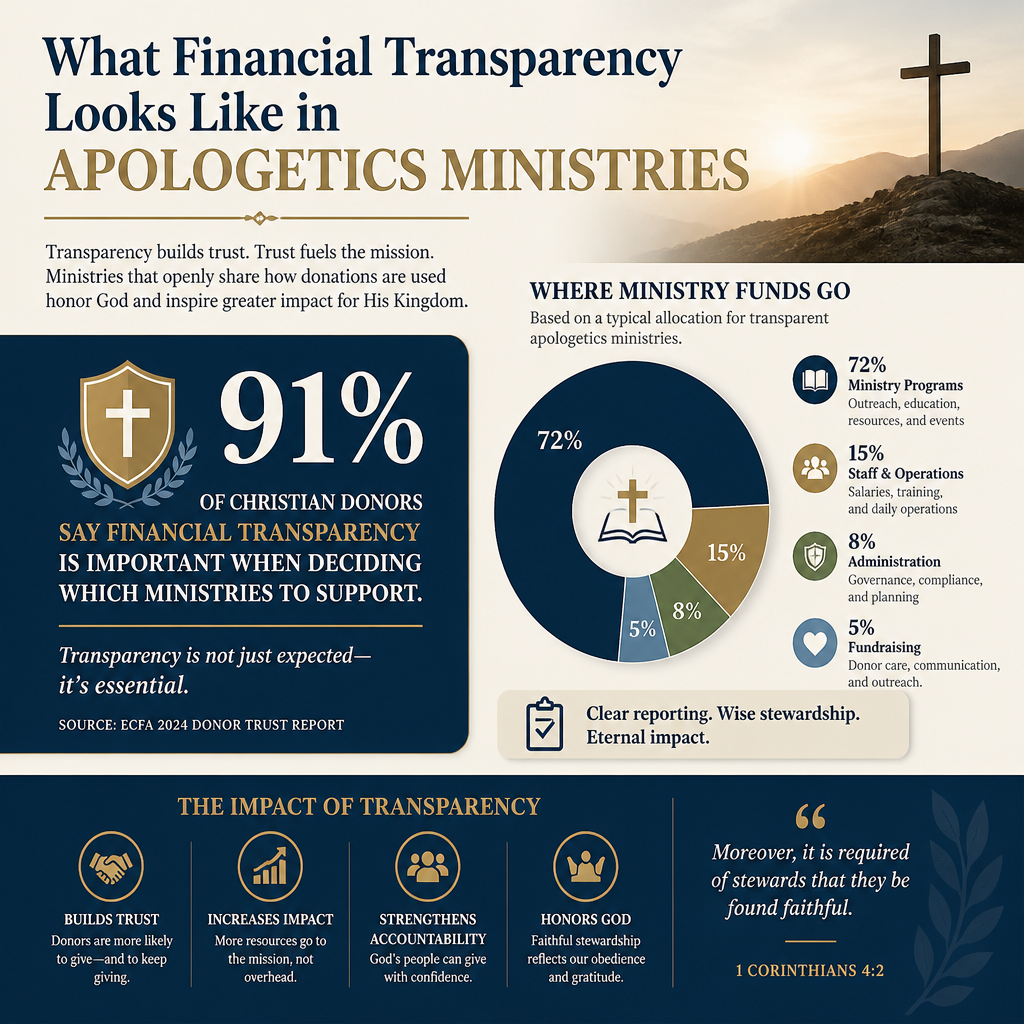
Financial transparency in this context includes itemized clarity about major categories such as content production, event production, curriculum development, translation, research support, and pastoral or student training. It also includes a candid explanation of what is free to the public, what is underwritten by donors, and what is funded through earned revenue such as ticket sales or product sales.
Fundraising and marketing must be distinguished from mission communication
Apologetics ministries live by communication. That reality creates a legitimate tension: the same team may create evangelistic content, donor appeals, and brand-building material. The ethical question is not whether communication costs exist; it is whether the ministry is clear about which costs are primarily fundraising and which are primarily program.
Donors should be able to see, at least at a high level, the difference between teaching content intended for the public good and fundraising content designed to acquire donors. A ministry that blurs those lines may not be lying, but it may be forming donors to confuse emotional resonance with measured effectiveness.
For donors comparing organizations, our readers often begin with the broader landscape of Christian Apologetics Ministries, then ask which ministries demonstrate mature financial reporting and governance appropriate to their scale.
Governance signals that numbers are being told truthfully
Independent oversight and conflict of interest controls
Financial transparency is not only a reporting question. It is a governance question. A ministry can publish attractive summaries and still be operationally opaque if its board is inactive, conflicted, or captive to the founder.
Donors should look for board independence, documented conflict of interest policies, and evidence that the board exercises genuine oversight of budget, executive compensation, and related-party transactions. These concerns are not merely procedural. They are safeguards against the perennial temptations Scripture associates with money: partiality, self-dealing, and the quiet rationalizations that can grow around a charismatic public ministry.
Executive compensation should be explainable, not whispered
Some donors want a single “acceptable” salary figure for ministry leaders. The harder truth is that compensation must be evaluated in context: geography, organizational complexity, revenue scale, and the leader’s responsibilities. It is possible for compensation to be both lawful and pastorally unwise; it is also possible for underpaying leaders to create instability or distort incentives.
Transparency means the ministry does not treat compensation as a taboo topic. Where Form 990 reporting applies, it should be complete and consistent. Where it does not, donors can still reasonably ask for the board’s compensation philosophy and the process used to set pay.
Effectiveness reporting for apologetics should be honest about what can be measured
Outputs, outcomes, and the limits of attribution
Apologetics ministries can often report outputs with high confidence: number of events, resources produced, languages translated, campus engagements, or training cohorts completed. Outcomes are more complex: strengthened confidence in the faith, reduced doubts, or greater evangelistic readiness are real goals, but they are difficult to quantify without reducing spiritual formation to a survey score.
Transparency, in this setting, means the ministry refuses two opposite errors. The first is claiming certainty it does not have—such as attributing a conversion directly to a podcast episode without qualification. The second is offering no evidence at all, as though any request for evaluation were faithless. Mature ministries describe what they track, why they track it, and what they cannot responsibly claim.
Donor communications should not outpace financial reality
One of the most damaging forms of opacity is the gap between fundraising language and actual financial capacity. When appeals imply urgency without disclosing reserves, or present a project as “fully funded” while soliciting again for the same purpose, trust erodes. The field of Christian giving has seen enough public failures to justify careful scrutiny; religious affiliation does not eliminate the need for controls.
As donors assess different approaches, many find it helpful to compare how ministries describe their use of donations across the broader category of How Christian Apologetics Ministries Use Donations, especially where organizations clearly distinguish restricted gifts, general operating support, and the true cost of sustaining free public resources.
FAQs for What financial transparency looks like in apologetics ministries
Should we avoid apologetics ministries that spend heavily on media and staff?
Not necessarily. In apologetics, media and staff are often core program inputs rather than administrative excess. The question is whether the ministry can explain those costs plainly, categorize them consistently across filings and reports, and demonstrate that governance and financial controls are mature. Donors should look for coherence: a budget that matches the stated mission, and reporting that does not obscure fundraising costs as program activity.
What if a ministry will not share an audit or detailed financials?
Scale matters. Smaller ministries may not have audited statements, and in some cases an audit could be a disproportionate expense. But a refusal to share basic financial information, governance policies, or a credible accounting of restricted gifts is a meaningful concern. At minimum, donors should be able to verify public filings where required, understand high-level allocations, and see evidence of independent oversight appropriate to the organization’s size.
Trustworthy transparency is a form of witness
Apologetics ministries argue publicly for truth in a skeptical age. Financial transparency is one way those arguments are embodied. When a ministry makes its stewardship verifiable—through consistent reporting, accountable governance, and honest claims about effectiveness—it offers donors more than reassurance. It offers a quiet testimony that the gospel’s claims about truth and integrity govern the organization’s handling of money as well as its handling of words.
At Most Trusted, we evaluate ministries against The Most Trusted Standard so donors can give with confidence where financial integrity, governance, and transparency are not assumed but demonstrated.



