

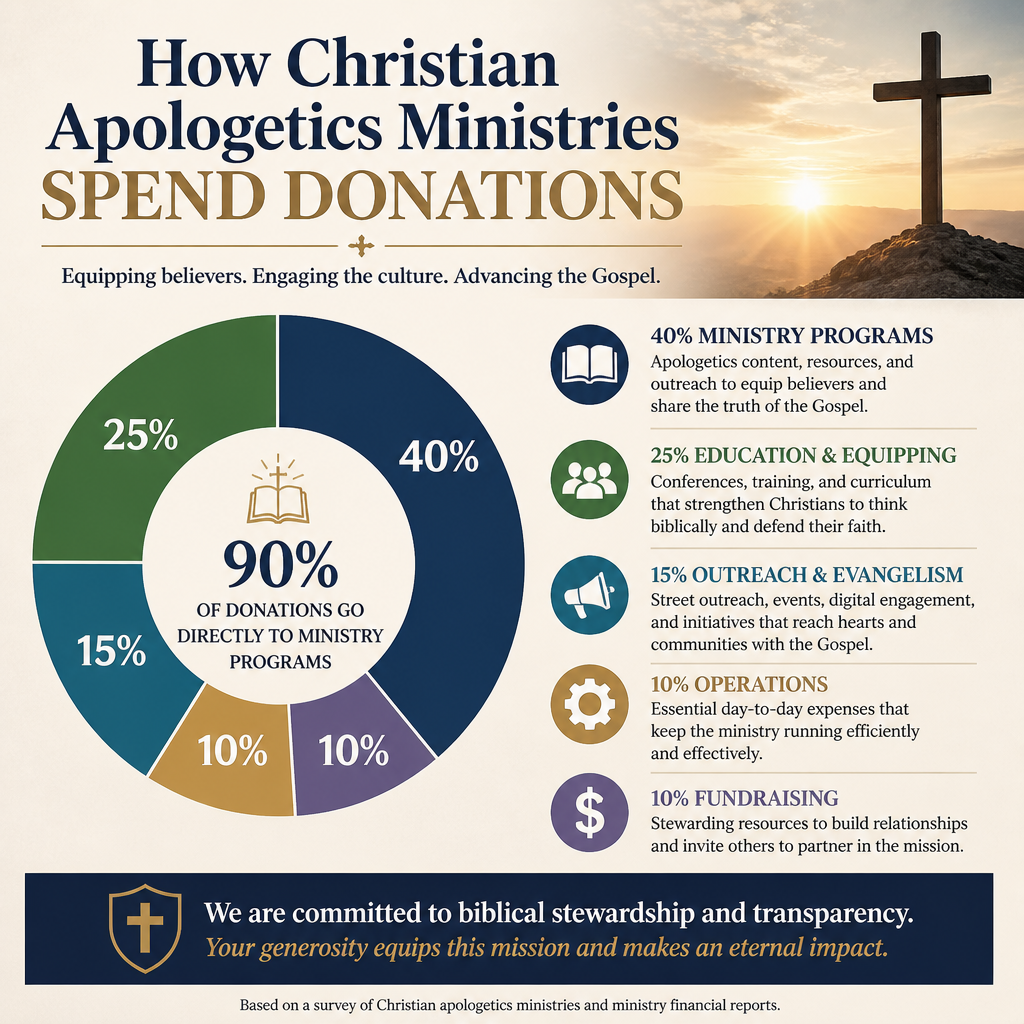
How Christian apologetics ministries spend donations is a stewardship question before it is a strategy question. Donors are not simply underwriting content; they are funding public witness to the truthfulness of the gospel, and Scripture treats both truth and money with sobering seriousness (1 Timothy 6:10–11). The central issue is whether a ministry’s spending patterns match its stated mission, its theological commitments, and the trust it is asking the Church to extend.
Apologetics also operates in a contested environment. Some Christians worry that apologetics over-intellectualizes faith or rewards combative instincts. Others see it as a work of mercy for doubters, a defense of the vulnerable, and a support for evangelism. Those disagreements do not remove the need for financial clarity; they increase it. Donors deserve to know what, concretely, their gifts make possible.
Apologetics spending begins with a theology of witness and stewardship
What apologetics is actually funding
Apologetics ministries exist to help people see that Christian faith is not a leap into irrationality. That work can take the form of scholarship, public communication, pastoral care for doubt, and training local churches. Because the outputs are often intangible—arguments, resources, conversations, credibility—budget categories can appear less obvious than in direct-service ministries. Mature donor assessment begins by asking what kind of witness the ministry believes it is called to offer, and to whom.
In the New Testament, apologetic labor is tethered to both conviction and posture: “always being prepared to make a defense… yet do it with gentleness and respect” (1 Peter 3:15). Spending that consistently rewards heat over light may still produce attention, but it should raise questions about formation and mission fidelity.
Why donors should resist simplistic ratios
Apologetics organizations are frequently judged by overhead assumptions imported from other sectors. Yet the field has had to reckon with the “overhead myth”—the idea that low administrative costs automatically signal effectiveness. Charity Navigator, Candid, and the Better Business Bureau have publicly warned donors against evaluating nonprofits primarily by overhead ratios, because those ratios can incentivize underinvestment in governance, financial controls, evaluation, and staff development.Charity Navigator
What this means in practice is that donors should ask whether “administration” includes essential protections: competent accounting, board oversight, cybersecurity, child and vulnerable-adult protections when relevant, and program evaluation. A ministry that refuses to fund these responsibilities is not necessarily lean; it may be fragile.

The main places donations go in apologetics ministries
Content production and distribution
Many apologetics budgets concentrate in content: books, curricula, videos, podcasts, articles, and study guides. The costs include research time, editorial work, design, studio production, licensing, transcription, translation, and distribution. Ministries that publish frequently may also carry platform costs—web hosting, learning management systems, email infrastructure, and analytics.
The donor question is not whether content is “real ministry.” The question is whether the content is the ministry’s primary means of discipleship and evangelistic support, and whether the organization can show that it is reaching the intended audience with integrity. When a ministry claims global reach, donors should expect sober descriptions of what “reach” means and what it does not mean.
Training and events
Conferences, church trainings, campus engagements, and speaker travel are another major line item. These costs can be substantial: venue rental, AV, insurance, staffing, travel, honoraria, and scholarships. Events can serve churches well, but they also tempt ministries toward growth-by-stagecraft: expanding production values without equal attention to discipleship outcomes or local church partnership.
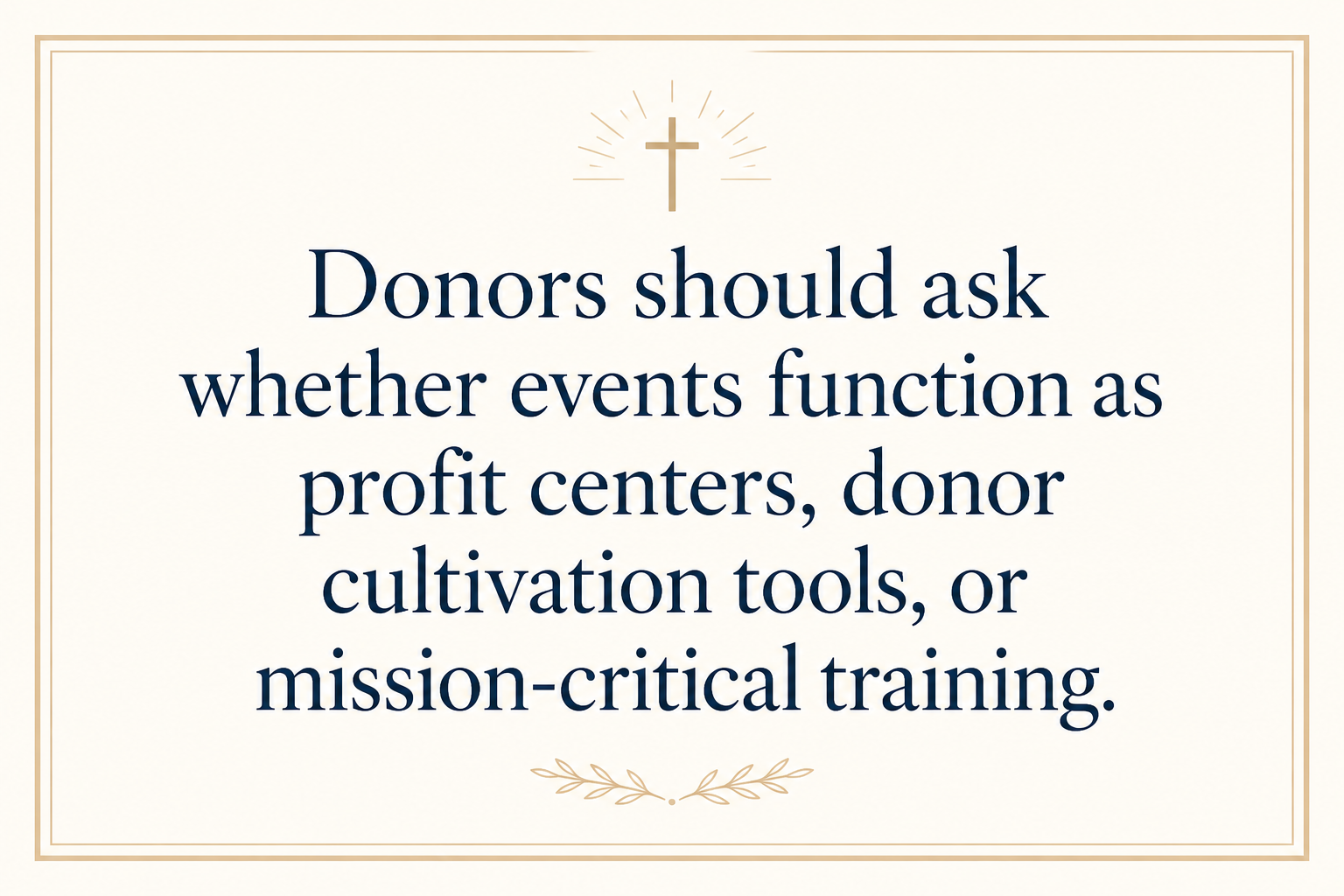
Donors should ask whether events function as profit centers, donor cultivation tools, or mission-critical training. Each model can be legitimate, but each calls for different transparency. If ticket revenue is a major component of sustainability, the ministry should be able to explain pricing ethics, scholarship policies, and how revenue relates to mission.
Personnel costs are the heart of apologetics work
Scholar-teachers, communicators, and pastoral care for doubt
Apologetics is labor-intensive. The most significant expense in many organizations is people: theologians, philosophers, biblical scholars, campus staff, writers, editors, communications teams, and operations staff. In some ministries, a portion of personnel time is devoted to direct engagement with questioners—email correspondence, small-group discipleship, counseling referrals, or moderated forums. Those hours rarely show up as neat “units of service,” but they can be among the most pastorally significant uses of donor funding.
Because personnel is central, compensation ethics matter. Donors can ask whether salaries are set by independent board processes, whether related-party transactions are avoided, and whether the ministry follows conflict-of-interest standards. Across our verification work at Most Trusted, the ministries that meet The Most Trusted Standard tend to treat compensation as a governance matter, not a founder prerogative, and they document decisions accordingly.
Marketing, fundraising, and the cost of acquiring donors
Some apologetics ministries spend heavily on marketing and fundraising: direct mail, digital advertising, list rentals, donor management systems, and external agencies. A mature assessment recognizes that fundraising is not inherently suspect; it can be the mechanism that sustains teaching, training, and resources over decades. But donors should insist on clarity about what is being promised and what is being measured.
In the wider nonprofit sector, fundraising costs can vary significantly by channel and life-cycle stage. The caution for donors is not simply “avoid fundraising expense,” but “avoid manipulative fundraising.” Appeals that trade in fear, outrage, or exaggerated claims about impact can distort the ministry’s posture and public credibility.
- Ask what portion of fundraising is recurring maintenance versus expansion into new channels.
- Ask how donor data is handled and whether lists are sold or rented.
- Ask whether appeals are theologically responsible in their promises and urgency.
- Ask for governance documentation on vendor selection and contract oversight.
- Ask how the ministry evaluates messaging for truthfulness and spiritual formation.
Transparency is a spiritual discipline and a donor safeguard
The baseline documents donors should expect
Apologetics ministries commonly ask donors to trust that “the work matters,” often without offering equivalent clarity about how the work is governed and evaluated. Mature ministries make transparency normal. In the United States, the IRS Form 990 is a starting point for many nonprofits, and it provides meaningful insight into revenue, expenses, governance, and top compensation. Donors can access many organizations’ filings through Candid’s GuideStar directory.Candid GuideStar
Form 990s are imperfect. They lag by a year or more, and they cannot fully capture mission effectiveness. But a ministry unwilling to share basic financial and governance information is not merely “private.” It is asking the Church to carry risk it should carry itself.
Effectiveness without reductionism
Apologetics outcomes are real, but they can be difficult to measure. Counting views, downloads, or social impressions may be appropriate for communications goals, yet these numbers can be spiritually thin if they substitute for discipleship fruit. At the same time, donors should not demand a kind of laboratory proof that the ministry cannot honestly provide. The better question is whether the organization has a coherent theory of change and whether it gathers credible indicators that match its purpose.
For example, a training-focused apologetics ministry can track church partnerships, repeat invitations, curriculum adoption, and participant feedback paired with follow-up practices. A campus-focused ministry can track small-group participation, mentoring relationships, and referrals to local churches, while protecting privacy and avoiding inflated claims.
Within Christian Apologetics Ministries, donors often tell us their deepest concern is not whether a ministry is “perfect,” but whether it is forthright. Transparency does not eliminate disappointment, but it does restrain self-deception—both for ministries and for donors.
How Most Trusted evaluates apologetics ministries against The Most Trusted Standard
What verification seeks to clarify
Most Trusted exists because Christian donors should not have to choose between cynicism and naiveté. Apologetics ministries can do vital work, and they can also be shaped by incentives that reward brand growth over ecclesial service. Verification helps donors see what is actually true: whether a ministry’s faith commitments are clear, whether financial controls are credible, whether governance is independent and functional, and whether transparency is treated as normal.
The Most Trusted Standard evaluates ministries across four domains: Faith Foundation, Financial Integrity, Governance and Leadership, and Transparency and Effectiveness. Donors do not need to become auditors, but they should expect ministries to welcome scrutiny proportional to the trust and funds they receive.
Patterns donors can watch for
Apologetics ministries that handle donations well tend to exhibit several consistent traits: they distinguish between mission and brand, they treat local churches as partners rather than a market, they communicate impact without exaggeration, and they invest in the unglamorous work of compliance and accountability. They also show restraint in public tone, recognizing that defending truth does not require contempt.
Ministries that handle donations poorly often share different patterns: concentrated authority without counterweights, vague reporting that substitutes inspiration for information, fundraising that pressures rather than persuades, and a reliance on controversy as an attention engine. None of these issues is fixed by a single budget ratio. They are governance and discipleship problems that surface in financial choices.
For donors assessing spending in more detail, How Christian Apologetics Ministries Use Donations addresses common expense categories and the questions that best clarify whether those expenses serve the gospel with integrity.
FAQs for How Christian apologetics ministries spend donations
Should apologetics ministries spend donor money on media and production quality?
Sometimes they should. If a ministry’s primary output is teaching and public communication, competent production can remove distractions and increase accessibility. The donor question is whether production serves clarity and reach without becoming a substitute for substance. Donors can ask for examples of how content is used in churches, small groups, or evangelistic conversations, and for evidence that the ministry prioritizes accuracy, charity, and theological fidelity over virality.
How can donors evaluate impact when apologetics results are hard to measure?
Donors can look for coherent indicators tied to the ministry’s purpose rather than generic metrics. For a training ministry, that may include repeat partnerships with churches, curriculum adoption, and documented follow-up practices. For a content ministry, it may include meaningful engagement measures, translation strategy, and testimonies handled with integrity rather than sentimentality. The decisive issue is not whether the ministry can quantify every spiritual outcome, but whether it reports honestly and avoids claims it cannot support.
Giving with eyes open and faith intact
Apologetics ministries stand at a sensitive intersection of truth, persuasion, and public credibility. Donations that fund this work should be treated as sacred trust, governed by the same seriousness Scripture brings to speech, money, and power. Donors best serve the Church when they support ministries whose spending patterns demonstrate disciplined stewardship, credible accountability, and a posture of witness shaped by gentleness and respect.



