

How Christian apologetics ministries measure impact is not a question of marketing; it is a question of stewardship. Donors are not funding a mere content machine. They are funding a form of witness that aims, by God’s grace, to clarify truth, remove intellectual obstacles, and strengthen the church’s public confession of Christ.
The harder question is that apologetics sits at the intersection of the measurable and the mysterious. Scripture commands clarity, integrity, and fruit (Matthew 5:16; 1 Peter 3:15), but it also reminds us that only God gives growth (1 Corinthians 3:6–7). Mature Christian giving does not demand omniscience. It asks for credible evidence that a ministry’s inputs, practices, and outcomes are coherent with its stated calling.
Impact measurement in apologetics begins with theological and strategic clarity
What apologetics can claim and what it cannot
Apologetics ministries often serve multiple audiences at once: skeptics, seekers, believers under pressure, and pastors responsible for formation. Impact measurement begins by naming which audience is primary and what change is expected. Without that clarity, ministries are pushed toward whatever is easiest to count—clicks, views, and followers—rather than what is most faithful to pursue.
Christians genuinely disagree about the role of apologetics in conversion. Some emphasize rational argument; others emphasize the Spirit’s sovereign work with apologetics as secondary support. Responsible ministries acknowledge this tension and frame their goals accordingly: not “we convert people,” but “we present reasons for faith, address objections, and equip believers for faithful witness.” That kind of precision is not evasive; it is truthful.
From mission statement to a defensible theory of ministry
What this means in practice is that impact measurement should track a ministry’s “theory of ministry”: the pathway from activities (content, events, training) to outcomes (increased confidence, reduced doubt, better pastoral tools, clearer public witness). Donors can reasonably ask a ministry to show the logic of that pathway and the evidence it collects at each step.
Across our verification work at Most Trusted, the ministries that meet The Most Trusted Standard tend to define impact in a way that is both theologically honest and operationally specific. They state what they do, who they serve, what change they are pursuing, and what evidence they will accept as meaningful.

Outputs are not impact, but they are still accountability
Counting activities without mistaking them for fruit
Apologetics work produces visible outputs: articles, podcasts, books, conference talks, campus debates, video series, and curricula. These are not spiritual fruit in themselves, but they are the ministry’s labor, and labor should be accounted for. A donor should be able to see whether the ministry actually delivered what it said it would deliver, at the quality level it claimed.
Output measurement is also where some of the most common distortions appear. Platforms can reward provocation over clarity, and volume over pastoral responsibility. When a ministry treats reach as its primary scorecard, it can drift toward partisan performance rather than Christian persuasion shaped by gentleness and respect (1 Peter 3:15).
What donors should expect to see reported
A credible apologetics ministry will often report outputs with definitions and context, not as a vanity list. Examples include:

- Number of training events, with attendee counts and the audience type served
- Content production, paired with editorial standards and theological review practices
- Translation or localization work, where relevant, with clear language and distribution partners
- Partnerships with churches, campuses, or seminaries, stated with scope and accountability
- Staff and speaker time allocation, showing whether resources match stated priorities
Reach metrics can belong in that reporting, but they should be treated as distribution measures, not proof of transformation. A million impressions may mean a message was seen; it does not mean it was understood, trusted, or acted upon.
Outcomes require evidence that people actually changed
Reasonable outcomes for apologetics ministries to measure
The most defensible outcomes in apologetics tend to be proximate rather than ultimate. A ministry can often measure whether people are better equipped, less confused, or more confident in articulating Christian truth. It can sometimes track whether pastors and leaders use provided tools. It can occasionally document how a skeptical audience moved from hostility to openness. These are not small matters; they often represent the removal of real obstacles to faith and perseverance.
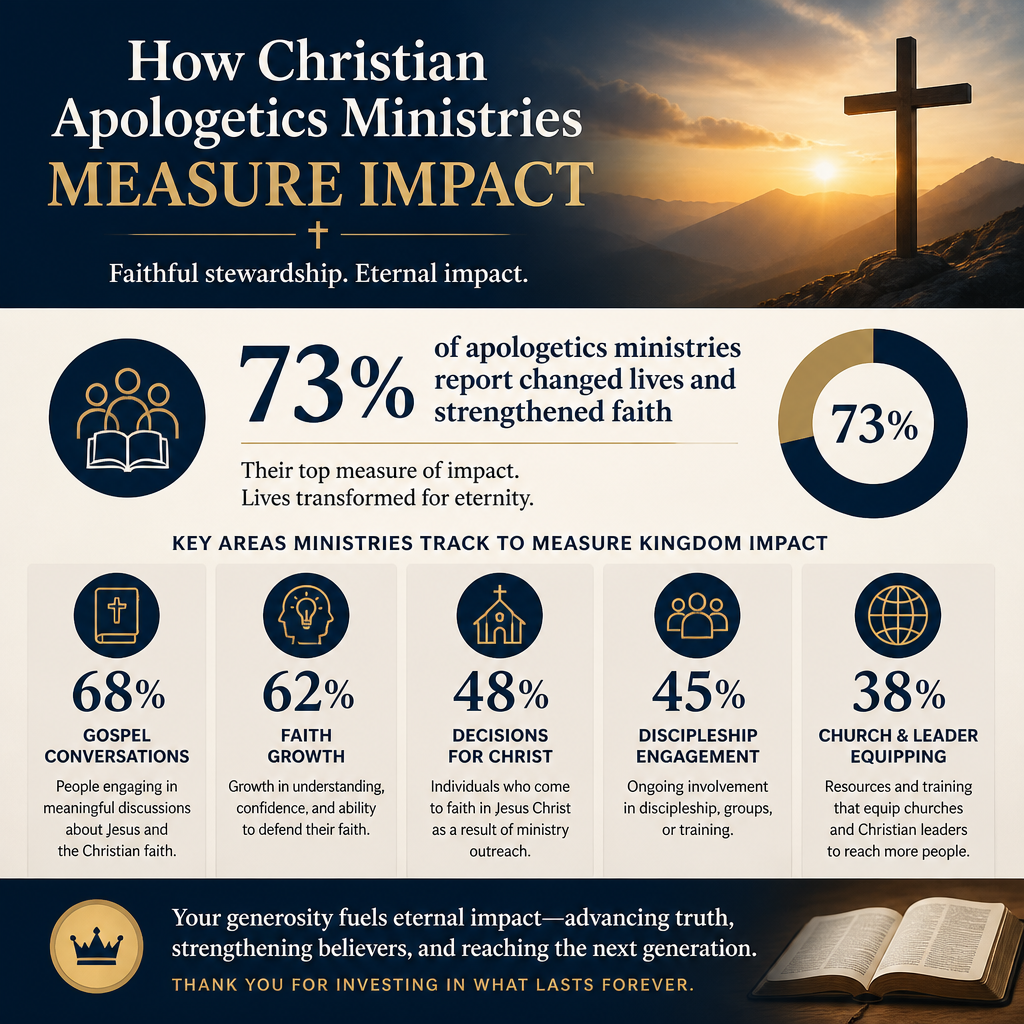
Outcome evidence typically comes from structured feedback: pre- and post-training surveys, follow-up interviews, longitudinal cohorts, pastoral feedback loops, and curriculum adoption data. Donors should expect ministries to explain their methods and their limitations, especially where response rates are low or where feedback may be biased toward enthusiastic supporters.
Guardrails against overclaiming
Outcome language becomes untrustworthy when it claims more than the data can bear. “Thousands came to Christ” is a serious claim that requires serious evidence and careful attribution, especially in digital contexts where the same person may engage repeatedly or where self-reports are difficult to verify. The New Testament’s concern for truthful speech is not suspended because a story is inspiring (Ephesians 4:25).
When apologetics ministries do speak about conversions or recommitments, the best practice is to present them as testimonies with context rather than as totals presented as proof. A testimony can be precious and real. A total can be misleading without a transparent method.
Impact in apologetics includes formation, not only decisions
Measuring resilience, not just moments
Many donors support apologetics because they see the erosion of confidence among young believers and the confusion created by digital misinformation. Measuring impact, then, includes measuring resilience: whether believers are less vulnerable to common objections, more capable of charitable engagement, and more grounded in historic Christian doctrine.
Here the ministry’s educational philosophy matters. A content-heavy approach can inform without forming. A discipleship-oriented approach may reach fewer people but develop deeper competence. Donors can honor both approaches, but they should not confuse scale with maturity.
Connecting apologetics to the life of the local church
Apologetics that is detached from the church’s worship and pastoral care tends to harden into argument. Healthy apologetics serves the church’s ordinary work: preaching, catechesis, evangelism, and spiritual care. That is why donors should pay attention to whether a ministry measures impact through church-adjacent indicators such as curriculum usage, pastor training outcomes, or repeat engagement from congregations.
For donors seeking the broader landscape of this work, we maintain coverage of Christian Apologetics Ministries with attention to the distinct ways ministries define faithfulness and effectiveness.
Donors should evaluate the credibility of impact claims
What trustworthy measurement looks like
Impact reporting is not only about what is measured; it is about whether the ministry’s culture can be trusted with truth. The same habits that produce careful theology should produce careful reporting: defined terms, consistent methods, and an unwillingness to exaggerate.
Independent standards can help donors avoid a purely subjective assessment. Most Trusted evaluates ministries against The Most Trusted Standard, a 15-criteria framework across Faith Foundation, Financial Integrity, Governance and Leadership, and Transparency and Effectiveness. That last category matters for apologetics in particular, because persuasion work can be tempted to substitute narrative strength for verifiable evidence.
Financial and governance signals that support impact integrity
Donors often separate “impact” from “operations,” but the separation is artificial. Weak governance and unclear financial practices corrode the credibility of every impact claim. A ministry that will not disclose meaningful program costs, that does not explain reserve policy, or that treats donor restrictions casually is not positioned to report honestly about outcomes.
The field has also had to reckon with the persistent misunderstanding of overhead. The widely cited “Overhead Myth” letter—signed by Charity Navigator, GuideStar, and the BBB Wise Giving Alliance—warns donors against treating low administrative cost as a proxy for effectiveness, because it can punish necessary investments in staff quality, evaluation, and internal controls Charity Navigator. Apologetics ministries that invest in editorial review, theological accountability, safeguarding practices for student events, and evaluation capacity may show higher indirect costs precisely because they are taking stewardship seriously.
Donors comparing how ministries describe the use of funds can also review How Christian Apologetics Ministries Use Donations and weigh whether spending narratives match the measured work.
FAQs for How Christian apologetics ministries measure impact
Should apologetics ministries measure conversions?
They may collect testimonies and, in some contexts, count expressed faith commitments, but they should be cautious about treating conversion totals as a primary metric. Conversion is ultimately God’s work (1 Corinthians 3:6–7), and attribution is often unclear in digital or multi-ministry environments. Stronger practice is to measure outcomes the ministry can responsibly claim—such as reduced doubts, increased confidence, and documented use of resources—while treating testimonies as qualitative evidence offered with humility and context.
What impact metrics matter most for donors who care about truth and faithfulness?
The most meaningful metrics are those that show real change with transparent methods: pre- and post-training shifts in confidence and competence, follow-up results that indicate retention, curriculum adoption by churches or schools, and documented feedback from pastors and ministry leaders. Donors should also weigh integrity signals: clear definitions, conservative claims, and governance and financial practices that make honest reporting more likely.
A donor’s aim is not perfect measurement but trustworthy stewardship
Apologetics ministries cannot quantify every work of grace, and donors should not demand a precision that Scripture itself does not require. They can, however, require honesty, methodological clarity, and evidence that resources are producing the kind of fruit the ministry claims to seek. When measurement is shaped by truth-telling and anchored in the church’s mission, it becomes an act of discipleship rather than a performance for supporters.



