

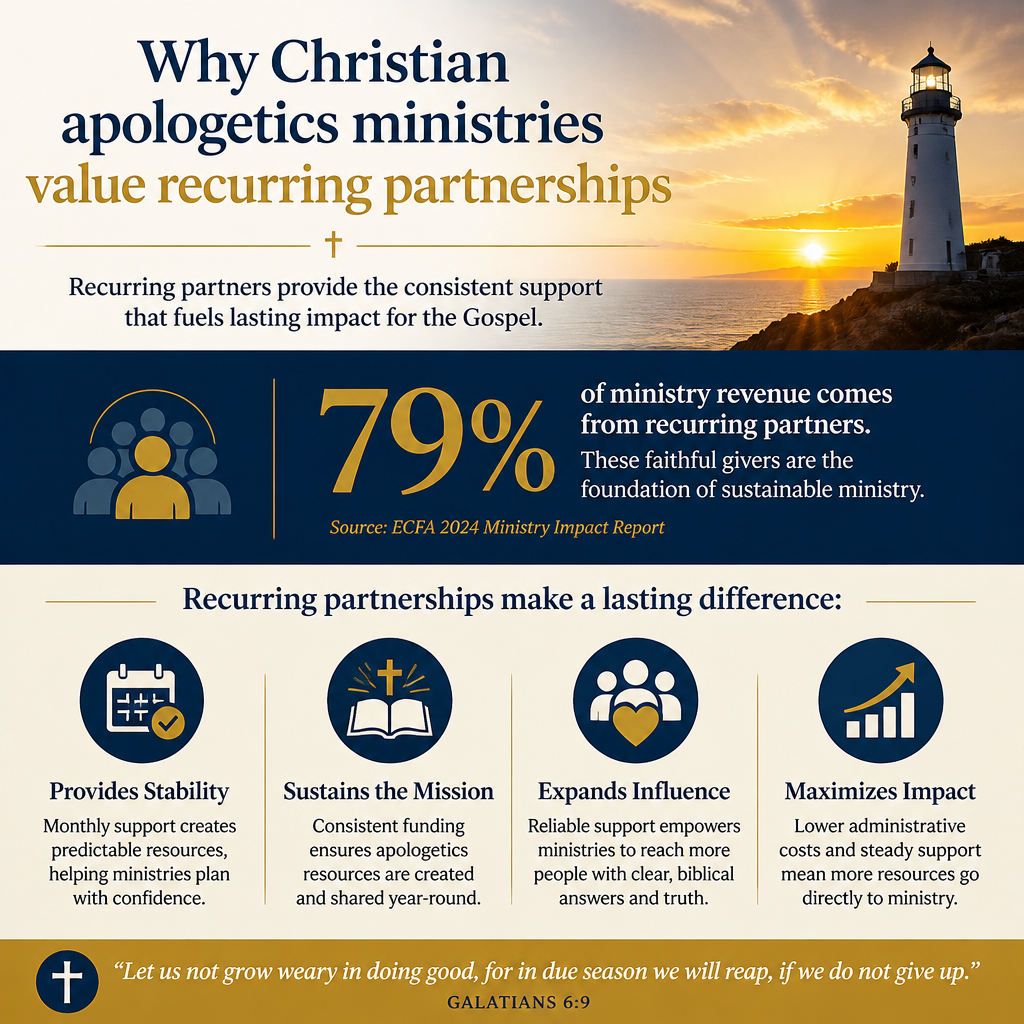
Recurring partnerships matter because Christian apologetics ministries rarely face a one-time question. The work is a long obedience: helping seekers and believers return, again and again, to the reasonableness of faith, the trustworthiness of Scripture, and the credibility of the gospel in a skeptical age.
Many donors already sense this intuitively. A one-off gift can fund a conference or a video series, but apologetics ministries are sustaining institutions of witness: research, content development, scholar training, pastoral resourcing, and patient engagement with critics. Recurring support does not merely stabilize a budget; it underwrites the kind of intellectual and spiritual formation that is hard to measure quickly and difficult to build without continuity.
Apologetics is formation work, not event work
The questions are persistent, and so is the calling
The New Testament does not treat Christian reasoning as optional. Peter’s command is comprehensive: “always be prepared to give an answer” and to do so “with gentleness and respect” (1 Peter 3:15). Preparation assumes time, training, and repeated practice. That is precisely what recurring partnerships make possible: sustained readiness rather than intermittent reaction.
In many settings, apologetics functions as “pre-evangelism,” addressing barriers that keep a person from hearing the gospel as good news. Those barriers reappear in each generation, but they also mutate. The questions of evil and suffering, science and faith, sexuality and identity, religious pluralism, and the reliability of the biblical texts do not remain static. Ministries that answer these questions responsibly tend to invest in ongoing research, editorial discipline, and theological accountability, which usually cannot be funded from sporadic spikes of donor enthusiasm.
Attention is episodic, but discipleship is cumulative
Digital media rewards novelty, but Christian maturity is cumulative. A podcast episode may be a person’s first step toward Christ, but it is seldom the final step. Recurring support allows apologetics ministries to accompany people over time: follow-up resources, courses, live events, small-group curricula, and pastoral guidance that carries someone from initial intellectual openness to deeper trust in Christ and integration into a local church.
This is one reason sophisticated donors increasingly evaluate apologetics ministries through the same lens they apply to seminaries and mission agencies: Do they have the theological depth and institutional discipline required for lasting work? The question is not only whether the content is compelling, but whether the ministry is built to endure.

Recurring revenue protects integrity in a market-driven attention economy
It reduces dependence on volatility and performative fundraising
Most ministries operate inside a volatile environment: algorithms shift, ad costs rise, platforms change their rules, and donor attention is scattered across many urgent causes. That instability can quietly shape a ministry’s incentives. When revenue depends primarily on spikes of attention, the temptation is to produce what provokes outrage or guarantees clicks. Recurring partnerships create a different set of incentives: careful argumentation, charitable engagement with opponents, and doctrinal precision rather than rhetorical heat.
Christians genuinely disagree about how sharp public critique should be, especially when confronting false teaching or cultural pressure. Yet even where disagreement remains, recurring support gives leaders greater freedom to avoid sensationalism and to speak with the kind of “gentleness and respect” Scripture requires, even under controversy.
It allows difficult work that donors still need
Some apologetics work is not immediately “shareable”: scholarly translation for lay audiences, careful peer review, long-form responses to academic arguments, curriculum development, or investment in young scholars who will serve the church for decades. Recurring partnerships fund these quieter forms of service.
They also allow ministries to maintain appropriate boundaries. When a ministry is desperate for one more viral moment, the line between apologetics and entertainment becomes easier to cross. When a ministry has patient, dependable partners, it can choose fidelity over flash.
Strong apologetics depends on credible governance and financial stewardship
Donors are not only funding content, they are funding institutional trust
Apologetics ministries trade, in a sense, on credibility. They ask audiences to trust their research, their citations, and their theological judgments. That moral authority is not sustained by intellectual horsepower alone. It also depends on the integrity of governance, financial oversight, and transparency. Recurring partners are often the donors most concerned with these questions because they are making a long-term commitment.
Across our verification work at Most Trusted, we observe that ministries that meet The Most Trusted Standard tend to have clearer financial controls, more accountable boards, and more consistent disclosure practices. Those disciplines do not guarantee theological faithfulness, but they do reduce common forms of risk: conflicts of interest, unclear related-party transactions, founder-centric governance, and reporting that substitutes inspirational stories for verifiable outcomes.
What recurring partners should expect in return
Recurring giving is not a blank check, and mature ministries should not ask for one. The best recurring partnerships are characterized by clarity: what the ministry claims, what it measures, and how it handles money. Donors who support Christian Apologetics Ministries often benefit from reviewing recurring-partner communications with the same seriousness they apply to annual reports.
As a practical matter, recurring partners should expect a ministry to provide at least the following, in ordinary language and on a consistent schedule:
- Current financial statements or a clear summary with meaningful categories
- Board composition and evidence of active oversight
- Doctrinal commitments that are public and specific
- Plain reporting on program outputs and signs of effectiveness
- A credible approach to handling controversy, complaints, and corrections
These expectations are not adversarial. They honor the biblical logic of stewardship: “it is required of stewards that they be found faithful” (1 Corinthians 4:2). Faithfulness includes how funds are handled and how claims are substantiated.
Recurring partnerships help resist the Starvation Cycle and the Overhead Myth
The economics of ministry often reward underinvestment
Many Christian donors have been trained, implicitly or explicitly, to distrust administrative costs. Yet the nonprofit sector has publicly corrected this assumption. The joint “Overhead Myth” letter from GuideStar, Charity Navigator, and the BBB Wise Giving Alliance warned that focusing on overhead ratios can do “tremendous damage” by encouraging underinvestment in infrastructure and talent needed for effectiveness GuideStar.
Apologetics ministries are particularly vulnerable to this dynamic because their “program” is often content and education, which depend on skilled labor, editorial processes, research tools, and secure digital systems. Underfunding those essentials can degrade quality in ways donors do not immediately see: weak sourcing, rushed arguments, insufficient theological review, and preventable reputational crises.
Stable support allows faithful investment in capacity
Recurring partnerships allow leaders to budget responsibly rather than improvising month to month. That includes appropriate staff compensation, risk management, and internal accountability systems. It also supports long-term planning: multi-year course development, translation work, and strategic collaboration with churches and schools.
The sector has long recognized how chronic underfunding pushes organizations into a destructive loop. Stanford Social Innovation Review described the “Nonprofit Starvation Cycle,” in which unrealistic expectations about overhead lead nonprofits to underinvest and then appear less effective, reinforcing donor skepticism Stanford Social Innovation Review. Recurring support, when paired with transparent reporting, can be one of the few practical ways to break that pattern without drifting into constant crisis fundraising.
Recurring support aligns with how cultural and spiritual change actually happens
Conversions and deconversions rarely happen on a single timeline
Many donors want to fund direct evangelism and clear gospel proclamation, and apologetics ministries should never treat those priorities as optional. Yet the path to faith can involve long seasons of resistance, reconsideration, and gradual trust. Some hear the gospel for years before they can honestly say, “I believe.” Others need rebuilding after deconstruction, pastoral harm, or public scandal in the church.
Research on religious change consistently suggests that religious identity is shaped over time through family, community, and formation rather than only through isolated moments. For example, Pew Research has documented long-term patterns of religious switching and disaffiliation that unfold across years, not days Pew Research Center. Apologetics ministries that serve in this environment need partners who understand that the fruit may be slow, but it can be substantial.
Recurring partnerships can be a disciplined form of Christian hope
Recurring giving is, at its best, a form of covenantal steadiness. It says that the church’s intellectual and evangelistic responsibilities are not funded only when the news cycle is favorable. It also acknowledges that apologetics is often service to pastors and parents as much as to skeptics: equipping the saints for conversations at the dinner table, in classrooms, and in workplaces where faith is regularly contested.
Donors who want a fuller picture of how sustained partnerships function across this field often find it helpful to review patterns and expectations within Donor Partnerships with Christian Apologetics Ministries, especially where transparency and accountability are treated as part of discipleship rather than as administrative add-ons.
FAQs for Why Christian apologetics ministries value recurring partnerships
Should recurring support replace project-based gifts to apologetics ministries?
Not necessarily. Project gifts can be highly appropriate for discrete work such as a documentary, a campus tour, or a curriculum launch. Recurring support is often what sustains the underlying capacity that makes those projects credible: research, editorial review, theological oversight, and long-term follow-up with audiences. Many mature donors do both, treating recurring support as the foundation and project gifts as targeted acceleration.
What should donors verify before starting a recurring partnership?
Donors should verify doctrinal commitments, governance accountability, financial transparency, and evidence that the ministry corrects errors and handles controversy responsibly. Recurring giving increases the importance of these factors because the relationship is ongoing. Our team at Most Trusted encourages donors to look for ministries that welcome scrutiny and can demonstrate alignment with The Most Trusted Standard, especially in financial integrity, leadership oversight, and transparency about outcomes and limitations.
A steady partnership for a steady witness
Christian apologetics ministries value recurring partnerships because the work itself is recurring: the same gospel proclaimed into new cultural questions, the same Scriptures defended with fresh clarity, the same people shepherded through doubt with patience and truth. Donors who commit to sustained support are not merely funding content. They are funding the kind of institutional faithfulness that helps the church speak with credibility, humility, and courage over time.



