

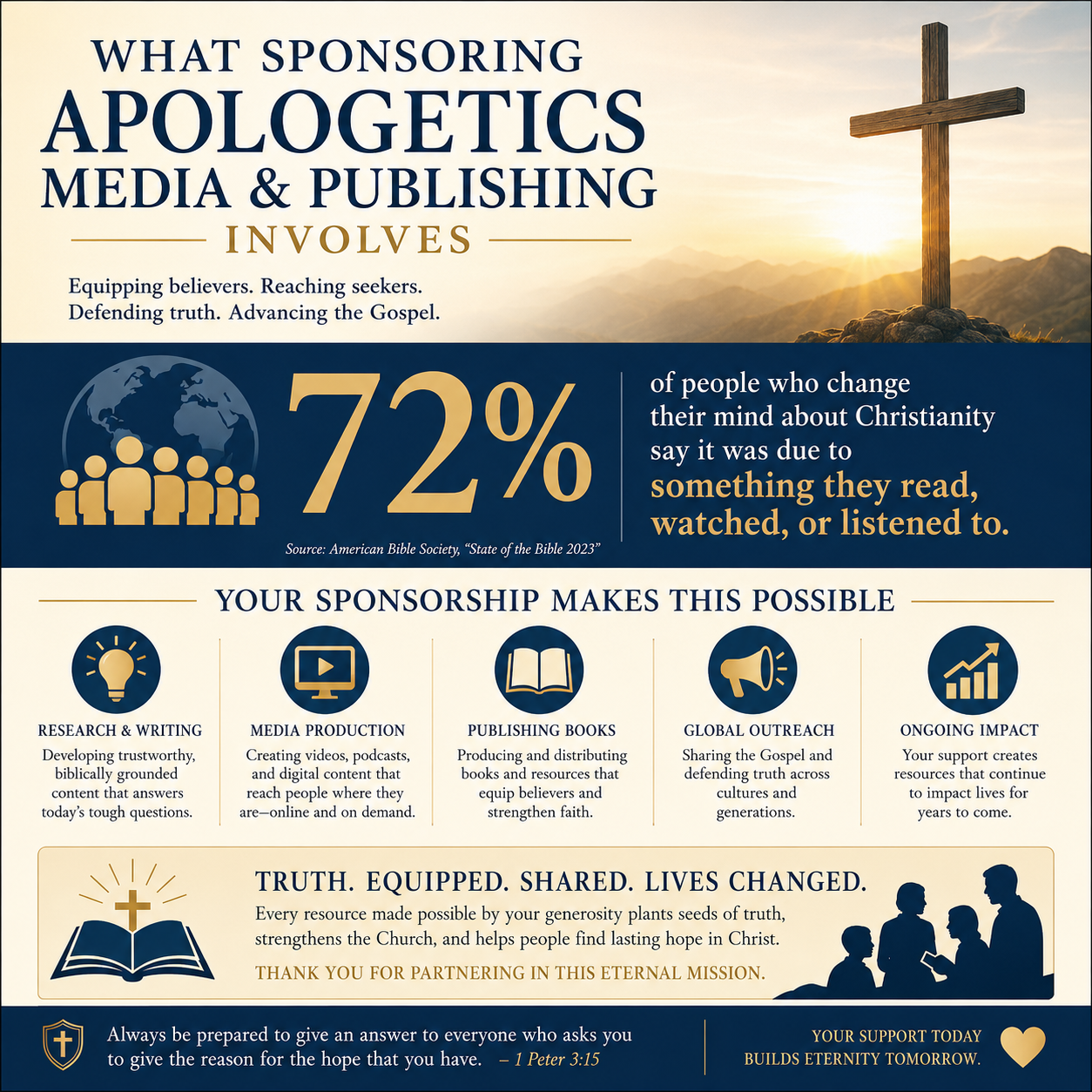
What sponsoring apologetics media and publishing involves is not merely buying airtime or paying for print runs. It is a form of Christian patronage that shapes what the church hears, how it reasons, and which voices receive the credibility that sustained funding confers. For donors, the question is not whether apologetics matters, but what kind of apologetics our giving is forming.
Scripture commends both proclamation and persuasion. Peter exhorts believers to be prepared to give a reasoned defense with gentleness and respect (1 Peter 3:15). Paul describes demolishing arguments raised against the knowledge of God (2 Corinthians 10:5). Sponsorship becomes spiritually weighty because it helps determine whether that defense is truthful, charitable, and pastorally responsible—or whether it becomes performative, polarizing, or financially opaque.
Media apologetics is formation, not only information
Apologetics content catechizes an audience over time
Apologetics media and publishing shape habits of mind: what counts as evidence, how to treat opponents, what questions are worth asking, and whether doubt is met with patient clarity or suspicion. In a media environment that rewards velocity and outrage, the donor is effectively underwriting an editorial theology of attention. That is why sponsorship decisions should be treated as discipleship decisions.
Christians genuinely disagree about style. Some defend confrontational debate formats as a necessary counterweight to secular public rhetoric; others argue that such formats train the church to mistake winning for faithfulness. Sponsorship does not resolve that disagreement, but it does allocate influence. Donors should be clear about which virtues are being funded: intellectual honesty, courage, humility, pastoral sensitivity, or something less Christian but more marketable.
“Reach” is measurable, but spiritual fruit is harder to verify
Digital apologetics often reports reach: views, downloads, subscriber growth, impressions, and click-through rates. These can be useful operational indicators, but they are not equivalent to fruit. The New Testament’s categories are more demanding: truth, love, unity, holiness, repentance, perseverance. When sponsors require only platform growth, they may unintentionally pressure ministries toward sensational topics, overconfident certainty, or combative tone.
Some outcomes can be responsibly documented: distribution numbers, translation completion, or classroom adoption of a curriculum. Yet the most important outcomes—strengthened faith amid suffering, renewed trust in Scripture, reconciled relationships—typically require qualitative reporting and careful interpretation. Mature sponsors ask for more than numbers without demanding what no ministry can provide: precise spiritual attribution.

Sponsorship is underwriting an editorial and theological posture
Publishing decisions function like doctrinal gatekeeping
When a donor sponsors an apologetics imprint, documentary series, podcast network, or YouTube channel, the gift subsidizes selection. Which scholars are featured? Which questions are treated as serious? Which internal Christian disagreements are handled with care, and which are dismissed? Editorial selection becomes an implicit doctrinal curriculum for a broad audience—often broader than any single local church.
This does not require donors to demand a narrow party line. It does require clarity about confessional commitments and boundaries. A ministry may be orthodox on paper yet repeatedly platform voices that trade in speculation, denigration of the church, or cynical contempt for lay Christians. Over time, that posture becomes the product.
Personality-driven apologetics creates real governance risk
Apologetics media often concentrates authority in a founder-host. That can be effective for clarity and consistency, but it raises predictable risks: weak board independence, blurred lines between personal brand and ministry assets, conflicts of interest in compensation, and reputational fragility if a public figure fails morally or doctrinally.
Across our verification work at Most Trusted, we observe that ministries that meet The Most Trusted Standard tend to document safeguards that do not depend on the leader’s personal integrity alone: conflict-of-interest policies, meaningful board oversight, clear IP ownership, and transparent related-party transactions. Those are not bureaucratic distractions. They are practical expressions of the biblical concern that leaders be above reproach and that the church not be discredited through financial or ethical scandal (1 Timothy 3:2–7).
What donors are actually paying for
Media is a complex cost structure, not a simple overhead story
High-quality apologetics media and publishing are expensive in ways donors do not always see. Costs include research and fact-checking, theological review, legal clearance, audio and video engineering, translation, accessibility work such as captioning, licensing of music and archival footage, distribution platforms, and donor reporting. Publishing adds editorial development, design, printing, warehousing, returns, and the cash-flow burden of inventory.
Some donors still evaluate ministries using simplistic “low overhead” assumptions. The philanthropic sector has pushed back on this for years. The “Overhead Myth” letter—signed by GuideStar, BBB Wise Giving Alliance, and Charity Navigator—argued that administrative ratios are poor proxies for impact and can pressure nonprofits into underinvesting in essential infrastructure (Candid GuideStar). Apologetics ministries are especially vulnerable to that distortion because quality control is largely invisible to the casual audience.
Sponsorship models differ, and each brings different obligations
“Sponsoring” can mean underwriting an episode, funding a season of content, purchasing ad inventory, providing a challenge match, underwriting translation, supporting a publishing advance, or giving unrestricted support to a media ministry’s general fund. These models are not interchangeable. Each changes expectations about deliverables, accountability, and the ministry’s freedom to follow its mission rather than its sponsors.
What this means in practice is that donors should ask straightforward questions: Is this gift restricted or unrestricted? Who owns the content produced? Will the ministry accept topic direction from sponsors? How are donor acknowledgments handled so that gratitude does not become an editorial incentive?
- Underwriting funds a defined project with stated deliverables and timeline.
- Advertising purchases audience access and typically expects measurable performance.
- Unrestricted giving strengthens stability but requires higher trust in governance and reporting.
- Matching grants can accelerate growth but may distort fundraising priorities.
- Rights sponsorship can create future revenue streams, but it raises ownership and control questions.
Due diligence that fits apologetics ministries
Evaluate theological integrity alongside institutional integrity
Doctrinal statements matter, but so does operational practice. A ministry can affirm historic creeds and still operate with weak financial controls, unclear compensation practices, or a culture that punishes internal dissent. Sponsoring such a work may increase output while increasing fragility.
We encourage donors to assess apologetics ministries through a framework that holds faith commitments and institutional integrity together. Most Trusted evaluates ministries against The Most Trusted Standard, a 15-criteria framework across Faith Foundation, Financial Integrity, Governance and Leadership, and Transparency and Effectiveness. For donors seeking broader context on how apologetics ministries function across the sector, the most direct starting point is Christian Apologetics Ministries.
Ask for evidence of editorial accountability
Because apologetics trades in claims, citations, and public persuasion, it warrants explicit editorial accountability. Serious ministries can usually describe how they prevent error and correct it when it occurs. That includes theological review processes, fact-checking standards, correction policies, and clear differentiation between reporting, commentary, and testimony.
The harder question is whether the ministry’s incentives are aligned with those standards. When revenue depends on controversy-driven engagement, donors should look for counterweights: independent advisors, a board willing to challenge the founder, transparent metrics that do not confuse attention with fruit, and a pattern of publicly correcting mistakes rather than moving past them.
Partnerships that strengthen the church rather than fragment it
Support work that serves pastors and local congregations
Apologetics can function as a ministry adjacent to the church or as a ministry accountable to the church. The difference matters. Sponsors can encourage healthy alignment by prioritizing ministries that equip pastors, produce resources for catechesis, and speak with respect about the ordinary means of grace. When apologetics portrays the local church as inadequate or implicitly obsolete, it often cultivates a consumer audience rather than a discipled people.
At its best, media apologetics helps Christians answer questions their neighbors actually ask—about the resurrection, the reliability of Scripture, the problem of evil, the dignity of the human person, and the uniqueness of Christ—without training them to treat unbelievers as enemies. That posture is closer to Peter’s instruction: truth told with gentleness and respect.
Be candid about contested questions and donor expectations
Several tensions will not disappear: how to engage political questions without collapsing into partisanship; how to address science and faith without caricature; how to handle internal Christian disagreements on creation, spiritual gifts, or cultural strategy without turning apologetics into intramural warfare. Sponsorship does not require donors to resolve every debate, but it does require a choice about what kind of discourse will be funded.
Donors can help by setting expectations that reward careful argument, honest citation, and charitable representation of opposing views. For those who give within the broader context of funding apologetics work, we have found it helpful to view sponsorship decisions as one part of the wider practice described in Donor Partnerships with Christian Apologetics Ministries.
FAQs for What sponsoring apologetics media and publishing involves
Is it better to fund apologetics media projects or give unrestricted support?
Project funding can be appropriate when a ministry has a clear plan, credible budget, and specific deliverables, such as a translation, a curriculum, or a defined series. Unrestricted support is often more strategic for stability and long-term editorial maturity, but it requires higher confidence in governance, financial controls, and transparent reporting. Many donors use a blended approach: a core unrestricted commitment with occasional project underwriting tied to clear outcomes.
What should donors ask about accountability in a personality-led apologetics platform?
Donors should ask whether the board is meaningfully independent, whether compensation is reviewed and documented, whether there are conflict-of-interest disclosures for related-party transactions, and whether the ministry has a written corrections policy for public errors. It is also reasonable to ask who owns the content and brand assets, and what continuity plan exists if a founder steps away. These are not adversarial questions; they are stewardship questions appropriate to the influence such platforms can exert.
A sober, hopeful form of patronage
Sponsoring apologetics media and publishing can extend the church’s witness, strengthen believers facing real intellectual pressure, and place durable resources into the hands of pastors, parents, and students. It can also subsidize a style of public Christianity that prizes dominance over truthfulness and platform growth over pastoral care. Donors serve the church best when sponsorship is treated as accountable patronage—grounded in Scripture, attentive to incentives, and tested by verifiable integrity.



