

What Christian apologetics ministries teach about other religions is not a secondary question for serious Christian donors. The way a ministry names other faiths reveals its doctrine of revelation, its confidence in the uniqueness of Christ, and its posture toward the neighbor whom Scripture commands us to love.
Apologetics can be practiced as a form of public witness or as a form of tribal boundary-keeping. Donors often feel that tension acutely: funding the defense of the faith can either strengthen the church’s evangelistic clarity or subsidize rhetoric that is careless with truth and corrosive to charity. Scripture requires both conviction and integrity. “Always being prepared to make a defense” is joined to doing so “with gentleness and respect” (1 Peter 3:15). Any account of other religions that neglects either clause is already out of alignment.
1. Apologetics ministries usually begin with what Christianity claims about God and revelation
Apologetics is not first a comparative religion project. At its best, it starts by clarifying Christianity’s own claims: that God has spoken in creation and conscience, that human beings suppress the truth in unrighteousness, and that God has decisively revealed himself in the incarnation, death, and resurrection of Jesus Christ (Romans 1:18–25; Hebrews 1:1–3). Other religions are then assessed in light of that revelation, not as parallel paths evaluated from a neutral vantage point.
That theological starting point matters for donors because it determines how a ministry will treat both common grace and contradiction. A ministry grounded in historic orthodoxy can acknowledge real insights present in other traditions while still naming the decisive differences that separate them from the gospel.
General revelation and the reality of religious striving
Many apologetics ministries stress that religious devotion is not surprising in a world where God has left a witness to himself. Paul’s sermon at the Areopagus affirms that God’s providence orders human history so that people “should seek God” (Acts 17:26–27). In practice, this can lead ministries to teach donors and church members to expect partial truths, moral seriousness, and genuine spiritual longing within other religions, without confusing those features with saving knowledge of God.
The point is not to flatter other faiths; it is to tell the truth about the human condition. The image of God is real, and the fall is real. Apologetics that cannot hold both truths together often becomes either sentimental or combative.
Special revelation and the uniqueness of Christ
Apologetics ministries also tend to return repeatedly to the exclusivity of Christ’s mediatorship. “There is salvation in no one else” (Acts 4:12) is not a slogan but a doctrinal claim with missional consequences. When ministries teach about Islam, Hinduism, Buddhism, or new religious movements, the central question is not merely “What do they believe?” but “What do they deny about God, sin, and redemption that the gospel must correct?”
For donors, this is often where confidence rises or falls. If a ministry speaks about other religions with a vagueness that implies religious equivalence, it may gain cultural approval but lose theological substance. If it speaks with clarity but without truthfulness and neighbor-love, it undermines its own credibility.

2. How ministries portray other religions reveals whether they aim for evangelism or culture-war validation
Christians genuinely disagree about how much apologetics should prioritize evangelistic persuasion versus cultural critique. Some ministries focus on equipping Christians for respectful conversations with friends and coworkers of other faiths. Others devote more attention to diagnosing ideologies that shape public life. Both emphases can be legitimate. The danger is when “other religions” become props in domestic political narratives rather than real communities made up of actual neighbors.
Accuracy is not optional
An apologetics ministry that misrepresents another religion will eventually misrepresent Christianity as well. Serious donors should expect ministries to cite primary sources when possible, consult recognized scholarship, and correct errors publicly. A ministry’s credibility is not established by confidence of tone but by habits of truth-telling.
When a ministry engages Islam, for example, accuracy includes distinguishing between the Qur’an, hadith collections, classical jurisprudence, and the lived diversity of Muslim communities. When engaging Hindu traditions, accuracy includes avoiding the simplistic claim that “Hinduism teaches X” without clarifying which schools, texts, and practices are in view. These distinctions are not academic ornamentation; they are basic neighbor-respect.
Charity and clarity can coexist
The New Testament does not treat false worship as harmless, yet it also does not permit contempt. Paul can describe idolatry in severe terms (Romans 1) while still speaking to idolaters with patience and public reason (Acts 17). Many apologetics ministries attempt to train Christians in that dual fidelity: naming contradictions in other religions without treating adherents as enemies.
What this means in practice is that donors should listen for whether a ministry’s tone encourages prayerful engagement and evangelistic hope, or whether it forms supporters in suspicion and disdain. The fruit of the teaching matters.
3. The strongest ministries teach comparative religion with doctrinal guardrails
Not every apologetics ministry is equipped to teach world religions responsibly. Some have deep expertise; others function more as commentary platforms. Donors should not assume that a ministry’s confidence in defending Christianity automatically translates into competence in describing other faiths.
Core comparison points that actually matter
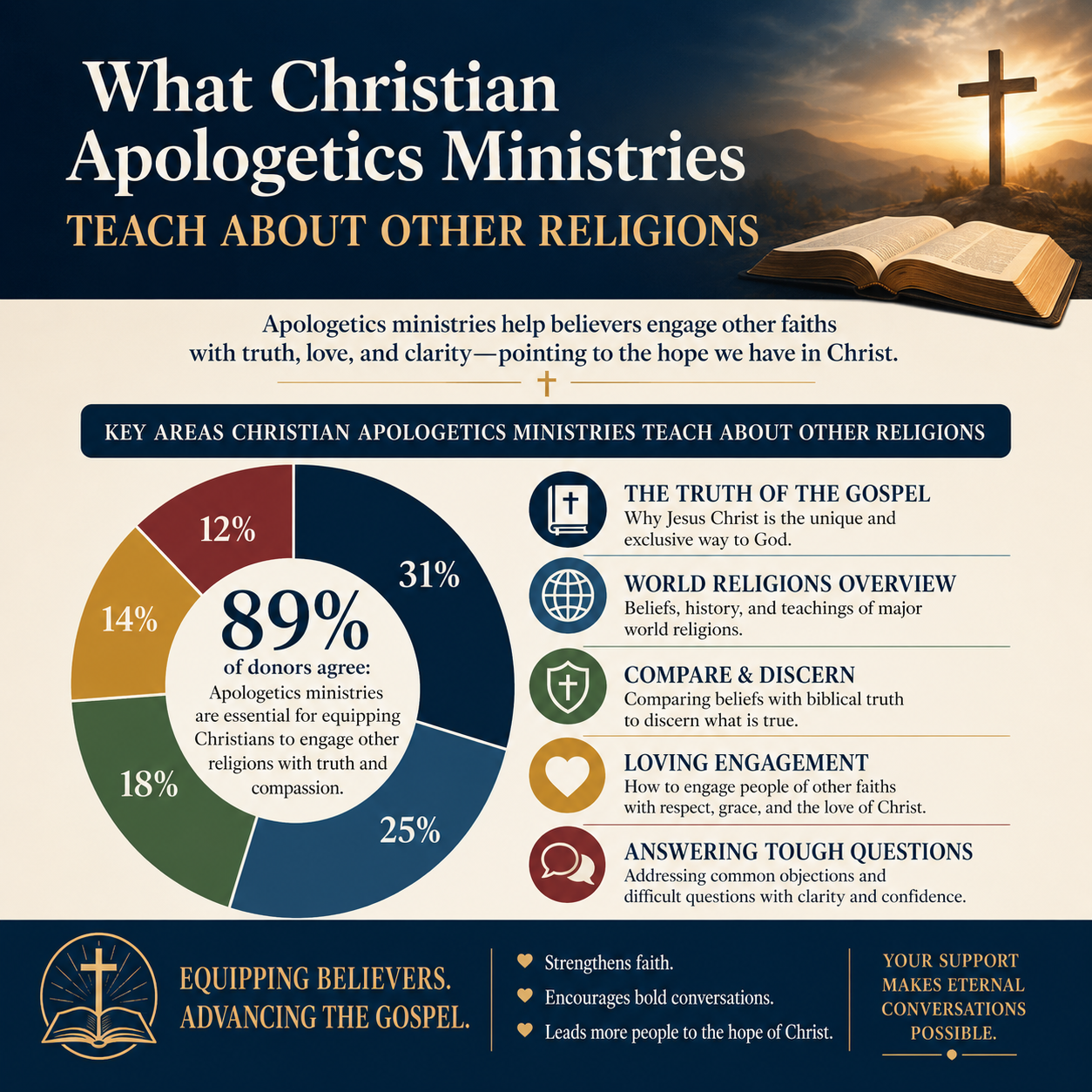
When apologetics ministries do comparative work well, they tend to organize it around a limited set of doctrinal questions that expose real differences rather than superficial contrasts. These questions commonly include: Who is God? What is the human problem? What counts as sin or bondage? What is salvation or liberation? What is the authority structure for truth claims? What is the end of history?
This kind of framing also helps prevent a common donor misunderstanding: that apologetics is mainly about “winning arguments.” In reality, it is about clarifying rival gospels and calling people to Christ with intelligibility and humility.
Common misunderstandings donors should notice
Across apologetics publishing, several recurring errors appear precisely where donors most want clarity.
- Reducing a religion to its most extreme expressions, as though a fringe movement represents the whole.
- Flattening internal diversity, treating traditions with centuries of debate as if they have one voice.
- Confusing cultural practices with core doctrine, especially in immigrant communities where faith and ethnicity overlap.
- Overstating common ground, turning “shared moral language” into “shared gospel.”
- Understating spiritual seriousness, speaking as though adherents do not truly worship, fear, hope, or sacrifice.
Donors should not mistake these as minor issues. When a ministry teaches inaccurately about others, it trains Christians to be careless with truth, and carelessness eventually spreads.
4. Donors should evaluate apologetics ministries with the same rigor used for any Christian nonprofit
Apologetics is influence work. Influence work can drift into personality-driven operations, opaque funding structures, and unaccountable platforms. That is why donors need the same disciplines of verification here as they would apply to missions, education, or mercy ministry. At Most Trusted, we exist to help donors give with confidence by assessing ministries against The Most Trusted Standard, a 15-criteria framework across four essential areas: faith foundation, financial integrity, governance and leadership, and transparency and effectiveness.
What accountability looks like in apologetics
Because apologetics ministries often trade in public speech, donors should look for clear doctrinal commitments and meaningful oversight. A board that is real, informed, and empowered is not a formality. Financial statements that are accessible and intelligible are not optional. A serious conflict-of-interest policy is not an insult to leadership; it is an act of stewardship.
When donors are assessing a ministry’s public teaching about other religions, they should also ask whether the ministry has internal processes for correction. Are retractions possible? Do leaders invite qualified critique? Are teachers connected to a local church in more than name only? These are governance questions, not merely theological ones.
What effectiveness can and cannot mean
Measuring effectiveness in apologetics is genuinely complex. Conversions are not a metric any ministry can control, and public engagement outcomes are often indirect. Still, donors can reasonably expect evidence of responsible activity: curricula used by churches, documented training outcomes, published research practices, and partnerships that demonstrate credibility rather than self-assertion.
Donors interested in the broader landscape of apologetics organizations and their approaches will find it helpful to review Christian Apologetics Ministries as a reference point for the field’s major categories and accountability questions.
5. Teaching about other religions is part of a larger calling to cultural engagement
Apologetics ministries do not merely relay information; they shape moral imagination. The church’s engagement with other religions will either be governed by fear or by faith. It will either portray Christians as a people who can speak the truth without manipulation, or as a people who must distort to persuade. In a pluralistic society, that witness has public consequences.
Pluralism does not remove the Great Commission
Christian teaching about other religions should never imply that we must choose between loving our neighbors and preaching Christ. Jesus joins those obligations. We are sent to make disciples of all nations (Matthew 28:18–20), and we are commanded to love even those who oppose us (Matthew 5:44). Apologetics ministries serve donors well when they train Christians to engage without surrendering theological clarity or human dignity.
When ministries speak of other religions, donors should listen for whether the ultimate aim is reconciliation with God through Christ, not merely the satisfaction of being “right.” The gospel is not a debate trophy.
Forming Christians for public life
Many donors support apologetics because they are concerned about their children and grandchildren inhabiting a culture where religious claims are treated as private preferences. The harder question is how that concern is discipled. Some apologetics content forms Christians to be thoughtful, patient, and courageous in public life. Other content forms Christians to treat disagreement as threat.
Our editorial work at Most Trusted routinely intersects with these broader concerns about witness, rhetoric, and credibility in the public square. Readers tracking these dynamics across the wider field should also consult Cultural Engagement in Christian Apologetics for related questions of posture, persuasion, and integrity.
FAQs for What Christian apologetics ministries teach about other religions
Should Christian apologetics ministries say that other religions contain truth?
In a limited sense, yes. Scripture affirms that God’s “eternal power and divine nature” are perceived in creation (Romans 1:20), and human beings remain image-bearers capable of moral reasoning and genuine religious longing. Many traditions preserve partial moral insights or true observations about the human condition. Apologetics ministries serve the church best when they can acknowledge partial truths while still naming the decisive gospel claim: saving knowledge of God comes through Christ’s self-revelation and atoning work, not through religious striving.
What should donors look for before funding an apologetics ministry that critiques another religion?
Donors should look for theological clarity, demonstrated accuracy, and accountable operations. The teaching itself should cite primary texts and credible scholarship rather than recycled polemics. The ministry should show evidence of board oversight, transparent financial reporting, and a willingness to correct errors publicly. These are not distractions from mission; they are the conditions that make mission trustworthy, especially when the work involves public claims about God and neighbor.
A mature apologetics ministry strengthens both truth and love
What Christian apologetics ministries teach about other religions will either deepen the church’s confidence in Christ or deform it into suspicion and caricature. Donors should seek ministries that can speak with doctrinal firmness and scrupulous accuracy, whose posture reflects the gentleness and respect commanded by Scripture, and whose institutional practices merit trust. The church does not need less conviction. It needs conviction governed by truth, tested by accountability, and expressed as love of neighbor for the sake of the gospel.



