

How Christian apologetics ministries use donations is not a peripheral curiosity for Christian donors. It is a question of stewardship: whether the resources God entrusts to his people are being directed with integrity toward the work those ministries claim to serve.
Apologetics is a form of public discipleship. It seeks to “make a defense” with “gentleness and respect” (1 Peter 3:15), and to “destroy arguments” that raise themselves against the knowledge of God (2 Corinthians 10:5). That calling can be carried out wisely or unwisely, transparently or opaquely, patiently or performatively. Donors are right to ask what their gift actually funds.
Apologetics spending is mission spending, but mission must be defined
Most Christian apologetics ministries describe their work in familiar categories: evangelistic outreach, disciple-making resources, intellectual formation for the church, and public witness in the academy and broader culture. The practical question for donors is whether a ministry’s budget tells the same story as its marketing.
Across our verification work at Most Trusted, the ministries that meet The Most Trusted Standard tend to define their mission in operational terms: who they serve, what they produce, and what outcomes they can reasonably claim. Clear mission definition is not branding. It is accountability.
Many apologetics organizations operate with a blended model. A single ministry may run a podcast, publish a curriculum, host debates, train pastors, send speakers to universities, and maintain a digital library. That breadth is not inherently suspect. The donor challenge is that blended models can hide cross-subsidies: fundraising dollars intended for outreach may quietly sustain internal overhead, or flagship media may function largely as donor acquisition rather than ministry delivery.
Program costs look different in ideas-based ministry
In a relief organization, donors can often picture “program” as tangible goods delivered. In apologetics, “program” is often labor: research, writing, editing, teaching, production, and pastoral presence in difficult conversations. Salaries may be the core program expense, not a regrettable administrative necessity. A budget that is heavy on staff compensation can be faithful stewardship if the staff are producing substantive work and the ministry is governed well.
Outputs can be counted, outcomes must be handled with care
Apologetics ministries often report outputs: books distributed, episodes released, event attendance, online views, course enrollments. Outputs matter, but they are not the same as spiritual fruit. Donors should be cautious about ministries that claim direct conversion numbers without explaining how such numbers are collected and verified. Scripture warns against measuring success in ways that inflate human pride; Paul’s ministry frame was faithful planting and watering under God’s sovereign growth (1 Corinthians 3:6–7).
Donors should expect theological seriousness in financial narratives
Some of the most troubling patterns in Christian fundraising are not technical accounting errors but moral drift: urgency language that pressures rather than persuades, promises that imply guaranteed spiritual results, and a subtle shift from proclamation to platform-building. A theologically serious ministry will speak about money with sobriety, not spectacle.

Where donations typically go in apologetics ministries
Christian donors usually want a concrete picture: when we give, what are we actually paying for? While every organization differs, apologetics budgets tend to cluster around several recurring expense types, each of which can be healthy or unhealthy depending on governance and transparency.
Content production and distribution
This includes research time, editorial work, podcast and video production, web development, translation, graphic design, printing, and platform costs. Distribution increasingly includes paid search, email software, and marketing contractors. Donors should not assume that “media” equals “vanity.” High-quality content can be a legitimate form of ministry delivery. The donor question is whether the content is the ministry, or merely a lead-generator for donations.
Pay attention to whether a ministry can explain its editorial process and theological accountability. Who reviews doctrinal claims? How are controversial topics handled? How does the ministry correct errors publicly? A serious teaching ministry should have serious controls.
Events, training, and campus presence
Conferences, church trainings, debates, and campus lectures require travel, venue rentals, insurance, staging, recording, and staff time. Some ministries also fund scholarships to train pastors or students. These costs can escalate quickly, especially when events are designed as media products. Donors should ask whether events are evaluated beyond attendance: what follow-up structures exist, what partnerships with local churches are formed, and what is learned from failures.
Staff compensation and expert labor
Ideas-based ministries rely heavily on skilled labor. Scholars, writers, theologians, philosophers, and communicators are not easily replaced. Compensation is therefore a stewardship issue in two directions: underpaying can create instability and compromise, and overpaying can signal misaligned priorities. Compensation also intersects with governance. When the founder sets his own pay without independent oversight, donors should ask harder questions.
Fundraising and donor communications
Every donor-funded organization spends money to raise money. The question is not whether fundraising exists, but whether it is proportionate, truthful, and governed. Major-donor travel, direct mail, digital ads, and development staff are common. Donors should look for honest reporting that separates fundraising from program delivery, even when the ministry’s “product” is content that also functions as donor acquisition.
Many donors have been trained to fixate on overhead ratios. The nonprofit field has repeatedly argued that overhead alone is a poor measure of effectiveness; in 2013, Charity Navigator, BBB Wise Giving Alliance, and GuideStar warned against the “overhead myth” and encouraged donors to consider governance, transparency, and results instead of simplistic ratios (Charity Navigator).
What faithful transparency looks like for apologetics donors
Christians genuinely disagree about what “good transparency” requires. Some donors want audited financials; others are satisfied with a Form 990 and a credible board. The deeper question is whether a ministry gives enough information for a prudent donor to discern whether the work is coherent, governed, and truthful.
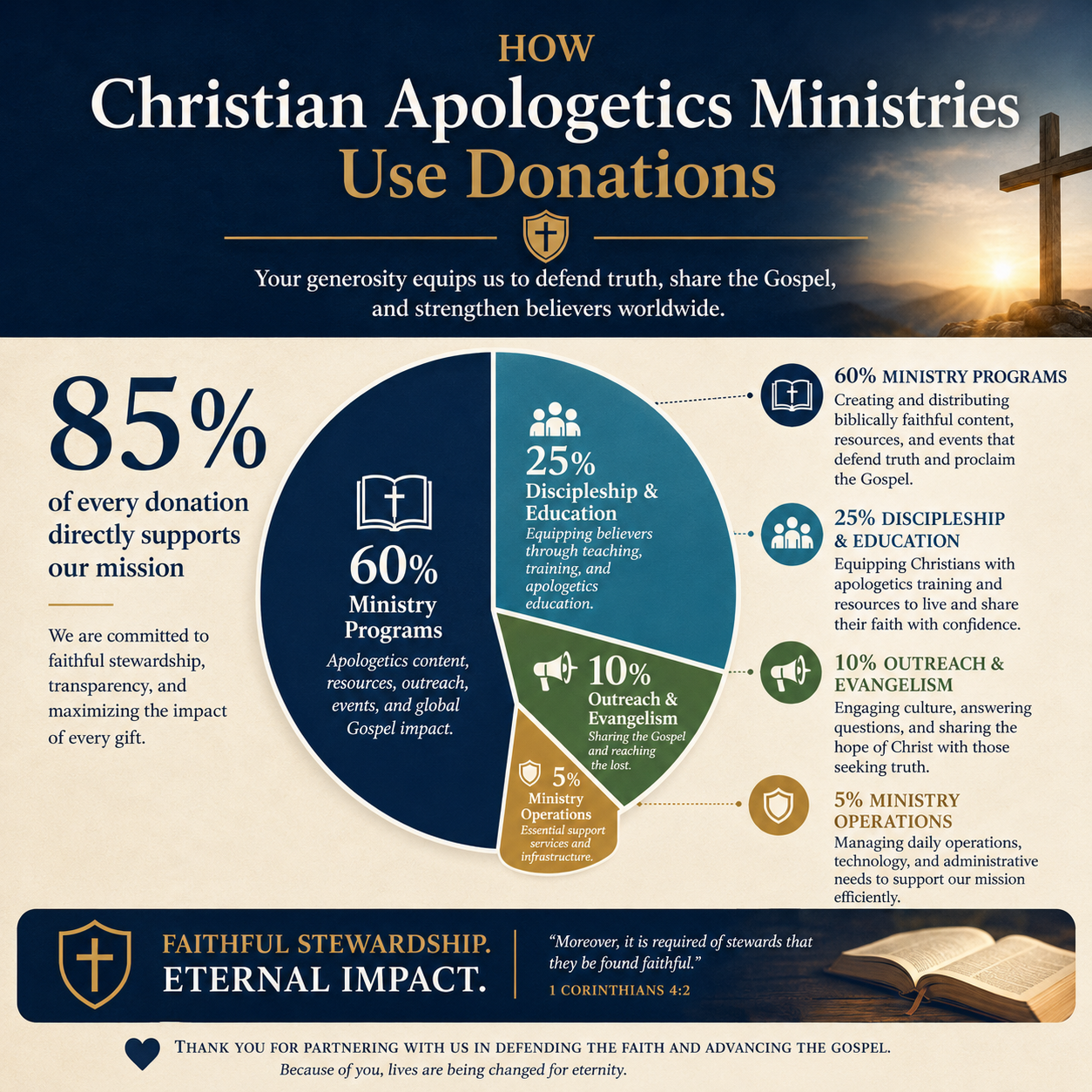
At minimum, a serious apologetics ministry should make its financial and leadership structures legible. If a ministry asks the church to trust its teaching, it should not ask the church to accept financial opacity.
Financial documents and clarity of categories
For U.S. nonprofits, donors can reasonably expect access to IRS Form 990 (or 990-EZ) and, for larger ministries, audited financial statements. Form 990 is not infallible, but it is a meaningful window into compensation, related-party transactions, governance disclosures, and program spending categories (IRS Tax Exempt Organization Search).
Donors should also look for explanatory notes that translate accounting categories into ministry reality. A ministry may report “program services” as a single line while operating multiple initiatives. Thoughtful reporting will describe what sits inside that line item: what was produced, what was distributed, what was taught, and what it cost.
Governance that is independent, not ceremonial
Apologetics ministries often grow around a founder with recognized communication gifts. That can be a blessing to the church, but founder-centered structures carry predictable risks: conflicts of interest, board passivity, and blurred lines between personal brand and charitable asset.
Donors should look for independent board governance, clear conflict-of-interest policies, and documented review of executive compensation. A ministry can be doctrinally orthodox and still be financially naïve or structurally vulnerable. Wise donors pay attention to both.
Impact reporting that respects spiritual realities
Apologetics exists in the realm of persuasion, formation, and witness. Measuring that work is real, but complicated. The most credible ministries tend to combine quantitative indicators (reach, completion rates, training participation) with qualitative evidence (pastor feedback, student testimonies handled with restraint, case studies that can be verified). The least credible rely on inflated claims and unverifiable numbers.
Donors can also ask whether a ministry demonstrates intellectual honesty: Does it cite sources carefully? Does it acknowledge counterarguments? Does it correct mistakes? Those habits are not merely academic virtues; they are moral disciplines for those who represent truth.
How donors can evaluate giving with confidence
Donors are not called to suspicion, but to discernment. Scripture commends both generosity and wisdom: “The simple believes everything, but the prudent gives thought to his steps” (Proverbs 14:15). The aim is not to interrogate ministries as adversaries, but to give as stewards.
Practical evaluation begins with asking a small set of questions and insisting on clear answers. What is the ministry’s defined mission, and what activities carry it out? What portion of spending goes to those activities, and how is that reported? Who governs the ministry, and how independent is that governance? What does the ministry claim as impact, and what evidence supports those claims?
Some donors also face a more personal tension: apologetics can become combative, and donors may worry that their support is underwriting a posture that does not reflect the meekness of Christ. That concern is not sentimental. Ministries that consistently traffic in contempt, rage, or ridicule may gain clicks, but they rarely build durable disciples. Donors should feel free to treat tone as a stewardship issue, not an aesthetic preference.
What this means in practice is that giving decisions should integrate theology, governance, and evidence. Most Trusted exists to serve that integration. Our evaluations under The Most Trusted Standard examine faith commitments, financial integrity, governance and leadership, and transparency and effectiveness in a single frame, because donors are rarely helped by one-dimensional metrics.
For donors comparing organizations within this field, our coverage of Christian Apologetics Ministries provides a broader context for what healthy patterns look like across the sector.
Stewardship that strengthens public witness
Christian apologetics is not merely about winning arguments. It is about faithful witness to the truth of Christ in a confused world, offered with humility and courage. Donations can underwrite scholarship, careful communication, training that steadies young believers, and public engagement that honors the gospel.
Donors best serve this work by insisting that ministries match theological seriousness with financial clarity. When apologetics organizations tell the truth about what they do, what it costs, how they are governed, and what can reasonably be claimed as fruit, Christian giving becomes not only generous but trustworthy.



