
Christian anti-trafficking ministries need monthly donors because the work itself is long, legally complex, trauma-informed, and rarely linear. A rescue story may capture attention, but faithful anti-trafficking work more often looks like patient case management, credible investigations, coordinated care, and years of aftercare that do not fit neatly inside a one-time gift.
For Christian donors, this is not merely a budgeting question. Scripture consistently ties faithfulness to steady stewardship rather than episodic impulse. Jesus’ teaching on daily bread forms a people who trust God day by day (Matthew 6:11), and Paul’s instruction to set aside gifts regularly reflects disciplined generosity ordered toward sustained ministry (1 Corinthians 16:2).
Monthly giving funds the parts of anti-trafficking work that rarely make headlines
Aftercare is measured in years, not weeks
Many Christian donors first encounter anti-trafficking through public awareness campaigns and urgent appeals. Those can serve a purpose, but they can also distort expectations. Survivors often need stable housing, trauma-informed counseling, medical care, legal advocacy, education support, and vocational pathways that unfold over time. A ministry that offers responsible aftercare must be able to make commitments that extend beyond the next fundraising cycle.
This is one reason the field has had to mature. Early public narratives sometimes implied that rescue alone was the decisive moment. The harder reality is that restoration is frequently non-linear. Stability can involve setbacks, re-traumatization, and complex family dynamics. Monthly donors underwrite a posture of long obedience rather than short-term intensity.
Prevention and systems change require patient capital
Anti-trafficking ministry is not only reactive. Many faithful organizations invest in prevention: strengthening families under economic strain, supporting at-risk youth, training churches to recognize grooming, and building community-based referral pathways. These efforts are essential, but they are difficult to “prove” in a single quarter because success often means a harm that did not occur.
Donors who understand prevention recognize that faithful stewardship includes investing upstream. Scripture commends the quiet work of wisdom and prudence, not only the dramatic deliverance. Monthly giving creates room for that kind of patient, preventative ministry.

Predictable revenue protects survivors from the volatility of Christian fundraising cycles
Stability reduces program whiplash
Most ministries operate with financial constraints that are invisible to the public. Staff salaries, safe-house leases, security upgrades, clinical supervision, insurance, and compliance requirements do not pause when giving declines. When income is unpredictable, ministries may be forced into cycles of hiring freezes, shortened program timelines, or reduced services precisely when survivors need consistency.
Monthly donors help smooth that volatility. Predictable revenue supports responsible staffing ratios, appropriate clinical oversight, and the ability to keep commitments to survivors without constantly recalibrating services around the next campaign.
Church patterns of giving are increasingly uneven
Christian donors have become more responsive to emergencies, social media campaigns, and highly visible causes. That responsiveness can reflect genuine compassion, but it can also produce instability for ministries whose work cannot be paused and restarted without cost. When a ministry’s revenue depends heavily on seasonal appeals, the organization is tempted to design communications around urgency rather than accuracy.
Monthly giving changes the incentive structure. It allows ministries to tell the truth about the work’s pace and complexity, rather than feeling pressured to promise outcomes that cannot be guaranteed in trauma recovery and criminal justice processes.
Monthly donors strengthen integrity in a field vulnerable to hype and harmful shortcuts
The movement has had to reckon with contested claims
Christians genuinely disagree about strategy in anti-trafficking, and the field has had to reckon with inflated numbers, simplistic narratives, and methods that can unintentionally harm those they intend to help. Even widely repeated claims about trafficking prevalence are often contested, in part because trafficking is underreported and definitions vary across jurisdictions. Serious ministries therefore tend to be cautious in what they claim and careful in how they measure results.
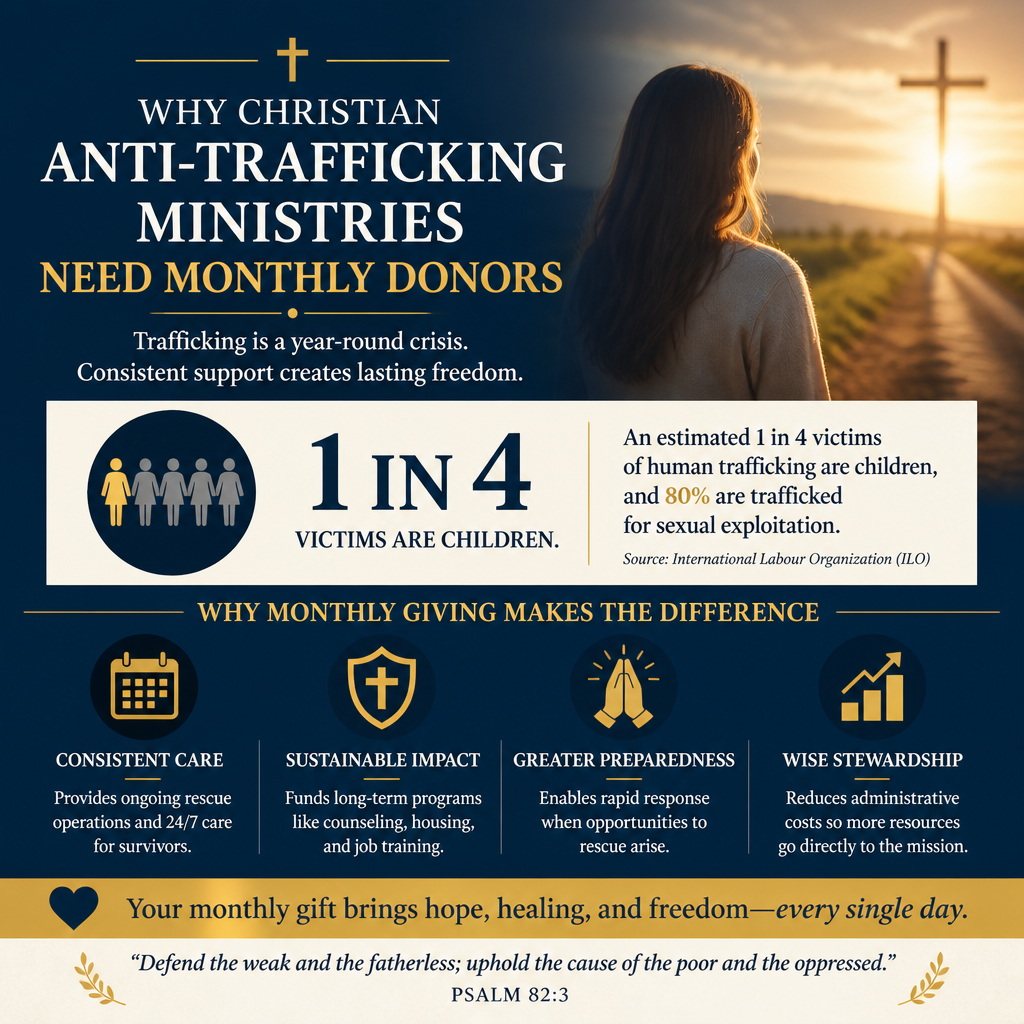
What this means in practice is that sustainable funding matters. Organizations that feel constant pressure to “prove impact” with dramatic stories may drift toward sensationalism. Monthly donors can help create an environment where a ministry is rewarded for sober reporting, ethical storytelling, and careful outcomes measurement.
Ethical anti-trafficking work costs more than donors expect
Faithful anti-trafficking ministry often requires higher overhead than donors assume: trauma-informed clinician partnerships, training for staff and volunteers, background checks, secure data systems, legal counsel, and coordination with law enforcement and social services. Mature donors increasingly recognize the “Overhead Myth” critique advanced by leading charity evaluators: focusing on low overhead can harm effectiveness by starving organizations of necessary capacity. Charity Navigator summarizes this argument and the need to assess impact more holistically (Charity Navigator).
Monthly donors help ministries build durable capacity instead of living hand-to-mouth. Capacity is not a luxury; it is a safeguard against cutting corners with survivor care, volunteer screening, and data protection.
What we look for in ministries asking for monthly support
Verification protects donors and strengthens ministries
Because the anti-trafficking space can attract both sincere compassion and opportunistic fundraising, careful due diligence is an act of love. At Most Trusted, we evaluate Christian nonprofits against The Most Trusted Standard, a 15-criteria framework spanning Faith Foundation, Financial Integrity, Governance and Leadership, and Transparency and Effectiveness. The point is not bureaucratic scrutiny; it is to help donors give with confidence and to encourage ministry practices that are worthy of trust.
Across our verification work, we observe that ministries prepared to ask for monthly support usually have a clearer articulation of program model, a more disciplined approach to financial reporting, and better internal controls. Monthly donors are not merely a revenue stream; they are often a constituency that expects consistent communication, measurable progress, and humble honesty about limitations.
Marks of a monthly giving program that deserves confidence
Monthly donors should expect more than emotional appeals. Responsible ministries tend to offer clear evidence of governance, transparency, and survivor-centered practice. When evaluating an anti-trafficking ministry’s request for monthly support, we recommend looking for the following signals:
- Clear, non-sensational descriptions of programs, avoiding exaggerated claims and respecting survivor dignity.
- Documented safeguarding policies, including volunteer screening and survivor privacy protections.
- Financial statements and accountable oversight that demonstrate funds are handled with integrity.
- Partnership posture with local churches, professional providers, and, where appropriate, law enforcement.
- Evidence of trauma-informed practice, including training, supervision, and referral networks.
Donors seeking broader context on the ministry landscape often begin with Christian Anti-Trafficking Ministries, where the aim is to approach the work with seriousness rather than slogans.
Monthly giving aligns with Christian discipleship and with responsible outcomes
Steady generosity reflects covenant faithfulness
Scripture repeatedly commends faithfulness over time. The language of steadfast love, endurance, and perseverance is not incidental to Christian ethics; it is central. Monthly giving is one practical expression of that steadiness. It is a commitment to bear burdens over time rather than only in moments of heightened attention.
This does not mean every donor must give monthly to every cause. Prudence and calling differ. But for donors who sense a particular burden for anti-trafficking, recurring giving is often the most responsible way to fund a ministry model that depends on continuity.
Better funding supports better measurement
Trafficking cases and survivor outcomes are difficult to quantify responsibly. Confidentiality constraints, legal timelines, and the complexity of trauma recovery can make simplistic metrics misleading. The best ministries typically report a mix of outputs (services delivered), outcomes (changes over time), and qualitative learning, while acknowledging what cannot be known or disclosed.
Consistent funding helps ministries invest in case management systems, evaluation partnerships, and staff capacity to track outcomes without turning survivors into marketing content. Donors who want a sober view of how gifts support real work can also consult How Christian Anti-Trafficking Ministries Use Donations for category-level perspective on common expense lines and program realities.
FAQs for Why Christian anti-trafficking ministries need monthly donors
Does monthly giving actually help survivors, or does it mainly help a ministry’s budget?
It does both, and the connection is direct. Survivor care depends on continuity: stable housing, consistent case management, clinical referrals, and reliable legal advocacy. A ministry’s budget is the instrument by which that continuity is kept. When revenue is volatile, ministries are more likely to reduce services, delay hiring, or shorten program commitments, which can undermine survivor stability.
How can donors avoid funding exaggerated anti-trafficking claims?
Donors can insist on sober language, transparent reporting, and credible governance. Responsible ministries typically avoid sensational statistics, explain their program model clearly, and describe outcomes with appropriate humility. Donors can also prioritize organizations that submit to independent evaluation and verification, since accountability structures reduce the incentive to inflate claims for fundraising advantage.
A steady gift for a long work
Monthly donors make it possible for Christian anti-trafficking ministries to practice patient, survivor-centered faithfulness: care that is not rushed, prevention that is not neglected, and reporting that is truthful rather than theatrical. For donors seeking to love neighbors harmed by exploitation, recurring support is often the most practical way to align compassion with the durable structures that restoration requires.



