
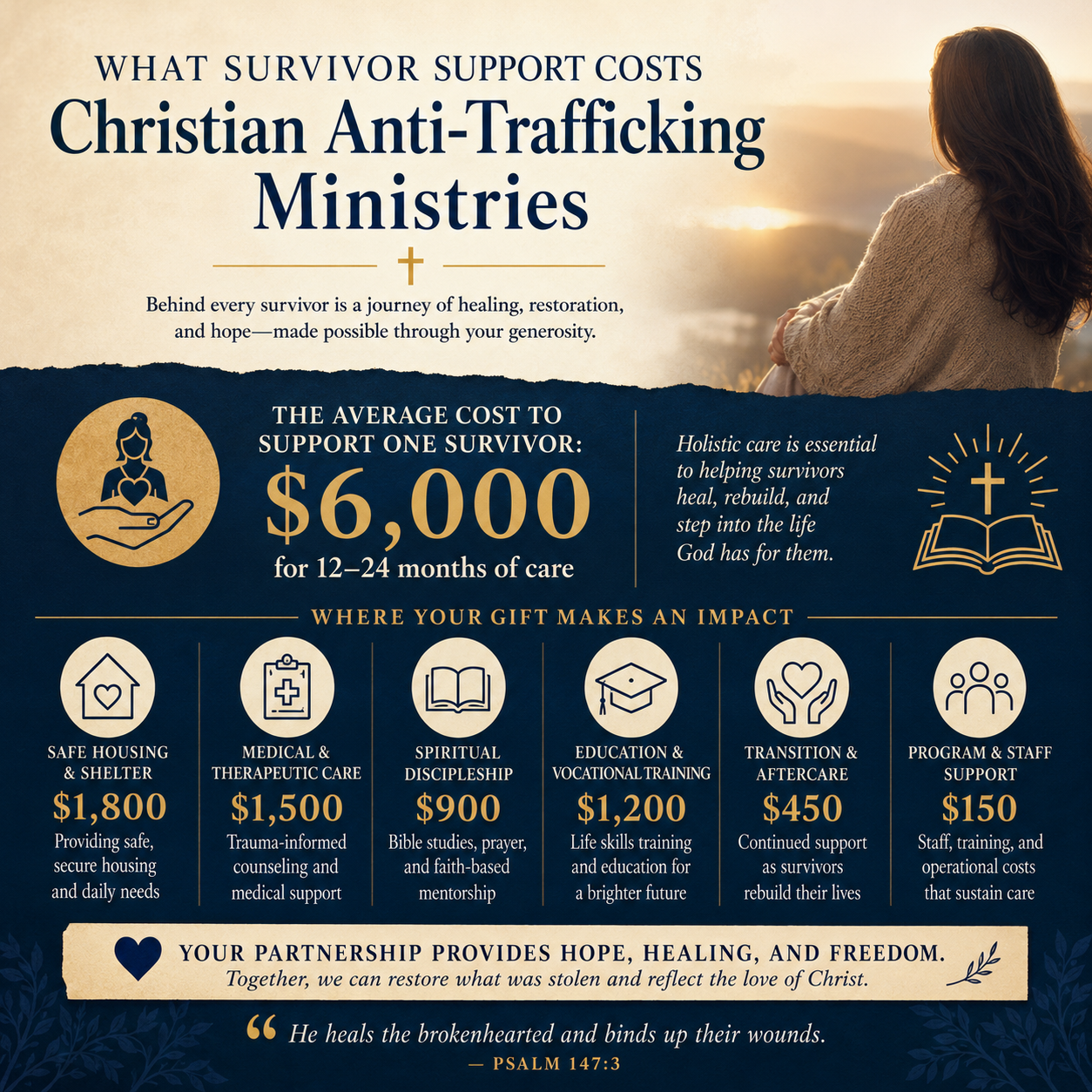
What survivor support costs Christian anti-trafficking ministries is often misunderstood because donors are formed by a simple question: how much of my gift goes “to the survivor”? A serious ministry answer is more demanding. Survivor care is a long, clinical, relational, and legal process that must be funded patiently if it is to be faithful, safe, and effective.
Christian donors rightly want to avoid waste, and they also want to avoid becoming accidental patrons of harm. Trauma recovery is not a one-time rescue event; it is the slow work of restoration. Scripture’s vision is not merely extraction from danger, but a return to wholeness—“to bind up the brokenhearted… to set at liberty those who are oppressed” (Isaiah 61:1). That vision has real costs, and some of the most essential costs are the least visible.
Survivor care is not an episode but a continuum
Many ministries can describe a “hotline call” or an “operation,” but survivor support begins before a survivor ever enters a program and extends long after the first moment of safety. The continuum commonly includes crisis response, stabilization, long-term therapeutic care, life skills development, and durable reintegration through family, church, and work.
The harder question is what it takes to provide care that is competent, lawful, and spiritually responsible. Ministries that treat survivor care as a short program phase often underfund what follows: clinical treatment, legal advocacy, and steady relationships that do not collapse under complexity.
Why timelines are long and budgets follow
Trafficking is a form of complex trauma. Survivors may carry layered histories of abuse, coercion, addiction, homelessness, and fractured family systems. It is not unusual for recovery plans to include months of stabilization and years of support, with intensity that rises and falls. That reality makes “cost per rescue” an inadequate category for Christian stewardship.
What donors often miss when they ask about overhead
Some costs that appear indirect are in fact protective. Case management systems, staff training, supervision, secure data practices, insurance, and policy compliance are not distractions from mission; they are part of loving a survivor as a person rather than as a story. The broader nonprofit sector has pushed back against simplistic overhead judgments; the “Overhead Myth” letter signed by leaders from GuideStar, BBB Wise Giving Alliance, and Charity Navigator made the case that overhead ratios are a poor proxy for impact and can pressure organizations into unhealthy underinvestment in capacity GuideStar.

The cost drivers are clinical, legal, and human
When we examine survivor support budgets across verified ministries, the largest costs are usually staff and services. This is not surprising: good survivor care depends on trained people who can sustain wise, bounded relationships over time. Underfunding staffing is among the fastest ways to produce burnout, program instability, and eventually diminished care.
Clinical care is specialized and expensive
Survivors often need evidence-based trauma treatment delivered by licensed clinicians. That may include trauma-focused cognitive behavioral therapy, EMDR, psychiatric evaluation, medication management, and substance use treatment. Ministries sometimes provide therapy in-house; others pay for external clinical services. Either route carries costs: salaries and supervision on one side, contracts and referral networks on the other.
These costs are easier to appreciate when donors remember that many forms of trafficking intersect with prior or concurrent violence. The CDC has documented the long-term health impacts associated with adverse childhood experiences, including increased risk for mental health challenges and substance use Centers for Disease Control and Prevention. Ministries do not fund “therapy sessions” in the abstract; they fund the sustained clinical work that makes stability possible.
Legal and advocacy work is often unavoidable
Even when a ministry does not provide legal services directly, it typically funds staff time and partnerships for court accompaniment, protection orders, immigration relief referrals when relevant, and coordination with law enforcement and prosecutors. Survivors may need help replacing identification, addressing criminal records tied to exploitation, and navigating child custody or family court issues. Each element requires specialized competence and careful boundaries.
Human presence is the central line item
Residential programs require 24/7 coverage, including awake overnight staff, supervisors, and relief coverage for sick leave and turnover. Non-residential programs still require consistent case management, transportation coordination, and crisis availability. Survivor support is labor-intensive because the core “service” is safe relationship sustained over time.
Safety and quality require infrastructure, not improvisation
Christian donors sometimes worry that infrastructure spending signals institutional drift. In anti-trafficking survivor care, the opposite is often true: infrastructure is what keeps care from becoming improvised, unsafe, or legally exposed. Trauma-informed practice is not merely a posture; it is a system of training, policies, supervision, and documentation.
Facility and security costs are part of protection
Residential care may require secure locations, controlled access, cameras, alarms, reinforced doors, and safety protocols. Non-residential programs may still require secure meeting spaces, confidential address handling, and transportation policies that protect both survivors and staff. These are not “extras.” They reflect a sober understanding that trafficking networks can retaliate and that survivors’ privacy is a moral duty.
Compliance, reporting, and safeguarding are not optional
Depending on services offered and jurisdiction, ministries may navigate child welfare regulations, mandated reporting, HIPAA-adjacent privacy expectations, background checks, and professional licensure requirements. Sound governance demands written policies, board oversight, and periodic review. Across our verification work at Most Trusted, we observe that ministries with mature safeguarding practices tend to document them clearly and submit themselves to external accountability rather than relying on informal assurances.
Faithful care must address formation, not only services
Survivor support in Christian anti-trafficking ministries is not only a package of social services. It is also an invitation into a renewed moral and spiritual horizon: dignity, truth, repentance where needed, forgiveness where possible, and a future not defined by exploitation. That is delicate work. It can be rushed, mishandled, or confused with control. It can also be done with great humility and care.
Christian distinctives add both responsibility and cost
When a ministry offers spiritual care, it must do so without coercion and with trauma-informed competence. Chaplaincy time, discipleship resources, partnerships with local churches, and staff training around spiritual dynamics of trauma can be real expenses. Done well, this becomes a form of pastoral stewardship rather than a marketing claim.
Christians genuinely disagree about how explicitly a survivor program should integrate spiritual practices into daily programming, especially in residential settings. Mature ministries name that tension and design for informed consent, clear options, and survivor agency—because the gospel never needs manipulation to be true.
Reintegration costs are often the most strategic
A survivor can exit immediate danger and still be at high risk of return if she lacks housing, income, and supportive community. Reintegration spending may include transitional housing, education, job placement support, transportation assistance, and emergency help that prevents relapse into exploitation. Research on human trafficking prevalence and patterns is complex and contested in places, but major global reporting has consistently emphasized the scale and profitability of exploitation, underscoring why survivor reintegration is not a side issue UN Office on Drugs and Crime.
How donors can evaluate costs without rewarding dysfunction
Not every high budget is faithful, and not every lean budget is prudent. The point is not to sanctify expense, but to fund the real work rather than the cheapest story. Donors serve the church best when they learn to read survivor care costs the way they would read costs in medicine or education: as signals to be interpreted in context, not simplified into a single ratio.
Questions that clarify whether spending protects survivors
We recommend asking ministries for specific, verifiable explanations of major expense categories, aligned to their model of care. A few questions tend to surface substance quickly:
- What is the program model, and what is the typical length of engagement for survivors?
- What portion of care is delivered by licensed clinicians or supervised by qualified professionals?
- How is safeguarding handled: background checks, training, incident reporting, and survivor confidentiality?
- What partnerships exist for legal services, medical care, and housing, and how are referrals tracked?
- What outcomes are measured, and what limits do you place on outcome claims?
Where Most Trusted fits for donors who want confidence
Most donors do not have time to audit policies, parse financial notes, and assess governance quality across multiple ministries. Most Trusted exists to help close that gap. We evaluate Christian nonprofits against The Most Trusted Standard, a 15-criteria framework that examines faith commitments, financial integrity, governance and leadership, and transparency and effectiveness. The goal is not to replace prayerful discernment, but to support it with verification that is specific enough to be meaningful.
Donors who want to compare approaches across the field can begin with Christian Anti-Trafficking Ministries, where the emphasis is on clarity about models, accountability, and the realities of survivor-centered practice. For a closer look at how ministries allocate and explain spending, How Christian Anti-Trafficking Ministries Use Donations frames the categories donors most often ask about without reducing the work to optics.
FAQs for What survivor support costs Christian anti-trafficking ministries
Should we be concerned when a survivor care ministry has higher administrative costs?
Concern should attach to opacity and weak governance, not to administration as such. In survivor care, “administration” can include safeguarding systems, training, supervision, compliance work, secure data management, and program evaluation—functions that protect survivors and staff. The question is whether the ministry can explain those costs plainly, document policies, and show that leadership and board oversight are real.
Is direct financial assistance to survivors a wise use of donor funds?
It can be, but it should be bounded and integrated into a care plan. Cash assistance without case management can create new risks, including coercion by exploiters or unstable spending under addiction pressure. Many ministries use controlled assistance—transportation, rent support, food, or fees—paired with budgeting support and clear accountability, aiming to strengthen agency without increasing vulnerability.
What faithful funding makes possible
Survivor support costs Christian anti-trafficking ministries real money because the work is real: clinically complex, legally demanding, and deeply human. Christian donors honor the image of God in survivors when giving is patient enough to fund the unglamorous necessities—qualified staff, safe systems, and long-term reintegration. The church’s calling is not to purchase inspiring moments, but to underwrite durable mercy that can withstand scrutiny and endure over time.



