
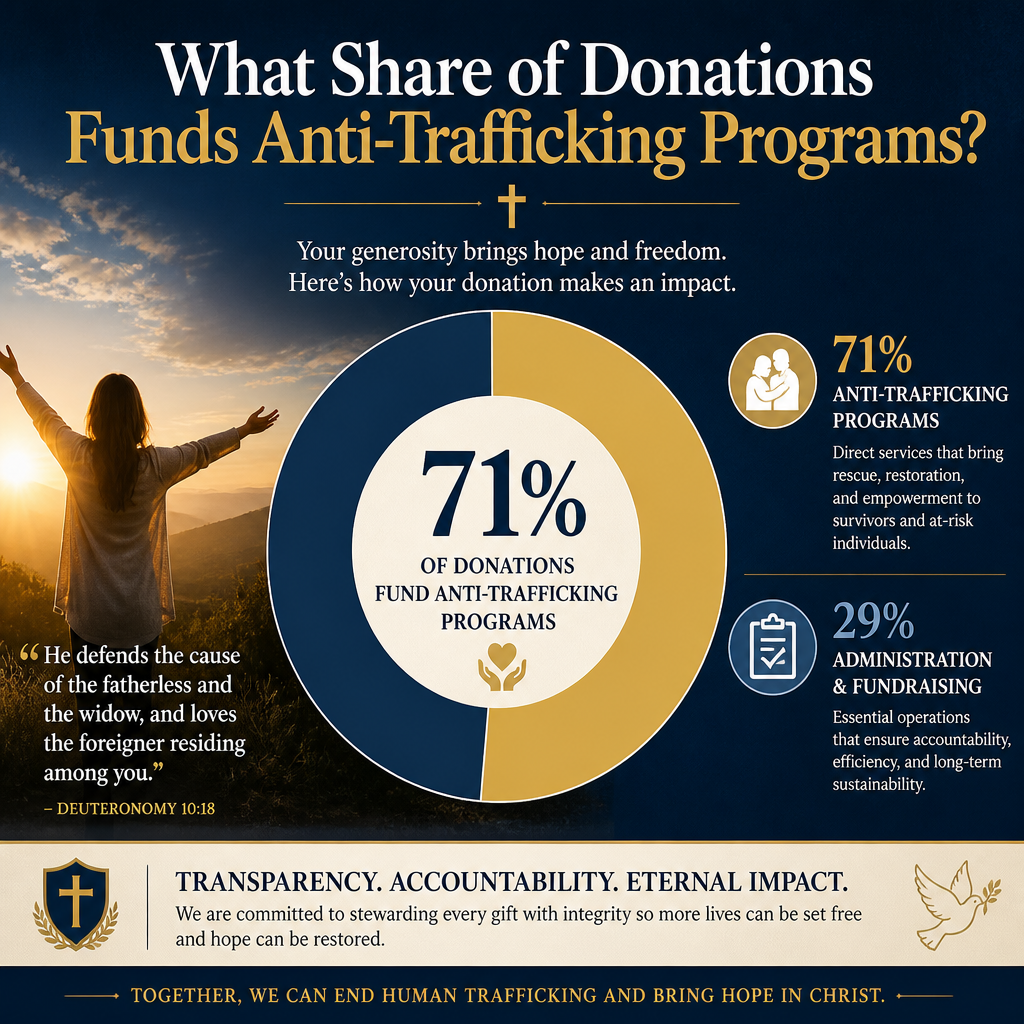
Asking what share of donations funds anti-trafficking programs is a morally serious question, not a cynical one. For Christian donors, it is part of stewardship before God: ensuring that gifts intended to protect the vulnerable are actually bearing the fruit of protection, justice, and healing.
The harder reality is that there is no single faithful percentage that applies across all Christian anti-trafficking ministries. “Program” can mean anything from survivor housing to legal aid to prevention in high-risk communities, and each comes with different cost structures and risks. Donors can still evaluate ministries with clarity, but it requires better questions than the familiar “overhead ratio.”
Why the percentage question is legitimate and limited
Stewardship requires clarity about what the gift accomplishes
Scripture treats money as spiritual freight. Jesus’ teaching ties treasure to the heart (Matthew 6:21), and the church’s diaconal practice in Acts assumes accountable distribution to real needs (Acts 6:1–6). It is appropriate to ask whether a ministry’s spending reflects its stated mission, and whether the mission itself is framed truthfully.
But the “share” question becomes misleading when donors treat all non-program spending as waste. Effective anti-trafficking work depends on competent supervision, compliance, safety protocols, staff training, evaluation, and sometimes legal expertise. A ministry that under-invests in these areas may display an attractive ratio while taking unacceptable risks with survivors and staff.
The field has learned why overhead alone is a poor proxy for impact
The nonprofit sector has had to correct a persistent donor instinct: to equate low overhead with integrity and effectiveness. In 2013, Charity Navigator, GuideStar, and the BBB Wise Giving Alliance publicly warned against this assumption, noting that “overhead is a poor measure of a charity’s performance” and that starving essential infrastructure can undermine outcomes Charity Navigator. Anti-trafficking ministries, in particular, operate in contexts where poor infrastructure can become a safeguarding failure.
What this means in practice is that donors should treat “program percentage” as one diagnostic among several, not as a verdict. The more urgent question is whether reported program spending corresponds to well-designed, ethically delivered, and demonstrably helpful services.
What qualifies as an anti-trafficking program expense
Programs are not only direct services
In financial statements, “program services” generally includes the costs that directly advance the mission: frontline staff, client assistance, survivor care, program travel, supplies, and sometimes monitoring and evaluation tied to the program. It may also include program-related portions of leadership time, accounting, and facilities when allocations are reasonable and documented.
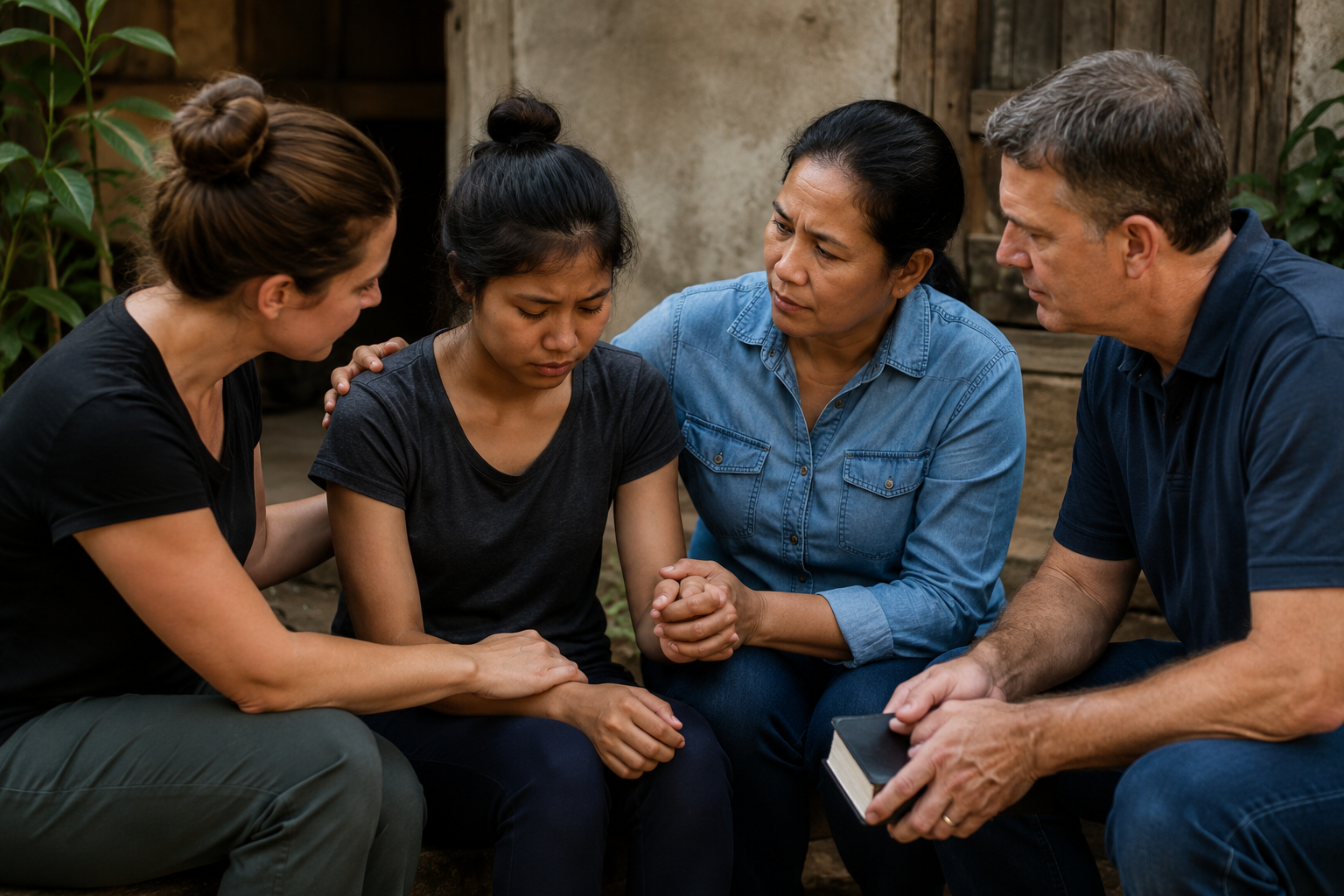
In anti-trafficking ministry, program services often includes trauma-informed case management, safe housing, vocational training, counseling, legal advocacy, and prevention education. It can also include collaboration with vetted partners, especially when a ministry’s most faithful role is to strengthen existing local capacity rather than build a parallel system.
Fundraising and administration are not morally neutral but they are not automatically suspect
Fundraising costs are sometimes portrayed as a regrettable necessity. Yet fundraising can be a form of truth-telling if it accurately represents need, avoids exploitation narratives, and invites donors into long-term partnership rather than emotional impulse giving. Administration, similarly, can be either bureaucratic bloat or essential governance. The distinction is not the label; it is the substance.
For donors comparing ministries, it is wise to verify whether the organization reports functional expense allocation and whether those allocations are consistent over time. Sharp year-to-year swings can be legitimate, but they can also be a signal that accounting practices are thin.
Why responsible ministries often have different program shares
Different interventions carry different fixed costs
Two faithful ministries may report meaningfully different program percentages because they do different work. Residential aftercare has high staffing and facilities costs. Legal services require licensed professionals and careful casework. Prevention education may have lower per-participant costs but requires curriculum development and safeguarding protocols for work with minors.
Even within “aftercare,” the clinical and legal responsibilities change the financial picture. A ministry providing counseling by licensed clinicians will look different from one offering pastoral care and peer support. Both may serve survivors; both can be done well or poorly; their cost profiles will not match.
Growth phases affect ratios without changing integrity
Newer organizations often carry higher fundraising and administrative shares as they build systems, recruit qualified leadership, and establish policies. More mature organizations may show higher program shares once infrastructure is in place. Neither pattern guarantees virtue or vice; it simply describes organizational development. The donor’s task is to discern whether infrastructure spending is purposeful and bounded, or whether it has become self-perpetuating.
Across our verification work at Most Trusted, ministries that meet The Most Trusted Standard tend to explain these dynamics plainly: what is changing, why it is changing, and what controls are in place to keep spending aligned with mission over time.
How to evaluate a ministry beyond the ratio
Ask whether the ministry can defend its theory of change
Anti-trafficking is a contested field in the best sense: practitioners are trying to learn what actually reduces exploitation and restores lives. Christians genuinely disagree about emphases—rescue operations versus long-term aftercare, public policy work versus local prevention, direct service versus capacity building. A trustworthy ministry does not hide these trade-offs. It articulates a coherent theory of change and sets expectations for what it can and cannot promise.
Donors should be cautious with language that implies guaranteed rescues, simple metrics, or a single lever that ends trafficking. The U.S. Department of State’s annual Trafficking in Persons Report repeatedly emphasizes the complexity of the crime and the need for coordinated prevention, protection, and prosecution efforts U.S. Department of State.
Look for governance and safeguarding, not only inspiring stories
Because anti-trafficking work intersects with trauma, criminal justice, and vulnerable populations, a credible ministry should be able to show safeguarding policies, staff training expectations, incident response procedures, and appropriate boundaries in storytelling. These are not secondary “administrative” details; they are part of ethical program delivery.
When donors explore the broader landscape of Christian Anti-Trafficking Ministries, the most revealing documents are often unglamorous: audited financials where available, board lists and independence, conflict-of-interest policies, and clear descriptions of partner vetting. The question is whether the ministry has built structures that are consistent with the weight of the work.
- Financial clarity: functional expense reporting with stable, explainable allocations
- Governance maturity: an active board with documented oversight and conflict-of-interest practices
- Safeguarding: survivor-centered policies, training, and crisis response protocols
- Truthful communications: fundraising that avoids sensationalism and protects dignity
- Evidence posture: measurable outputs and honest limitations, not inflated claims
What donors can ask for and what ministries should already provide
Request concrete reporting that matches the ministry’s work
Anti-trafficking ministries should be able to tell a donor what “program” means in their context. For aftercare, that might include the number of clients served, average length of engagement, the services offered, and how referrals work. For prevention, it might include training delivered, audience demographics, and how the ministry evaluates whether messaging changes vulnerability over time.
Not every ministry can run randomized trials, and donors should not demand research burdens that divert resources from care. Yet donors can reasonably expect consistent, verifiable reporting, along with ethical evaluation practices that do not reduce survivors to data points.
Use category-level patterns without treating them as universal rules
Donors often ask for a “good” program percentage. In practice, the acceptable range depends on the intervention, scale, geography, and compliance environment. What donors can do is compare a ministry to others doing similar work and ask whether differences are explained candidly.
For a deeper view of common spending patterns and the underlying trade-offs, we encourage donors to read How Christian Anti-Trafficking Ministries Use Donations. The goal is not to force every ministry into the same template, but to develop donor discernment that is resilient against both waste and simplistic metrics.
FAQs for What share of donations funds anti-trafficking programs
Is a higher program percentage always better?
No. A higher program percentage can indicate focus, but it can also reflect underinvestment in governance, financial controls, staff development, and safeguarding. The 2013 joint statement from Charity Navigator, GuideStar, and the BBB Wise Giving Alliance cautioned donors against using overhead ratios as the primary indicator of nonprofit performance GuideStar. In anti-trafficking work, a “lean” organization that lacks strong policies and qualified oversight can create real harm.
What should we do if a ministry will not provide clear financial and program reporting?
We recommend treating opacity as a substantive risk, not a minor inconvenience. Responsible ministries may have legitimate constraints—privacy obligations, security risks, or sensitive partnerships—but they should still provide basic financial statements, clear descriptions of services, governance information, and a coherent account of how funds are used. If a ministry cannot or will not provide this, donors can direct their giving toward organizations that demonstrate transparency consistent with the gravity of survivor care.
Stewardship that serves survivors, not metrics
The question of what share of donations funds anti-trafficking programs is best approached as a gateway to deeper evaluation. Program percentages matter, but they do not absolve donors from asking whether the work is truthful, safe, well-governed, and effective in its context.
At Most Trusted, our purpose is to help Christian donors give with confidence by assessing ministries against The Most Trusted Standard. The aim is not to reward the thinnest administration, but to identify organizations whose financial integrity, leadership, transparency, and faith foundation support the kind of long obedience that survivor restoration requires.



