
How Christian anti-trafficking ministries spend donations is not a peripheral curiosity for serious Christian donors. It is a moral question about whether our giving actually serves the enslaved, strengthens the vulnerable, and honors God in truth rather than in sentiment.
Trafficking is both a crime and a pastoral reality. It involves coercion, deceit, and exploitation, but it also involves poverty, family breakdown, addiction, migration pressures, and demand for commercial sex and forced labor. Christian donors tend to want clarity: what does faithful, effective work cost, and what should we expect to see when donations are stewarded well?
Begin with the mission field as it is, not as we wish it were
Why trafficking resists simple program accounting
Anti-trafficking work does not behave like a single-input, single-output intervention. The pathway from risk to exploitation to exit is often nonlinear, and the same donation dollar can support prevention today, emergency response tomorrow, and long-term restoration for years. Ministries that promise clean, immediate outcomes often end up over-claiming results or under-supporting the slow work of rebuilding a life.
Many donors understandably look for “rescue numbers.” Yet the field has had to reckon with the reality that raids can retraumatize victims, disrupt fragile trust, and sometimes misidentify consenting adults as trafficking victims. Christians genuinely disagree about enforcement-forward strategies, but there is broad agreement that a victim-centered approach must guard against using survivors as props for fundraising.
A biblical frame for spending and truth-telling
Scripture’s concern is not only compassion but integrity. “Whoever is faithful in very little is also faithful in much” (Luke 16:10) is a stewardship standard that applies to budgets, claims, and governance. The question for donors is not whether a ministry’s work is emotionally compelling. The question is whether the ministry’s spending practices match its stated theology, its model of care, and the realities survivors face.

Most anti-trafficking budgets cluster around five legitimate cost centers
Direct services are often more expensive than donors expect
The most visible category is survivor care: safe housing, food, transportation, trauma counseling, medical care, legal advocacy, case management, and long-term discipleship. Housing and clinical care are cost-heavy because safety and trauma recovery require trained staff, high supervision, and reliable facilities. Donors sometimes assume ministries can run these programs with volunteer labor, but that expectation can unintentionally pressure ministries into unsafe staffing ratios or underqualified care.
Trauma-informed care is not a slogan; it is a competence. The National Child Traumatic Stress Network has long emphasized that trauma can affect cognition, emotional regulation, relationships, and physical health, which is why sustained, specialized support is often necessary for recovery.National Child Traumatic Stress Network
Prevention and community strengthening are less photogenic but often strategic
Prevention spending can include school-based education, training for churches and employers, strengthening family income, and partnerships that reduce vulnerability among migrants and marginalized workers. In many contexts, prevention is not an alternative to “rescue”; it is the attempt to keep the next person from being exploited in the first place. The When Helping Hurts framework, articulated by Corbett and Fikkert, has shaped many Christian ministries toward approaches that strengthen local agency rather than creating dependency.
Prevention work is also where Christian institutions can bring distinct strengths: congregational networks, pastoral presence, and long-term relational commitment. But prevention can be difficult to measure, which means donors should expect careful, modest claims rather than inflated numbers.
What responsible spending looks like in practice
Staffing, training, and supervision are not administrative bloat
Anti-trafficking ministries that handle crisis response and survivor care carry genuine duty-of-care obligations. Spending on vetted staff, background checks, clinical supervision, security protocols, and ongoing training is frequently a sign of seriousness, not drift. The harder question is whether these costs are governed well: clear roles, documented policies, and leadership accountability that prevents both moral failure and operational chaos.
Across our verification work at Most Trusted, we observe that ministries that meet The Most Trusted Standard tend to treat policies and oversight as ministries of protection. That includes documented safeguarding practices, conflict-of-interest boundaries, and decision-making structures that do not collapse into founder control.
Outcomes measurement should be cautious, survivor-centered, and honest
Donors should not expect precision that the field cannot bear. Yet neither should donors accept storytelling that replaces evidence. A responsible ministry will define what success means for its model: safety planning completed, stable housing maintained, counseling milestones, education and job placement, family reunification when appropriate, and church community integration when welcomed by the survivor.
It is also prudent when ministries partner with qualified researchers or use validated tools for trauma symptoms, well-being, and program fidelity. Evaluation costs money, but it also guards the donor from funding work that feels righteous while failing the people it claims to serve.
Red flags Christian donors should not ignore
Fundraising claims that outpace documentation
Trafficking is a space where dramatic narratives can be monetized. Donors should be wary of ministries that publish large “rescued” counts without clarifying definitions, timeframes, and partner roles. A ministry may participate in a broader ecosystem—law enforcement, shelters, hospitals, legal clinics—and it is misleading to attribute an entire outcome to one organization without careful attribution.
Donors should also scrutinize ministries that depend on graphic imagery, sensational language, or detailed survivor stories that compromise privacy. Ethical storytelling is a spending issue because it reveals what the organization is willing to trade to raise money.
A fixation on overhead ratios rather than stewardship quality
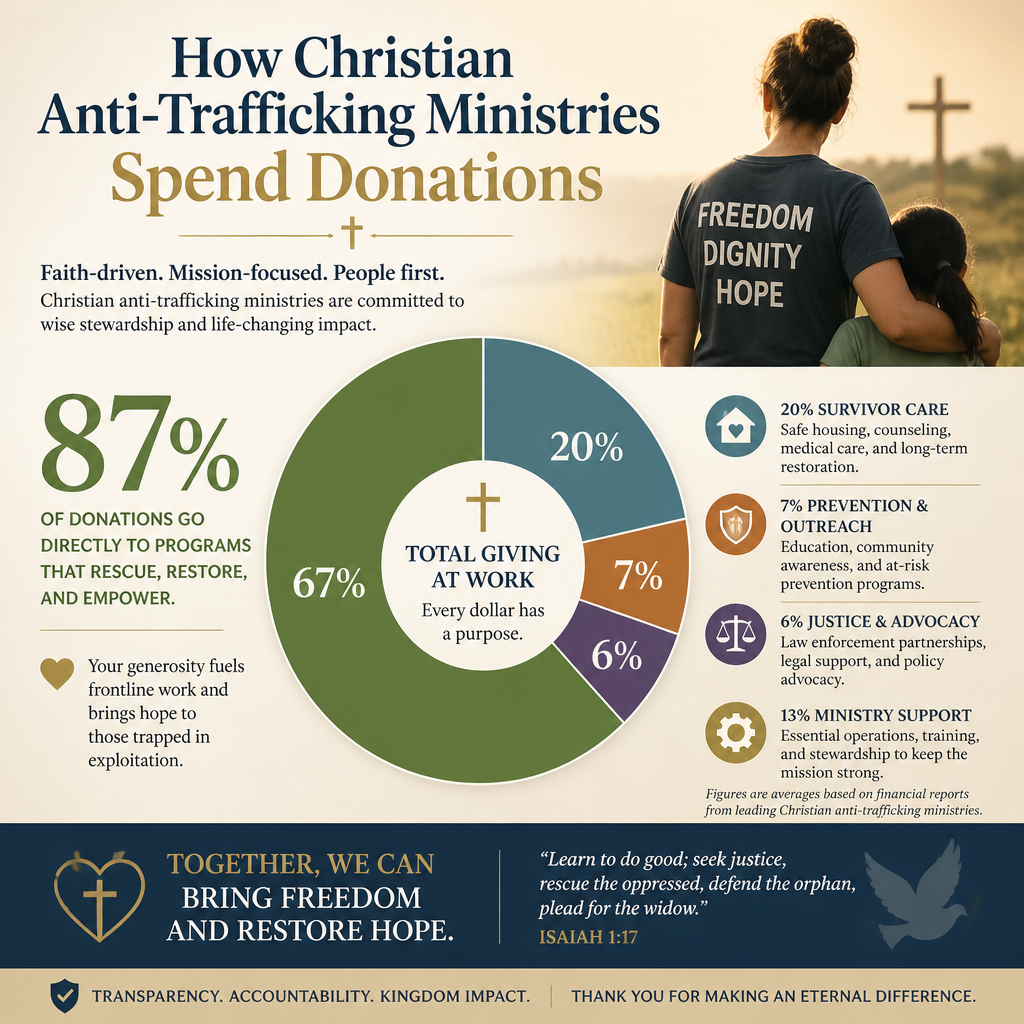
Many Christian donors were taught to evaluate a charity primarily by the percentage spent on “programs.” The sector has pushed back on that reductionism for good reason. The Overhead Myth letter signed by GuideStar, Charity Navigator, and the BBB Wise Giving Alliance argued that overhead ratios are a poor proxy for effectiveness and can incentivize unhealthy underinvestment in systems and people.Candid GuideStar
What this means in practice is that a ministry can spend a high percentage on “program” and still deliver unsafe care, weak governance, or misleading reporting. Conversely, a ministry may carry legitimate infrastructure costs—clinical supervision, security, audits, data systems—precisely because it is pursuing quality and accountability.
Donors can ask a better set of questions:
- Does the ministry define its model clearly and explain what donations fund?
- Are safeguarding and trauma-informed policies written, current, and enforced?
- Does the board provide real oversight, including financial and ethical accountability?
- Are survivor stories protected with consent, privacy, and non-exploitation?
- Are outcomes reported with modesty, definitions, and external corroboration where possible?
How to read a ministry budget with discernment and confidence
Follow the money to the model
Spending patterns should match the ministry’s stated approach. A residential restoration program will reasonably show higher personnel, housing, and clinical costs. A church training and prevention organization will show higher content development, travel, and convening costs. A legal advocacy ministry will show specialized staff and case-related expenses. The question is not whether categories look “lean.” The question is whether they look coherent.
Donors also benefit from examining whether the ministry is building local capacity or importing solutions. In international contexts, healthy budgeting often includes local staff compensation, language-appropriate counseling resources, and partnerships that avoid displacing existing community organizations.
Expect transparency that is specific, not performative
Financial statements, annual reports, and clear program descriptions are baseline. Mature transparency goes further: it explains what the ministry will not do, what it has learned, and where outcomes remain uncertain. It names risks: secondary trauma among staff, survivor relapse patterns, threats from traffickers, and the constraints of legal processes.
For donors who want a structured approach, Most Trusted evaluates ministries against The Most Trusted Standard, a 15-criteria framework that examines faith foundation, financial integrity, governance and leadership, and transparency and effectiveness. When donors want to understand the broader landscape, we maintain editorial coverage of Christian Anti-Trafficking Ministries that reflects both theological seriousness and field realities.
Donors often also want to compare similar approaches side-by-side. Within this area, our category work on How Christian Anti-Trafficking Ministries Use Donations focuses on how budgets align with models of care, how ministries communicate impact, and what practices tend to correlate with safer and more credible operations.
FAQs for How Christian anti-trafficking ministries spend donations
Should most donations go to rescue operations rather than long-term care?
Not necessarily. “Rescue” is only one moment in a long and complex pathway. Many survivors need extended, trauma-informed support, safe housing, legal advocacy, and stable community to avoid being re-exploited. A responsible budget often includes substantial spending on long-term restoration because liberation without sustained care can become a revolving door.
Is a higher administrative percentage always a sign of waste?
No. In anti-trafficking work, certain so-called administrative costs may be essential to safety and effectiveness: background checks, clinical supervision, data security, audits, staff training, and governance. The more faithful question is whether the ministry’s leadership and board can explain these costs clearly and demonstrate that they protect survivors and strengthen program quality.
A faithful donor posture in a field that demands truth
Christian donors give against the backdrop of a God who hears the cry of the oppressed and judges with impartiality. That theological conviction should lead not only to generosity but also to disciplined discernment. The most trustworthy anti-trafficking ministries tend to spend in ways that are coherent with their care model, sober about complexity, and transparent enough to withstand honest scrutiny.



