
What administrative costs fund in Christian anti-trafficking ministries is not a secondary question for donors; it is often the difference between a ministry that can protect survivors over time and one that can only respond in flashes. When donors treat “admin” as spiritual compromise, ministries are pressured into underinvesting in the very systems that prevent harm, sustain compliance, and make outcomes verifiable.
Scripture does not commend waste, but it does commend order, accountability, and faithful stewardship. Paul’s collection for the Jerusalem church was administered “honorably not only in the Lord’s sight but also in the sight of man” (2 Cor. 8:21). That instinct—doing what is right and being able to show it—is precisely where administrative spending becomes a moral category, not merely a budget line.
Administrative costs are often the safety infrastructure behind survivor care
Trauma-informed care requires policies, supervision, and documentation
Anti-trafficking work routinely involves minors, survivors with complex trauma, and high-risk perpetrators. The work can be spiritually motivated and still require disciplined safeguards. Administrative costs commonly fund case management systems, clinical supervision, staff training, and documentation practices that keep care consistent across turnover and across time.
In practice, the question is not whether a ministry will have “overhead,” but whether its overhead is sufficient for the level of risk it carries. Survivors deserve continuity: coherent intake procedures, risk assessments, safety plans, and referral protocols. Those are not optional add-ons to “real ministry.” They are part of the care itself when the mission includes vulnerable people.
Compliance and reporting protect survivors and ministries
Some administrative spending is driven by legal and ethical obligations: background checks, mandatory reporter training, secure recordkeeping, and incident reporting. In the United States, child abuse prevention and response is not only a moral duty but often a legal one, and federal guidance has historically underscored the importance of mandatory reporting frameworks in child welfare contexts U.S. Department of Health and Human Services. Ministries operating internationally face additional complexities: cross-border data handling, consent standards, and partnership due diligence.
Donors sometimes underestimate how quickly a ministry can do harm through informal practices. A “lean” operation without strong controls may appear efficient on paper while exposing survivors to preventable risks.

Good administration is not “less spiritual” but more accountable
The Bible’s concern is faithful administration, not minimal administration
Christian donors often carry an understandable fear: money meant for the oppressed drifting into bureaucracy. Yet Scripture’s concern is not that administration exists, but that it is faithful. The Pastoral Epistles assume structured leadership, credible reputation, and orderly governance in the household of God (1 Tim. 3). Administrative costs frequently fund the functions that make these requirements concrete: governance support, financial controls, and documented decision-making.
Across our verification work at Most Trusted, ministries that meet The Most Trusted Standard tend to show evidence of mature internal discipline: clear lines of authority, written policies that are actually used, and reporting that matches the reality on the ground. These elements rarely emerge from “program spending” alone. They are typically built and maintained through administrative investment.
Resisting the overhead reflex is consistent with sector-wide guidance
The nonprofit sector has had to correct the simplistic assumption that low overhead equals high impact. Charity Navigator, Candid (formerly GuideStar), and the BBB Wise Giving Alliance jointly warned donors against using overhead ratios as the primary measure of a nonprofit’s value, urging evaluation of results, transparency, and governance instead Charity Navigator. Christian donors should hear this as a stewardship invitation: do not substitute a single percentage for moral and practical discernment.
Christians genuinely disagree about what “efficient” should mean in a ministry context. But there is broad agreement that a ministry serving vulnerable people must be demonstrably safe and accountable.
What administrative costs typically fund in anti-trafficking ministries
Core functions donors rarely see but survivors depend on
Administrative costs vary by model—aftercare homes, hotline and outreach teams, legal advocacy, prevention training, or partnership-based work overseas. Still, several categories recur in credible programs:
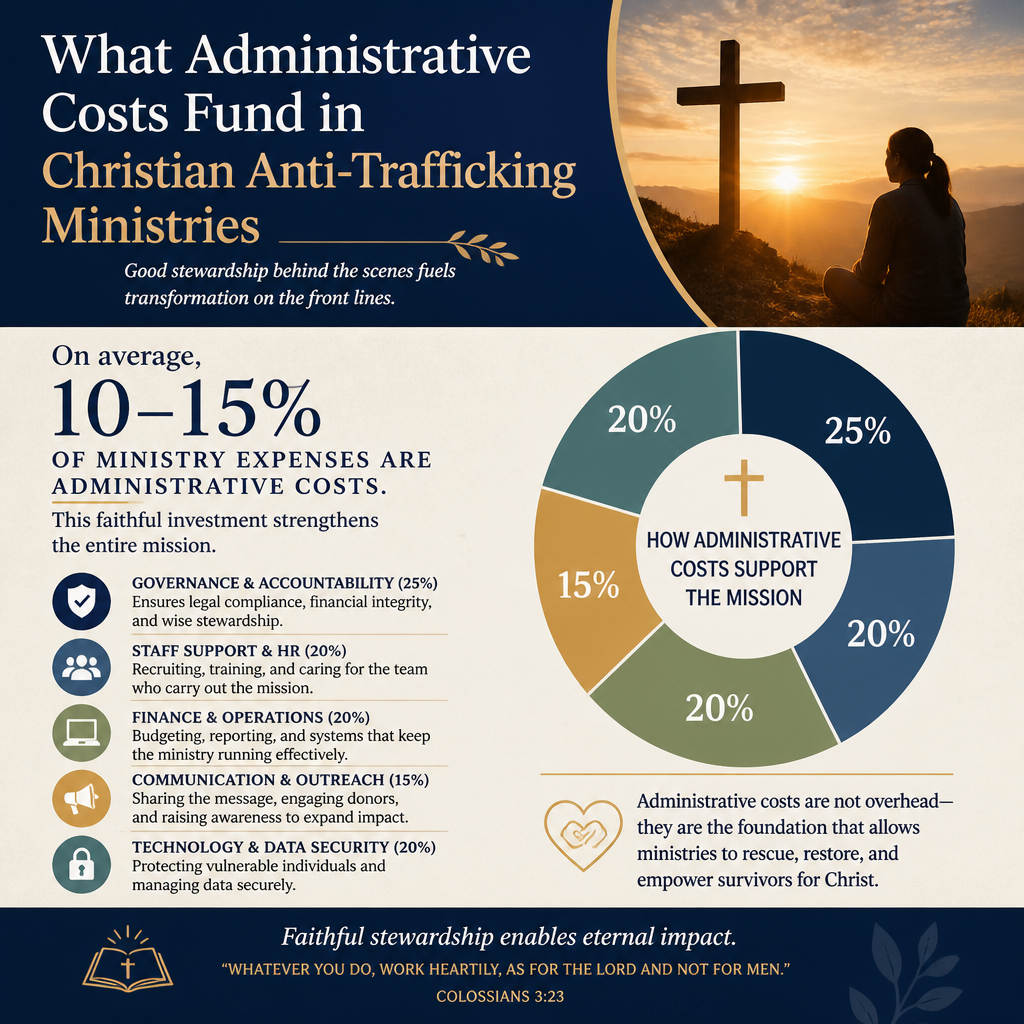
- Financial controls and audit readiness: bookkeeping, internal controls, restricted fund tracking, and preparation for independent review.
- Human resources and safeguarding: hiring processes, background checks, staff files, supervision structures, and misconduct response.
- Case management infrastructure: secure databases, documentation standards, consent management, and continuity planning.
- Clinical and pastoral supervision: licensed oversight where required, referral networks, and secondary trauma mitigation for staff.
- Partnership and vendor due diligence: vetting shelters, translators, transport providers, and local implementing partners.
These costs can feel indirect to a donor who wants to picture meals served or rescues conducted. Yet they often determine whether those front-line activities are safe, legal, and sustainable.
Administrative spending often carries the load for transparency
Donors who ask for evidence of effectiveness are asking for administrative capacity. Measurement requires defined outcomes, consistent data collection, and the willingness to publish results with appropriate privacy protections. When a ministry reports “people served,” the responsible question is “served how, for how long, with what safeguards, and what changed?” The ability to answer requires staff time, systems, and review processes that typically sit in administrative categories.
This is one reason donors looking for deeper accountability often gravitate toward work that is willing to be examined publicly. Administrative costs are frequently the price of honesty.
How to assess whether administrative spending is faithful stewardship
Ask questions that connect dollars to risk, quality, and outcomes
Administrative costs can fund either mission support or mission drift. The difference becomes clearer when donors ask about the ministry’s operating reality. Sound questions include:
Safeguarding: What are the child protection and vulnerable adult policies? How are incidents reported and reviewed? What training is required for staff and volunteers?
Financial integrity: Who approves expenditures? How are restricted gifts tracked? Is there an independent audit or review process appropriate to size and complexity?
Outcomes: What does success mean for this ministry’s model? How does it measure progress without compromising survivor privacy?
Governance: Who is on the board, and what oversight does it provide? How are conflicts of interest managed?
Donors will find that serious ministries welcome these questions. Evasion is not a neutral signal in a high-risk field.
Interpret ratios carefully, especially in smaller or younger ministries
Administrative percentages can be misleading. A young ministry may show higher administrative spending because it is building policies, systems, and staff capacity that will eventually support more direct service. A small ministry may also have fixed costs that do not scale down neatly. The more relevant question is whether the spending is proportional to risk and aligned with a clear plan.
For donors seeking a structured way to evaluate these factors, our work at Most Trusted applies The Most Trusted Standard across faith foundation, financial integrity, governance and leadership, and transparency and effectiveness. In anti-trafficking, these areas cannot be separated in practice. Weak governance becomes unsafe programming. Weak financial controls become credibility loss. Weak transparency becomes unverifiable impact.
Why underfunding administration can harm survivors and distort the mission
The starvation cycle is real in high-care ministries
When donors pressure ministries to keep overhead artificially low, ministries can enter a pattern nonprofit researchers have described as the “nonprofit starvation cycle,” where underinvestment in infrastructure leads to weak performance and further pressure to appear lean Stanford Social Innovation Review. In anti-trafficking work, that cycle is not merely inefficient; it can become dangerous. Undertrained staff, inconsistent supervision, and poor documentation create conditions where survivors can be mishandled, retraumatized, or lost in the system.
Christian compassion should not demand fragility. If a ministry cannot afford basic controls, it may be forced into shortcuts that put the very people it serves at risk.
Donors should watch for two equal and opposite errors
One error is assuming “admin” is inherently suspect. The other is assuming any level of administrative spending is justified because the work is hard. The mature approach is to test whether administrative capacity is serving mission integrity: protecting the vulnerable, ensuring stewardship, and enabling truth-telling about results.
Most donors are not trying to micromanage. They are trying to obey God with their resources. That is why it is appropriate to examine not only what a ministry claims to do, but whether it has built the administrative means to do it responsibly.
Within Christian Anti-Trafficking Ministries, donors will encounter a wide range of operational models and theological emphases. Our counsel is consistent: the more vulnerable the people served, the more a ministry’s invisible infrastructure matters.
FAQs for What administrative costs fund in Christian anti-trafficking ministries
Should we avoid ministries with higher administrative costs?
Not automatically. A higher administrative percentage can reflect necessary safeguarding, compliance, clinical oversight, and outcome measurement—especially in residential aftercare or complex case management. The responsible question is whether the spending is clearly connected to risk management, care quality, and verifiable stewardship, rather than vague “office” costs without explanation.
What administrative signals should concern Christian donors most?
Persistent lack of transparency is the most concerning signal: unclear financial statements, evasive answers about safeguarding, no meaningful board oversight, or refusal to explain how decisions are made. Donors can also be cautious when a ministry emphasizes dramatic stories while providing little documentation of policies, partnerships, or measurable outcomes. Many of these concerns sit within Accountability and Transparency in Christian Anti-Trafficking Ministries, where donors are right to ask how integrity is demonstrated, not merely asserted.
A faithful ministry can usually explain its administrative spending without embarrassment
Administrative costs fund the moral architecture of anti-trafficking work: safeguarding, supervision, compliance, financial integrity, governance, and honest reporting. Donors should not be satisfied with a low number; they should be satisfied with credible answers. When a ministry can show how its administrative capacity protects survivors and strengthens stewardship, Christians can give without the false choice between compassion and accountability.



