
Learning how to read Christian anti-trafficking ministry annual reports is not a secondary skill for serious donors. In a field where suffering is acute and stories are powerful, the annual report is often the most accessible window into whether a ministry is faithful, competent, and truthful about what it can actually prove.
Scripture binds compassion to truth. “We are to grow up in every way… into Christ” by “speaking the truth in love” (Ephesians 4:15). Anti-trafficking work is an arena where love without truth becomes naïve, and truth without love becomes cold. Mature giving requires both.
Annual reports are theology in public
What a ministry celebrates reveals what it believes
An annual report is not merely a fundraising artifact. It is a public account of what a ministry believes God has called it to do, what it attempted in that calling, and what it can responsibly claim. A Christian ministry’s language about human dignity, agency, repentance, justice, and hope will appear in its reporting if those convictions are real.
Pay attention to what is treated as “success.” If the report prizes dramatic rescues above long, patient restoration, it may be reflecting a rescue-centered imagination that can drift from the slower biblical work of healing. If it celebrates growth in influence without corresponding humility about risk, it may be shaping donors into patrons of a brand rather than stewards of mercy.
Christian anti-trafficking requires moral clarity and operational sobriety
Christians genuinely disagree about some tactics in this space: the role of law enforcement partnerships, the wisdom of certain awareness campaigns, and the balance between prevention and aftercare. Annual reports should not pretend these tensions do not exist. The best reports name trade-offs, describe safeguards, and avoid simplistic moral narratives that flatten complex realities.
When a report presents every initiative as unambiguously triumphant, it is often less a reflection of excellence than of an organization that has not learned to tell the truth under pressure. A credible ministry can report growth and still acknowledge setbacks, unintended consequences, and lessons learned.

Start with the claims, then test the evidence
Separate stories from substantiated outcomes
Annual reports often lead with survivor stories. Stories can be truthful and still be selective. What donors need is not less storytelling, but reporting that distinguishes between narrative illustration and verifiable outcomes. A mature report makes clear what is anecdotal, what is measured, and what is inferred.
In anti-trafficking, outcome measurement is difficult for real reasons: privacy constraints, security risk, trauma dynamics, and the long time horizon of restoration. That difficulty does not excuse vagueness. It should push ministries toward careful definitions and honest limits.
Ask whether numbers have definitions and denominators
Be cautious with tallies that are emotionally potent but methodologically thin: “rescued,” “freed,” “saved from trafficking,” “at risk,” or “impacted.” A trustworthy report defines terms and explains who is counted. For example, “survivors served” should clarify whether that means a single hotline conversation, a week of shelter, a full case-management plan, or months of ongoing care.
When a ministry reports “X people trained,” look for downstream evidence that the training changed behavior or improved identification and referral. Research suggests that training alone does not consistently translate into improved outcomes unless it is paired with systems, supervision, and reinforcement; the U.S. Department of Justice’s Office for Victims of Crime has published guidance emphasizing coordinated, trauma-informed responses rather than stand-alone interventions (Office for Victims of Crime).
Follow the money without reducing ministry to overhead
Financial statements matter because people matter
Christian donors sometimes hesitate to “scrutinize” finances, fearing it signals distrust. Scripture frames the matter differently. Stewardship is love in economic form. The church’s collection for the saints was managed with visible care “so that no one should blame us about this generous gift” (2 Corinthians 8:20–21). Financial clarity honors both donors and survivors.
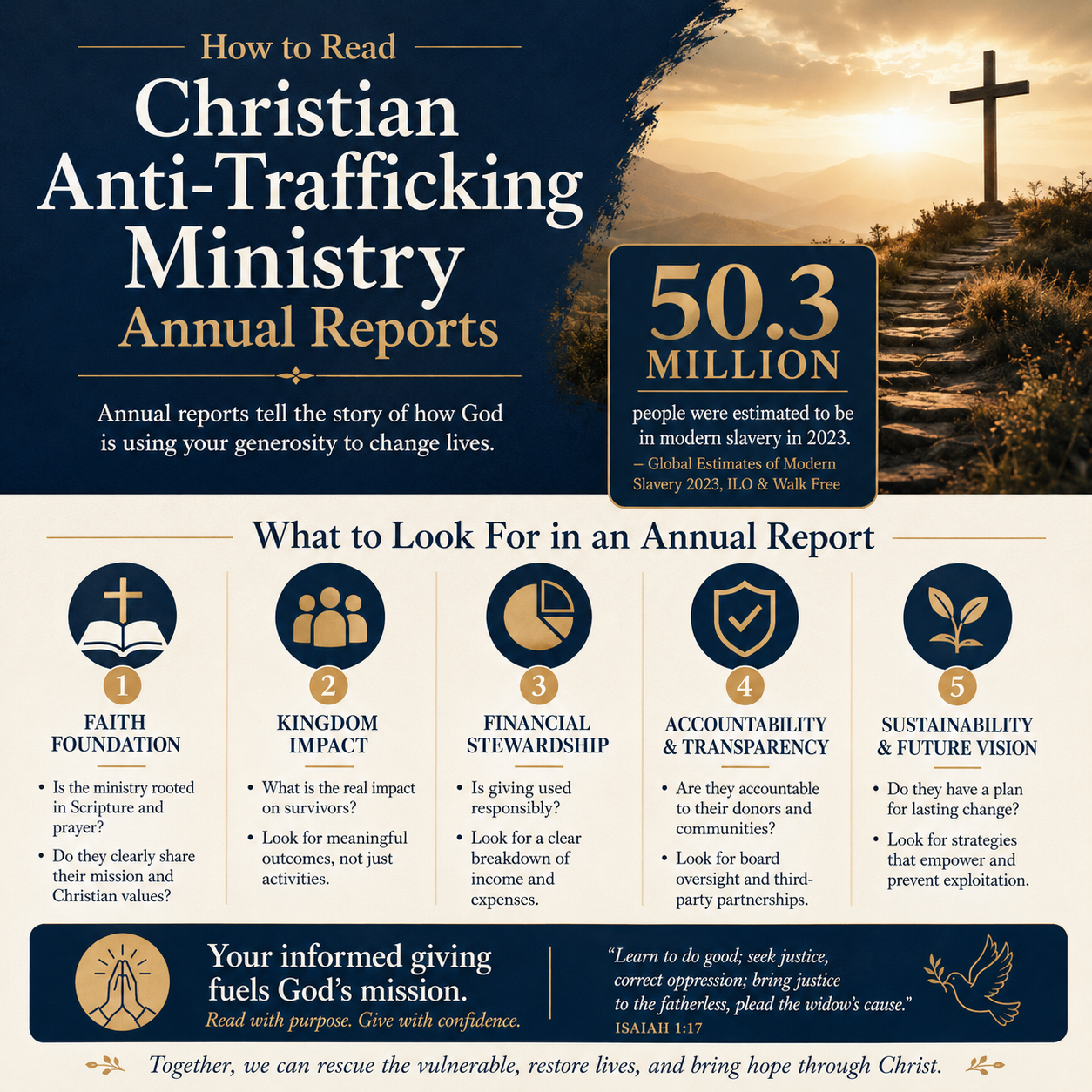
Annual reports often include simplified charts. When possible, donors should also review audited financial statements and the IRS Form 990 for U.S. nonprofits. The 990 remains one of the few standardized, legally required disclosures that allows cross-ministry comparison (Internal Revenue Service Form 990 resources).
What to examine beyond the program percentage
The charity sector has learned the hard lesson that minimizing “overhead” can harm effectiveness and accountability. The joint “Overhead Myth” letter signed by Charity Navigator, Candid, and the BBB Wise Giving Alliance urged donors to focus on results and transparency rather than a single administrative ratio (Candid). Anti-trafficking work, in particular, requires trained staff, security protocols, supervision, and strong compliance—none of which are free.
In practice, donors should look for whether administrative and fundraising costs align with the ministry’s stage and strategy, and whether reserves exist to sustain survivor care through downturns. Pay attention to restricted funds and whether the report explains how designated gifts are handled.
- Revenue concentration: Is the ministry dependent on one donor, one event, or one grant stream?
- Reserves: Is there a stated reserve policy appropriate to the risk profile of survivor services?
- Executive compensation: Is it disclosed and explained with comparables, not defensiveness?
- Related-party transactions: Are there disclosures about vendors connected to leaders or board members?
- Restricted vs. unrestricted giving: Does the report clarify what flexibility leadership has to respond to need?
Governance and safeguarding are not optional in this field
Board independence and competence protect the vulnerable
Anti-trafficking ministries often work with minors, traumatized adults, and individuals under coercion. This places governance and safeguarding at the center of moral credibility, not at the edges. Annual reports should identify board members, describe how the board is chosen, and indicate how conflicts of interest are managed.
Donors should look for evidence that the board is not merely honorary. Strong reports describe oversight practices: audit and finance functions, program review, safeguarding policies, and leadership evaluation. Weak reports treat the board as a list of names.
Safeguarding policies should be visible and specific
Annual reports do not need to publish security-sensitive procedures, but they should disclose the existence of key safeguards: background checks, mandatory reporting training, survivor-informed practice, data privacy standards, and clear boundaries for volunteers. A ministry that cannot speak plainly about safeguarding should not be trusted with the vulnerable.
Given the history of harm in some corners of the broader care sector, including failures of governance and accountability, sophisticated donors increasingly weigh transparency about misconduct reporting and response. A credible annual report will not promise perfection, but it will describe mechanisms for disclosure, investigation, and corrective action.
Transparency and effectiveness require the discipline of candor
Look for evaluation, partners, and external accountability
Some ministries operate in isolation; others are embedded in coordinated community responses with shelters, clinicians, prosecutors, and churches. Annual reports should name significant partnerships where appropriate and clarify roles. Vague references to “working with authorities” or “partnering with experts” can conceal overclaiming.
When a report references “evidence-based” practice, donors should ask what evidence and whose. Trauma-informed care, for example, is a meaningful orientation, but it is often used as a slogan. Strong reports identify training sources, clinical oversight, and evaluation methods, and they explain how survivor voice shapes program design without turning survivors into marketing assets.
How Most Trusted approaches verification
Across our verification work at Most Trusted, we observe that ministries that meet The Most Trusted Standard tend to treat annual reporting as part of discipleship: a commitment to truthfulness before God and neighbor. That framework examines a ministry’s faith foundation, financial integrity, governance and leadership, and transparency and effectiveness through 15 concrete criteria. Annual reports rarely answer every question on their own, but they can signal whether leadership welcomes scrutiny or manages perception.
For donors comparing organizations in Christian Anti-Trafficking Ministries, annual reports become far more useful when read alongside governing documents, audited statements, and clear program descriptions. What this means in practice is that a ministry’s report should be an entry point to deeper disclosure, not a substitute for it.
FAQs for How to read Christian anti-trafficking ministry annual reports
What if an annual report has very few numbers because the ministry says confidentiality prevents reporting?
Confidentiality is real, but it is not a blanket exemption from accountability. A responsible report can protect identities while still offering defined outputs and outcomes: retention rates in programming, completion of care plans, referral pathways, staff qualifications, independent financial audits, and clear policies. When a ministry cites confidentiality, donors can still ask for aggregate reporting and third-party verification without requesting sensitive details.
Is it wrong to prioritize ministries with the lowest administrative costs?
Low administrative costs are not a reliable proxy for faithfulness or impact. Anti-trafficking work requires trained personnel, supervision, compliance, and safeguarding systems that will appear as administrative expense. Donors should seek ministries that demonstrate both prudent spending and adequate investment in accountability and quality. The question is not “How small can overhead be?” but “Does the financial structure support durable, safe, effective care?”
Giving that honors both zeal and knowledge
Christian donors often come to anti-trafficking giving with righteous anger and tender compassion. Both are proper. Yet Scripture repeatedly warns against zeal without knowledge (Romans 10:2). Annual reports are one of the ordinary means by which donors can grow in knowledge without losing love.
The most credible annual reports combine theological seriousness, financial clarity, governance transparency, and honest measurement. For donors seeking stronger accountability in this space, Accountability and Transparency in Christian Anti-Trafficking Ministries remains a necessary lens, not a luxury.



