
Legal support and partnerships in Christian anti-trafficking work are where compassion meets the slow, exacting demands of justice. Donors often assume rescue is the decisive moment; in practice, the legal pathway after identification is frequently what determines whether a survivor is protected, believed, and able to rebuild without being pulled back into exploitation.
This part of the field also exposes hard tensions. The justice system is not designed around trauma. Prosecution can require testimony that feels like a second violation. Civil remedies can take years. Immigration relief can hinge on deadlines and documentation survivors may not have. The church’s moral clarity about the evil of trafficking must be matched by patient, technically competent legal work that can withstand scrutiny.
Why legal work is central to lasting freedom
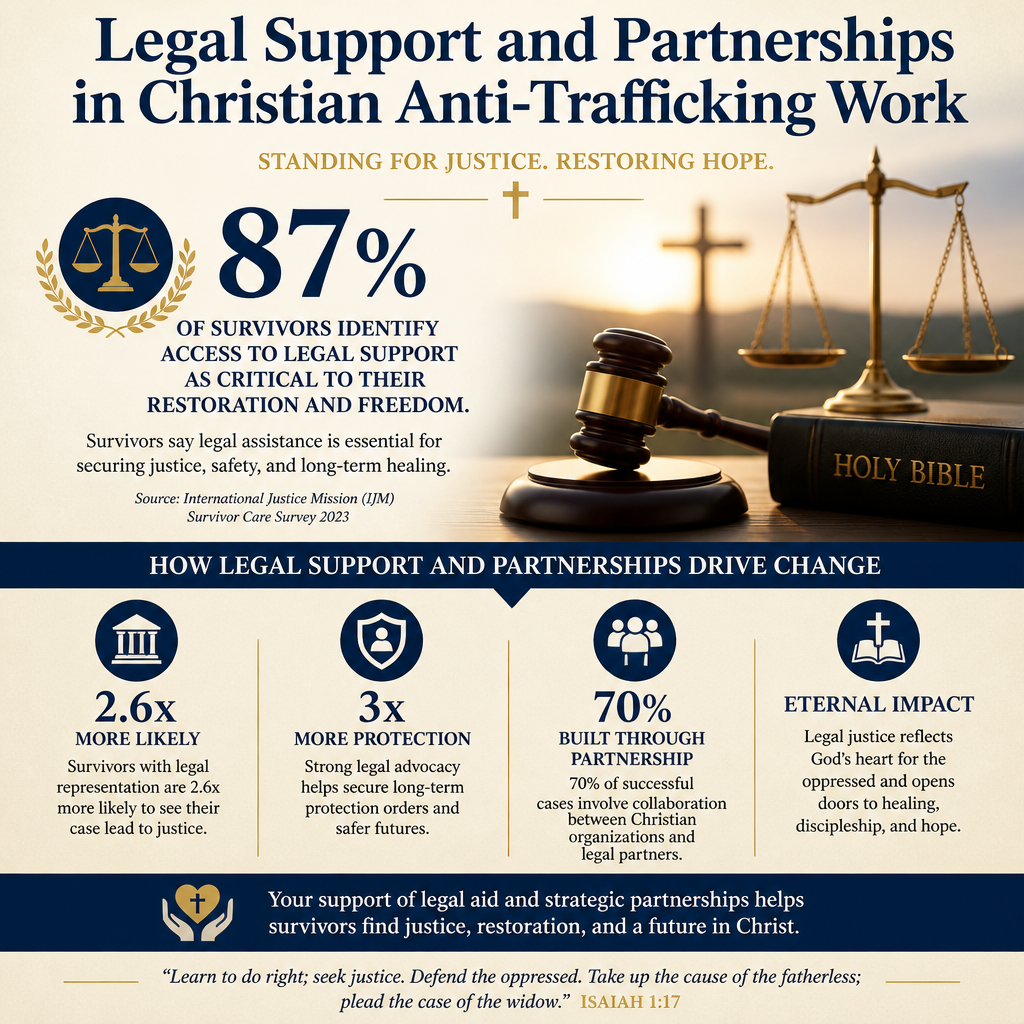
Trafficking is a crime, but survivors often first encounter the system as defendants, not victims. A credible anti-trafficking strategy therefore includes legal triage: criminal defense for trafficking-related charges, protection orders, expungement, family law stabilization, and immigration representation when needed. These interventions can be as decisive for long-term safety as any immediate service because they remove leverage traffickers use—warrants, probation violations, custody threats, debt judgments, and immigration fear.
Federal law provides an important baseline. The Trafficking Victims Protection Act established trafficking as a federal crime and created mechanisms for survivor protection, including immigration options such as T nonimmigrant status for certain victims who assist law enforcement under defined conditions. The U.S. Department of State’s annual Trafficking in Persons Report remains the most widely referenced government synthesis of trafficking patterns and state responses, and it underscores that effective counter-trafficking requires law enforcement, victim protection, and prevention working together rather than in isolation. U.S. Department of State Trafficking in Persons Report
Donors who care about measurable outcomes should understand what “justice” can realistically mean. A criminal conviction is not always possible or wise for a survivor at a given moment. Sometimes the most protective legal result is a sealed record, a safe custody order, or lawful status that prevents deportation. The moral aim is consistent—defend the oppressed and restrain evil—but the legal route will vary case by case.

How Christian ministries partner with law enforcement and prosecutors
Healthy partnerships with law enforcement are built on role clarity. Police investigate crimes and preserve evidence. Prosecutors weigh charges and trial strategy. Victim advocates and service providers stabilize survivors and explain options without coercion. When ministries blur these lines—especially when a ministry’s fundraising depends on dramatic outcomes—survivors can become instruments rather than neighbors.
Government guidance has increasingly recognized that survivor cooperation cannot be demanded as the price of help. The U.S. Department of Justice frames a “victim-centered” and “trauma-informed” approach as essential to effective trafficking investigations and prosecutions, in part because retraumatization and distrust reduce the likelihood of sustainable engagement. U.S. Department of Justice Human Trafficking
What credible collaboration looks like
Across our verification work at Most Trusted, we observe that the strongest ministries enter partnerships through written protocols rather than personality-driven relationships. These protocols typically address information sharing, confidentiality, mandatory reporting, survivor consent, and boundaries around media exposure. They also clarify what the ministry will not do: promise legal outcomes, pressure a survivor to cooperate, or present itself as a quasi-law-enforcement entity.
Credible ministries also invest in training that is specific, not symbolic—understanding subpoena risks, how digital evidence is handled, and why certain details cannot be shared publicly. Many donors want transparency, and transparency is a Christian obligation. But in trafficking cases, public storytelling can compromise safety, contaminate testimony, or expose a survivor to retaliation. Wise ministries treat discretion as part of protection, not as evasiveness.
The place of victim advocates
Victim advocates often become the translating layer between survivors and the justice system. They help survivors understand timelines, accompany them to interviews and court, and coordinate housing, counseling, and medical care so that legal participation is even possible. Funding advocates is not ancillary; it is often what makes a trauma-informed process real rather than theoretical.
Donors should also recognize the difference between advocacy and legal advice. Advocates can explain processes and support decision-making, but only a licensed attorney can give legal counsel. Mature programs honor that boundary precisely because they value the survivor’s right to competent representation.
What legal aid ministries actually fund and why it matters
Legal aid in anti-trafficking work is usually less cinematic than donors expect. It is document-heavy, deadline-driven, and emotionally costly. Yet it can remove the practical obstacles that keep a survivor trapped. Funding legal aid means paying for professional time, expert consultations, filing fees when they cannot be waived, interpretation, and sometimes travel to court or consular appointments.
Criminal record relief and trafficking-related charges
Survivors may carry criminal histories tied directly to their exploitation—prostitution charges, theft, drug possession, or probation violations connected to coercion. Many states now provide some form of vacatur or expungement relief for trafficking survivors, but the legal path differs by jurisdiction and often requires careful documentation. A ministry that supports this work is funding a long process that can reopen painful history but can also unlock employment, housing, and education.
When donors evaluate these programs, the most telling question is not “How many records were cleared?” but “How were survivors protected during the process?” A program can report high numbers while mishandling consent or creating pressure. The Most Trusted Standard weighs not only outputs but governance and safeguards—how a ministry makes decisions when survivor welfare conflicts with organizational incentives.
Family law and protective orders
Family law is often where safety becomes concrete. Custody determinations, visitation boundaries, name changes, and protective orders can physically separate survivors and children from traffickers or abusive partners. These cases also reveal the system’s limitations. Courts may not understand coercive control. Survivors may face credibility attacks because of past criminal charges or substance use. Trauma-informed attorneys are not a niche preference here; they are essential for presenting evidence in ways that do not punish survivors for trauma responses.
Immigration relief and legal status
Trafficking intersects with migration in complex ways, and donors should resist simplistic narratives. Some survivors are U.S. citizens exploited domestically; others are foreign nationals exploited after recruitment. For some, immigration status becomes the trafficker’s most effective tool. Competent immigration counsel can pursue relief such as T visas or other lawful pathways when applicable, but these are technical applications with strict requirements.
Programs that do this well tend to partner with established legal services organizations or law school clinics and to maintain strong referral networks. They also budget for time: immigration matters can take years, and stability during that period often depends on wraparound support funded by donors.
How donors can assess credibility under The Most Trusted Standard
Legal partnerships are a high-risk environment for misrepresentation. Because cases are confidential, donors cannot easily “see” the work, and that opacity can be exploited—sometimes unintentionally, sometimes deliberately. Responsible Christian giving requires more than trusting a compelling story; it requires looking for verifiable indicators of integrity.
Most Trusted exists to help donors give with confidence by evaluating ministries against The Most Trusted Standard, a 15-criteria framework across Faith Foundation, Financial Integrity, Governance and Leadership, and Transparency and Effectiveness. In legal-adjacent anti-trafficking work, several signals matter consistently.
Governance that restrains incentives
Effective boards ask uncomfortable questions. They review partnership agreements, insist on clear boundaries around law enforcement collaboration, and establish policies that prevent fundraising from driving operational decisions. They also require incident reporting processes for confidentiality breaches, boundary violations, or conflicts of interest with referral partners.
Donors should look for evidence of board independence, conflict-of-interest policies, and documented oversight of programs that involve minors, survivors, and sensitive legal data. When a ministry cannot explain how it governs risk, donors are being asked to substitute trust in personalities for trust in accountable structures.
Financial integrity in a complex service mix
Legal support often involves multiple funding streams: restricted grants, pro bono hours, government referrals, and direct donor support. Credible ministries can explain, plainly, what donor dollars actually pay for and what is provided through partners. They do not imply that donor funding “paid for the prosecution” or “rescued a victim” when the real expenditure was case management, transportation, or a portion of legal staff time.
Donors also deserve clarity about compensation and related-party transactions. A ministry’s work may be righteous and still be financially disordered. The ministries that meet The Most Trusted Standard tend to provide accessible financial statements, disclose material transactions, and avoid overstating impact.
Transparency that protects survivors
Christian donors often carry a legitimate desire for accountability: “If we cannot see outcomes, how can we know this is faithful stewardship?” The answer is not less transparency, but disciplined transparency. Mature ministries report program metrics, third-party evaluations when available, and partnership descriptions without identifying survivors or compromising active cases.
They also speak carefully about collaboration with law enforcement and prosecutors. When a ministry implies operational control over arrests or charging decisions, donors should be cautious. The more accurate posture is supportive: ensuring survivors have choices, safe care, and competent counsel, and cooperating appropriately when survivors consent and legal obligations require.
For broader context on how these legal and partnership dynamics fit within the movement, see Christian Anti-Trafficking Ministries.
Donor confidence requires both moral clarity and legal realism
Legal support and partnerships in Christian anti-trafficking work are not peripheral services. They are often the means by which a survivor moves from crisis to stability, from isolation to protection, and from coercion to agency. Scripture’s call to “seek justice, correct oppression” (Isaiah 1:17) is not satisfied by strong emotions or public denunciations; it requires patient, competent action within the systems where oppression is formalized and contested.
The donors who serve this work well are those who fund excellence that can be audited: careful governance, truthful reporting, responsible partnerships, and trauma-informed legal capacity. When ministries meet The Most Trusted Standard, donors can support them with confidence that the pursuit of justice is not only sincere, but disciplined enough to endure.



