

How to give wisely to Christian anti-trafficking ministries begins with a sober recognition: the cause is morally urgent, spiritually weighty, and operationally complex. Donors are often asked to respond quickly to harrowing stories. Wisdom, however, requires more than urgency. It requires discernment shaped by Scripture, informed by evidence, and anchored in verifiable practices that protect survivors and honor the Church’s witness.
Human trafficking is not a cinematic problem with simple villains and simple rescues. It intersects with poverty, addiction, migration, family breakdown, online exploitation, and in some places corrupt systems that profit from vulnerability. Christian donors can do real good here, and Christians can also do real harm when funding rewards sensationalism, weak governance, or interventions that increase risk for those they intend to serve.
Begin with a theological frame that refuses both cynicism and naivete
The Christian case for opposing trafficking is not primarily ideological. It is biblical. Every person bears the image of God (Genesis 1:27), and therefore cannot be reduced to labor, sex, or profit. The gospel also trains our moral imagination: Christ does not merely denounce evil; he seeks, restores, and makes whole. Donors should expect ministries to articulate a Christian account of human dignity that is more than a slogan, and to demonstrate that this theology actually governs practice.
The harder question is how zeal for justice can be disciplined by truthfulness. Trafficking work is an arena where exaggeration spreads quickly because it attracts attention and funding. A ministry’s credibility is not measured by how vivid its stories are, but by whether it communicates with restraint, accuracy, and respect for the people it serves.
Resist funding models that depend on shock
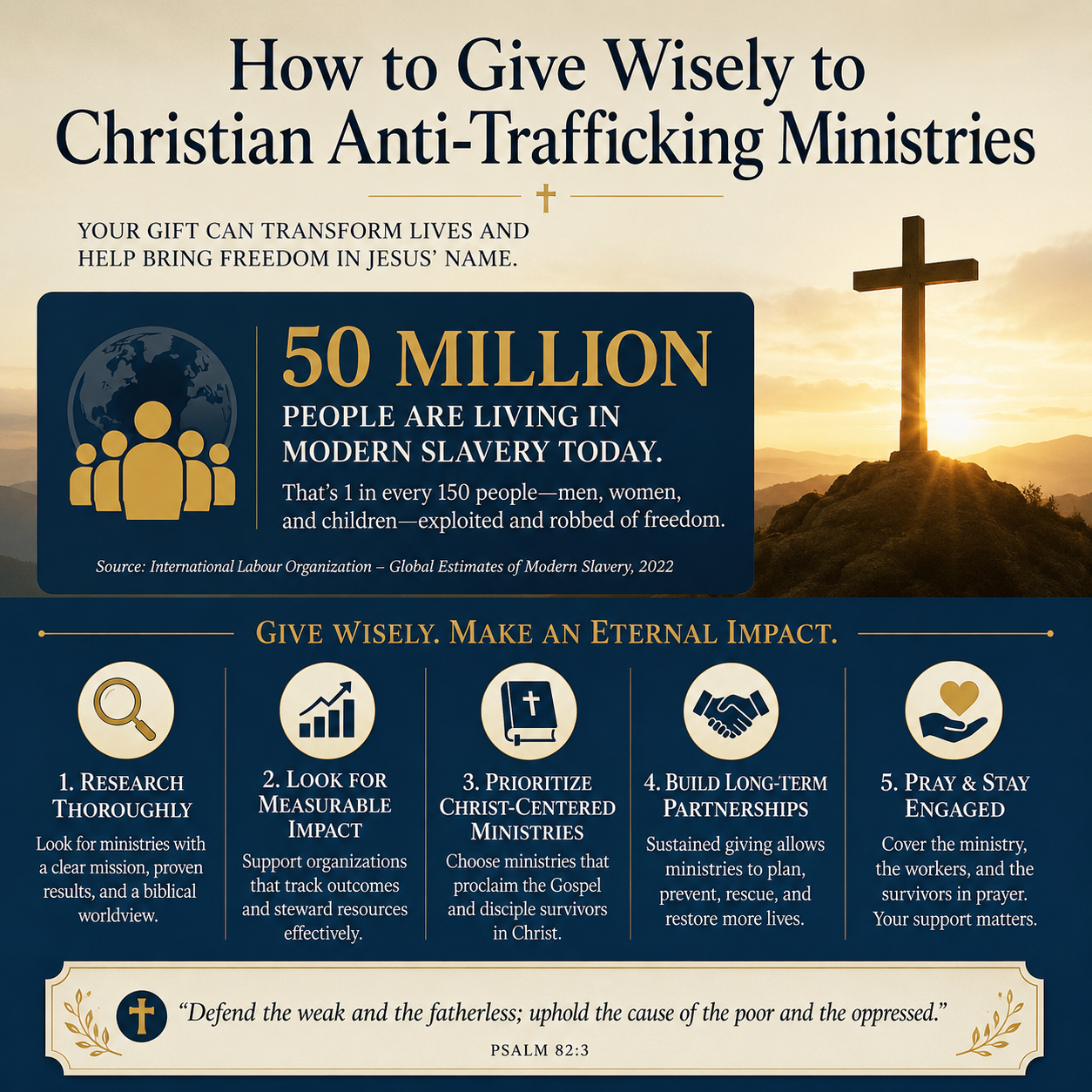
Many anti-trafficking appeals rely on unverified global numbers or imply that rescues are frequent, simple, and repeatable. In reality, responsible organizations speak carefully about prevalence because measurement is difficult and definitions vary. When ministries use statistics, they should cite credible institutions and clarify what the numbers can and cannot tell us. The International Labour Organization is one example of a source that publishes careful estimates and methodological notes, and ministries that cite it well usually show the discipline donors should prefer.
Donors should also pay attention to how imagery and testimony are used. Public storytelling can expose survivors to retaliation, shame, and long-term harm. A trauma-informed ministry will avoid identifiable photos, protect case details, and obtain consent in ways that account for power imbalance. When “awareness” content resembles marketing more than moral formation, donors should slow down.
Hold together justice and pastoral care
Christians genuinely disagree about which interventions should receive priority: prevention, law enforcement support, aftercare, public policy, economic development, digital safety, or church-based mobilization. The field has had to reckon with the fact that certain approaches can conflict. Aggressive “rescue” operations may create short-term removals without long-term stability. Overly therapeutic models can neglect the public justice dimensions of trafficking. Donors can honor these tensions by funding organizations that state their role clearly, partner appropriately, and do not pretend to be competent at everything.

Understand what effective anti-trafficking work looks like in practice
Effective work in this field is rarely glamorous. It is patient, coordinated, and governed by protocols. It treats survivors as persons with agency rather than as props for donor emotion. It also recognizes that “success” is often incremental: a safe night, a completed court appearance, a stable job, a repaired relationship, a sustained sobriety plan.
Aftercare requires long horizons and local credibility
Survivors often face complex trauma, housing instability, medical needs, legal barriers, and fractured social networks. Responsible ministries typically invest in licensed counseling partnerships, safe housing standards, case management, and vocational pathways. Donors should look for realistic program descriptions: staffing ratios that make sense, policies for safeguarding, and partnerships with qualified providers rather than claims of self-sufficiency.
What this means in practice is that donors should be cautious of ministries that promise rapid transformation on a predictable timeline. The rehabilitation of a life is not a production schedule. A more credible signal is whether a ministry can describe its care model with specificity, including how it handles relapse, re-victimization risk, and long-term follow-up.
Prevention is often less visible and more measurable
Prevention work can include strengthening families, improving economic resilience, building digital safety awareness, reducing demand, and equipping churches to identify grooming and exploitation. These interventions can be evaluated with clearer intermediate outcomes: school retention, employment stability, reported safety behaviors, and referral patterns. Donors should not treat prevention as secondary simply because it generates fewer dramatic narratives.
At the same time, donors should not confuse “prevention” with generic good works. Credible prevention programs articulate a theory of change, target a clearly defined risk context, and test whether the work is actually reducing vulnerability.
Collaboration with authorities is not a simple litmus test
Some donors assume that a faithful ministry must work closely with law enforcement; others assume any proximity to policing is suspect. Neither reflex is sufficient. In some regions, survivor safety depends on strong relationships with trustworthy authorities. In other regions, corruption or misuse of power is a real concern. Ministries should be transparent about how they assess these risks, how they protect survivor confidentiality, and how they ensure that cooperation does not expose people to further harm.
Evaluate ministries with verifiable questions, not brand impressions
Wise giving is not primarily a matter of personal chemistry with a charismatic founder or a compelling video. It is a matter of accountability. Donors should be able to ask concrete questions and receive concrete answers. When a ministry cannot answer basic governance, safeguarding, and financial questions, the problem is rarely “privacy.” More often, it is immaturity.
Ask for safeguarding and trauma-informed policies that are written and practiced
Anti-trafficking work involves high vulnerability and high stakes. Donors should ask whether the ministry has written policies for background checks, boundaries in survivor relationships, mandatory reporting, secure data handling, and incident response. It is not enough to say, “We love people well.” Love requires structures that prevent predictable abuses of power.
Donors should also ask how the ministry incorporates trauma-informed practice. Trauma-informed care is not merely a counseling concept; it shapes how staff communicate, how programs are paced, and how consequences are handled. A ministry that punishes trauma responses as “disobedience” may harm the very people it intends to help.
Look for governance that can correct a leader
Because anti-trafficking work can generate intense loyalty and moral urgency, it is especially vulnerable to founder centralization. Donors should ask: Does the board have independence and relevant competence? Does it meet regularly? Is there evidence of oversight beyond personal admiration? Healthy ministries can describe real checks and balances without resentment.
Financial transparency matters here as well. The IRS Form 990 and audited financial statements are not perfect, but they provide a baseline for accountability. Ministries that consistently refuse to share basic financial documents should not expect donor trust.
Refuse simplistic overhead tests
Mature donors have learned that low overhead does not necessarily mean high integrity. Under-investing in finance, HR, security, and data protection can create risk for survivors and staff. The broader nonprofit sector has publicly challenged the “overhead ratio” obsession, including in a joint statement by major evaluators. Donors who want a credible summary of that argument can consult Charity Navigator, which has long addressed why overhead alone is a poor measure of effectiveness.
What donors should seek instead is coherence: spending that matches strategy, documented controls, and evidence that leaders understand fiduciary responsibility as a moral duty.
Give with confidence by using a consistent standard and a long-term posture
Anti-trafficking ministries often experience volatile funding cycles because donors respond to media attention. Yet the needs of survivors and the slow work of prevention do not follow the news. Donors who want to serve faithfully should consider making fewer, more deliberate commitments and sustaining them over time. Stability is not glamorous, but it is a form of love.
Use The Most Trusted Standard to compare ministries across the factors that matter
Most Trusted exists to help Christian donors give with confidence by verifying ministries against The Most Trusted Standard, a 15-criteria framework spanning Faith Foundation, Financial Integrity, Governance and Leadership, and Transparency and Effectiveness. Across our verification work, the ministries that meet The Most Trusted Standard tend to share a common posture: they welcome scrutiny, document their claims, and accept that integrity must be demonstrable, not presumed.
If a donor is deciding between organizations, a consistent framework prevents giving from being driven by narrative strength alone. It also reduces the temptation to reward ministries that are loudest rather than those that are safest and most competent.
Choose giving methods that fit the ministry’s actual work
Different interventions call for different funding structures. Emergency safe housing and crisis response often require flexible funds. Vocational programs may be well-suited for restricted grants with clear outcomes. Church mobilization efforts may need multi-year support to build durable training systems. Donors considering sponsorship models should ask what the ministry means by “sponsorship,” how funds are allocated, and whether the approach protects dignity and privacy rather than creating a transactional relationship.
Planned giving is also worth considering for donors who want to underwrite long-horizon work such as survivor education, housing endowments, or legal advocacy. A ministry’s readiness for planned giving can be a signal of governance maturity, but donors should still require clarity on restrictions, reporting, and financial controls.
Support the Church’s role without collapsing it into activism
The local church has a distinctive calling: proclaiming the gospel, forming conscience, strengthening families, and providing practical care. Anti-trafficking ministries can help churches do this well, but donors should be cautious of efforts that treat the Church as merely a distribution channel for campaigns. A ministry’s ecclesial posture becomes visible in whether it equips pastors, respects church authority, and speaks of spiritual formation with seriousness rather than as branding.
For donors seeking wider context on the range of approaches and the kinds of organizations operating in this field, see Christian Anti-Trafficking Ministries.
Wise giving in this field is a form of moral witness
Christian donors cannot end trafficking alone, and no ministry can promise outcomes that belong to God’s providence. Yet donors can insist that Christian compassion be joined to truthfulness, safeguards, and accountable leadership. Giving wisely to Christian anti-trafficking ministries is not only about funding outcomes; it is about refusing to let urgency excuse carelessness, and refusing to let sentiment replace stewardship.



