
Governance practices that strengthen Christian recovery ministries are the ones that protect the vulnerable, clarify spiritual authority, and make stewardship verifiable. Donors tend to focus on program stories, but recovery work is uniquely sensitive to power dynamics, relapse risk, and the temptations that come with close-access ministry. The strongest ministries treat governance as a form of neighbor-love: guardrails that make faithfulness durable.
Christian recovery settings also concentrate ethical complexity. Residents may be estranged from family, under court pressure, or in early sobriety with impaired judgment. Staff and volunteers may be former participants with lived empathy and also unresolved formation needs. A ministry can preach grace and still drift into coercion, financial confusion, or unaccountable leadership. Governance is where good intentions either become trustworthy practices or remain merely aspirational.
Define authority clearly and keep pastoral care accountable
Christian recovery ministries require leadership. They also require limits. The governance question is not whether a ministry should be spiritually direct, but how spiritual authority is exercised, reviewed, and restrained when people are fragile. The New Testament consistently pairs shepherding with accountability and non-domineering leadership (1 Peter 5:2–3). In recovery, that principle is operational, not abstract.
Separate spiritual oversight from unilateral control
Healthy ministries distinguish between pastoral leadership and organizational control. A board can affirm doctrinal commitments and spiritual practices while still requiring ordinary safeguards: documented policies, independent review, and appropriate delegation. Where the executive director also functions as primary counselor, disciplinarian, and final appellate authority, the ministry is relying on personality rather than structure.
In practice, we look for written role definitions: what belongs to the board, what belongs to senior staff, what belongs to clinical or recovery leadership, and what belongs to outside professionals. The boundary matters because recovery participants may interpret spiritual directives as conditions for housing, food, or belonging. A ministry can maintain theological clarity without making access to care contingent on unreviewable personal authority.
Make discipleship non-coercive and program expectations transparent
Christians genuinely disagree about how explicitly evangelistic a recovery program should be, especially when the ministry receives government referrals or partners with public systems. The governing principle should be candor. Faith practices, participation requirements, and disciplinary processes should be stated in writing before admission, explained orally, and reiterated after detox or stabilization when comprehension improves.
Where ministries operate in contexts that intersect with the justice system, governance should explicitly address coercion risk. The U.S. Department of Justice has pursued cases involving religious coercion in publicly funded settings, underscoring that clear boundaries and documentation are not optional when government money or referrals are involved (U.S. Department of Justice).

Build a board that governs, not merely blesses
Boards in Christian ministries sometimes default to affirmation rather than oversight, especially when founders are beloved and the mission is urgent. Recovery ministry is precisely where a board must function as a governing body: independent enough to ask hard questions, close enough to understand the work, and spiritually mature enough to resist both cynicism and naïveté. Donors should not have to choose between zeal and prudence.
Prioritize independence, relevant competence, and lived integrity
We expect to see a board with members who can read financial statements, understand safeguarding and HR risks, and evaluate the program’s theology and discipleship in a way that is neither performative nor partisan. Independence matters. A board dominated by employees, relatives, or paid contractors may be affectionate, but it is structurally limited in its ability to correct.
We also encourage board composition that reflects the complexity of recovery work: pastoral wisdom, professional expertise in behavioral health or social services, and community accountability. Recovery culture can normalize secrecy. A board should normalize disclosure and documentation.
Establish board rhythms that produce evidence, not impressions
A strong board calendar is one of the simplest indicators of strength: regular meetings, recorded minutes, documented votes, annual evaluation of the chief executive, and an executive session without staff present. These rhythms make room for bad news to surface before it becomes scandal. Ministries that meet The Most Trusted Standard tend to treat minutes, policies, and decision trails as part of Christian witness—“we have renounced disgraceful, underhanded ways” (2 Corinthians 4:2).
Donors who want an accessible way to assess board seriousness can look for a posted list of board members, board leadership roles, and basic governance policies. Where that information is absent, it does not prove misconduct, but it does increase the amount of trust a donor is being asked to extend without verification.
Protect participants through safeguarding and grievance systems
Recovery participants are vulnerable to exploitation—financial, sexual, spiritual, and emotional. Governance must make the ministry safe for the person who reports misconduct, not merely safe for the institution’s reputation. The aim is not suspicion; it is protection for those Jesus describes as easily harmed (Matthew 18:6).
Implement safeguarding policies with enforcement authority
Safeguarding cannot live in a binder. A ministry should have a written code of conduct, boundaries for staff-resident interactions, policies for transport and overnight supervision, and clear rules for romantic or sexual relationships (including between staff and participants, which should be prohibited). Background checks are a baseline, but governance must also include training and supervision that recognizes relapse, manipulation, and grooming behaviors as real risks in residential and close-contact settings.
What this means for donors is straightforward: ask whether safeguarding policies exist, whether staff and volunteers are trained annually, and whether policy violations are documented and addressed. “Trust” in a redeemed community is not the same as leaving the vulnerable unprotected.
Create a grievance pathway that bypasses the chain of command
The most important test of a grievance process is whether it is usable when the accused person is powerful. Participants should be able to report concerns to more than one person, including someone outside the daily program authority. An ombudsman arrangement, a board-designated safeguarding officer, or a third-party hotline can serve this purpose, provided reports are tracked and acted upon.
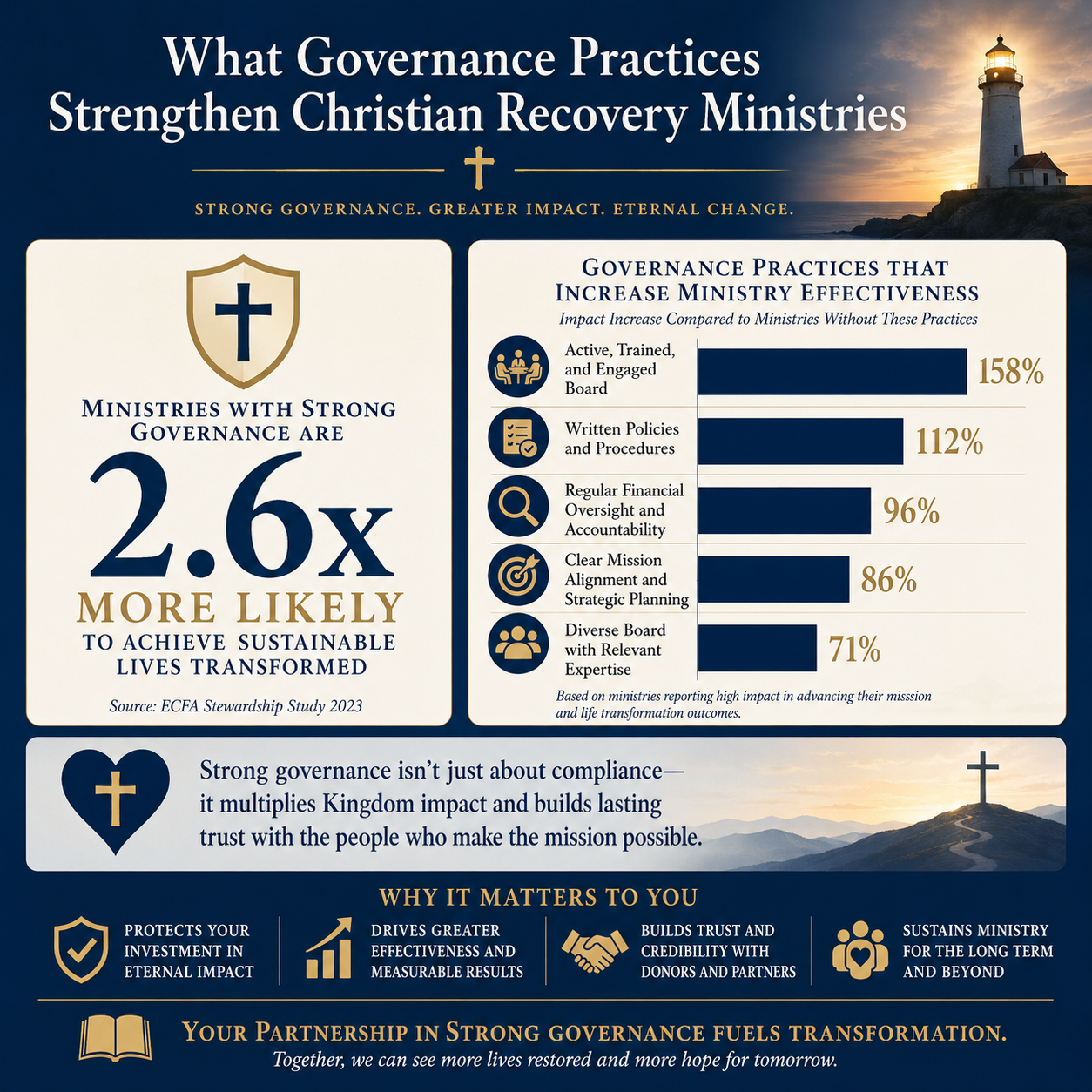
A short list of governance elements that materially strengthens participant protection includes:
- Written grievance policy provided at intake and posted on-site
- At least two reporting routes, including one that reaches the board
- Mandatory incident documentation with a defined review timeline
- Clear non-retaliation policy with consequences for violations
- Annual safeguarding training and signed code of conduct for all staff and volunteers
These measures do not eliminate risk. They do make risk governable, and they create a record that can be audited rather than merely asserted.
Require financial controls that match the cash intensity of recovery work
Recovery ministries often handle tuition-like participant payments, cash donations, in-kind goods, vehicle use, and informal benevolence. They also operate in contexts where participants may be required to surrender phones, limit access to money, or work while in the program. Governance must ensure that these realities are not exploited and are not even perceived as exploitable.
Adopt internal controls and enforce conflict of interest discipline
Basic internal controls are a theological matter because they operationalize honesty and protect reputations from avoidable suspicion. At minimum, donors should expect separation of duties for receiving funds and reconciling accounts, documented approval thresholds for spending, and board review of monthly financials.
Conflict of interest policies are especially important in tight Christian communities where vendors and leaders may share church ties, family ties, or business ties. A conflict policy is not a statement of distrust; it is a shared commitment to fairness and transparency. Where conflicts arise, recusals should be documented in minutes. These details are often the difference between an allegation that can be disproven and one that metastasizes.
Be explicit about participant fees, labor, and restricted giving
Christians genuinely disagree about program models that incorporate work therapy, social enterprise, or required employment. The moral question is not whether work can be formative—it can—but whether it is transparent, fairly compensated where appropriate, and never used as a hidden revenue strategy. Governance should require written participant agreements that specify fees, refund policies, expectations for work, and how income is handled.
Where ministries solicit restricted gifts for specific homes, scholarships, or capital projects, governance must track those restrictions and report on them. The Evangelical Council for Financial Accountability has long emphasized donor intent and restricted gift stewardship as core integrity issues (ECFA).
Across our verification work at Most Trusted, we find that the ministries with the fewest donor disputes are not those with the most dramatic stories. They are those that can produce clean documentation when questions arise—receipts, policies, board approvals, and consistent financial statements.
Measure what matters and publish enough to be accountable
Donors often ask for “impact,” but recovery ministry outcomes are not as simple as a graduation count. Relapse is a reality; some participants leave early; and spiritual renewal does not reduce to a number. Governance strengthens ministries when it insists on truthful reporting: neither exaggerated success nor fatalistic ambiguity.
Use outcome measures that respect the complexity of recovery
We recommend a small set of measures that can be tracked consistently and interpreted honestly: retention milestones, post-program follow-up participation, reunification indicators where appropriate, employment or stable housing markers, and documented engagement in a local church. Ministries should also report what they mean by “completion” and how they handle transfers, dismissals, and voluntary departures.
Where clinical partnerships exist, governance should clarify what is evidence-based treatment, what is peer support, and what is pastoral counseling. The field has had to reckon with category confusion—especially when donors assume clinical claims are being made without clinical credentials. A ministry can be explicitly Christian and still be precise about what it is and is not providing.
Publish governance and effectiveness information proportionate to donor trust
Transparency does not require publicizing private participant details. It does require publishing enough about governance, finances, and program practices that donors can evaluate credibility. Many donors rely on third-party evaluation precisely because internal reporting can be sincere and still incomplete. Most Trusted exists to help donors give with confidence by evaluating ministries against The Most Trusted Standard, a 15-criteria framework across Faith Foundation, Financial Integrity, Governance and Leadership, and Transparency and Effectiveness.
For donors comparing ministries, it is also useful to read within the broader field context of Christian Addiction Recovery Ministries, where program models and accountability expectations vary meaningfully. Governance quality often explains why two ministries with similar theology produce very different patterns of safety, financial stability, and long-term fruit.
Governance is never merely an internal concern. It is part of the ministry’s public witness. When ministries publish board information, independent financial review practices, and clear policies, they reduce the need for donors to rely on charisma, proximity, or denominational familiarity.
FAQs for What governance practices strengthen Christian recovery ministries
Should Christian recovery ministries require board members to share the ministry’s statement of faith?
In many cases, yes—especially where the ministry’s approach is explicitly discipleship-based and theological oversight is part of governance. The stronger practice is to require clear alignment on core doctrine while still ensuring the board includes members capable of independent oversight in finance, safeguarding, and organizational leadership. A board that is theologically aligned but structurally dependent on the founder is not strong governance; it is a spiritualized form of organizational risk.
What should donors ask for if a recovery ministry is small and informal?
Size does not remove the need for safeguards; it changes what is feasible. Donors can ask for written policies on safeguarding and grievance reporting, a basic conflict of interest policy, a list of board members or advisors with defined authority, and current financial statements with evidence of review. Where capacity is limited, a ministry can still demonstrate seriousness by adopting simple controls and inviting outside accountability. For further context on oversight expectations across the sector, see Leadership and Operations in Christian Addiction Recovery.
Governance as a ministry of truth and protection
Christian recovery ministries do not earn trust by claiming they are different from the world. They earn trust by showing, in verifiable practices, that power is restrained, money is handled with clean hands, participants are protected, and truth is told even when it is costly. Governance is one of the ordinary means by which a ministry embodies repentance, integrity, and love of neighbor over time.



