
Christian addiction recovery impact stories need safeguards because testimony is not a marketing asset; it is a human life bearing the image of God. Donors rightly want to see fruit, and ministries rightly want to honor what the Lord has done. But when a person’s worst years become public proof of a program’s effectiveness, the church can unintentionally trade dignity for persuasion.
The New Testament does not treat speech as a neutral tool. James warns that the tongue can bless God and wound people in the same breath. For donors, the ethical question is not whether stories should be told, but whether the conditions under which they are gathered, edited, and distributed align with Christian love, truthfulness, and the obligations of stewardship.
Testimony is sacred speech, not donor content
What a story is for
Christian communities have always told conversion narratives. Paul recounts his former violence to magnify grace, and the man born blind refuses to speculate beyond what he knows: “I was blind, now I see.” Yet biblical testimony is framed as worship and witness, not as a deliverable. The aim is the glory of God and the good of neighbor, not the satisfaction of an audience’s curiosity.
What this means in practice is that a recovery story should never be shaped to secure a gift by intensifying shame, heightening drama, or implying a predictable formula. Addiction does not resolve neatly, relapse is not rare, and sanctification is often slow. A donor can absorb a distorted theology of transformation if every narrative implies that a single program milestone guarantees lasting freedom.
Why sophisticated donors should resist narrative certainty
Donors who fund addiction recovery ministries are often supporting work at the intersection of trauma, mental health, criminal justice, and family systems. The field has had to reckon with the limits of linear “before and after” accounts. Major clinical guidance treats addiction as a chronic condition with common recurrence, and many people require multiple episodes of treatment and support. The National Institute on Drug Abuse notes that relapse rates for substance use disorders are comparable to rates for other chronic illnesses, with estimates in the 40–60% range National Institute on Drug Abuse.
Safeguards protect donors from being discipled by exceptional anecdotes. They also protect ministries from the subtle temptation to promise what they cannot control: outcomes that finally belong to God and to the complex realities of human agency, community, and care.

The people in the stories are vulnerable in specific ways
Consent can be compromised without coercion
A person in early recovery may be newly housed, newly employed, or newly reconciled to family. Gratitude toward a ministry can be genuine, and still create a power imbalance. When staff who control access to housing, programming, transportation, or references ask for a story, “yes” can be an attempt to remain safe rather than a free choice.
Even when participation is technically voluntary, the social dynamics of discipleship communities can blur the lines. A resident may fear appearing ungrateful. A graduate may fear losing belonging. A mother rebuilding custody may worry that refusal signals instability. Ethical storytelling assumes these pressures exist and builds systems that reduce them.
Privacy harms are spiritual harms
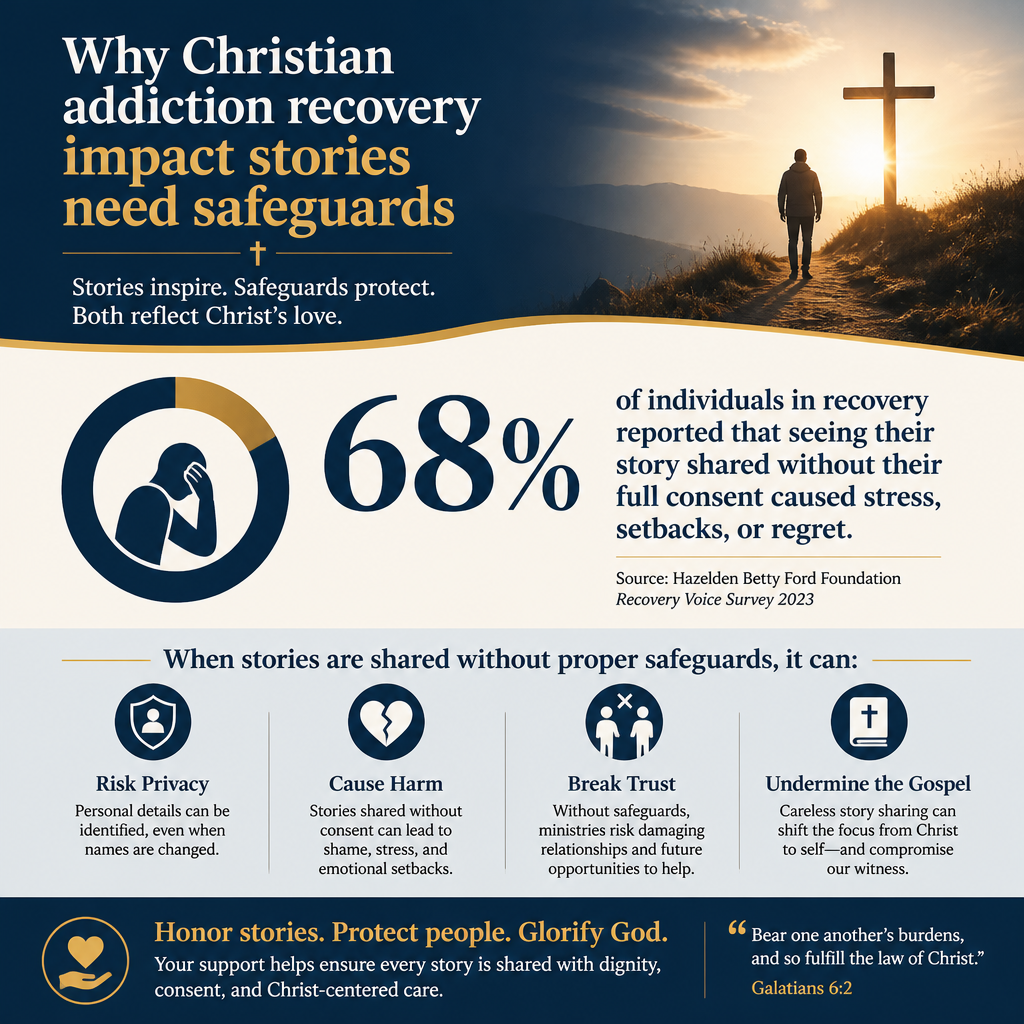
Some risks are obvious: the resurfacing of warrants, employment discrimination, or child custody complications. Others are quieter: renewed shame, family estrangement, or the collapse of a fragile identity into a permanent label. Christian ministries can accidentally reinforce the idea that a person’s most sinful or painful chapter is their primary identity for the rest of their life.
Scripture does not deny sin; it re-narrates it under redemption. “If anyone is in Christ, he is a new creation” is not a slogan for brochures; it is a claim about identity. Safeguards help ensure that the church’s public speech honors that newness rather than imprisoning someone in their worst remembered self.
Stories can mislead without anyone intending to deceive
The temptation to select only the best outcomes
Most ministries do not set out to misrepresent impact. But storytelling is inherently selective, and selection can become a form of bias. If only the most dramatic transformations are shared, donors may infer that such outcomes are typical. If relapse is never mentioned, donors may infer that relapse indicates spiritual failure rather than a common clinical and pastoral reality.
The larger philanthropic sector has learned that narratives, when untethered from evidence, can distort giving. The “Overhead Myth” letter—signed by GuideStar and the BBB Wise Giving Alliance—challenged the idea that donors should evaluate charities mainly by overhead ratios, because such simplifications can drive harmful organizational behavior GuideStar. Addiction recovery storytelling has a parallel risk: if donors are trained to expect constant “wins,” ministries may feel pressured to curate outcomes rather than to tell the truth about long-term formation.
When confidentiality norms meet fundraising incentives
Many recovery contexts operate with an instinct for privacy for good reason. Yet fundraising teams are often built to increase reach, expand email lists, and showcase “proof.” Without explicit guardrails, confidentiality can erode one social media post at a time.
The safer path is not silence. It is disciplined truth-telling: stories that are accurate, proportionate, and contextualized, and that never imply a ministry can guarantee sobriety. Christians genuinely disagree about how much detail is appropriate in public testimony. Mature ministries name that disagreement and set policies that protect people with the most to lose.
Safeguards are measurable, not merely aspirational
What strong ministries put in writing
Donors often ask how to distinguish careful storytelling from performative reassurance. Across our verification work at Most Trusted, the ministries that meet The Most Trusted Standard tend to treat storytelling as an extension of pastoral care and governance, not as an informal communications task. That posture becomes visible in documents, workflows, and accountability.
Practical safeguards donors can look for include:
- Written, revocable consent that specifies where and how a story will be used, including social platforms and paid advertising.
- A clear statement that services are never contingent on participation in marketing or fundraising materials.
- De-identification practices when sharing sensitive histories, including changes to names, locations, and timelines.
- Trauma-informed interviewing and editing, with the option for the storyteller to review final drafts before publication.
- Boundaries for children and families, including policies that restrict identifying details for minors.
These are not burdensome bureaucratic additions. They are a form of neighbor-love applied to modern media realities, where content can be copied, scraped, and redistributed indefinitely.
How safeguards relate to impact measurement
Impact stories should complement, not replace, credible outcome tracking. Responsible ministries can describe program participation, retention, and post-program support without overclaiming causality. They can also distinguish between spiritual formation metrics and clinical recovery markers without collapsing one into the other.
Donors who want to go deeper into how ministries communicate results should consider the broader conversation in How Christian Addiction Recovery Ministries Measure Impact. A ministry that cannot articulate what it measures, why it measures it, and what it does with unfavorable data is more likely to compensate with emotionally powerful stories.
What donors can ask without becoming cynical
Due diligence that honors both compassion and truth
Christian donors are not called to suspicion, but they are called to discernment. Paul commends the Thessalonians for receiving the word, and he warns against manipulation. That combination is a useful posture for philanthropic stewardship: warmhearted toward people, clear-eyed about systems.
Questions that tend to surface the presence or absence of safeguards include:
- Who initiates story collection, and what training do they have in trauma-informed practice?
- How does the ministry document consent, and can a participant revoke it later?
- Does the ministry publish any stories that include ongoing struggle, relapse, or long-term complexity?
- What happens when a participant asks for a story to be removed from public channels?
- How does the ministry protect children, spouses, and victims who may be implicated in a narrative?
Donors can ask these questions without implying bad faith. The ministries doing careful work are usually relieved when donors care about ethics rather than only about emotional resonance.
Connecting stories to trustworthy governance
Safeguards are ultimately a governance issue. Communications staff cannot carry the burden alone. Boards should approve storytelling policies, ensure compliance, and ask whether fundraising incentives are distorting pastoral judgment. In a media environment that rewards shock and immediacy, governance is what slows a ministry down enough to act wisely.
For donors evaluating where to give, it is often helpful to situate storytelling practices within the larger ecosystem of Christian addiction recovery work. The ministry landscape described in Christian Addiction Recovery Ministries includes programs with widely different levels of clinical integration, discipleship structure, and transparency. Strong safeguards are one of the clearest indicators that a ministry understands both its power and its responsibility.
FAQs for Why Christian addiction recovery impact stories need safeguards
Do safeguards mean ministries should stop sharing recovery testimonies?
No. Safeguards clarify the moral conditions under which testimonies can be shared truthfully and without exploitation. The aim is not to mute God’s work, but to ensure that a person’s dignity, safety, and long-term flourishing are treated as more important than a donation outcome.
What is the most common red flag in addiction recovery storytelling?
The most common red flag is implied certainty: stories that present a single program experience as a guaranteed pathway to permanent sobriety and uncomplicated restoration. Addiction recovery is often non-linear, and ministries that tell only triumphant endings may be hiding relapse, excluding less “marketable” participants, or confusing pastoral hope with statistical promise.
Safeguards are part of Christian faithfulness in public witness
Christian addiction recovery ministries operate on holy ground. They walk with people through repentance, trauma, rebuilding, and fragile new obedience. When impact stories are gathered and shared without safeguards, the church risks turning a person’s vulnerability into a fundraising instrument.
When safeguards are present, stories can do what testimony is meant to do: tell the truth, honor the person, and magnify the mercy of God without collateral damage. For donors committed to careful stewardship, that is not an optional refinement. It is a measure of whether a ministry’s public witness is aligned with the love it proclaims.



