
What outcomes Christian addiction recovery ministries track is not a technical afterthought; it is a stewardship question. Donors are not merely funding activity. We are funding a claim: that Christ meets people in bondage and leads them into freedom that is durable, accountable, and visible in real lives.
Addiction recovery is also one of the clearest places where Christian conviction and measurement discipline must coexist. Scripture speaks with moral clarity about slavery to sin and the hope of new life (Romans 6), yet the path from crisis to stability is often non-linear. Relapse, co-occurring mental illness, housing insecurity, and fractured family systems complicate the story. Serious ministries do not use that complexity as an excuse for vagueness; they let it shape what they measure and how they interpret it.
1. Outcomes must reflect a Christian definition of freedom
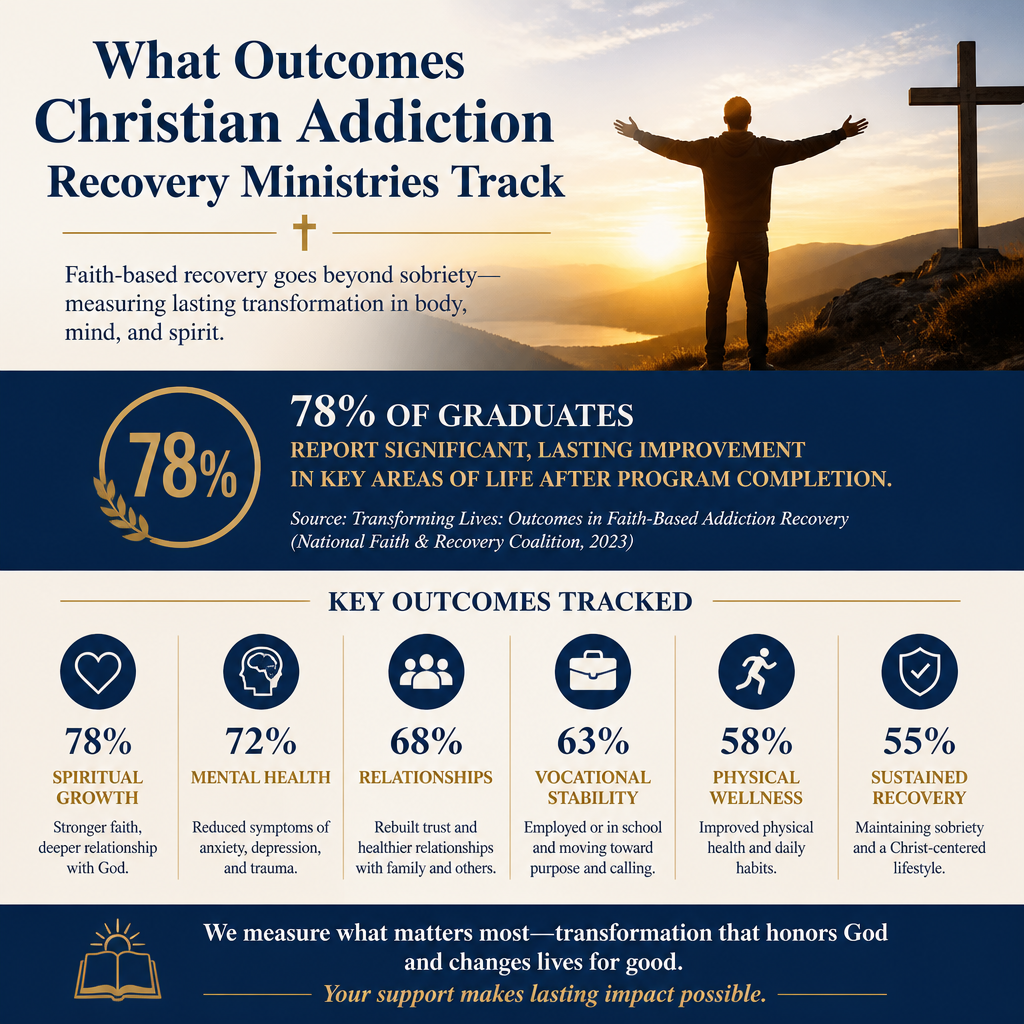
The field’s first temptation is to borrow a single outcome from clinical or criminal justice settings and treat it as the whole story. Abstinence matters. Reduced harm matters. Public safety matters. But Christian recovery ministries claim more than symptom management. They testify that union with Christ forms a new identity, new loves, and new patterns of life that include both spiritual and practical change.
That theological claim should shape measurement categories. The question is not whether a ministry tracks spiritual fruit or practical stability; faithful work tracks both, without confusing either one for the gospel itself.
Spiritual formation outcomes that can be tracked without manipulation
Measuring spiritual growth is contested. Christians genuinely disagree about what can be quantified without turning discipleship into a scorecard. The more responsible posture is to track concrete discipleship practices and community attachment rather than trying to quantify internal states.
Examples include consistent participation in Christian community, engagement in Scripture and prayer rhythms taught within the program, and involvement in a local church beyond the ministry’s own gatherings. These are imperfect proxies, but they are observable. They also align with how historic Christian formation has been practiced: ordinary means of grace, sustained over time, in accountable community.
Freedom expressed as restored responsibility
Addiction often erodes the basic responsibilities that make life livable: work, family obligations, legal compliance, financial order, and honesty. A Christian account of freedom is not autonomy; it is restored capacity to love God and neighbor, which includes keeping promises and honoring responsibilities. Ministries commonly track employment, stable income, housing stability, and reunification or responsible engagement with children and spouses where appropriate and safe.
Donors should ask whether a ministry defines freedom in a way that is both biblically grounded and operationally clear. That clarity is one reason we maintain The Most Trusted Standard at Most Trusted: to press ministries toward outcomes that reflect their stated faith commitments while remaining verifiable and ethically measured.

2. Track the full pathway, not only the graduation photo
Christian recovery work unfolds as a pathway: engagement, stabilization, formation, reintegration, and long-term perseverance. Ministries that track only end-of-program graduation often report outcomes that are easier to celebrate than to trust. The harder work is to measure movement along the pathway, including who leaves early and why.
Engagement and retention as early indicators
Retention is not a perfect measure of quality; some people leave because they secure safer housing, reunite with family, or transition to higher levels of clinical care. Still, retention and program participation are meaningful early indicators. A ministry that cannot clearly report how many participants enroll, how many remain at 30, 90, and 180 days, and the reasons for exit is not positioned to interpret downstream outcomes with integrity.
Donors can ask for definitions. What counts as “enrolled”? What counts as “active”? How are participants counted if they leave and return? Clear counting rules are not cold-hearted; they protect truthful reporting.
Completion outcomes should be paired with post-program follow-up
Graduation is a milestone, not a finish line. Many programs now track follow-up at 3, 6, and 12 months. The research community has long treated sustained recovery as a time-based outcome rather than a momentary one, and ministries should be candid about the difficulty of follow-up, especially with transient populations.

For donors evaluating credibility, the presence of a follow-up plan matters as much as the percentage reported. A ministry that acknowledges lost-to-follow-up cases and reports denominators transparently is more trustworthy than one reporting clean numbers without explaining who disappeared from the dataset.
3. Recovery outcomes include health, safety, and stability
Some donors hesitate when ministries discuss clinical measures, as if spiritual ministry and behavioral health cannot coexist. In practice, the most responsible faith-based programs respect medical reality while maintaining Christian moral and theological clarity. Substance use disorder carries real risks: overdose, infectious disease, psychiatric crisis, and violence. Ministries serve people made in God’s image, and safeguarding life is a work of mercy.
Substance use and relapse measurement should be honest and humane
Relapse is common in substance use disorder, and the research literature treats it as part of the condition’s chronic, relapsing profile for many people. The National Institute on Drug Abuse describes relapse rates for substance use disorders as comparable to other chronic illnesses, noting that relapse “does not mean that treatment has failed.” National Institute on Drug Abuse
What this means in practice is that ministries should not hide relapse to protect reputation, nor normalize it as inevitable. Strong programs track relapse events, response protocols, and re-engagement pathways. They also track overdose incidents and safety outcomes, including naloxone access where appropriate and lawful, and referral relationships with medical providers.
Mental health and trauma indicators are often central
Many participants face depression, anxiety, PTSD, or serious mental illness alongside addiction. Even when a ministry is not a licensed clinical provider, it can track screening referrals, engagement with counseling, medication adherence support where appropriate, and crisis episodes that required higher levels of care.
These measures should be handled with confidentiality and consent. Donors should expect privacy safeguards and trauma-informed practices that honor participants as persons, not as ministry proof points.
4. Community reintegration outcomes reveal whether recovery is durable
Recovery is tested in ordinary life: bills, relationships, triggers, and disappointments. Many ministries say they prepare participants for “reentry,” whether from a residential program, incarceration, or street homelessness. The integrity question is whether the ministry tracks outcomes that show reintegration is taking hold.
Economic stability and vocational formation
Employment is not salvation, but it is frequently a crucial stabilizer. A ministry might track job placement, job retention at 90 and 180 days, hours worked, and wage progression. Some track completion of GEDs, vocational certificates, or apprenticeships. When reporting employment outcomes, donors should look for clarity about what counts as employment and whether placements are subsidized by the ministry.
It is also appropriate to ask whether the ministry’s approach respects the “Starvation Cycle” described by Ann Goggins Gregory and Don Howard, which warns against underfunding the administrative and staffing capacity required to deliver outcomes reliably. Stanford Social Innovation Review
Family restoration and relational health
Christian donors often care deeply about reunification stories, and Scripture dignifies reconciliation. Yet wisdom requires caution. Some relationships are unsafe; some families are part of the addiction ecosystem; some reunification decisions belong to courts and child welfare agencies. Responsible ministries track relational outcomes with safeguards: participation in supervised visitation plans, compliance with legal requirements, engagement in parenting classes, and counseling participation, not merely “family restored” claims.
They also track the health of community ties: participation in a local church, connection to a sponsor or mentor, and involvement in peer support groups. For donors seeking broader context, our coverage of Christian Addiction Recovery Ministries addresses how these programs differ in model and accountability.
5. Effectiveness requires definitions, denominators, and independent checks
Outcome claims in Christian recovery ministry are vulnerable to two errors. The first is sentimentality: reporting inspiring narratives without denominators or verification. The second is technocracy: importing clinical metrics without regard for a ministry’s actual scope, staffing, or theological commitments. Mature measurement avoids both by defining outcomes plainly, reporting them transparently, and using outside standards where appropriate.
What donors should expect in outcome reporting
Across our verification work, we observe that ministries with credible outcomes tend to publish definitions alongside results. They clarify who is counted, over what time period, and under what conditions. They disclose limits, including missing follow-up data. They separate outputs from outcomes rather than blending them.
The following are reasonable expectations for many programs:
- Clear participant counts and eligibility criteria for each program track
- Retention and completion rates reported with time frames and reasons for exit
- Post-program follow-up plan and reporting of lost-to-follow-up cases
- At least a small set of stability outcomes: housing, employment, legal compliance
- Safeguarding and confidentiality policies that constrain what can be publicly shared
Independent verification strengthens trust without displacing faith
Christian donors do not need ministries to pretend that transformation can be reduced to spreadsheets. We do need ministries to show that claims are anchored in evidence, not marketing. That is why Most Trusted evaluates ministries against The Most Trusted Standard, including governance, financial integrity, and transparent effectiveness practices. Recovery ministry is spiritually weighty work, and precisely for that reason it should welcome accountability.
Donors who want to compare measurement practices across program models may find it helpful to review How Christian Addiction Recovery Ministries Measure Impact, where we examine how ministries define and report effectiveness under real-world constraints.
FAQs for What outcomes Christian addiction recovery ministries track
Should Christian addiction recovery ministries track abstinence as an outcome?
Yes, most should track substance use outcomes in some form, because sobriety or reduced use is closely tied to safety, stability, and the ability to sustain responsibilities. The credibility issue is how abstinence is defined and measured, how relapse is handled, and whether reporting is paired with follow-up after program exit. Ministries should avoid using abstinence rates as a publicity metric detached from denominators, definitions, and humane relapse response.
How can ministries measure spiritual growth without turning discipleship into a scorecard?
Responsible programs usually track observable practices and community attachment rather than attempting to quantify internal spiritual states. Examples include consistent participation in Christian community, engagement in Scripture and prayer rhythms taught in the program, and connection to a local church. These measures should be presented with humility and protected by confidentiality, recognizing that sanctification is real yet not fully capturable in metrics.
Stewardship asks for outcomes that are truthful and theologically coherent
Christian addiction recovery ministries are dealing with life, death, and the possibility of genuine transformation. Donors serve that work best by funding programs that can name what they seek, show what they can verify, and admit what they cannot control. Outcomes are not a replacement for faith; they are one of the ways we honor the truth, protect the vulnerable, and steward gifts offered to God for the good of neighbor.



