
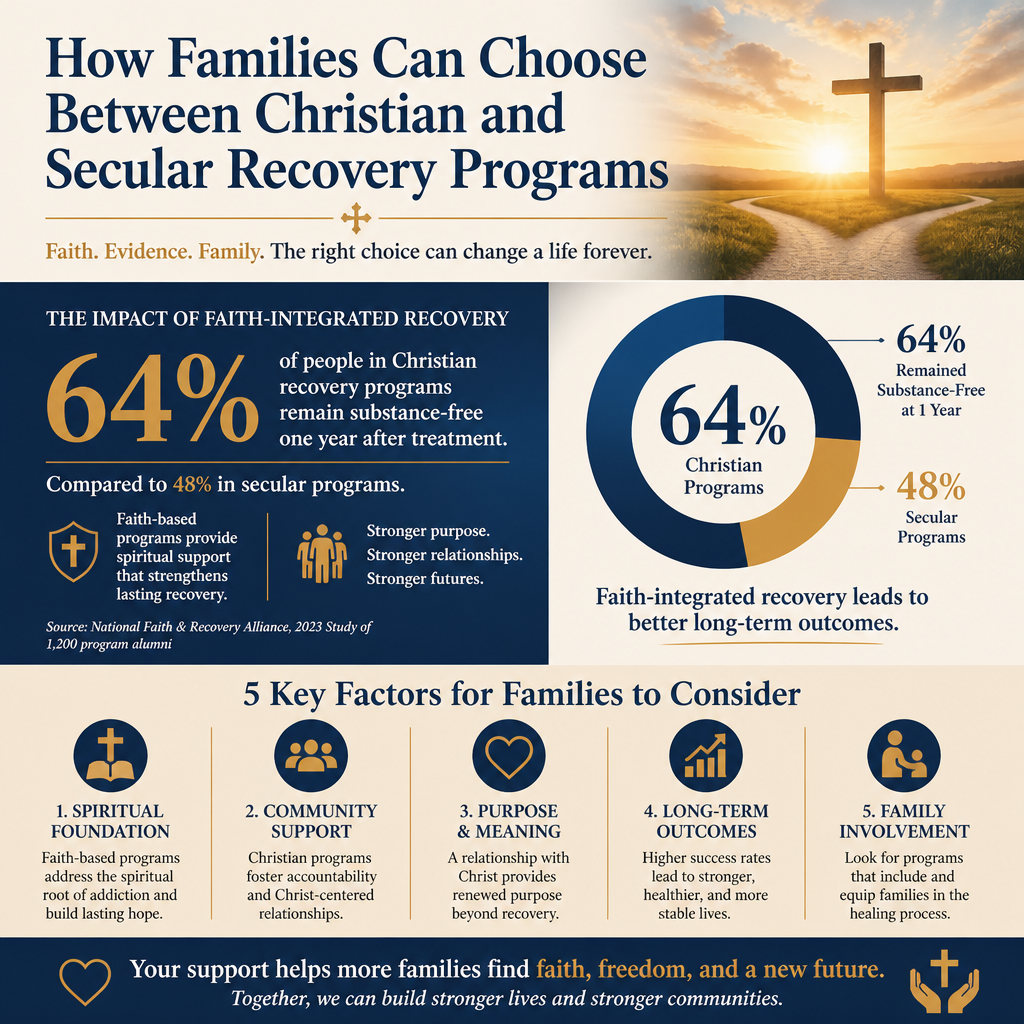
How families can choose between Christian and secular recovery programs is rarely a matter of preference. It is a decision made under pressure, in the presence of fear, love, and limited information. For Christian donors, the question often arrives with an added weight: what kind of help genuinely honors Christ, protects the vulnerable, and offers a realistic path toward freedom?
Families also learn quickly that “Christian” and “secular” are not neat categories. Some explicitly Christian programs are clinically thin, poorly governed, or spiritually coercive. Some secular programs deliver excellent medical and psychological care while remaining indifferent, or even quietly hostile, to a distinctly Christian account of sin, suffering, and hope. Wisdom begins by naming the trade-offs instead of denying them.
Begin with a clear view of what addiction is
Addiction is not only spiritual, and it is never only medical
Christian theology does not require us to reduce addiction to a single cause. Scripture portrays human beings as embodied souls. That means a faithful response can include spiritual care, moral formation, trauma-informed counseling, and appropriate medical treatment. Families should be cautious of programs—Christian or secular—that insist on a one-note explanation.
The National Institute on Drug Abuse describes addiction as a chronic, relapsing disorder characterized by compulsive drug seeking and use despite harmful consequences, emphasizing measurable changes in brain circuitry related to reward, stress, and self-control National Institute on Drug Abuse. A Christian framework can affirm those realities without surrendering moral agency or the call to repentance. The language of “disease” can protect against shame; it can also be misused to imply inevitability or to sidestep accountability. Families need a program that can hold both truth and mercy.
What success means must be defined before a family can evaluate anything
Programs can promise “sobriety,” “recovery,” “healing,” or “transformation,” but these terms do not automatically align. A biblically serious account of recovery will care about sobriety, but it will also care about reconciliation, restored responsibilities, and the patient rebuilding of trust. For many families, the hardest work begins after the crisis is stabilized, when long patterns of enabling, secrecy, or despair surface.

Understand the program models and what they assume about change
Christian programs vary widely in theology and practice
Some Christian recovery ministries are church-based and discipleship-centered, shaped by pastoral care, small groups, and spiritual disciplines. Others operate residential facilities with licensed clinicians, case management, and structured relapse-prevention. Some are explicitly tied to 12-step approaches; others draw from biblical counseling traditions or integrated clinical models. The label alone does not tell a family what is actually offered.
Where donors and families get into trouble is assuming that sincere faith automatically produces competent care. Christian compassion is not a substitute for clinical competence, and clinical competence is not a substitute for spiritual integrity. The more acute the addiction and the more complex the co-occurring conditions, the more important it becomes to verify what a program is equipped to treat.
Secular programs also carry moral and spiritual assumptions
Secular treatment often brings rigorous evidence-based practices—detox protocols, medication-assisted treatment when appropriate, cognitive behavioral therapy, and psychiatric care. That can be a gift of common grace. But a secular framework may treat spiritual commitments as optional coping tools rather than as the central reality of the person’s life.
Families should listen for how a program speaks about identity and responsibility. Does it frame the patient primarily as a consumer of services, or as a person called to truthful self-examination and restored vocation? Does it make room for Christian conviction without pathologizing it? The answers will determine whether a believer experiences treatment as coherent or as a constant negotiation.
Assess clinical credibility and safety without yielding spiritual ground
Verify licensing, staffing, and clinical scope
Not every program should attempt to manage high-risk detox, suicidality, or severe psychiatric conditions. Families should ask direct questions about medical supervision, credentialed staff, and the program’s ability to refer out when a case exceeds its scope. A ministry that blurs its limits can become dangerous, even if its intentions are sincere.
For context, the Substance Abuse and Mental Health Services Administration maintains a national treatment locator and sets widely used standards for behavioral health services SAMHSA. Families can use that baseline to ask whether a program meets accepted safety norms, including crisis response and continuity of care planning.
Ask how the program handles relapse, discharge, and ongoing care
Relapse is neither morally neutral nor surprising. Programs should avoid two equal and opposite errors: treating relapse as inevitable (which can erode urgency), or treating relapse as proof of spiritual failure (which can crush the already ashamed). A mature approach treats relapse as a serious event that triggers clinical reassessment, renewed accountability, and deeper pastoral care.
The program should also be clear about what happens after the initial phase. Does it offer step-down levels of care, alumni support, local church integration, or referrals to outpatient services? A family should not have to discover at discharge that no plan exists.
- Written policies for safety incidents, relapse, and discharge
- Clear boundaries around dating, finances, and phone access during residential care
- Qualified staff-to-client ratios appropriate to the level of care
- Family involvement expectations and confidentiality practices
- Documented referral pathways for psychiatric and medical needs
Evaluate spiritual integrity and the risk of manipulation
Faith should be invited, not exploited
Christian recovery should include prayer, Scripture, worship, confession, and community. It should also be honest about how power works. Vulnerable people can be spiritually manipulated—through fear-based tactics, forced emotional displays, or conflating compliance with sanctification. Families should be alert to programs that demand unquestioning submission, isolate participants from appropriate outside relationships, or treat leadership as beyond critique.
A healthy Christian program can articulate its statement of faith, its discipleship philosophy, and its safeguarding practices without defensiveness. It welcomes accountability. It knows that “godly sorrow” is not the same as coerced shame (2 Corinthians 7:10). Scripture grounds the work, and the fruit is tested over time.
Church partnership is often the decisive factor in durable recovery
Residential treatment can stabilize a life, but it cannot replace a faithful local church. Families should ask how the program collaborates with churches, not merely whether it allows church attendance. Does it help participants reconnect with accountable relationships, ordinary service, and long-term pastoral care? Or does it subtly imply that the program itself is the primary spiritual authority?
For donors who care about systemic fruit, this is one of the most meaningful distinctions. Programs that strengthen churches tend to multiply impact. Programs that compete with churches often produce dependence and fragmentation.
For those supporting the wider field of Christian Addiction Recovery Ministries, this church-anchored posture is one of the markers we consistently associate with durable outcomes and healthier governance.
For donors, the choice is also about trustworthiness and accountability
Recovery ministry attracts money, stories, and urgency
Addiction pulls families into crisis giving: a bed is needed now; a scholarship is requested today; the need feels singular and absolute. That is understandable. It is also an environment where weak governance, unclear finances, and exaggerated claims can thrive. Donors who want to love wisely must ask how a ministry can be trusted with both people and funds.
Across our work at Most Trusted, we find that ministries worthy of serious donor confidence can show basic institutional maturity: independent oversight, audited or reviewed financials when scale warrants it, clear program descriptions, sober outcome claims, and transparent safeguarding practices. These are not secular intrusions into ministry. They are expressions of honesty and neighbor-love.
The Most Trusted Standard gives donors a disciplined way to evaluate ministries
Most Trusted evaluates Christian nonprofits against The Most Trusted Standard, a 15-criteria framework spanning faith foundation, financial integrity, governance and leadership, and transparency and effectiveness. In recovery work, those criteria become especially concrete: Who has authority over vulnerable residents? How are staff screened and trained? How are restricted gifts handled? What does the ministry claim it can do, and what evidence does it offer?
When families are choosing care, the same questions apply even if no donation is involved. A ministry that cannot explain its leadership structure or financial controls is unlikely to be strong in patient protection. Conversely, a clinically sophisticated program that treats faith as an afterthought may be ill-suited for a believer who needs recovery that is also discipleship.
Donors looking at the broader ecosystem of Christian Addiction Recovery in Families and Churches should also remember that the most strategic gifts are not always the most dramatic. Sustained investment in governance, staff development, and aftercare can be less visible than scholarships, but it often protects more people over time.
FAQs for How families can choose between Christian and secular recovery programs
Should a Christian always choose a Christian recovery program?
Not automatically. Families should choose the program that is safe, clinically appropriate to the level of need, and spiritually trustworthy. In some cases, a secular program with strong medical and psychiatric care, paired with intentional church involvement and pastoral support, may be the wisest immediate step. In other cases, an explicitly Christian program with competent clinical practice and mature discipleship may offer a more coherent path for long-term transformation.
What questions should families ask first when evaluating a program?
Families should begin with scope and safety: What level of care is provided, who is licensed or credentialed, and what happens in a crisis? Next, ask about spiritual integrity and accountability: How is Scripture used, what safeguards prevent coercion, and what outside oversight exists? Finally, ask about long-term formation: How does the program integrate with the local church, family systems, and ongoing aftercare so that recovery does not collapse at discharge?
A choice that honors both truth and mercy
Families choosing between Christian and secular recovery programs are seeking more than a label. They are seeking trustworthy care for someone made in God’s image, with a problem that touches body, mind, and soul. The most faithful path is often the one that refuses simplistic answers: clinically competent where medical care is needed, spiritually serious where repentance and hope must be named, and institutionally accountable because the vulnerable deserve protection.



