
How churches partner with Christian addiction recovery ministries is one of the most consequential questions in contemporary pastoral care and Christian philanthropy. Addiction is not only a medical and psychological crisis; it is also a spiritual and communal crisis that tests whether the church will bear one another’s burdens with wisdom, patience, and truth (Galatians 6:2).
For Christian donors, this partnership question is rarely abstract. Giving often begins with names and faces: a son cycling through relapse, a pastor trying to respond to overdoses in the congregation, a small group watching a couple’s marriage fracture under the weight of alcohol misuse, a church member returning home from jail. The call to mercy is clear. The harder question is how to direct resources so that compassion becomes durable care rather than short-lived relief.
Begin with a shared theology of recovery, not a shared event calendar
Addiction involves the body, the soul, and the community
Churches and recovery ministries collaborate best when they share a theology that can hold complexity. Scripture describes sin as enslaving, deception as blinding, and idolatry as re-ordering loves. It also describes human beings as embodied creatures whose habits and wounds shape what we can see and choose. A faithful Christian response refuses reductionism: addiction is not merely a moral failure, and it is not merely a disease category emptied of moral agency. Many recovery leaders describe it as bondage that requires repentance, treatment, discipleship, and long obedience in community.
That integrated view matters because it changes what a church asks a ministry to provide. If the church sees the ministry as a vendor that “fixes” people offsite, it will be disappointed and often disengaged. If the church understands recovery as a process of formation, it will ask better questions: How does the program connect participants to a local church? What does discipleship look like after detox? How does the ministry engage trauma, grief, and family systems without surrendering the call to holiness?
Mutual clarity protects both participants and the witness of the church
Christians genuinely disagree about some program models: the role of medication-assisted treatment, the best posture toward 12-step language, and how explicitly gospel proclamation should be integrated into clinical care. Those disagreements do not need to be hidden; they need to be handled with humility and clarity. The strongest partnerships name convictions upfront, set boundaries, and then build a referral and support pathway that keeps the recovering person from being bounced between conflicting expectations.
For donors, this is a central due-diligence question: is a ministry’s theological and clinical posture coherent, and can it work constructively with a range of churches without diluting its convictions? Across our verification work at Most Trusted, ministries that meet The Most Trusted Standard tend to document their discipleship approach, safeguarding practices, and referral criteria in ways that reduce confusion at the point of crisis.

Define partnership as a continuum of care, not a one-time referral
Most churches underestimate the long arc of recovery
Addiction recovery is often measured in years, not weeks. Churches commonly refer someone to a program and then assume the hardest work is finished. Many ministries report the opposite: the most fragile period may come after a participant returns home, re-enters old routines, and faces stressors that once drove substance use.
Public health data underscores how lethal the window can be after treatment or incarceration. The National Institute on Drug Abuse notes that overdose risk can rise after a period of abstinence because tolerance decreases, making a return to prior doses far more dangerous; NIDA summarizes this dynamic in its treatment and recovery resources (National Institute on Drug Abuse). Churches that understand this risk structure their partnerships around sustained support: transportation, mentoring, accountability, and spiritual care that persists long after a discharge date.
A mature continuum includes family care, not only individual care
Addiction concentrates harm in the family system: spouses learn survival patterns, children absorb instability, and extended family members cycle between enabling and cutting off. A recovery ministry that treats only the individual, with no attention to the household, often leaves the most immediate relational drivers untouched.
Churches can strengthen a ministry by wrapping a recovering person and family in practical supports: childcare during counseling sessions, meal trains that do not create dependency, financial coaching that addresses debt and employment, and biblically grounded pastoral counseling. This is also where the partnership intersects with the broader landscape of Christian Addiction Recovery in Families and Churches, because local congregations are uniquely positioned to provide long-term relational stability that residential programs cannot replicate.
Build operational agreements that honor dignity and reduce risk
Clear referral pathways and safeguarding are spiritual responsibilities
Good intentions can produce avoidable harm when churches and ministries lack shared protocols. Confidentiality is one example. Pastors want to mobilize support, but oversharing can shame participants and expose families. Another example is volunteer engagement: well-meaning church members can be drawn into complex situations involving relapse, domestic conflict, or legal constraints without training or supervision.
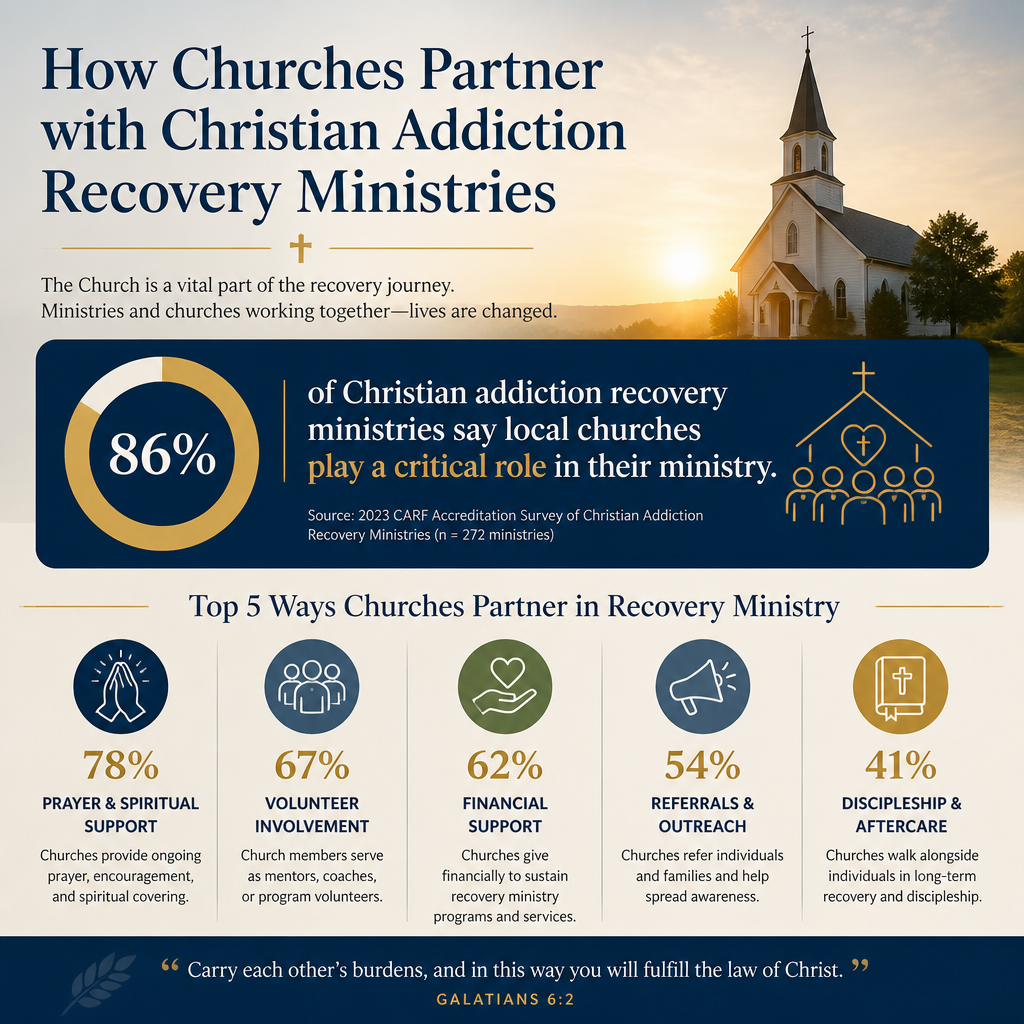
Partnership works best when there is an explicit agreement about who does what: intake criteria, emergency procedures, communication boundaries, and expectations for spiritual counsel. This is not bureaucratic caution. It is love expressed through order. Paul’s instruction that worship be conducted “decently and in order” reflects a wider biblical wisdom: structure can protect the vulnerable and preserve the integrity of the church’s witness.
Financial support should be framed as stewardship, not rescue
Churches often want to pay for beds, scholarships, transportation, or rent. These gifts can be merciful. They can also become enabling if they bypass accountability or substitute for the participant’s own responsibilities. The When Helping Hurts framework, articulated by Steve Corbett and Brian Fikkert, has reshaped many Christian approaches to material aid by warning against assistance that erodes agency, dignity, and mutuality (Moody Publishers).
A wise partnership sets criteria for financial assistance: time-limited support, participation requirements, and coordination with case management. Donors can strengthen this maturity by funding the systems that make aid responsible: trained staff, documented policies, and measured outcomes rather than only direct relief.
For donors, the key question is whether the partnership is verifiable
Trustworthy ministries can demonstrate integrity without defensiveness
Addiction recovery is a field where stories are powerful and where marketing can easily outrun accountability. Donors should not accept inspirational narratives as substitutes for verifiable governance and financial integrity. The healthiest ministries can answer detailed questions: Who sits on the board, and how independent are they? Are financial statements reviewed or audited? What is the safeguarding policy for vulnerable adults and minors? How are staff trained, supervised, and evaluated?
This is where Most Trusted serves churches and donors. We evaluate Christian nonprofits against The Most Trusted Standard, a 15-criteria framework spanning Faith Foundation, Financial Integrity, Governance and Leadership, and Transparency and Effectiveness. The aim is not to burden ministries with paperwork. The aim is to make trust concrete, so generosity can be confident rather than anxious.
Outcome claims require care, but avoidance is not honesty
Christian recovery work deals with realities that are hard to quantify: spiritual renewal, restored relationships, resilience through suffering, and repentance over time. At the same time, ministries routinely make implicit outcome claims when they ask donors for money. A mature posture is to measure what can be measured, tell the truth about what cannot, and refuse to manipulate with certainty that the field does not support.
Research on treatment outcomes varies by substance, treatment type, and population. Donors should be cautious of simplistic “success rates,” especially when definitions are unclear or follow-up is minimal. A more credible posture includes transparent definitions, third-party partnerships when possible, and evidence of learning when results are disappointing. Ministries that meet The Most Trusted Standard tend to publish clear program descriptions, explain their evaluation limits, and provide financial reporting that makes program scale and cost intelligible.
What strong church partnerships consistently include
A practical checklist that keeps compassion aligned with wisdom
Across churches that collaborate effectively with recovery ministries, certain elements appear repeatedly. They are not glamorous, but they are the difference between episodic charity and sustained care.
- Shared definitions of recovery goals, discipleship expectations, and crisis-response responsibilities
- Trained lay support that is supervised and bounded, not informal counseling without accountability
- Family ministry integration for spouses, parents, and children affected by addiction
- Responsible benevolence tied to a care plan, not reactive funding in the moment of panic
- Clear data and reporting that respects dignity while making stewardship verifiable
Partnership requires ecclesial humility
Churches do not need to become treatment centers to serve people with addiction well. Recovery ministries do not need to become local churches to contribute meaningfully to discipleship. Each has a distinct vocation. The partnership becomes distorted when either side assumes it can replace the other.
This is also why donors should resist funding models that implicitly isolate recovery work from the local church. Programs that treat the church as optional often struggle to sustain long-term formation. Conversely, churches that resist specialized expertise can inadvertently spiritualize problems that require clinical competence and structured care.
Donors looking for the broader landscape of faithful, accountable work in this space can begin with Christian Addiction Recovery Ministries, where the focus is on ministries whose commitments can be examined rather than merely admired.
FAQs for How churches partner with Christian addiction recovery ministries
Should churches require a recovery ministry to be explicitly Christian?
Churches should be clear about their purpose. If the church’s partnership is part of its discipleship and pastoral care, it is reasonable to prioritize ministries that can integrate spiritual formation with clinical competence and that can articulate the gospel without manipulation. At the same time, some churches maintain relationships with nonsectarian providers for detox, psychiatric care, or specialized treatment, while locating discipleship, community, and long-term accountability in the church. The wisest approach is often a both-and network, governed by clear theological boundaries and careful referral practices.
What should Christian donors ask before funding a church partnership with a recovery ministry?
Donors should ask for evidence that the partnership protects vulnerable people and treats money as stewardship: governance independence, financial transparency, safeguarding policies, and clear program descriptions. It is also appropriate to ask how the ministry defines outcomes, how follow-up is handled, and how the local church remains meaningfully involved after program completion. When a ministry can answer these questions without defensiveness, donors are usually seeing an organization that expects accountability as part of Christian witness.
A partnership model worthy of the church’s calling
The church is not called to choose between truth and mercy. In addiction recovery, both are required: mercy that bears burdens patiently, and truth that refuses denial, manipulation, and sentimentality. Churches partner well with Christian addiction recovery ministries when they build a continuum of care, establish clear operational agreements, and fund work that can be verified rather than merely celebrated.
Donors serve that partnership by insisting that compassion be accountable. When gifts are grounded in clear theology, competent practice, and verifiable integrity, generosity becomes one of the ways God sustains people on the long road from bondage to freedom.



