
Christian addiction recovery in families and churches is rarely a question of whether the gospel matters. The harder question is how a congregation’s spiritual care, relational support, and practical help can strengthen a household without confusing compassion with control. Donors who care about integrity have learned that recovery ministry is not sustained by good intentions alone; it requires sober theology, credible practice, and accountable leadership.
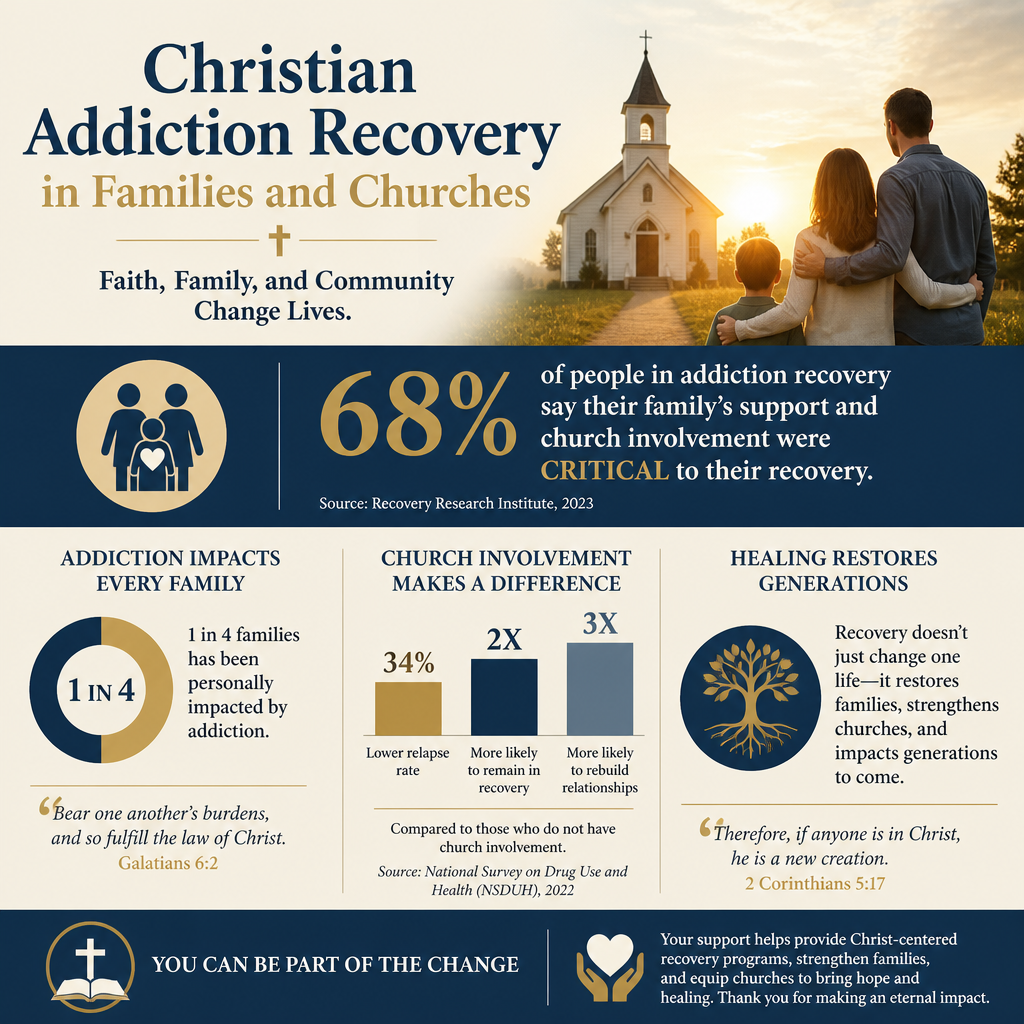
Addiction reaches beyond the individual who is using. It reshapes marriages, parenting, finances, church relationships, and a family’s sense of safety. A church can become a place of healing, but it can also intensify shame if it treats addiction as merely a private sin problem or a simple matter of willpower. Most families who remain engaged in recovery describe a long obedience with many setbacks, and the church’s posture during those setbacks often determines whether they continue in the light.
Why family systems matter in Christian addiction recovery
Scripture’s moral clarity about sin does not negate the complex moral injuries, traumas, and patterns of relational coping that often accompany addiction. Christian recovery work that ignores the family system tends to oscillate between two errors: excusing destructive choices as “only a disease” or treating the entire struggle as “only rebellion.” Most effective ministries refuse that false choice. They take responsibility seriously and treat suffering seriously, because both are present.
Addiction frequently includes cycles of secrecy, denial, and enabling that reshape an entire household’s decision-making. Families may become skilled at crisis management while losing ordinary rhythms of trust and truth-telling. Churches can unintentionally reinforce those dynamics when they prioritize a public image of “having it together” over confession, accountability, and wise boundaries.
Sin, suffering, and the call to truth
The New Testament consistently links maturity to walking in the light. “If we walk in the light, as he is in the light, we have fellowship with one another” (1 John 1:7). For families living with addiction, walking in the light usually includes telling the truth to pastors, to trusted friends, and often to professionals. It also includes naming consequences without treating consequences as condemnation.
Christians genuinely disagree about how to describe addiction: some emphasize moral agency; others emphasize brain changes, trauma, and compulsive patterns. The field has had to reckon with the fact that both frames can be partially true, and both can be weaponized. Donors should be cautious of ministries that resolve the tension with slogans. Serious care work usually sounds less certain and more faithful: clear about repentance, equally clear about perseverance, relapse risk, and the slow work of renewed desires.
The family as a discipleship environment
When addiction is present, family discipleship often becomes triage. Spouses and children may learn to read moods, conceal conflict, and minimize pain. Recovery, by contrast, requires forming a household around truth, safety, and worship. That can include learning how to pray honestly, how to confess without manipulation, and how to rebuild ordinary faithfulness: steady employment, daily responsibilities, consistent presence, and humble accountability.
In practice, churches strengthen family discipleship by supporting non-crisis spiritual formation: marriages that practice confession and forgiveness, parents who learn to speak plainly without shaming, and small groups that can sustain long seasons of prayer without demanding quick resolutions.

What churches can do well and what they often do poorly
Local churches are not treatment centers, but they are meant to be communities of truth and mercy. The best churches neither abandon families to professionals nor replace professional care with spiritual shortcuts. They make room for testimony and lament, and they establish structures of care that do not depend on one charismatic leader.
Many churches also carry understandable fears: fear of legal liability, fear of scandal, fear of manipulation, fear of enabling. Those fears can lead to distance when families most need wise presence. A mature church learns to differentiate between compassion and access. Compassion is always owed; access to vulnerable people and leadership responsibilities must be earned.
Supporting families without enabling addiction
One of the most common failures we observe across Christian care ecosystems is confusing “help” with “rescue.” Families, small groups, and benevolence teams can inadvertently finance addiction, conceal consequences, or pressure a spouse to reconcile prematurely. The When Helping Hurts framework, articulated by Steve Corbett and Brian Fikkert, has helped many churches re-examine how aid can undermine dignity and responsibility when it bypasses appropriate boundaries and mutuality. Donors should welcome ministries that train churches in this kind of discernment rather than relying on emotional urgency.
Wise support often includes practical assistance that strengthens stability without removing responsibility: childcare that allows a spouse to attend counseling, transportation to a verified program, meals during an intensive season, or temporary financial help tied to transparent budgeting and accountability. It also includes clear boundaries: no cash gifts without oversight, no pressure campaigns, and no secret arrangements that isolate decision-makers from the church’s pastoral and governance processes.
Relapse, restoration, and pastoral credibility
Relapse is not inevitable in every case, but it is common enough that churches should plan for it rather than pretend it will not happen. Public declarations that a person is “completely delivered” may be spiritually sincere and pastorally costly if relapse follows. Families can feel shamed into hiding, and churches can feel betrayed into disengagement. A credible church culture speaks of sanctification as real and sometimes gradual, with vigilance and hope held together.
Pastoral credibility matters here. Families need shepherds who can state plainly that repentance includes concrete change, that consequences may remain, and that restoration to leadership is not guaranteed or quick. The church’s concern is not preserving optics; it is protecting the flock and honoring Christ through truth.
How donors should assess Christian addiction recovery ministries
Donors often ask for a single proxy: “Is the program biblical?” That question is necessary and incomplete. A ministry can use Christian language and still practice poor stewardship, weak safeguarding, or unaccountable leadership. Conversely, a ministry can be clinically competent and still flatten the gospel into generic spirituality. Discernment requires attending to both faithfulness and competence.
This is where Most Trusted’s work as an independent verification service serves donors well. We evaluate ministries against The Most Trusted Standard, a 15-criteria framework across Faith Foundation, Financial Integrity, Governance and Leadership, and Transparency and Effectiveness. The aim is not to replace prayerful discernment but to discipline it with evidence, documentation, and accountable norms.
Faith foundation without spiritual coercion
Christian recovery ministry should speak clearly about sin, grace, repentance, and the new life Christ gives. It should also refuse coercive practices that weaponize Scripture against vulnerable people. We recommend looking for ministries that can articulate how spiritual formation functions in recovery without claiming that faith is a simplistic substitute for treatment, medication management, or trauma-informed care when those are appropriate.
Donors should also ask whether families are served as moral agents rather than treated as props for the addicted person’s story. Programs that honor spouses and children tend to provide parallel support groups, pastoral care pathways, and clear expectations about confidentiality and safeguarding.
Governance, safeguarding, and measurable integrity
Addiction recovery creates unique power dynamics: people in crisis, dependence on leaders, and high emotional intensity. Those conditions require unusually strong governance, clear policies, and external accountability. Ministries should have documented safeguarding practices, conflict-of-interest policies, and transparent financial reporting that allows donors to understand how funds support actual care rather than vague “program expenses.”
Verifiable evidence suggests that many households affected by addiction do not receive treatment at all, which means churches and nonprofits often become a first point of contact. In 2023, the National Survey on Drug Use and Health reported that among people aged 12 or older with a substance use disorder in the past year, a minority received substance use treatment. Donors can confirm those figures through the Substance Abuse and Mental Health Services Administration. This treatment gap is precisely why Christian nonprofits must be both theologically grounded and operationally credible.
Effectiveness that respects the complexity of recovery
Outcome measurement in faith-based recovery is contested. Christians genuinely disagree about what counts as “success”: continuous abstinence, reduced use, restored family relationships, church reintegration, long-term employment, or spiritual maturity under pressure. Ministries should not claim certainty they cannot prove. They should, however, track meaningful indicators, report them transparently, and explain limitations candidly.
We recommend donors look for signs of honest reporting: clear definitions, time-bound outcomes, third-party evaluation when feasible, and careful handling of testimonials. The goal is not marketing polish; it is truthfulness that honors donors and protects families from inflated promises.
How churches and ministries can partner without confusion
The most durable recovery ecosystems treat roles with clarity. Churches are responsible for pastoral care, spiritual formation, and community accountability; specialized ministries often provide structured programming, peer support, mentoring models, and connections to clinical services. Confusion happens when a church tries to outsource discipleship, or when a ministry tries to function as a church without the ecclesial accountability that should govern spiritual authority.
Healthy partnerships are built on shared commitments: truth-telling, safeguarding, and a refusal to exploit family pain for fundraising. Donors can strengthen this ecosystem by funding capacity that is not glamorous but essential: training for church leaders, vetted referral networks, background checks, financial audits, and policy development. These are often the difference between a ministry that helps for a season and one that remains trustworthy for decades.
Across our verification work, we observe that ministries that meet The Most Trusted Standard tend to communicate expectations plainly: what participation requires, what boundaries are non-negotiable, what happens after relapse, and how family members will be supported even when the addicted person refuses help. That clarity is not coldness. It is one form of pastoral realism.
Donors looking to fund this work within a broader landscape can also situate it within Christian Addiction Recovery Ministries as a field that includes residential programs, church-based groups, prevention initiatives, and family-focused care. The category matters because families experience the consequences across all of it: the quality of partnerships, the transparency of claims, and the integrity of governance.
A sober hope for families and the church
Christian addiction recovery in families and churches is not primarily a story about organizational competence, though competence matters. It is a story about truth, repentance, endurance, and the slow rebuilding of trust under the mercy of God. Donors serve this work best by funding ministries and church partnerships that combine theological seriousness with operational integrity, so that families are not asked to stake their future on promises that cannot bear weight.



