
Biblical counseling in Christian addiction recovery raises a donor-level question with real stakes: is a ministry offering serious spiritual care that confronts sin, suffering, and embodied dependency, or is it using Christian language to avoid clinical rigor and measurable responsibility? The answer is rarely found in a brochure. It is found in how counseling is trained, supervised, integrated with medical and mental health realities, and governed with the kind of transparency that can bear scrutiny.
Scripture refuses simple stories about addiction. Sin is real and enslaving, and so are sorrow, trauma, and the groaning of creation (John 8:34; Romans 8:22–23). A mature Christian recovery ministry does not force a false choice between moral agency and human frailty. It calls people to repentance and faith, and it also acknowledges that addiction frequently includes physiological dependence, co-occurring mental illness, and complex relational damage. Donors should expect that kind of honest, integrated moral seriousness.
Why biblical counseling matters in addiction recovery
Biblical counseling is not a brand label. Properly practiced, it is the application of Scripture to the whole person, under the care of Christ and within the life of the church. Addiction is not only a set of behaviors to stop; it is often a web of worship, trust, identity, fear, and coping. The Christian claim is that grace does not merely restrain behavior but restores the heart, reorders loves, and forms endurance through suffering.
That theological center is not optional. Programs that treat addiction as merely a disease can drift toward resignation rather than repentance. Programs that treat addiction as merely a moral failure can drift toward shame, secrecy, and spiritual performance. Biblical counseling at its best refuses both reductions. It names sin without crushing the sinner, and it offers mercy without excusing bondage.
What a donor should listen for in a ministry’s theology of change
Healthy ministries describe change as more than abstinence. They talk about reconciliation with God and neighbor, membership in a local church, repair of family systems, restitution where appropriate, and formation in ordinary disciplines: confession, prayer, Scripture, work, rest, and service. Their counseling language is clear about sanctification as a long obedience, not a quick fix.
They also speak with care about suffering. Many participants come with histories of abuse, abandonment, or chronic anxiety. A ministry may rightly call for repentance while also acknowledging that some patterns were learned as survival strategies and now need patient re-training. Donors should be wary of programs that interpret every symptom as rebellion, or that promise rapid transformation without sustained community.
The field’s hard question is integration, not ideology
Christians genuinely disagree about how biblical counseling should relate to psychotherapy and psychiatry. The better ministries do not pretend the question is simple. They maintain theological clarity while making responsible room for medical detox, medication management, trauma-informed care, and clinical referral when necessary. Addiction recovery is one of the places where simplistic either-or thinking can put people at risk.

What biblical counseling should look like in a credible recovery ministry
In practice, biblical counseling in addiction recovery should be structured, supervised, and accountable. It is not merely a series of inspiring conversations. It includes clear intake, careful assessment, written care plans, and a defined counseling method. The counseling is also bounded by ethical commitments: confidentiality with appropriate limits, mandated reporting where legally required, and safeguards against spiritual manipulation.
Confession and accountability with spiritual sobriety
Confession is central to Christian recovery, but it can be mishandled. Ministries should distinguish between confession to God, confession to those harmed, and disclosure in peer settings. Wisdom requires discretion. Public or coerced confession can become a tool for control, or a way to create false intimacy in groups that are not prepared to hold the weight of someone’s story.
Accountability, likewise, should not be reduced to surveillance. Strong programs use accountability relationships to cultivate truthfulness, pattern interruption, and relational repair. They also measure what can be measured: attendance, relapse episodes, engagement with a sponsor or mentor, and compliance with safety plans. A donor should expect a ministry to treat relapse as serious without treating it as proof of spiritual worthlessness.
Pastoral care and biblical counseling are not identical
Pastors play an indispensable role in recovery ministries, but pastoral counseling and biblical counseling are not always the same practice. Pastoral care often includes preaching, sacraments, prayer, congregational oversight, and shepherding within the broader life of the church. Biblical counseling, when formalized, is typically a focused helping relationship with an articulated methodology and training expectations.
Where ministries blur these roles, risks multiply: boundary violations, inadequate handling of trauma disclosures, and confusion about authority. A responsible ministry clarifies who provides what kind of care, how supervision works, and how it handles cases that exceed its competence.
Trauma requires truth and skill, not avoidance
Many people in addiction recovery carry trauma. The U.S. Department of Veterans Affairs summarizes a consistent association between PTSD and substance use disorders, with higher rates of SUD among those with PTSD than among those without it (U.S. Department of Veterans Affairs). A ministry does not need to become a trauma clinic to take this seriously, but it must have competent pathways: screening practices, referral relationships, and counseling approaches that avoid re-traumatization.
Trauma-informed does not mean trauma-excusing. It means the ministry understands how fear conditioning, dissociation, and hypervigilance can shape behavior and relationships. It also means the ministry avoids simplistic counsel that unintentionally blames victims or uses spiritual language to rush lament. The Psalms give the church a vocabulary for fear, grief, anger, and hope; biblical counseling should know how to use it without turning it into a script.
How donors can discern quality and integrity before funding
Donors often meet addiction recovery ministries at moments of urgency: a loved one is spiraling, a church member has overdosed, a community is losing young men and women. In that pressure, the temptation is to fund the ministry with the most compelling testimony or the strongest spiritual rhetoric. Those signals are not irrelevant, but they are not sufficient.
Wise giving asks whether the ministry can be trusted with vulnerable people. That trust is spiritual and operational. At Most Trusted, our verification work focuses on whether a ministry meets The Most Trusted Standard, a 15-criteria framework that examines Faith Foundation, Financial Integrity, Governance and Leadership, and Transparency and Effectiveness. Addiction recovery is precisely the kind of ministry category where those criteria protect both participants and donors.
Signs of credibility in counseling practice
- Clear training expectations for counselors and mentors, including ongoing education and supervision.
- Defined policies on confidentiality, boundaries, mandated reporting, and handling of abuse disclosures.
- Referral pathways for detox, psychiatric care, and higher levels of clinical treatment when needed.
- Documented discipleship structures that connect participants to local churches rather than isolating them.
Training is not an optional extra. Many ministries draw from established biblical counseling institutions and certification pathways, and donors can ask directly what training standards are used and how they are maintained. A ministry may be faithful without formal certification, but it should still be able to describe its training content, supervision practices, and how it corrects counselor drift over time.
Governance, financial integrity, and transparency are pastoral issues
Addiction recovery ministries are vulnerable to two forms of distortion: overpromising outcomes and under-disclosing risks. Healthy boards push against both. They ask whether the program’s claims match its data, whether leaders are accountable, and whether participant safety is treated as a moral responsibility rather than a legal nuisance.
Financial integrity matters for spiritual reasons as well as fiduciary ones. The opioid epidemic has created genuine needs, and it has also attracted opportunists. The National Institute on Drug Abuse describes the scale of overdose deaths and the complexity of substance use as a public health challenge, underscoring how high the stakes are for communities and families (National Institute on Drug Abuse). Donors should expect a ministry to publish clear financial statements, explain how restricted gifts are handled, and describe how funds translate into care.
Effectiveness claims should be humble and verifiable
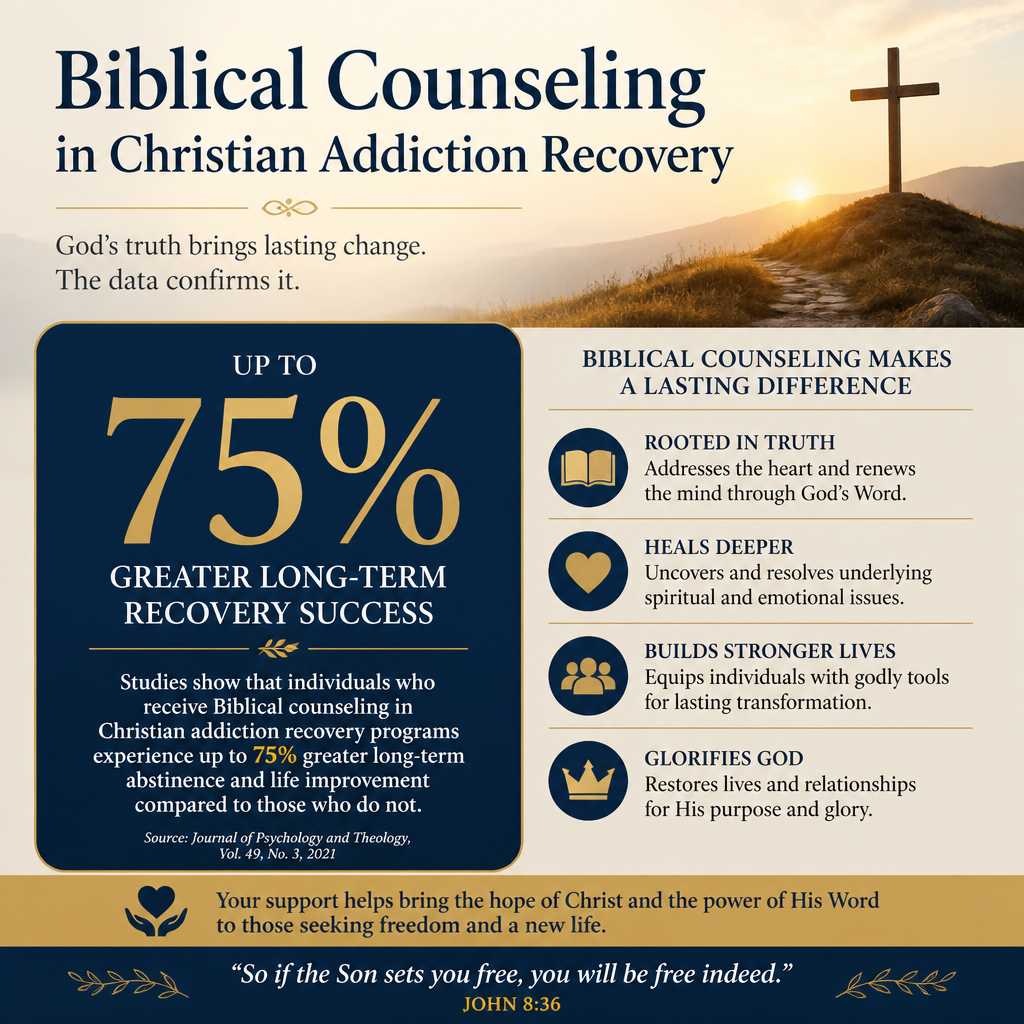
Recovery is difficult to measure, and simplistic metrics can deceive. Some programs count “decisions,” others count “graduates,” and others count “days sober.” Each can be manipulated. Responsible ministries name what they track, how they define success, and what they do with participants who relapse or disengage.
The best leaders speak with moral seriousness and statistical modesty. They do not treat human lives as marketing proof. They can describe participant pathways, retention patterns, and the limits of their data, and they welcome outside evaluation rather than fearing it.
For donors evaluating where biblical counseling fits within a broader ecosystem of care, it helps to situate this topic within the larger landscape of Christian Addiction Recovery Ministries. Biblical counseling is one essential element, but sustainable recovery typically involves a coordinated set of relationships and safeguards.
What strong support for biblical counseling achieves over time
Funding biblical counseling is not merely supporting “a counseling program.” It is supporting a theology of personhood and change that insists people are more than their cravings, more than their worst night, and more than their relapse history. It also insists that grace is not abstract. It takes institutional form: trained counselors, governed organizations, sober policies, and communities capable of telling the truth in love.
For donors, the mature aim is not to find a ministry that promises sinless graduates. It is to support ministries that combine doctrinal fidelity with operational integrity, so that the vulnerable are protected, the gospel is not weaponized, and help is offered with both compassion and competence. When biblical counseling is practiced in that way, it becomes a means of restoration that honors Christ, serves families, and strengthens the local church rather than substituting for it.



