

How child sponsorship ministries support children to graduation is one of the most searched questions in Christian giving because it sits at the intersection of compassion and stewardship. Donors want more than heartwarming correspondence; we want to know whether a child is measurably safer, learning, and progressing toward adulthood with real options, and whether the ministry’s model strengthens families and churches rather than creating dependency.
Graduation is a compelling milestone, but it can also become a simplistic proxy for transformation. Children can “graduate” from a program and still face early marriage, exploitative labor, or unemployment. A credible sponsorship ministry treats graduation as one point in a longer chain of outcomes: educational attainment, spiritual formation, resilience, and the ability to participate in a healthy local church and community.
Graduation is a milestone, not the mission
What ministries mean by graduation
In sponsorship, “graduation” can refer to multiple endpoints: finishing primary school, completing secondary school, passing a national exam, earning a vocational certificate, or aging out of a child program. Responsible ministries define the endpoint precisely and report it consistently. Ambiguous language creates room for inflated narratives and donor confusion.
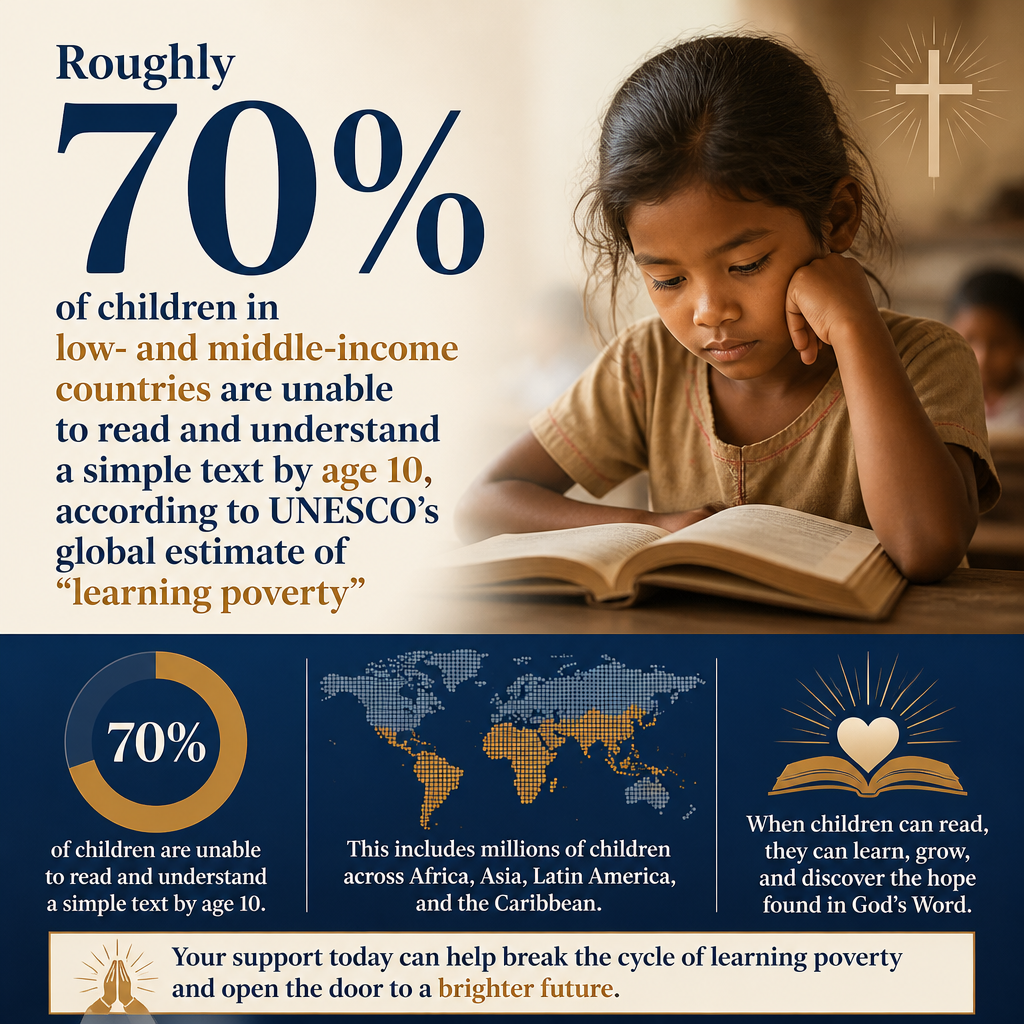
The better programs also distinguish between completion and competence. A child may complete school while remaining far below grade-level literacy. Globally, the scale of this challenge is sobering. Roughly 70% of children in low- and middle-income countries are unable to read and understand a simple text by age 10, according to UNESCO’s global estimate of “learning poverty” UNESCO. A graduation story that never addresses learning quality is incomplete.
Why donors should resist a single-number narrative
Christians genuinely disagree about what counts as “success” in child-focused ministry. Some emphasize academic outcomes; others emphasize spiritual formation and stability; still others emphasize the health of the family system around the child. Scripture does not reduce fruitfulness to one metric. The wisdom literature commends diligence and skill (Proverbs 22:29), while the New Testament’s moral vision centers on faith working through love (Galatians 5:6). Mature sponsorship ministries honor this complexity by measuring several outcomes and being candid about trade-offs.
From a verification standpoint, we treat graduation metrics as one indicator that must be tested against broader evidence: program design, safeguarding, financial integrity, and honest reporting. This is the posture behind The Most Trusted Standard: donors should not be asked to choose between compassion and scrutiny.

The pathway to graduation begins with family stability and local ownership
Why family strengthening is not optional
Education outcomes rarely improve in isolation from household stability. When a caregiver is chronically ill, when income is erratic, or when a family is under social pressure to withdraw a girl from school, a child’s attendance and performance suffer. Strong sponsorship ministries therefore put significant effort into family strengthening: parenting support, connection to local services, and practical assistance that reduces the likelihood a child must work instead of learn.
The field has had to reckon with a hard lesson: good intentions can undermine dignity and agency. The When Helping Hurts framework, articulated by Steve Corbett and Brian Fikkert, has shaped many sponsorship models by warning against solutions that displace local problem-solving and create unhealthy dependency When Helping Hurts. Programs that help children reach graduation typically include clear boundaries on material aid and a strategy for household resilience that does not rely on indefinite external subsidy.
How local churches shape durable outcomes
Christian sponsorship at its best is not a parallel system; it is a strengthening force within local institutions God has already placed in communities. Ministries that sustain progress to graduation usually have deep partnerships with local churches, school administrators, and community leaders. This does not mean the church becomes a distribution channel for donor funds. It means the church is present as a moral community: reinforcing the value of education, supporting families in crisis, and discipling youth as they face adult decisions.
Donors evaluating programs in this space should take time to understand how decisions are made locally. Who selects children for enrollment? Who adjudicates disputes? Who reports safeguarding concerns? The answers reveal whether the program is building local ownership or simply scaling an external system.
Effective sponsorship aligns interventions with the real barriers to schooling
Removing practical obstacles without buying outcomes
Children do not drop out only because they lack fees. They drop out because of transport distances, unsafe routes, family labor needs, early pregnancy, disability, conflict, and school quality. Sponsorship ministries that consistently support children to graduation typically do three things well: they diagnose barriers with local data, they tailor support to those barriers, and they avoid tying assistance to performative requirements that pressure families to conceal problems.
In many contexts, cash transfers and basic material support can be legitimate tools when they are carefully designed and locally accountable. Yet “paying for grades” can distort behavior and reporting. Programs that are serious about integrity do not purchase metrics; they support children and families through the conditions that make learning possible.
What credible program supports tend to include
Across our verification work at Most Trusted, the ministries that meet The Most Trusted Standard tend to describe their graduation pathway in concrete terms—inputs, activities, outputs, and outcomes—with evidence that matches what they claim. In practice, strong sponsorship approaches often include a mix such as:
- Consistent case management and attendance follow-up, including home visits when a child disengages
- Academic support that addresses learning gaps, not only school enrollment
- Safeguarding systems that are trained, enforced, and externally reviewable
- Health screening and referrals that reduce absenteeism from treatable conditions
- Adolescent life skills and vocational guidance to reduce risky transitions after school
These elements are not guarantees. They are signals that the ministry has translated compassion into a disciplined theory of change. Donors looking broadly at Child Sponsorship Ministries should expect to see these kinds of program mechanics, not only stories.
Measuring graduation requires sober definitions and honest data
Completion, retention, and learning must be distinguished
One of the more common weaknesses in sponsorship reporting is collapsing different concepts into a single “graduation rate.” Retention measures whether children remain enrolled year to year. Completion measures whether they finish a defined level. Learning measures whether literacy and numeracy actually improve. A mature ministry will avoid conflating them and will explain what is measured, how it is measured, and what is not measured.
When learning outcomes are measured, donors should ask whether the tool is credible and whether results are reported transparently. In global education, respected tools and approaches include Early Grade Reading Assessments and other standardized measures; what matters is not the brand name but whether the ministry can show consistent methodology and evidence of using results to improve programming.
What verification looks for in impact reporting
Transparency is not a public-relations posture; it is a moral obligation when Christians solicit gifts in the name of vulnerable children. The ninth commandment’s prohibition on false witness has direct relevance to fundraising claims. The ministries we can recommend with greater confidence tend to share:
Clear cohort definitions. Who is counted as “in program,” and at what point does a child enter or exit the denominator?
Attrition explanations. What proportion leaves, and why? Migration, family crisis, safety concerns, and school closures should be named plainly.
Third-party accountability. Independent audits for finances are common; external evaluation for outcomes is less common but meaningful when it exists.
Disaggregated reporting. Outcomes by gender, disability, or region help reveal who is being left behind.
Donors who want a deeper lens on these practices can review How Child Sponsorship Ministries Measure Impact. The core question is not whether a ministry tells moving stories; it is whether the story and the data belong to the same reality.
Risks and controversies donors should name directly
Child selection, equity, and unintended harm
Child sponsorship has faced sustained critique: it can create jealousy in communities, distort family incentives, or privilege children who are easier to serve. Those critiques should not be dismissed; they should be addressed through program design. Responsible ministries establish transparent selection criteria, invest in community-wide benefits where appropriate, and train staff to reduce stigma for non-sponsored children.
Another risk is the subtle commodification of children through marketing. Sponsors want connection, and ministries understandably facilitate it. But children are not fundraising assets. Ethical ministries protect privacy, obtain appropriate consent, avoid manipulative imagery, and treat correspondence as relationship rather than performance.
Safeguarding and the weight of trust
Any program that gathers children into activities, transports them, or facilitates sponsor communication carries safeguarding risk. Donors should expect more than a policy document. Strong programs train staff and volunteers, vet personnel, control data access, and maintain documented processes for reporting and responding to allegations. Where local legal systems are weak, the internal safeguards must be stronger, not weaker.
The broader humanitarian sector has increasingly recognized safeguarding as central to ethical practice. The Inter-Agency Standing Committee has published guidance on preventing sexual exploitation and abuse in humanitarian action, reflecting lessons learned across decades of failures and reforms Inter-Agency Standing Committee. Christian sponsorship ministries should meet or exceed these expectations, not treat them as secular concerns.
FAQs for How child sponsorship ministries support children to graduation
Does child sponsorship actually improve graduation outcomes?
The research landscape is mixed because sponsorship models vary widely and because attribution is difficult in complex social settings. Some long-term studies report positive associations between sponsorship and later educational attainment, but the credibility of any claim depends on methods, context, and baseline conditions. For donors, the more reliable question is whether a specific ministry can define its graduation endpoint, show consistent cohort tracking, and demonstrate that its support addresses the real barriers children face.
What should donors ask a sponsorship ministry about graduation before giving?
We recommend asking: How is “graduation” defined in your program? What percentage of enrolled children reach that endpoint, and what is the time horizon? How do you track children who migrate or exit early? What do you measure besides completion—attendance, learning, safety, spiritual formation? What safeguarding controls govern staff interaction, photos, and sponsor communication? A ministry that answers these questions clearly, with documentation, is more likely to be operating with the integrity donors should require.
Graduation worthy of Christian stewardship
Supporting a child to graduation is not simply funding school costs. It is walking with a child and family through the pressures that threaten persistence, while strengthening local institutions that will remain long after a sponsorship term ends. Donors can honor both compassion and truth by prioritizing ministries that define graduation carefully, measure outcomes with integrity, and protect children with seriousness commensurate with the trust placed in the church’s care.



