
When Bible translation ministries need funding most is rarely the moment donors first notice them. The critical seasons are often quiet: years of preparation before a single verse is published, and the long, less visible work after a New Testament dedication when a community still needs Scripture to take root in worship, literacy, and discipleship.
Christian donors rightly want to place their giving where it will bear enduring fruit. Yet Bible translation sits at the intersection of theology, linguistics, publishing, and local church formation. That complexity creates real funding vulnerabilities: long timelines, high upfront costs, security constraints, and the temptation to finance only what photographs well. Mature stewardship begins by understanding where translation efforts are most likely to stall without timely, patient capital.
Funding pressure rises long before the first draft exists
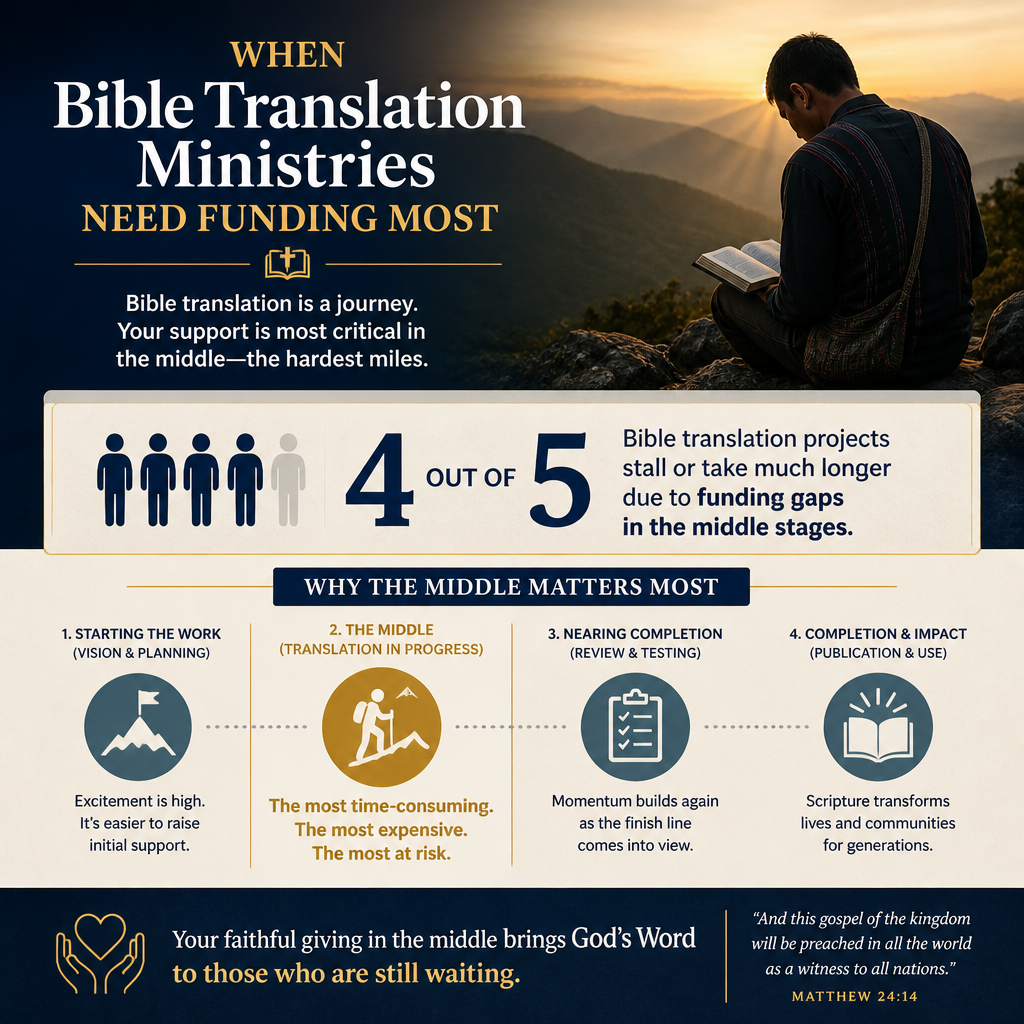
The Christian public often associates Bible translation with a finished book. Translation organizations know the decisive constraints begin earlier: language assessment, sociolinguistic research, community testing, orthography development, and the recruitment and training of local translators who can sustain the work. These phases are less legible to donors, but they are where projects are either grounded for decades of faithful service or built on fragile assumptions.
Early-stage research is expensive and not easily restricted
In early phases, ministries must pay for specialized staff and local partnerships before there is a “product” to show. Donors sometimes insist on tightly restricted gifts tied to visible outputs, yet research and relationship-building are precisely the work. When early-stage funding is thin, ministries may shorten assessment, overpromise timelines, or enter a language community without the depth of trust that Scripture work requires.
Security and access costs are real, even when they are not advertised
Some translation contexts involve restricted access, political instability, or high travel burdens. Ministries may be constrained in what they can communicate publicly, which can depress fundraising even as costs rise. Donors should assume that discretion is sometimes part of faithfulness, not a sign of opacity, and should ask ministries how they balance necessary confidentiality with meaningful accountability.
Transition points are where projects most often stall
Across our verification work at Most Trusted, we observe that many ministry failures do not come from doctrinal drift or moral scandal, but from predictable strain points where funding does not match the work’s actual cadence. Translation is not a steady monthly output; it is a sequence of transitions that require different competencies, different budgets, and often different partners.
The handoff from training to production exposes capacity gaps
A project can recruit a promising team and still falter when the work shifts from training to sustained drafting. Teams may need additional consultant support, software and equipment, and ongoing checking capacity. Underfunded ministries may reduce checking visits or overload a small number of consultants, which can slow progress or compromise quality.
Consultant checking and community testing are not optional costs
Translation is a ministry of truth-telling. The field has learned that accuracy, naturalness, and acceptance require rigorous checking and local testing. When donors fund “translation” but not the full pathway to an accepted, usable text, they unintentionally push ministries toward a thinner version of faithfulness. A Bible that is not trusted or understood will not serve the church well, no matter how quickly it was produced.
Printing and distribution surge when momentum is highest
The moment a translation portion is ready—often a Gospel, then a New Testament—costs can rise sharply. Printing, shipping, warehousing, and last-mile distribution can eclipse earlier monthly expenses. The need is especially acute in contexts where infrastructure is weak or import duties are unpredictable.
Physical Scripture still matters, even in a digital age
Digital distribution has expanded access, but it has not eliminated the need for print. In many settings, phones are shared, data is costly, and electricity is inconsistent. Donors sometimes assume a digital-first approach makes distribution inexpensive. Ministries on the ground often report the opposite: good digital strategy requires audio production, app development, user testing, and sustained support.
Inflation and supply chain volatility are stewardship issues
When paper prices rise or shipping routes are disrupted, translation organizations can face sudden budget gaps. Donors do not need to micromanage line items, but it is reasonable to ask whether a ministry has contingency planning and whether leadership is candid about cost pressures. Mature transparency is not the absence of uncertainty; it is the willingness to name it and govern through it.
After publication is where long-term fruit is either formed or lost
A New Testament dedication can create the impression that the mission is complete. In many cases, that is the moment a community is newly vulnerable. Scripture must be read, heard, taught, sung, and integrated into the life of the church. Without sustained support, the book may exist without becoming a living instrument of discipleship.
Literacy and Scripture engagement are often the hidden bottleneck
In some language communities, literacy rates are low, or a written form is newly established. Translation ministries may partner with literacy specialists, develop primers, or invest in audio Scripture. These efforts can feel secondary to donors who are passionate about “getting the Bible translated,” yet they are frequently the difference between a translation that sits on a shelf and one that forms a people.
Local church partnership is not automatic
Christians genuinely disagree about how closely translation work should be tied to formal church structures in each context. Some settings have fragile institutions; others have strong denominational systems. What donors should look for is not a single model but clear evidence that local believers are not treated as an audience for a product, but as stewards of Scripture in their own language community.
Practical signs that post-publication work is being funded and governed responsibly include:
- Dedicated budget for Scripture engagement, not only translation and printing
- Measurable plans for audio, literacy, and teacher training where needed
- Local leadership ownership with documented decision rights
- Safeguards against dependency, aligned with the When Helping Hurts framework articulated by Corbett and Fikkert whenhelpinghurts.org
- Clear timelines and honest reporting when adoption is slower than hoped
What wise donors watch for when urgency is used as a fundraising tool
Translation ministries sometimes communicate urgency because the need is real. Yet urgency can also become a rhetorical habit that trains donors to fund crises rather than faithfulness. A sober donor posture is to ask: what kind of need is this—structural, transitional, or truly unexpected—and does the organization’s governance match its claims?
Restricted giving can unintentionally create the starvation cycle
Donors often prefer to fund direct project costs and avoid “overhead.” The nonprofit sector has had to reckon with the damage this can cause. Stanford Social Innovation Review described the “Nonprofit Starvation Cycle,” in which underinvestment in administration and capacity creates chronic weakness rather than efficiency ssir.org. Translation ministries are not exempt. Underfunding finance, security, HR, and project management does not make translation cheaper; it makes it brittle.
Relatedly, many charity evaluators have urged donors to stop using overhead ratios as a primary measure of impact. Charity Navigator’s public statements on this shift are part of the broader correction away from simplistic efficiency metrics charitynavigator.org.
The harder question is whether the ministry can be verified
There is a legitimate tension between necessary confidentiality in sensitive locations and the donor’s obligation to exercise discernment. Wise donors do not demand reckless disclosure, but neither do they fund ministries that ask for trust without evidence. This is where independent verification can serve the church.
Most Trusted exists to help Christian donors give with confidence by evaluating ministries against The Most Trusted Standard, a 15-criteria framework spanning faith foundation, financial integrity, governance and leadership, and transparency and effectiveness. The ministries that meet The Most Trusted Standard tend to communicate their funding needs in a way that is specific, governed, and accountable rather than emotionally coercive. Donors exploring the broader landscape of Bible Translation Ministries should expect mature ministries to name their strain points plainly: transitions, checking capacity, post-publication engagement, and the real costs of operating faithfully in complex contexts.
FAQs for When Bible translation ministries need funding most
Is it better to give to a specific translation project or to general operations?
Both can be faithful, but they serve different needs. Project-restricted gifts can help a ministry initiate or complete a defined scope of work, especially when the project plan is clear and checking and engagement are fully funded. General operating support often meets the most fragile needs at transition points: consultant availability, security, finance, and the less visible work of sustaining quality over years. We generally recommend that donors who want long-term fruit include at least some unrestricted or lightly restricted support, because translation work rarely fails for lack of vision; it fails when capacity is starved.
What questions should donors ask when a ministry says a translation is urgent?
Ask what has changed and what will happen if the gap is not closed. Request a timeline that distinguishes drafting, checking, community testing, publication, and engagement. Ask how the ministry measures acceptance and use in churches, not only pages completed. Finally, ask how governance functions: who approves budgets, how risk is managed, and what transparency is possible given the context. Donors who want to compare practices across organizations can consult How to Give Wisely to Bible Translation Ministries and apply consistent standards rather than responding only to the intensity of an appeal.
Funding the slow work that serves the church
Bible translation is often described as urgent because the Word of God is not a peripheral good. “How are they to believe in him of whom they have never heard?” Paul asks, tying proclamation to the ordinary means by which God gathers his people (Romans 10:14). The donor’s task is to fund that calling in a way that honors truth, the local church, and the long obedience required.
When Bible translation ministries need funding most is frequently when the work is least visible: before the first draft, at technical handoffs, during checking and testing, and after publication when Scripture engagement determines whether a community will actually receive the Word. Donors who give patiently at those moments are not merely completing projects; they are strengthening the conditions under which the church can endure.



