
Legacy and planned giving for Bible study and engagement ministries forces a mature Christian question into the open: what should endure after our lives, and how should Scripture shape that endurance? The modern charitable toolbox makes it possible to give with unusual precision, but it also raises moral and practical questions about control, trust, and the long-term health of the ministries we love.
Many donors begin with a simple desire: that more people would meet Christ in the Word, not merely consume Christian content. Yet planned giving is rarely simple. It touches family obligations, tax law, church relationships, and the uneven quality of nonprofit governance. The same bequest that funds faithful discipleship for decades can also entrench a weak organization if the donor’s discernment is thin or the ministry’s accountability erodes over time.
Why legacy giving belongs in the stewardship of the Word
Scripture treats inheritance as a serious matter. Proverbs commends the long view—“A good man leaves an inheritance to his children’s children” (Proverbs 13:22)—while Jesus warns that treasure can quietly become a rival kingdom (Matthew 6:19–21). Planned giving sits at that intersection. It can be an act of worshipful foresight, or it can become a way to retain control long after death under the cover of generosity.
Bible study and engagement ministries are uniquely shaped by the long horizon. A translation initiative, a church-based literacy program, a prison Bible distribution partnership, or a multi-year discipleship pathway rarely fits into a single annual budget cycle. Planned gifts can underwrite work that is slow, relational, and spiritually formative, the kind of work donors often wish were more common in American Christianity.
Legacy giving and the formation problem
American Christians are not formed by Scripture automatically. Regular Bible reading has declined in measurable ways, and donors often feel that drift in their families and congregations. One widely cited benchmark comes from the American Bible Society’s State of the Bible research, which has tracked Scripture engagement across the country and reported multi-year declines among “Bible users” in recent cycles (American Bible Society). Planned giving is not a substitute for faithful local church life, but it can strengthen ministries that help churches and households recover durable habits.
Why donors choose end-of-life gifts for Word-centered work
Across our verification work at Most Trusted, we observe that many believers see legacy gifts as a way to align accumulated resources with settled convictions. Annual giving can be reactive—tied to immediate needs, crisis appeals, or a compelling new program. A will, trust, or beneficiary designation tends to express what the donor believes will still matter when marketing cycles and ministry trends have passed.

Planned giving tools and what they mean in practice
Planned giving is a category, not a single instrument. Each tool carries its own theological and practical trade-offs: who controls the asset, when the ministry receives it, what flexibility the donor retains, and what risks the donor introduces to heirs and to the ministry itself.
Bequests and will provisions
A bequest is often the simplest legacy gift: a provision in a will or revocable living trust that directs assets to a ministry at death. Donors commonly choose a specific dollar amount, a percentage of the estate, or a “residual” bequest (what remains after other distributions). Residual gifts can be wise when the estate size is uncertain, though they also make it harder for a ministry to estimate future support.
The harder question is not the mechanics but the ministry’s long-term suitability. If a bequest is restricted to a specific program, the donor should consider whether that restriction could become impractical years later. Restriction is sometimes necessary to protect donor intent; it can also become a burden if it does not allow the ministry to adapt responsibly to changing circumstances.
Beneficiary designations
Beneficiary designations on retirement accounts, life insurance policies, and certain bank or brokerage accounts can direct assets outside probate. For some donors, this is the most straightforward way to make a substantial gift without rewriting a will. It can also be a way to give tax-efficiently, since retirement accounts may carry income tax consequences for heirs in ways that do not apply to charities.
Because beneficiary designations override will language, they require careful coordination. Donors should ensure the legal name of the ministry is accurate and that the designation aligns with the rest of the estate plan. In practice, many disputes and disappointments arise from inconsistent documents rather than from bad intent.
Donor-advised funds and long-horizon giving
Donor-advised funds can function as a disciplined staging ground for long-term generosity: a donor makes an irrevocable charitable contribution, receives an immediate tax deduction, and recommends grants over time. Christians genuinely disagree about how DAFs should be used. Some view them as prudent and orderly; others worry that DAFs can become a parking place for charitable dollars that should be deployed more quickly.
That concern is not theoretical. National DAF grant payout rates have been reported as strong in aggregate, but individual accounts vary widely. The National Philanthropic Trust’s annual reporting is one of the more widely referenced sources on DAF activity and payout trends (National Philanthropic Trust). For donors focused on Bible engagement, the key question is whether a DAF is serving a faithful giving plan or becoming a substitute for one.
Charitable gift annuities and other life-income gifts
Charitable gift annuities and charitable remainder trusts can provide income to the donor (or another beneficiary) while ultimately transferring assets to ministry. These instruments can be appropriate for donors who are asset-rich but cash-flow cautious, or for those who want to give more significantly without jeopardizing household stability.
They also demand sober evaluation. The ministry must have the administrative competence to manage or partner well in administering such gifts, and the donor should understand that payout rates and tax treatment depend on age, funding assets, and the terms of the agreement. A life-income gift can be a generous expression of trust, but only if it is structured with clarity and with the ministry’s capacity in mind.
Gifts of appreciated stock and other non-cash assets
For donors with appreciated securities, giving stock can be a tax-wise way to increase charitable impact. Many Bible study and engagement ministries can accept publicly traded stock easily; some can also receive complex assets, though those gifts require additional governance and financial controls.
What this means in practice is that donors should ask whether the ministry has a written gift acceptance policy, how it values and liquidates non-cash assets, and whether it has safeguards against private inurement and conflicts of interest. Those questions are not suspicious; they are the ordinary due diligence of stewardship.
What faithful discernment requires from donors and from ministries
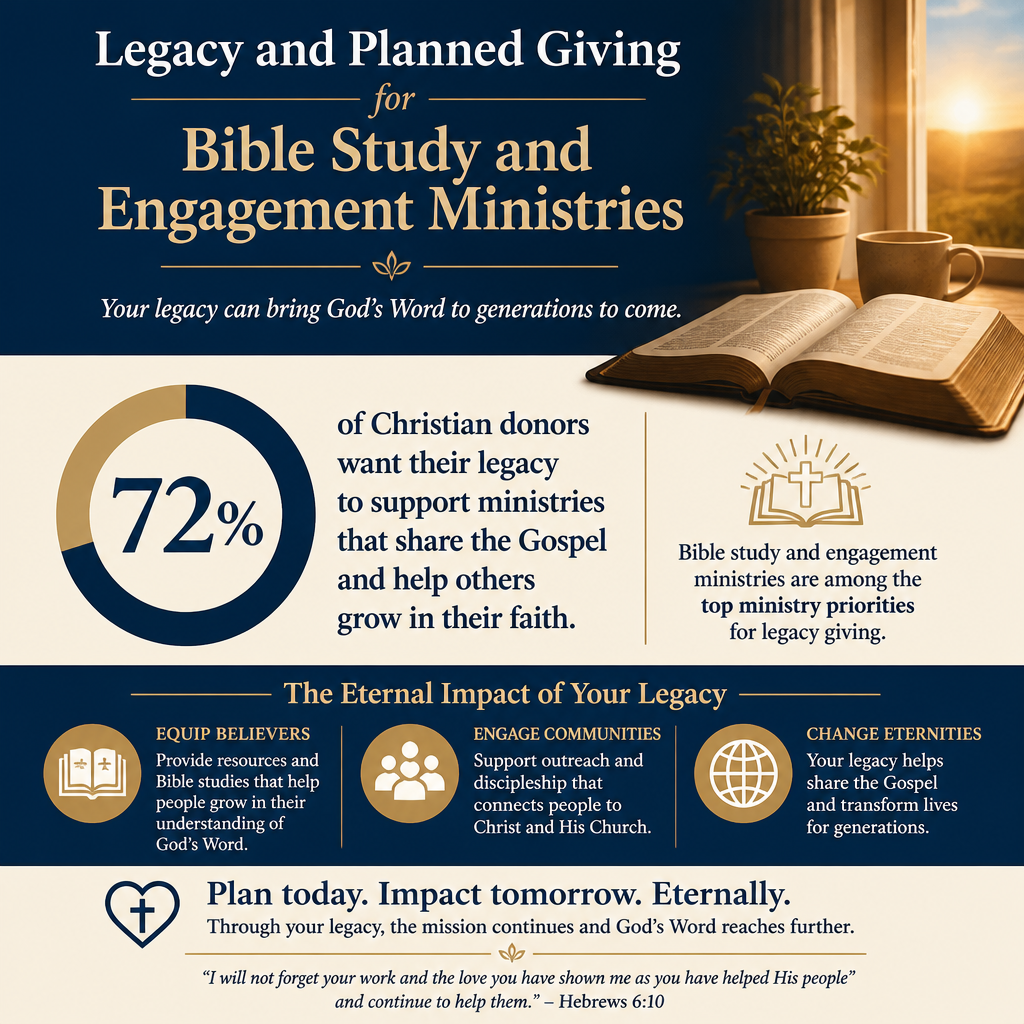
Legacy giving is an act of trust, and trust is not a sentiment. It is a judgment based on evidence, character, and accountability. Bible engagement ministries often have compelling stories—testimonies of lives changed through Scripture, churches revitalized, incarcerated men and women discipled, children learning to read through Bible-based literacy. The question for a planned gift is whether the organization’s structures are strong enough to carry that mission decades into the future.
Mission clarity and theological integrity
Word-centered ministries should be able to articulate what they mean by “Bible engagement.” Is the goal distribution, literacy, comprehension, spiritual formation, church integration, or evangelistic proclamation? Different aims can all be faithful, but they are not interchangeable, and donors should not assume alignment based on familiar language alone.
Doctrinal commitments matter here in a particular way. Because Scripture is the ministry’s subject, the ministry’s theological posture is not a side issue; it is part of the product. Donors should look for clear statements of faith, accountability to a church or ecclesial network where appropriate, and a track record of handling disputed issues with humility and integrity rather than with fundraising opportunism.
Governance that can survive leadership change
Planned giving is especially vulnerable to leadership transitions. A ministry that is faithful under one founder can drift under a successor. Donors should ask whether the board is genuinely governing, whether there is documented succession planning, and whether the organization demonstrates meaningful transparency about decision-making.
Across our verification work, we find that the ministries that meet The Most Trusted Standard tend to treat governance as a form of discipleship: sober-minded, accountable, and resistant to celebrity dynamics. That pattern is not guaranteed by size or by reputation. It is evidenced by clear policies, independent oversight, and an observable willingness to be examined.
Financial integrity and the temptation to over-promise
Legacy programs can create a subtle temptation for ministries: to sell certainty about future impact that no one can honestly guarantee. Donors should be wary of pressure, urgency, or language that implies a planned gift is the only serious form of faithfulness. Christian generosity is not a single instrument; it is a posture.
Strong financial practice is concrete. It shows up in audited financial statements when appropriate, disciplined reserves policies, clear reporting on revenue concentration, and fundraising practices that do not treat donors as means to an end. The sector has also had to reckon with simplistic narratives about overhead. The widely endorsed “overhead myth” critique—articulated in a public letter by leading nonprofit evaluators—argues that low overhead is not a reliable proxy for effectiveness (Candid (GuideStar)). For Bible engagement ministries, the analogous mistake is assuming that impressive distribution numbers or app downloads necessarily correspond to spiritual formation.
For donors who want a structured way to weigh these questions, Most Trusted evaluates ministries against The Most Trusted Standard, a 15-criteria framework across Faith Foundation, Financial Integrity, Governance and Leadership, and Transparency and Effectiveness. Verification is not a replacement for prayerful discernment, but it can reduce the risk of making a long-term commitment on the basis of incomplete information.
How to structure a legacy gift that serves your family and the mission
Christian donors often carry two obligations at once: responsibility to household and responsibility to the broader body of Christ. Scripture honors both. Paul speaks of providing for one’s relatives as a serious moral duty (1 Timothy 5:8), and Jesus commends sacrificial generosity that refuses to be ruled by fear (Mark 12:41–44). Planned giving decisions frequently require holding those truths together without forcing a false choice.
Start with clarity on priorities and a realistic estate picture
Effective planning begins with a sober inventory: major assets, contingent liabilities, dependent needs, and likely medical and care costs. Some donors assume their estate will be larger than it is; others underestimate how much they can give without threatening family stability. A faithful plan is neither reckless nor anxious. It is proportionate, transparent within the household, and consistent with the donor’s ordinary patterns of generosity.
When donors want to support Bible engagement across a range of faithful efforts, diversified legacy giving can be appropriate: a portion to a local church, a portion to a Bible translation or literacy initiative, and a portion to discipleship and formation ministries. The right mix depends on calling, family circumstances, and convictions about where Scripture engagement is most urgently needed.
Use restrictions carefully and write them well
Restricting a gift can protect donor intent, particularly when a ministry’s mission is broad or when the donor wants to support a specific population. Yet restrictions can become unworkable in future decades. A common practice among experienced donors is to include a measure of flexibility: a primary purpose statement, paired with language that allows the ministry’s board to redirect funds to the closest feasible purpose if circumstances change.
Donors should insist that restriction language be drafted with competent legal counsel and reviewed with the ministry. Informal letters and verbal understandings can collapse under staff turnover. A well-structured agreement honors the donor, protects the ministry from impossible obligations, and reduces the likelihood of future conflict.
Coordinate legal, tax, and ministry conversations without confusion
Legacy giving requires coordination among advisors. Estate attorneys, financial planners, and accountants bring necessary expertise, but they do not automatically understand ministry realities. Conversely, ministry gift officers may be sincere but are not disinterested parties. Wise donors keep each voice in its proper place and require documentation rather than assurances.
When evaluating Bible study and engagement ministries, donors also benefit from independent analysis. Our team’s work at Most Trusted is designed to serve that need, especially when donors are considering irrevocable or long-horizon commitments. For a broader view of how donors assess the category as a whole, see Bible Study and Engagement Ministries.
Legacy giving as a long obedience of trust
Legacy and planned giving for Bible study and engagement ministries is ultimately a question of whether our resources will continue to serve the Word after our voices are silent. The instruments matter, and the legal details matter, but the spiritual center is trust: trust that God uses faithful means, trust that institutions require accountability, and trust that our giving should strengthen the church rather than substitute for it.
The most enduring planned gifts are rarely those that chase the newest program. They are those that place meaningful resources with ministries that are doctrinally clear, governed with integrity, financially honest, and transparent about what they can and cannot claim. That combination does not remove risk, but it honors both prudence and hope—qualities Christian stewardship has always required.



