
How Bible distribution ministries handle literacy barriers is not a secondary operational question. It is a question of whether access to Scripture is being pursued as an act of faithful witness or reduced to a countable logistics problem. In many contexts, the printed Bible remains indispensable, yet literacy barriers mean that the physical presence of a book may not translate into comprehension, discipleship, or durable church formation.
Christian donors often feel this tension acutely. We want to fund tangible outcomes, and Scripture distribution is one of the most tangible forms of ministry. But the Great Commission is not fulfilled by volume alone; it is fulfilled as Christ’s words are heard, received, obeyed, and handed on (Matthew 28:19–20). Ministries that take literacy barriers seriously tend to be slower, more locally embedded, and less easily summarized in a single metric, even when their work is more faithful to the aim.
Literacy is not only an education problem
Literacy barriers are spiritual and social realities
In the modern imagination, literacy is primarily a technical deficiency: people cannot decode letters, so the solution is schooling. Yet ministries serving oral cultures, displaced populations, and communities affected by conflict encounter something broader. Literacy is tied to language status, economic stability, gender norms, disability access, and the legitimacy of local institutions. A Bible can be “available” and still inaccessible if the language is not the heart language of the listener, if schooling was disrupted, or if reading is socially restricted.
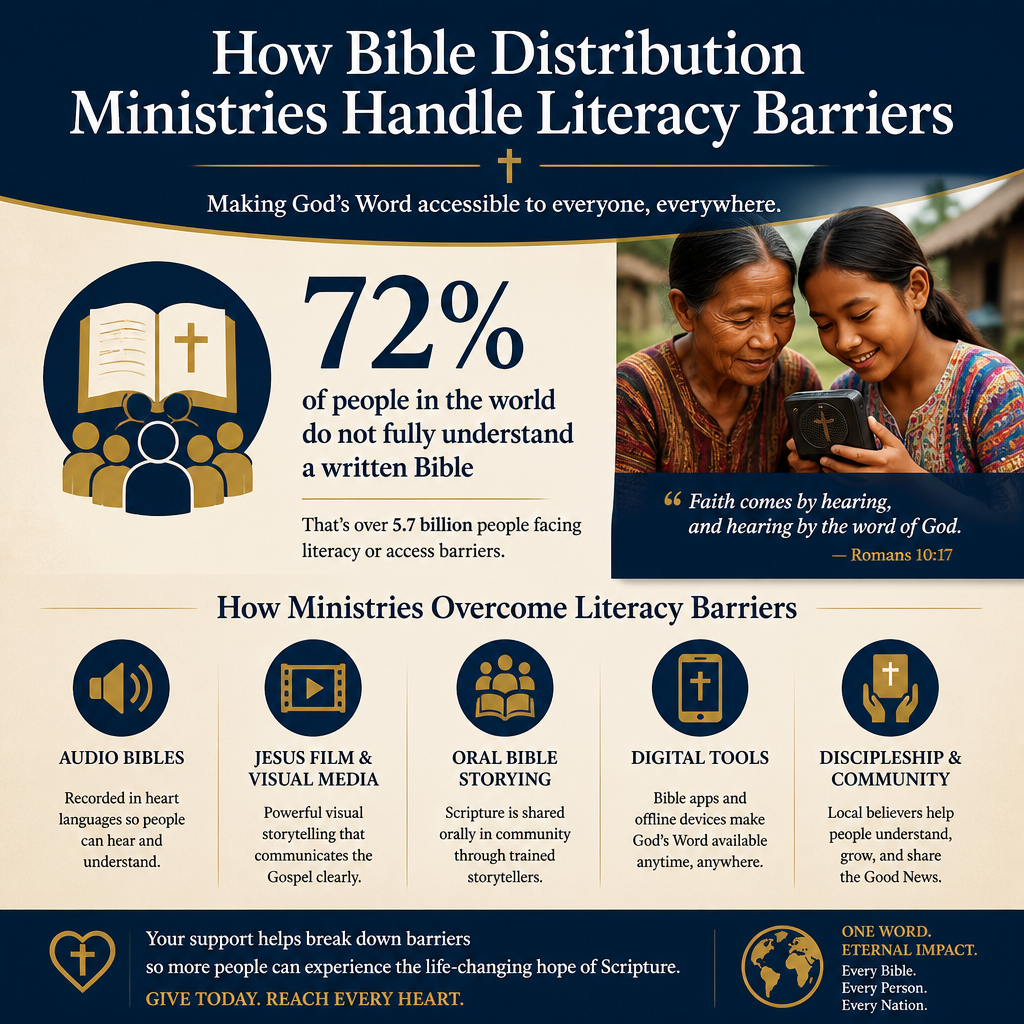
Scripture itself treats “hearing” as a central pathway of faith. Paul’s insistence that “faith comes from hearing” (Romans 10:17) is not an argument against literacy; it is a theological reminder that God’s Word is not bound to one medium. Bible distribution ministries that work credibly across literacy barriers tend to treat listening, memorization, and communal recitation as first-class forms of access rather than as stopgaps.
Donors should resist simplistic success measures
Counting copies distributed is not irrelevant, but it is incomplete. Sophisticated ministries pair distribution with evidence that people are actually encountering Scripture in ways that can be sustained. This is one reason we encourage donors to consider ministry approaches in the wider ecosystem of Translations, Formats, and Languages in Bible Distribution, where format choices and language decisions often determine whether the ministry is genuinely reaching those on the margins.
Formats that meet people where they are
Audio Scripture and the logic of orality
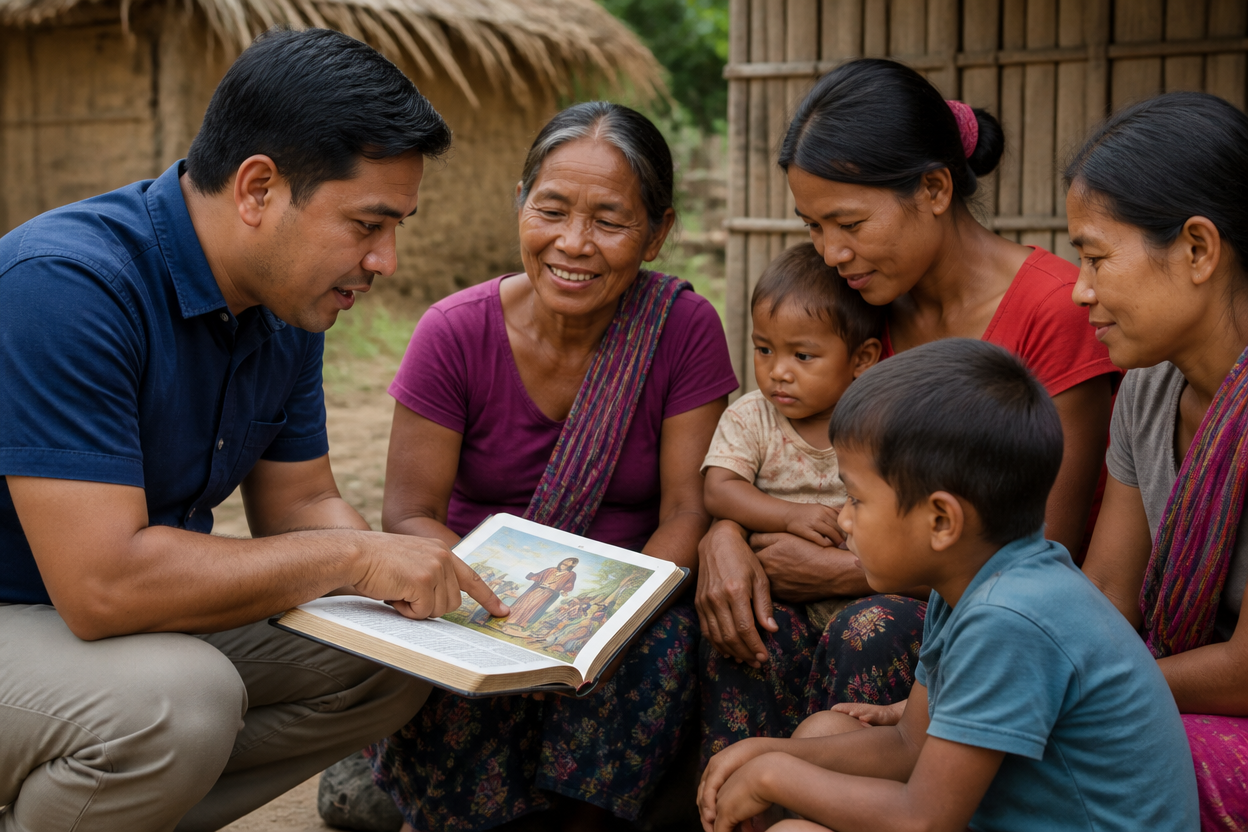
Audio Scripture has become one of the most significant developments in Bible access for low-literacy contexts. It aligns with the social reality that many communities learn primarily through story, song, and public speech. Audio also serves those with visual impairments and those whose reading skills are limited by interrupted education.
These approaches are not speculative. The World Bank has documented a global “learning poverty” crisis in which large numbers of children cannot read and understand a simple text by late primary age, limiting adult literacy over time; see the World Bank’s overview of learning poverty at World Bank. That context matters for donors because it clarifies why Bible engagement strategies that assume universal reading ability will often exclude the very poor.
Scripture engagement tools beyond the printed page
Responsible ministries increasingly combine formats, not because printed Bibles are obsolete, but because one format rarely serves an entire community. A congregation may benefit from printed texts for leaders and students, audio for households, and dramatized Scripture for communal listening. Some ministries also use sign-language Scripture resources where deaf communities have limited access to interpreters or written materials.
When donors assess these programs, the harder question is whether the format choice is grounded in local consultation or driven by a donor market. Audio devices, for example, can be appropriate, but they can also become dependency-prone giveaways if they are not repairable locally, if they require proprietary batteries, or if they displace local ministry rather than strengthening it.
Translation choices that affect literacy barriers
Heart language and comprehension
In many places, the “national language” is the language of school and government, not the language of home and worship. Ministries that distribute only in the prestige language may increase physical availability while leaving comprehension and ownership thin. Conversely, heart-language translation can lower the comprehension barrier substantially, even when formal literacy rates remain limited, because oral comprehension and story retention are often stronger in the mother tongue.
This is also where donors should be attentive to timelines and partnership models. Translation and distribution work that honors community review, theological accountability, and linguistic rigor does not move at the pace of a marketing campaign. Christians genuinely disagree about translation philosophy in some respects, but credible ministries are transparent about their process, their review structures, and their relationship to local churches.
Easy-to-read editions and the ethics of simplification
Some ministries pursue “easy-to-read” editions to help new readers and second-language speakers. This can be wise, but it raises real tensions. Simplification may reduce cognitive load, yet it can also flatten theological nuance if done carelessly. Donors should ask whether simplified texts are framed as a discipleship on-ramp rather than as a replacement for richer engagement with the whole counsel of God.
At the same time, Scripture distribution should not become a purity contest that leaves emerging readers behind. The New Testament itself was written in the common Greek of the day, not in a deliberately inaccessible register. The question is not whether a ministry uses approachable language, but whether it does so with theological responsibility and clarity about intended use.
Pairing distribution with literacy and discipleship pathways
Literacy programs as patient mercy
Many Bible distribution ministries partner with local churches to support basic literacy instruction, especially where women and rural communities have been structurally excluded from education. This is often slow, unglamorous work, and it does not always produce headline-ready numbers. Yet it aligns with a Christian understanding of neighbor love: enabling people to read not only Scripture but also medical instructions, legal documents, and school materials for their children.
For donors who want verifiable insight, it helps to separate two claims: “we taught literacy” and “people can now read.” Credible ministries define literacy benchmarks, document retention over time, and describe how instructors are trained and supervised. The most careful programs treat literacy as a community capacity, not a short-term class.
Oral Bible storytelling and church-based transmission
Oral Bible storytelling and communal Scripture use are not compromises; they are historically normal. Most Christians across church history encountered Scripture through public reading and catechesis, not private ownership. Ministries serving oral learners often train local believers to tell Bible stories accurately, use chronological story sets, and anchor stories in the wider biblical narrative so that listeners are not left with disconnected moral lessons.
Wise donors will also ask how these oral approaches are governed theologically. Are story sets reviewed by trained leaders? Is there accountability to local elders? Is there a clear connection to the church’s teaching ministry and sacraments? The goal is not merely story circulation; it is the formation of mature disciples who can discern truth and resist syncretism.
- Local language assessment that distinguishes school language from heart language
- Format diversity that includes audio and group listening, not only print
- Church-anchored distribution so Scripture access is tied to ongoing pastoral care
- Training and review for storytellers, facilitators, and translators
- Follow-up evidence showing engagement over time, not only initial delivery
What donor due diligence should look for
Evidence of effectiveness without reductionism
Donors should not accept a false choice between “stories that inspire” and “data that proves impact.” A mature ministry can provide both: qualitative evidence that demonstrates faithful local partnership, and measurable indicators that show whether people are actually engaging Scripture. That may include listening group continuity, local church adoption, distribution-to-engagement ratios, or documented pathways from first exposure to baptism and membership. Metrics will vary by context; what matters is whether they are honest, explained, and open to external scrutiny.
It is also worth remembering the caution raised by the “Overhead Myth” letter signed by GuideStar (now Candid), Charity Navigator, and the BBB Wise Giving Alliance: simplistic ratios can distort nonprofit behavior and mislead donors about effectiveness; see Candid. Bible distribution work across literacy barriers is a category where this warning applies directly, because the most faithful work often requires training, follow-up, and local capacity building that will never be captured by a low administrative percentage.
Alignment with The Most Trusted Standard
Across our verification work at Most Trusted, we see patterns that distinguish ministries that are likely to serve low-literacy communities well. The ministries that meet The Most Trusted Standard tend to be explicit about their theology of Scripture, careful about how they count outcomes, transparent about partnerships, and disciplined in governance. They can articulate why a particular format was chosen, who requested it, who can maintain it, and what the ministry will do when an approach is not working.
This is where donors can ask concrete questions without becoming cynical. How does the ministry avoid creating black-market incentives around devices or printed materials? What safeguards exist against leaders distributing resources along patronage lines? How are local churches empowered rather than bypassed? Strong answers typically include locally accountable distribution channels, documented handoff plans, and a willingness to report challenges as well as successes.
Donors who want broader context on how ministries operate in this field will often benefit from reviewing the wider landscape of Bible Distribution Ministries, especially when comparing organizations that emphasize mass distribution with those emphasizing translation, audio engagement, and church-anchored discipleship.
FAQs for How Bible distribution ministries handle literacy barriers
Is audio Scripture a replacement for printed Bibles?
Audio Scripture is best understood as a complementary form of access that matches how many communities learn and transmit knowledge. In low-literacy settings, it may be the primary first step into Scripture engagement, while printed Bibles remain essential for leaders, students, and maturing readers. Responsible ministries typically pursue multiple formats and connect them to church-based teaching so that listening leads toward deeper understanding, not isolated consumption.
What should donors ask to ensure literacy-related programs are not paternalistic?
Donors can ask who identified the literacy barrier, who designed the response, and who holds authority for ongoing decisions. Healthy programs are locally requested, locally staffed, and accountable to local church leadership or trusted community structures. They also name trade-offs plainly: the limits of short-term classes, the risk of device dependency, and the need for long-term follow-up that does not treat people as distribution endpoints.
Giving that honors the Word and the listener
Bible distribution in the presence of literacy barriers tests whether we believe Scripture is merely delivered or truly received. The ministries most worthy of donor confidence treat access as a relationship between God’s Word and real people in real communities, with all the complexity that implies. When donors fund work that is linguistically careful, format-wise, and anchored to the local church, they are not only placing Bibles in hands; they are helping ensure the Word is heard, understood, and carried forward with integrity.



