
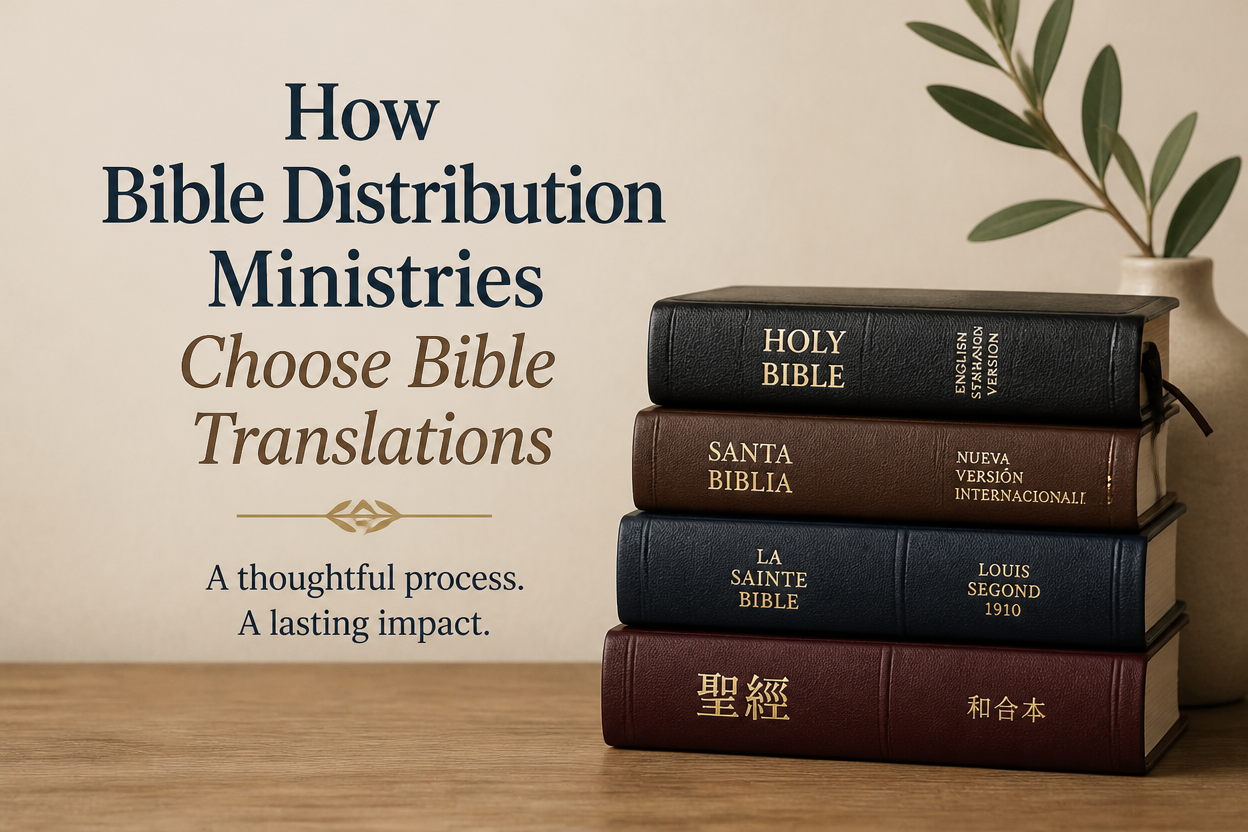
How Bible distribution ministries choose Bible translations is not a technical footnote; it is a theological and pastoral decision with real consequences for readers and for the witness of the church. For Christian donors, the question sits at the intersection of fidelity to Scripture, cultural humility, and stewardship: whether the Word being placed in someone’s hands is accurate, understandable, and suited to the setting where it will be read.
The field has learned that translation choice is rarely neutral. It reflects a ministry’s view of authority, its posture toward local churches, its tolerance for complexity, and its operational discipline. Translation decisions also reveal whether a ministry can explain its work with clarity rather than slogans, a pattern we examine across our verification work at Most Trusted.
Translation choice begins with a doctrine of Scripture and a philosophy of translation
Accuracy and clarity are not opposing virtues
Most Bible distribution ministries begin where the church has always begun: the conviction that God has spoken and that Scripture is “breathed out by God” and therefore authoritative (2 Timothy 3:16). That conviction does not settle every translation question, but it does establish the priority: the goal is not merely inspirational religious literature, but the faithful communication of what the biblical authors wrote.
From there, ministries typically weigh translation philosophy. Broadly, formal equivalence translations aim for closer correspondence to the structure of the source languages, while functional or dynamic equivalence translations aim for naturalness and comprehension in the receptor language. Christians genuinely disagree about how to balance those aims, and the disagreement is not always partisan; it often reflects differing views of how languages work and how people learn. A mature ministry can name its philosophy plainly, acknowledge trade-offs, and show how that philosophy serves its distribution context rather than its brand.
The harder question is that “accuracy” is not one thing. Translators must decide how to render idioms, metaphor, wordplay, and theological terms that do not map neatly across languages. The New Testament itself models the reality that faithful transmission may involve paraphrase and interpretive judgment, as New Testament authors cite the Old Testament in ways that reflect common Greek renderings rather than strict word-for-word replication. A ministry that pretends translation requires no interpretation is typically not being candid.
Confessional commitments shape what ministries will and will not distribute
Many distribution ministries are confessional, whether explicitly or implicitly. Some will prioritize translations aligned with evangelical consensus on authority and clarity of the gospel message. Others will distribute a wider range of translations in order to serve mixed church ecosystems, including Catholic or Orthodox contexts. Neither approach is automatically unfaithful; the moral question is whether the ministry’s stated commitments match its distribution practice and whether local churches are treated as partners rather than mere endpoints.
For donors, this is a place to ask sober questions. Does the ministry publish a statement of faith? Does it explain its translation philosophy in public? Does it have a process for addressing doctrinal disputes without politicizing them? Across our work evaluating ministries against The Most Trusted Standard, we observe that clarity here tends to correlate with other forms of integrity: governance discipline, transparent reporting, and consistent program decisions under pressure.
The primary question is not preference but readership and setting
Literacy, age, and first-time exposure to Scripture matter
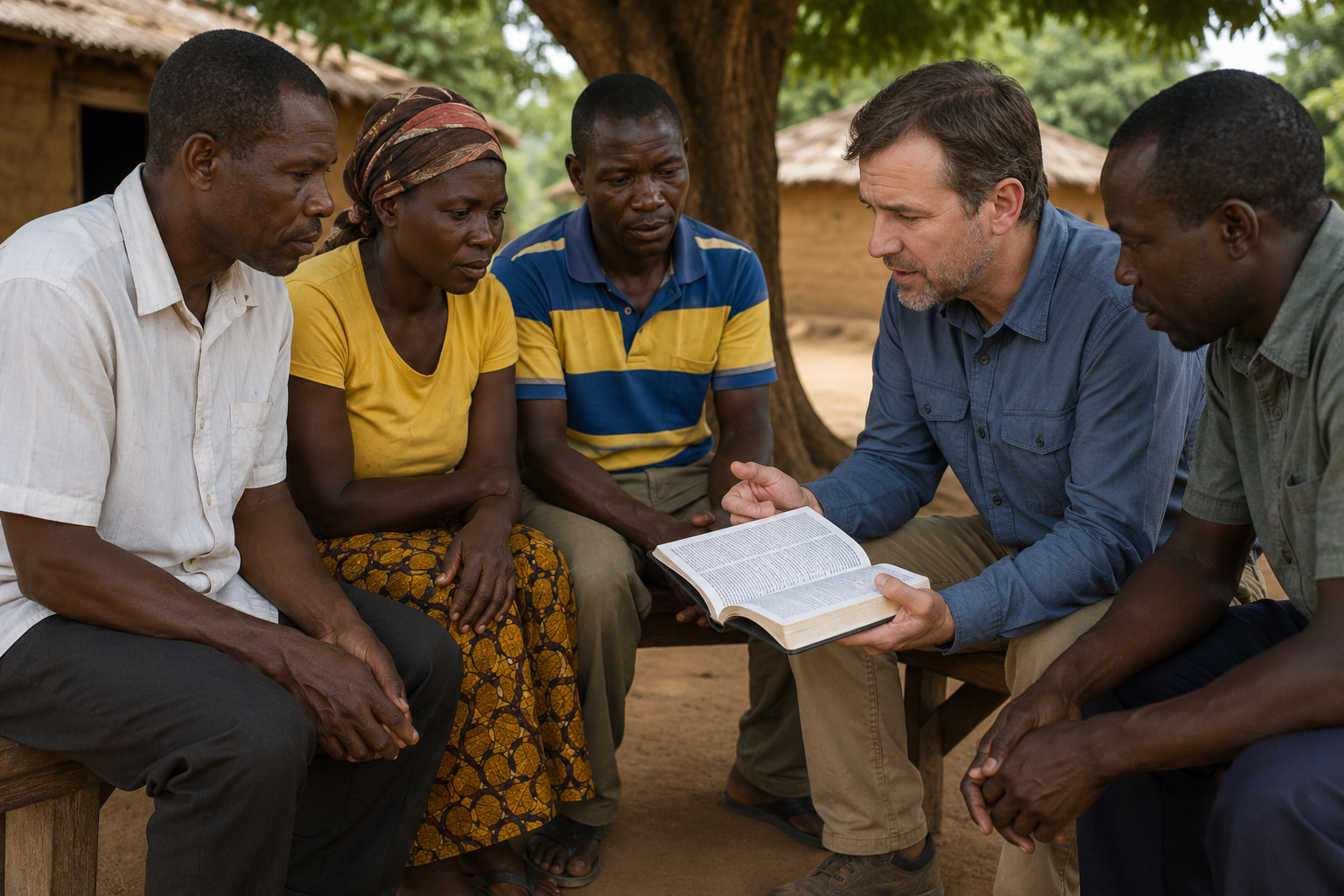
Distribution ministries often serve readers encountering Scripture for the first time, including children, new believers, and communities with limited formal education. The translation that serves a seminary classroom may not serve a first-generation reader. Ministries making responsible choices will often ask: What reading level is realistic? Is this audience reading aloud in groups? Will this Bible be used for evangelism, discipleship, or pastoral care?
In the United States, the literacy context alone should prevent simplistic assumptions. The National Center for Education Statistics reports that a substantial share of adults have limited literacy proficiency, with 21 percent of U.S. adults classified as illiterate and 54 percent reading below a sixth-grade level in one frequently cited summary of the underlying PIAAC results; donors should consult the original federal reporting for definitions and measures (National Center for Education Statistics). When ministries distribute in English, they often choose between translations that preserve traditional phrasing and translations designed for readability. Either can be faithful; the question is fitness for the people served.
Internationally, the constraints can be more severe. In some settings, oral communication is dominant, and “Bible distribution” includes audio Scripture, dramatized recordings, or storying resources that follow translation decisions closely. A ministry that treats audio as an afterthought may misunderstand the learning ecosystem of the communities it serves.
Church ecosystems and pastoral use shape the best choice
Translation selection also depends on how local churches and leaders will use the Scripture. Pastors may prefer a translation that supports close study and public reading; youth leaders may want a translation that supports comprehension and engagement. Where churches are under-resourced, a single translation may be expected to serve multiple functions, which can push ministries toward balanced translations that are neither highly literal nor aggressively idiomatic.
For donors comparing ministries, the key is not whether the translation matches one’s personal devotional preference, but whether the ministry can articulate a coherent rationale rooted in readership, church partnership, and a sober awareness of the setting. That is part of what donors are trying to discern when engaging the broader landscape of Bible Distribution Ministries.
Language and culture require more than swapping words
Translation is a long process of community testing and revision
In many languages, especially those with limited prior written literature, translation requires establishing orthography, building vocabulary decisions, and testing drafts with real communities. The highest-quality efforts typically involve mother-tongue speakers, trained translators, and layers of review that include exegetical checks and community comprehension checks. Ministries that distribute minority-language Scriptures responsibly often rely on the established processes of Bible translation agencies, then focus their own work on printing, logistics, and church partnership rather than attempting to shortcut translation itself.
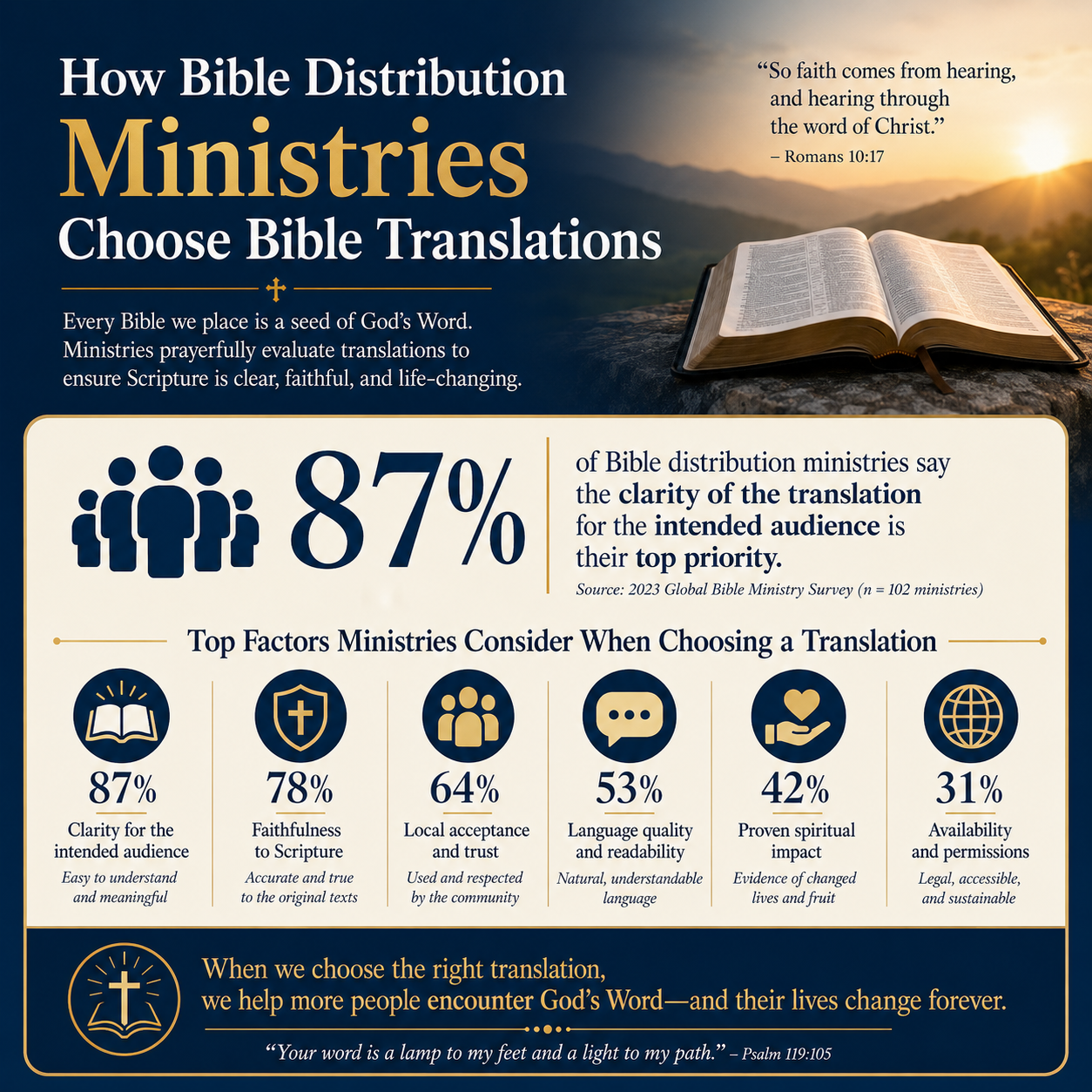
Donors sometimes encounter claims of “new translation completed” without clarity about the process or oversight. A prudent donor asks who produced the translation, what review bodies were involved, and whether the translation is accepted by local church leadership. When a ministry cannot answer those questions, the distribution work may still be energetic, but it may not be trustworthy.
Trade-offs become sharper in contested cultural contexts
Some translation decisions are culturally charged. How should familial terms be rendered in contexts where certain phrases are misunderstood? How should a translation handle honor-shame dynamics, kinship terms, or culturally loaded metaphors? These are not merely linguistic puzzles; they touch doctrine, discipleship, and sometimes security. Christians genuinely disagree about best practices in particular contested cases, and responsible ministries will neither sensationalize the disagreement nor pretend it does not exist.
A donor’s role is not to adjudicate every debated rendering. A donor’s role is to discern whether a ministry has credible, accountable decision-making. Does it consult local believers? Does it submit to recognized translation standards? Does it correct errors transparently? These questions align with the kind of organizational maturity Most Trusted looks for when assessing governance and transparency under The Most Trusted Standard.
Formats and licensing constrain translation choice more than many donors realize
Copyright and licensing can determine what is possible
Many popular translations are copyrighted, and large-scale printing or digital distribution requires permissions that can involve cost, restrictions, and specific quality-control requirements. Ministries that distribute at scale often choose between (1) public-domain translations, (2) licensed translations with negotiated agreements, and (3) translations produced within a partner network that allows freer reproduction. None of these is inherently superior, but donors should recognize that translation preference can collide with legal reality and the economics of printing.
Licensing constraints can also affect digital distribution, where Scripture apps, audio hosting, and offline sharing depend on permissions. A ministry that explains these constraints candidly is usually demonstrating operational maturity; a ministry that implies every translation is equally available may not understand the terrain it is operating in.
Format is part of the translation decision
In practice, ministries choose translation and format together: large print for older readers, children’s Bibles with carefully limited paraphrase, study Bibles for leaders, or compact editions for areas where portability and discretion matter. The best ministries test actual use. A beautifully printed Bible that is too heavy to carry to a rural church, too small to read in low light, or too fragile for repeated use is not a faithful stewardship of donor funds.
Many donors follow this topic because it sits within the broader set of choices about Translations, Formats, and Languages in Bible Distribution. A ministry’s clarity here often signals whether it treats Scripture distribution as a relational ministry integrated with churches, or as a commodity moved through a supply chain.
What disciplined ministries do differently and what donors should ask
Patterns we see in ministries that meet The Most Trusted Standard
Across our verification work, ministries that meet The Most Trusted Standard tend to make translation decisions that are documented, accountable, and tied to a clear theory of ministry. They can tell donors what they distribute, why they distribute it, and how they know it is being used. They are also careful not to overpromise outcomes that Scripture itself does not promise on a distribution timetable.
The donor’s task is not to demand perfection, but to require verifiable seriousness. A translation decision sits downstream of governance, theological clarity, partner relationships, and financial controls. When those upstream realities are weak, translation choices become reactive: driven by donor pressure, printing discounts, or internal preferences rather than by the needs of the church and the reader.
A short set of donor questions that reveal real maturity
- What translation philosophy guides your choices, and how do you explain trade-offs to local churches?
- Who decides which translations and languages are prioritized, and what accountability structures oversee that decision?
- How do you confirm that the translation you distribute is accepted and used by local church leadership?
- What licensing or copyright constraints shape what you can print or share digitally?
- How do you evaluate whether recipients can read and understand what is distributed, including oral and audio needs?
These questions are not adversarial. They are a form of Christian stewardship. Jesus’s parable of the talents frames accountability as a moral good, not an administrative burden (Matthew 25:14–30). In the distribution space, accountability includes not only financial reporting but also the integrity of what is placed in a person’s hands as “the word of life” (Philippians 2:16).
FAQs for How Bible distribution ministries choose Bible translations
Should donors insist on a single preferred English translation for every distribution program?
Not usually. Responsible ministries match translation to readership, literacy, church practice, and setting. A donor can rightly care about fidelity to Scripture while recognizing that different contexts call for different translation approaches. The more reliable signal is whether the ministry can explain its translation choices transparently and consistently, and whether local churches affirm the usefulness of what is being distributed.
Is it a warning sign if a ministry distributes multiple translations across different countries or programs?
Not necessarily. Multiple translations can reflect legitimate constraints: licensing, availability in a given language, the preferences of local church partners, or the needs of different age groups. It becomes a warning sign when the ministry cannot articulate a coherent rationale, cannot name who is accountable for decisions, or presents translation choice as an afterthought rather than a core element of faithful Scripture ministry.
Translation choice is a test of theological seriousness and organizational integrity
Choosing a Bible translation for distribution is ultimately a decision about how a ministry understands the nature of Scripture, the nature of the church, and the real circumstances of the people it serves. Donors should expect ministries to treat that decision with reverence and precision, and to speak about it with the kind of clarity that withstands scrutiny. When translation choices are thoughtful, accountable, and locally grounded, Bible distribution becomes not merely the movement of books, but a credible act of service to Christ’s church and to the neighbors Scripture is meant to reach.



