

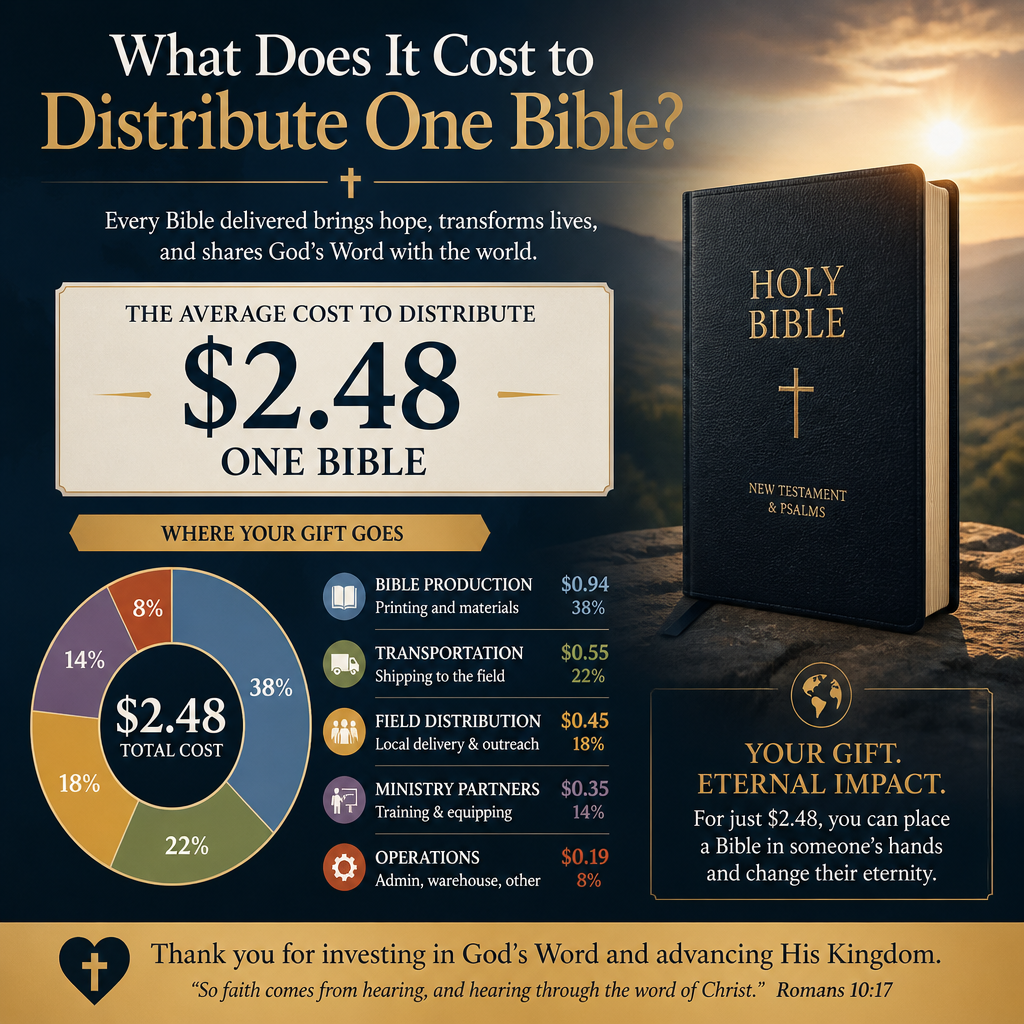
What does it cost to distribute one Bible? For Christian donors, the question is not merely a unit price; it is a moral inquiry about stewardship, integrity, and whether a ministry’s methods honor both the Word of God and the people receiving it.
The complication is that “one Bible distributed” can describe very different activities: printing, shipping, translation, local church partnership, follow-up discipleship, digital delivery, or all of the above. Ministries that speak about “cost per Bible” without clarifying what is included can unintentionally mislead, even when their intentions are sincere.
Why a single number rarely tells the truth
Distribution is a chain, not a moment
A Bible reaches a reader through a chain of decisions and costs: editorial work, printing or licensing, warehousing, international freight, in-country transport, customs, last-mile delivery, local partnership, and often security in hostile contexts. Each link is vulnerable to inflation, fuel prices, border disruptions, and local regulatory changes. When donors ask for a single figure, we recommend asking first: “Which parts of the chain are included in your number?”
There is also a theological dimension. Scripture is not a commodity that becomes “mission accomplished” when it changes hands. The pattern in the New Testament is the Word proclaimed and taught within the life of the church (Acts 2:42). A ministry may distribute faithfully without controlling follow-up, but a serious account of impact will not treat distribution as an end in itself.
Translation and literacy change the economics
The simplest distribution model is placing existing-language Bibles into the hands of literate readers with accessible church communities. The most demanding model may involve minority-language translation, Scripture engagement materials, and oral or audio formats for communities with limited literacy. Those differences can swing costs dramatically without signaling waste or inefficiency.
Christians genuinely disagree about whether donors should prioritize “more Bibles” or “deeper engagement per Bible.” Wisdom requires resisting false alternatives. A ministry working in a high-persecution context or an unreached language group may have a higher per-unit cost and still reflect exceptional faithfulness and prudence.

What ministries usually mean by cost per Bible
Common definitions and what they include
Across our verification work at Most Trusted, we see several recurring ways ministries calculate “cost to distribute one Bible.” None is inherently wrong, but each answers a different donor question.
- Print cost only: the manufacturing cost of a Bible (paper, binding, printing) without shipping or in-country delivery.
- Print plus freight: printing plus international shipping to a regional warehouse or port.
- Delivered cost: printing plus all logistics to place the Bible with the intended recipient or partner church.
- Program cost per Bible: delivered cost plus staff time, training, or Scripture engagement programming tied to distribution.
- All-in organizational cost: program cost plus shared overhead such as finance, compliance, safeguarding, and governance.
Donors often ask for “all-in” because it feels more honest. That instinct is sound, but the comparison problem remains: an “all-in” cost for a ministry doing translation, local pastor training, and high-risk delivery should not be benchmarked against a print-only figure from a ministry distributing in a stable, urban environment.
A caution about simplistic overhead thinking
The modern nonprofit sector has had to correct the damaging assumption that the lowest overhead is automatically the most faithful. Charity Navigator, Candid (GuideStar), and the BBB Wise Giving Alliance made this case directly in their “Overhead Myth” statement, arguing that overhead ratios alone are a poor measure of performance and can incentivize underinvestment in leadership and systems that protect mission integrity. Charity Navigator
For Bible distribution, the same logic applies. Safeguarding, financial controls, and transparent reporting are not distractions from ministry; they are part of loving our neighbor and honoring donors’ trust.
Reasonable cost drivers donors should expect
Physical production and supply chain realities
Even for an existing translation, costs move with paper pricing, printing capacity, and shipping conditions. Global freight disruptions are not theoretical; they have affected charitable supply chains across sectors. Donors should expect ministries to explain how they manage vendor relationships, quality control, and shipping risks rather than promising permanently low unit costs.
Language format also matters: study Bibles, large-print editions, children’s Bibles, or durable bindings for harsh climates are not interchangeable with low-cost paperback editions. A ministry that distributes durable Bibles to remote communities may be paying more to ensure the Scriptures endure in places where replacement is unlikely.
Local partnership and last-mile delivery
The last mile is often where both costs and integrity risks concentrate. Strong ministries typically distribute through vetted local churches, denominational networks, or trusted indigenous partners, with clear documentation and accountability. Weak distribution models can drift into one-off handouts with little verification, creating inflated reports and uncertain outcomes.
In some countries, formal importation may require fees, legal review, and careful compliance. In others, overt distribution can endanger believers. Those realities raise costs and reduce public detail in reporting. Mature transparency does not mean reckless disclosure; it means giving donors verifiable clarity without compromising the safety of the church.
How to evaluate a ministry beyond the unit cost
Questions that reveal stewardship and integrity
If a ministry claims a very low cost per Bible, the responsible response is not cynicism but due diligence. We recommend asking questions that clarify both accounting and mission practice:
Financial definition: Is the cost per Bible print-only, delivered, or all-in? Is it based on audited financials or internal estimates?
Verification: How does the ministry document deliveries and prevent double counting? What is the chain of custody?
Local church integration: Are Bibles distributed through local congregations and leaders who can teach and disciple?
Scripture engagement: What provision is made for literacy, oral learners, or first-time readers?
Risk management: How does the ministry handle security, corruption risk, and regulatory compliance?
Many donors also want to know whether the ministry’s model is consistent with the wider development lesson that aid can unintentionally harm when it bypasses local agency. The When Helping Hurts framework, articulated by Steve Corbett and Brian Fikkert, has shaped Christian thinking here: effective help strengthens local stewardship rather than displacing it. When Helping Hurts
Where Most Trusted fits in donor discernment
Most Trusted exists because mature Christian generosity requires more than compelling stories. We evaluate ministries against The Most Trusted Standard, a 15-criteria framework spanning faith commitments, financial integrity, governance and leadership, and transparent evidence of effectiveness. For Bible distribution ministries, that means we look for clarity on what “distribution” means, the integrity of reporting, the strength of local partnership, and the presence of controls that honor donors and protect recipients.
Donors seeking broader context on the field often begin with Bible Distribution Ministries, then narrow their giving approach through How to Give Wisely to Bible Distribution Ministries. The goal is not to reward the most polished marketing, but to support ministries whose practices can bear the weight of public trust.
What a faithful donor decision can look like
Matching your gift to the ministry model
For some donors, the primary conviction is to put physical Bibles into as many hands as possible where Scripture access is limited. For others, the priority is translation, discipleship, or Scripture engagement in communities where a printed book alone will not serve the church well. Both impulses can be faithful; they are different strategies with different cost structures.
What this means in practice is that a donor can ask for two numbers rather than one: (1) the delivered cost of placing Scripture with a recipient or church partner, and (2) the cost of ensuring that distribution is tied to durable local ministry—training, follow-up, or engagement—when that is part of the ministry’s calling.
Resisting both naïveté and suspicion
Christian donors are right to be wary of inflated claims. Scripture warns against dishonest measures and calls God’s people to integrity in handling money. Yet suspicion can also become a substitute for judgment. A higher per-unit cost can reflect translation complexity, secure delivery, or careful partnership rather than waste.
Faithful giving is patient enough to ask careful questions and discerning enough to accept that complex work rarely yields to simple pricing. When a ministry offers transparent definitions, credible documentation, and governance strong enough to withstand scrutiny, donors can give with the quiet confidence that they are serving the church and honoring the Lord of the Word.
FAQs for What does it cost to distribute one Bible
Is a lower cost per Bible always better?
No. A lower number may reflect scale efficiencies, but it can also reflect a narrower definition that excludes shipping, last-mile delivery, or follow-up. A higher number may reflect translation work, durable formats, security in hostile contexts, or integration with local discipleship. The faithful comparison is between ministries doing similar work with similar definitions.
What should we ask a Bible distribution ministry to explain about their numbers?
We recommend asking what “distributed” means in their reporting, what costs are included in the calculation, whether the number is based on audited financials, how deliveries are verified, and how distribution connects to local church leadership. Clear answers are often more revealing than the headline figure.
A cost figure is a starting point, not the verdict
The cost to distribute one Bible can be a useful metric when it is defined carefully and paired with evidence of integrity. For Christian donors, the deeper aim is not the cheapest Bible but the faithful stewardship of resources so that the Word of God reaches people through truthful reporting, sound governance, and the strengthening of Christ’s church.



